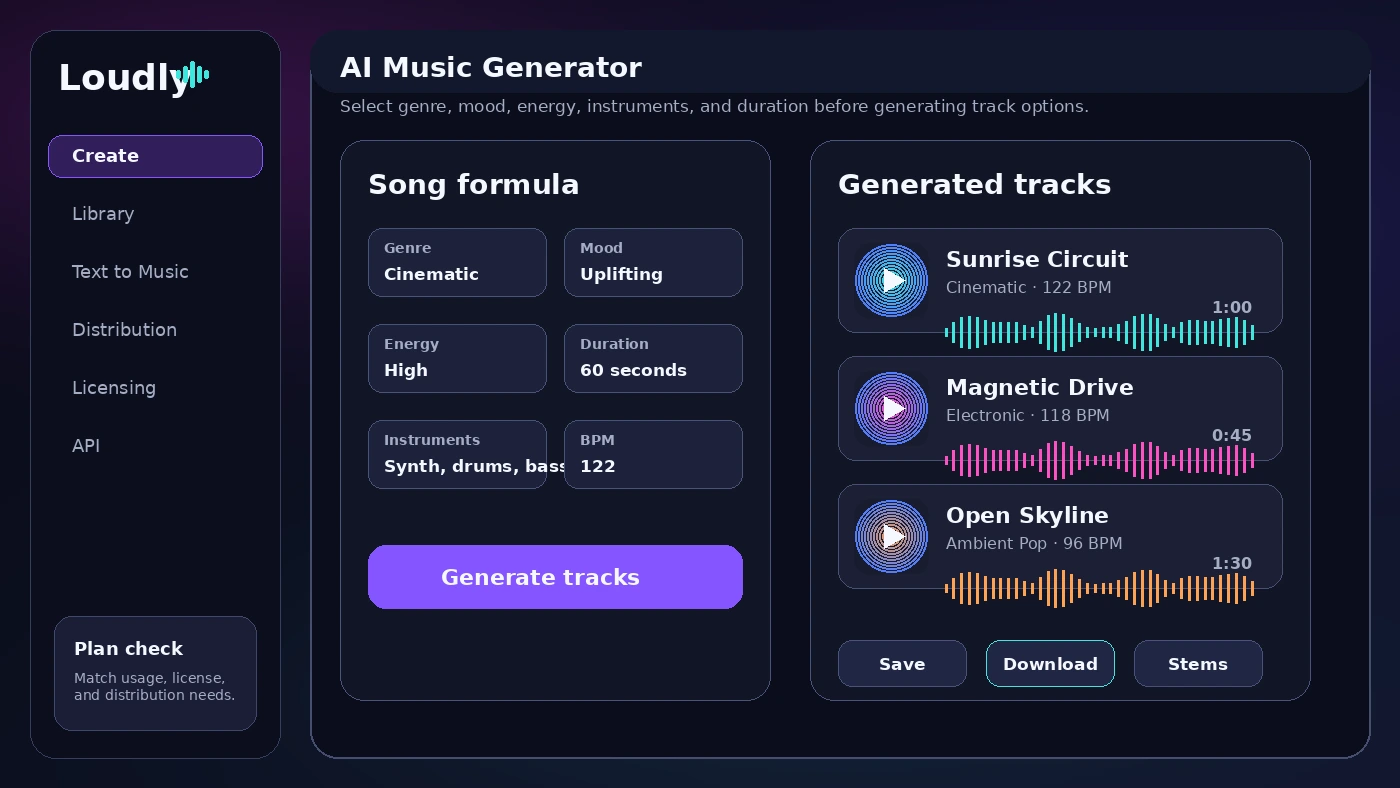
Quick verdict
Loudly is worth considering if you need fast royalty-free instrumental music for real creator work, but I would not judge it only by the promise of AI-generated tracks.
The buying decision is narrower than that. You need to know whether the generated music sounds usable inside your actual workflow, whether the plan gives you enough downloads and track length, whether the license covers your use case, and whether annual billing makes sense given the refund language.
That last part matters.
Loudly looks strongest for YouTubers, podcasters, social media editors, small brands, and music makers who need repeated background tracks, stems, remixing, sample packs, or distribution. It is less comfortable for buyers who need exclusive music, flexible refunds, a one-off soundtrack, realistic vocal songs, or high-stakes commercial usage where the license boundaries must be reviewed carefully.
For my money, the right way to approach Loudly is not coupon first. Start free. Generate tracks for one real project. Listen for mood accuracy, editing fit, generic output, loop usefulness, and whether the final file would actually go into your video, podcast, ad, or release workflow.
If it passes that test, a paid plan may make sense. If it does not, a lower monthly equivalent will not fix the mismatch.
Next step: If Loudly still fits your creator workflow, test the free path first and verify the current buyer route before checkout.
Review snapshot
| Review point | Practical take |
|---|---|
| Best for | Creators who need repeated AI-generated instrumental music for videos, podcasts, ads, social posts, or release workflows |
| Not ideal for | One-off users, buyers needing exclusive music, or teams with high-stakes licensing requirements |
| Main use case | Generate, customize, download, remix, or distribute royalty-free music for creative projects |
| Free path | Free plan is useful for testing, but free tracks are limited and should not be treated as proof of paid value |
| Paid path | Personal and Pro make more sense when downloads, longer tracks, stems, sample packs, distribution, or commercial rights matter |
| Pricing caution | Annual billing lowers the monthly equivalent but increases commitment risk |
| Main strength | AI music generation plus creator workflow tools in one platform |
| Main concern | Licensing, refund language, billing cycle, and platform claim risk need careful review |
| Direct/nearby alternatives | Mubert, Freebeat, Thematic, Unchained Music |
| Best next step | Generate music for one real project before choosing monthly, annual, or API access |
What is Loudly?
Loudly is an AI music platform for creating, customizing, and releasing royalty-free music. In plain buyer language, it sits between an AI music generator, a royalty-free music library, a remixing/stem workflow, and a music distribution tool.
The public product surface includes AI music generation, text-to-music, templates, remixing, sample packs, stems, a catalog, distribution, and an API path for developers or businesses. That makes Loudly broader than a simple prompt-to-track toy.
It also makes the buying decision more complicated.
A creator who only needs a 20-second background loop for one video has a different decision from a podcaster producing weekly episodes. A music maker who wants stems and distribution has a different decision from a brand that needs ad-safe music. A developer looking at the API has a completely different buying path from a normal creator using the browser app.
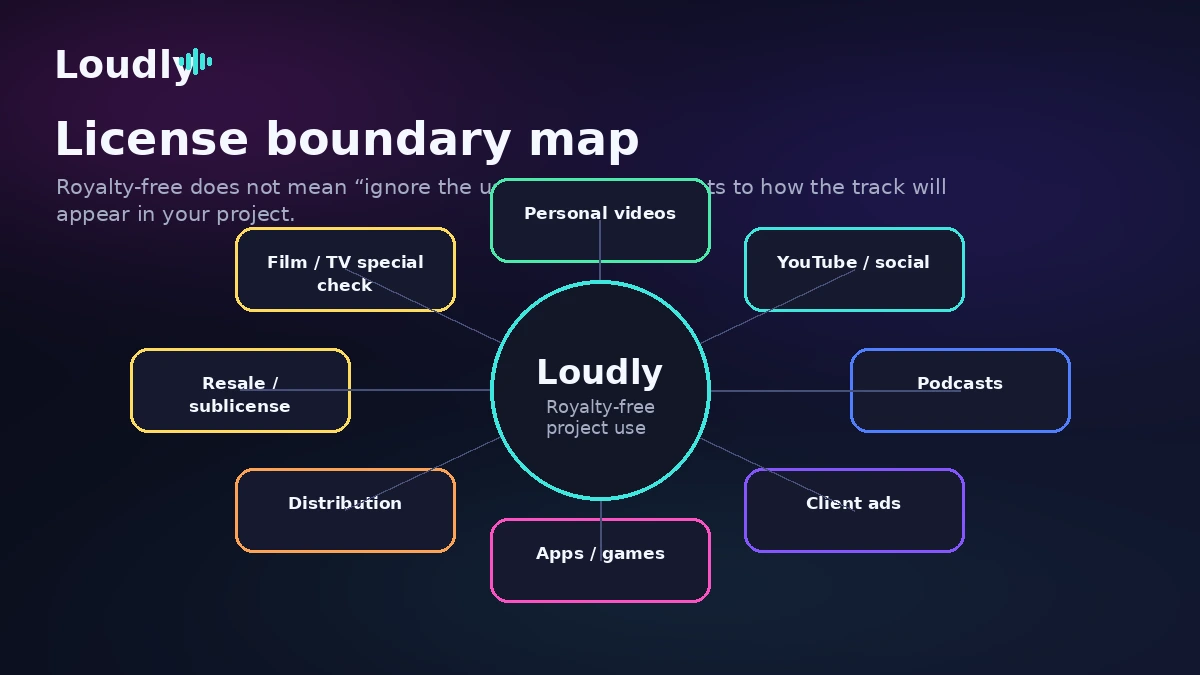
The common misunderstanding is assuming “royalty-free” means every possible use is automatically safe forever. It does not work that way. Royalty-free usually means the provider is not charging ongoing royalties under the stated license, but the buyer still needs to understand plan rights, subscription status, platform rules, distribution rules, third-party components, and special cases such as film, TV, resale, sublicensing, or high-budget advertising.
Our review approach compares public product positioning, pricing details, FAQ language, license boundaries, creator workflow fit, third-party feedback, and nearby alternatives. A lower annual price or active offer is not enough by itself. The better question is whether Loudly gives you music you can actually use, under terms you understand, at a price that matches your output volume.
Who should use Loudly?
Loudly makes the most sense for creators who produce content regularly and need music often enough for a dedicated tool to matter.
YouTube creators and social media editors are the easiest fit. If you are producing intros, background beds, Shorts, Reels, TikToks, product videos, or simple ad creatives, the value is speed. You can generate several directions, listen against your edit, and choose the track that supports the video without browsing a stock music library for an hour.
Podcasters and small brands may also find it useful. The right use case is not “replace a composer.” It is more practical: create intro beds, transitions, background loops, and branded audio directions quickly enough that your production process does not slow down every time you need music.
Music makers who care about stems, sample packs, remixing, and distribution should consider Loudly more seriously. This is where the platform becomes more than a soundtrack generator. If you want to experiment with AI-assisted ideas, pull pieces into a DAW, or release tracks through distribution, Loudly may be a better fit than a tool that only generates MP3 background tracks.
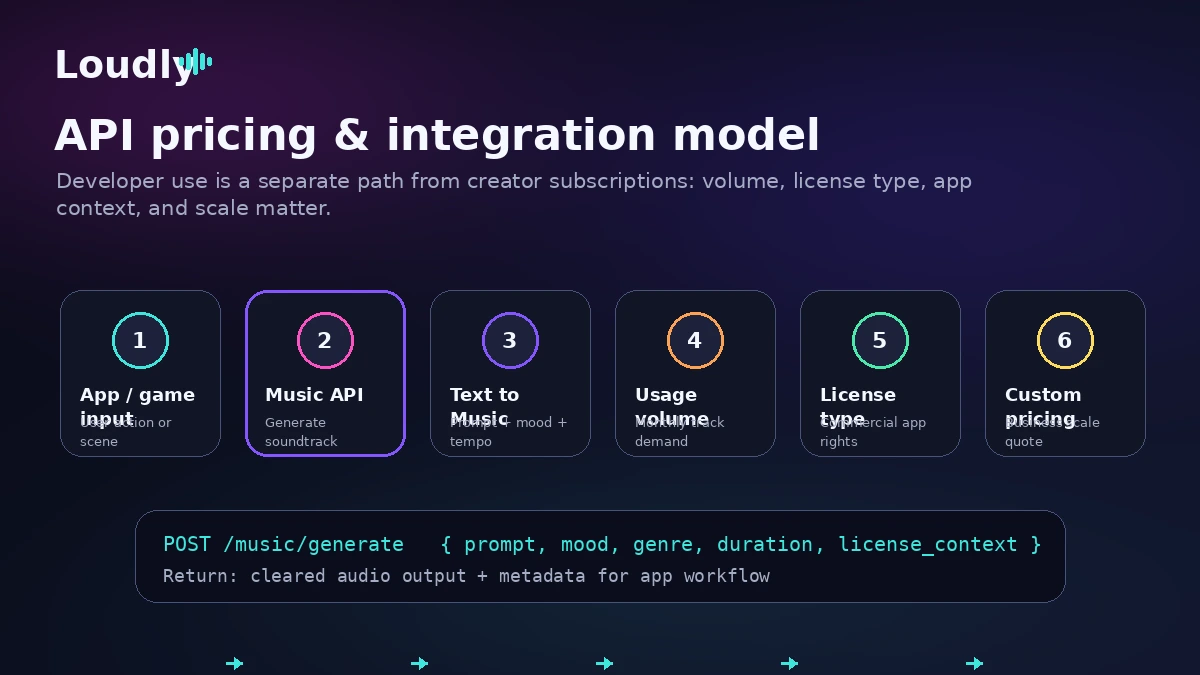
Developers and business buyers can also look at Loudly’s API path, but that is a separate decision. API pricing depends on business size, track volume, and license type, so the safe approach is to treat it as a custom integration discussion rather than a normal creator subscription.
Who should avoid Loudly?
I would be careful with Loudly if you only need one quick piece of background music. A free plan may be enough to test, and a paid subscription can become unnecessary if your workflow is occasional.
I would also avoid choosing Loudly only because the annual price looks cheaper. Annual billing can be a real savings path, but it is only sensible after the tool proves repeated value. If you are still unsure about output quality, licensing, or download needs, monthly testing is usually the safer decision.
Buyers who need exclusive, human-composed, or custom-scored music should slow down. Loudly can be useful for creator content, but a brand campaign, film placement, TV usage, or sensitive client project may need a more deliberate licensing review.
Creators who expect AI vocals and lyrics as the main output should also compare carefully. Loudly’s stronger public fit is instrumental AI music and creator workflow support. If your main goal is full songs with vocals, lyrics, and performance-style output, another AI music platform may be a better first comparison.
Finally, anyone worried about billing, support, or copyright-claim disputes should read the FAQ, license agreement, terms, and recent user feedback before paying. This does not mean Loudly cannot work. It means the buyer should not rely on a homepage promise alone.
How Loudly fits into a real workflow
A useful Loudly workflow starts before you open the generator.
First, define the project. Is this a YouTube intro, podcast transition, ad background, social clip, game loop, app sound, or release-ready track? That choice shapes everything else: length, mood, file format, license needs, and whether distribution matters.
Then generate several tracks for the same project. Do not test random prompts just to see what happens. A real project tells you whether the output is actually useful. Listen for mood accuracy, pacing, repetition, generic texture, and whether the music supports the voiceover or visual edit.
After that, customize. Loudly becomes more interesting when you use templates, remixing, stems, or sample packs to shape the result instead of accepting the first generated track. This is where non-musicians may get speed, while more experienced creators can decide whether the output is flexible enough to move into a deeper editing workflow.
The final step is the license and plan check. If the track will be used in monetized content, client work, ads, distribution, or a release workflow, the music decision is not finished until the license matches the use case.
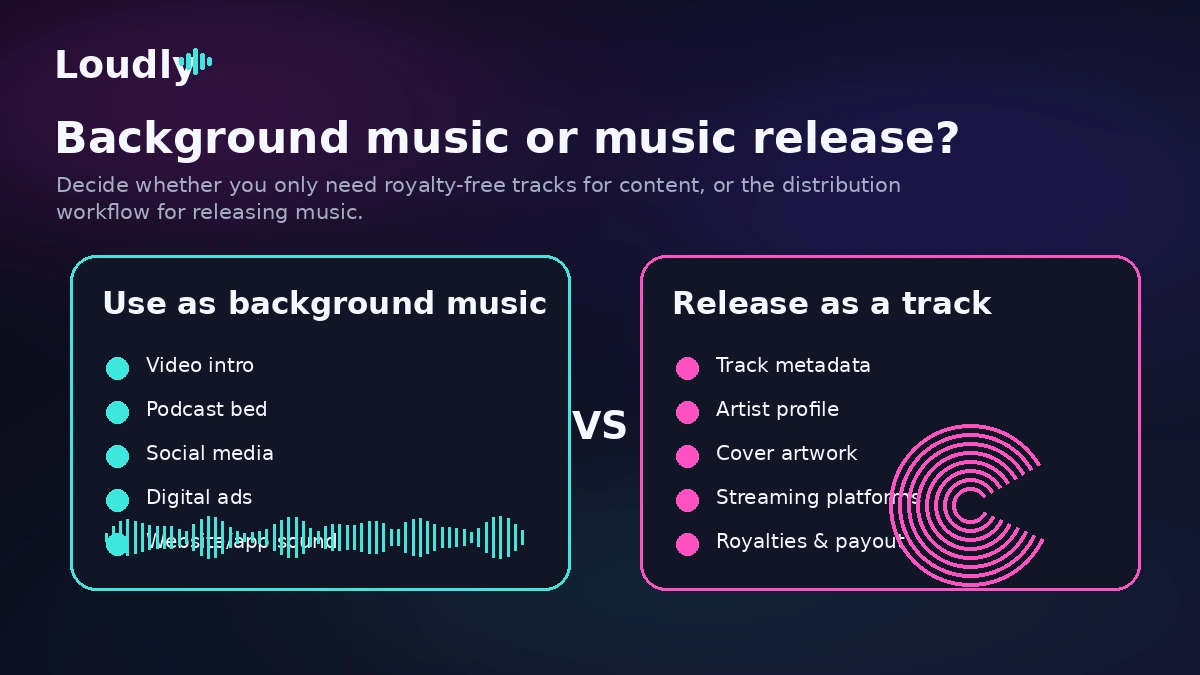
Workflow test: If Loudly sounds promising, generate music for one real project before comparing paid plans or annual billing.
Real-world buyer scenarios
A YouTube creator has the cleanest test case. The creator needs background music for recurring videos, but the music cannot distract from narration. Loudly fits if it produces usable beds quickly and the license covers the channel’s monetized use. It fails if the tracks sound generic, fight the voiceover, or create claim anxiety.
A podcaster has a slightly different decision. Intro and transition music can be reused, so a single good track may have long-term value. But if the podcast uses client sponsorships or brand campaigns, the buyer should verify commercial-use and licensing boundaries before treating the track as safe.
A social media editor may value speed more than depth. For short-form content, the question is whether Loudly can create something usable faster than browsing a music library or reusing platform sounds. If the creator needs beat-led video generation or social-template workflows, Freebeat may be a better adjacent comparison.
A music maker exploring distribution should think differently. Distribution, stems, sample packs, and Distro-related features can matter, but only if releasing music is part of the real plan. If the main job is distribution infrastructure rather than AI generation, Unchained Music may be the more relevant next tab.
A developer or product team should not treat the creator subscription as the API decision. Loudly’s API pricing depends on business size, track volume, and license type. That means the right test is not a coupon page. It is a requirements list.
Key features that actually matter
AI music generation
The core feature is simple: generate music quickly from creative direction, genre, mood, parameters, or prompts. This matters when the buyer needs music often and wants to avoid long stock-library searches.
Buyer note: judge the feature with real projects, not demo curiosity. If you would not place the output in a real edit, the generation speed does not matter.
Text-to-music workflow
Text-to-music is useful for non-musicians and fast-turnaround creators because it lets you describe the desired feel instead of building a track manually. It can work well for mood-based needs: cinematic, upbeat, ambient, corporate, lo-fi, dark, energetic, calm.
Buyer note: prompt control is only valuable if the final result follows the intended brand or channel tone. Test several prompts before assuming the paid plan will solve everything.
Stems, remixing, and sample packs
These features matter when the buyer wants more control than a finished MP3. Stems can help with editing, sample packs can support music-making, and remixing can create new versions from a base idea.
Buyer note: these features are only valuable if you will actually use them. Do not pay for a heavier plan just because advanced music terms sound impressive.
Music distribution
Loudly also includes distribution-oriented workflows. This matters for creators who want to release tracks to streaming platforms, manage artist-style output, or use Distro-related features.
Buyer note: distribution is not automatically useful for video creators. If you only need background music under content, distribution may be extra complexity.
API access
Loudly’s API path is for developers, apps, games, branded experiences, and businesses that need programmatic music generation. It includes a different pricing logic from normal creator plans.
Buyer note: verify track volume, license type, integration scope, output length, and commercial coverage before assuming API access is affordable or appropriate.
Pricing and plan value
Loudly has a free entry path and paid creator plans. The public pricing information currently shows Personal at a lower annual monthly equivalent and Pro at a higher annual monthly equivalent, while the FAQ explains that monthly and annual subscription cycles are available.
The important point is not just the headline price. It is what the plan allows you to do.
The free plan is useful for testing the product rhythm. Loudly’s FAQ says free users can try much of the platform, but free tracks have a 30-second limit. That is enough to evaluate interface, prompt behavior, and rough music style. It may not be enough to prove whether paid downloads, longer track length, stems, commercial use, or distribution will fit your workflow.
Personal is the plan to compare if you are a recurring creator but not a heavy music producer. The right question is whether the plan gives enough track generation, download ability, commercial rights, and output quality for your normal monthly production.
Pro makes more sense when output volume, stems, sample packs, longer tracks, distribution perks, or heavier creator work matter. But I would not move to Pro just because it sounds more complete. The buyer should know exactly which Pro feature changes the workflow.
Annual billing can lower the monthly equivalent, but it increases commitment risk. Loudly’s FAQ says subscriptions are generally non-refundable after purchase and annual subscribers commit to the full yearly fee. That makes annual billing something to choose after testing, not before.
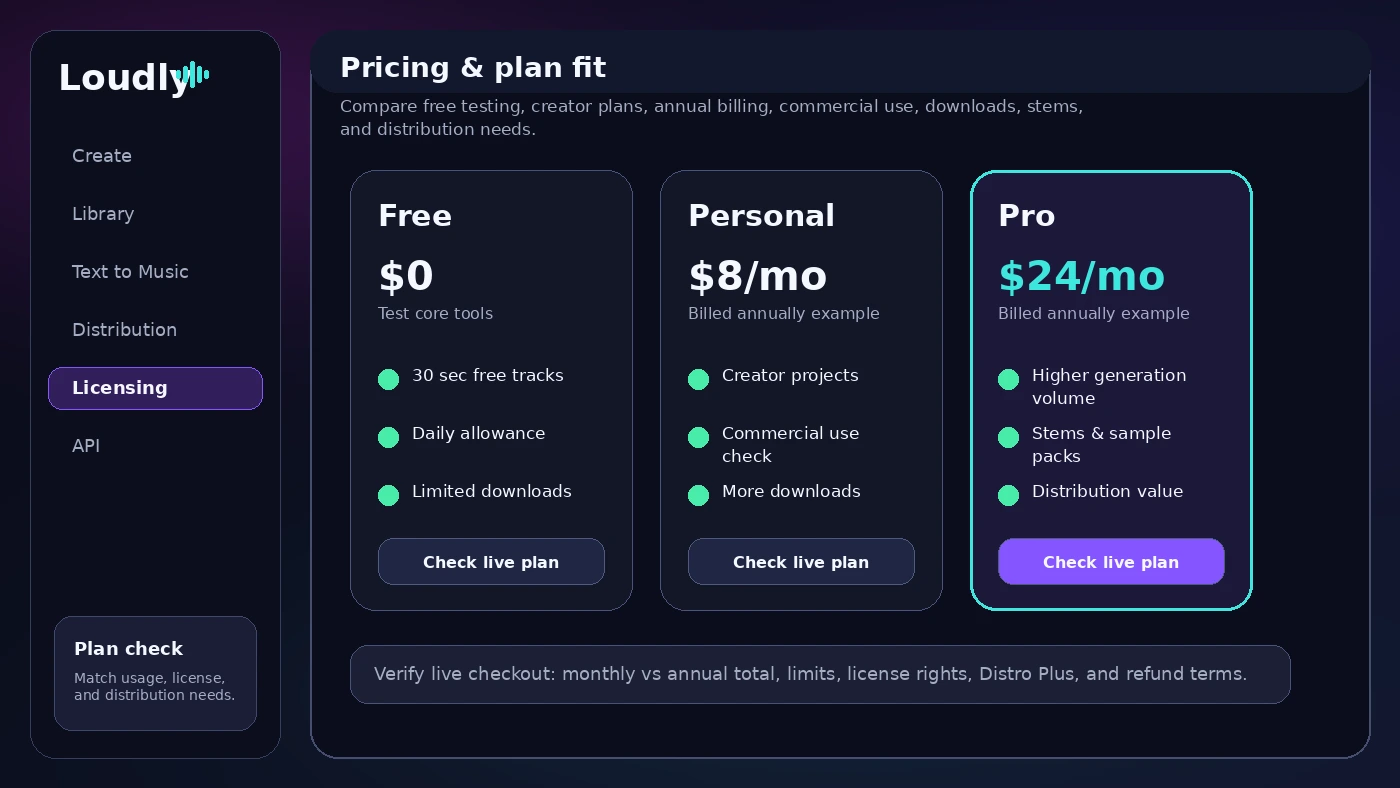
Pricing check: Before paying, compare the current plan limits, billing cycle, license terms, and refund language against your actual creator workload.
Free plan, trial, coupon, and checkout notes
The safest Loudly buying path is free plan first, paid plan second, coupon or annual savings last.
That may sound conservative, but it protects the buyer from a common mistake: paying for a music platform before knowing whether the output fits their style. AI music can be impressive in a demo and still miss the tone of a real channel, brand, or edit.
The free plan is useful because it gives you a way to test music direction. It is not a full proof of paid value because free-track limits can hide the exact questions paid users care about: longer outputs, download quality, stems, sample packs, distribution, and commercial-use rights.
A coupon or current offer can improve the purchase, but it should not be the reason you buy. The better order is:
- Generate music for a real project.
- Check whether the output is usable.
- Verify the license for your use case.
- Compare monthly versus annual billing.
- Review cancellation and refund language.
- Only then check the Loudly coupon page or current buyer route.
If the project involves client work, ads, film, TV, resale, sublicensing, stock-style distribution, or API integration, the checkout step should include a license review before publishing anything public.
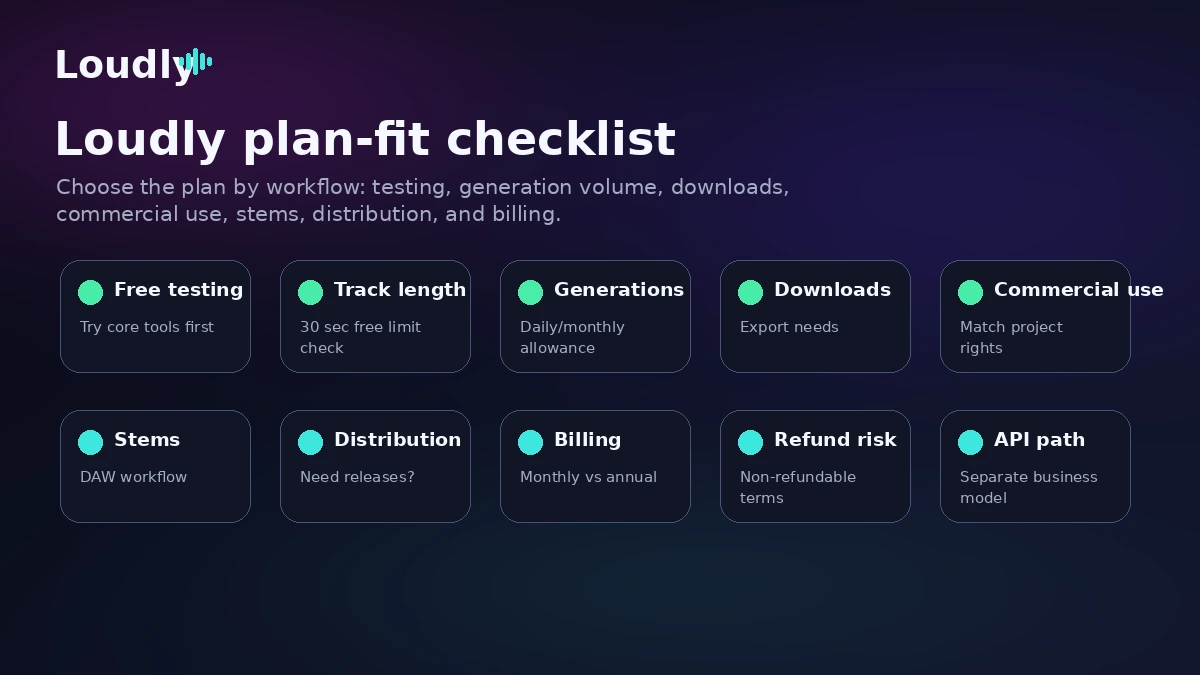
What I would check before buying Loudly
If I were buying Loudly for a real workflow, I would check these items before paying:
- Whether the free plan output is good enough on one real project, not just a random test prompt.
- Whether the paid plan includes enough track length, generations, downloads, stems, and sample-pack access for the actual monthly workload.
- Whether the license covers the exact use case: personal content, monetized YouTube, client work, ads, distribution, film, TV, or business use.
- Whether monthly billing is safer than annual billing during the first evaluation period.
- Whether cancellation is completed inside the account and whether premium access continues until the end of the paid term.
- Whether any platform claim, copyright dispute, or distribution problem would be manageable for the project.
- Whether Mubert, Thematic, Freebeat, or Unchained Music is a better fit for the specific job.
A simple test before paying
Before paying for Loudly, I would run a small test like this:
- Pick one real project that needs music, such as a video intro, podcast transition, social clip, or ad background.
- Generate at least five tracks with slightly different prompts or style choices.
- Place the best two tracks inside the actual edit or timeline.
- Listen for whether the music supports the content or distracts from it.
- Check whether the free-track limit hides a paid feature you would need, such as longer track length or downloads.
- Read the license notes for your exact project type.
- Compare the smallest paid plan against your expected monthly output.
This test will tell you more than a feature list. If none of the generated tracks survive a real edit, paying for more generations may only create more unused music.
Pros explained
The first real pro is speed. Loudly can help creators move from idea to soundtrack direction quickly. That matters when music selection is slowing down video, podcast, or social production.
The second pro is breadth. Loudly is not only a generator. It also has templates, text-to-music, remixing, stems, sample packs, catalog access, distribution, and API positioning. For buyers who genuinely need more than background audio, that broader surface can be useful.
The third pro is the free testing path. A free plan lowers the barrier to first evaluation, which is especially important for AI music because taste and project fit are hard to judge from marketing copy.
The fourth pro is commercial workflow potential. Paid plans can make sense for creators who need recurring royalty-free music and understand the license boundaries. For those users, Loudly can be part of a repeatable production process.
The fifth pro is API availability. This will not matter to most normal creators, but it is important for businesses that need music generation inside apps, games, branded experiences, or product workflows.
Cons explained
The first drawback is that free testing is limited. A 30-second free track can show whether the product is interesting, but it may not prove whether paid use will work for full content, longer tracks, or commercial delivery.
The second drawback is refund flexibility. Subscription purchases are generally non-refundable after purchase, and annual billing increases the commitment. Buyers should not treat the paid plan as a risk-free trial unless current terms clearly support that assumption.
The third drawback is licensing complexity. Loudly can be royalty-free under its license terms, but creator projects vary widely. Client work, ads, film, TV, resale, sublicensing, platform claims, and distribution can all change the risk profile.
The fourth drawback is output consistency. AI music may generate useful tracks quickly, but not every output will fit a brand, edit, or release. Buyers should expect some trial and rejection, not perfect music on the first prompt.
The fifth drawback is external confidence. Public user feedback includes billing, support, and copyright-claim concerns. That does not prove every buyer will have a bad experience, but it is enough to justify careful cancellation and license checks.
Green flags and red flags
Green flags for Loudly are easy to spot. You already produce content regularly. You can test tracks against real edits. You understand the difference between free testing and paid usage. You know whether you need background music, stems, distribution, or API access. You are willing to read the license before client or commercial use.
Those are good buying signals.
Red flags are also clear. You want one track and are about to buy an annual plan. You assume “royalty-free” means unlimited usage in every context. You have not checked whether your project involves ads, client delivery, broadcast, resale, distribution, or third-party platform rules. You care deeply about refunds but have not read the current FAQ. You expect AI music to replace all music judgment.
The easy mistake here is buying the plan before testing the music. The better way to judge Loudly is to ask whether it removes friction from a process you repeat.
Loudly vs alternatives
Loudly sits in a category where alternatives are not all one-to-one replacements. Some tools are closer AI music generators. Others are licensing libraries, short-form creator tools, or distribution platforms.
Mubert vs Loudly
Mubert is the closest direct comparison if the buyer wants AI-generated music and an API-style audio workflow. It may be stronger for buyers who care about generative background music at scale or integration paths.
Loudly may still make more sense if the buyer wants a broader creator surface with generation, remixing, stems, sample packs, and distribution in one place.
Thematic vs Loudly
Thematic is not a direct AI generator replacement. It is more of a creator-safe music discovery and licensing route.
Thematic may be better if the buyer wants to choose human-made music from a creator-focused library rather than generate tracks. Loudly is better if the buyer wants to create and customize music with AI.
Freebeat vs Loudly
Freebeat is more relevant when the buyer’s main job is short-form video or beat-led social content. It may fit creators who think in clips, edits, and social formats rather than longer music workflows.
Loudly may be better if the buyer needs broader music generation, downloads, stems, licensing, or distribution.
Unchained Music vs Loudly
Unchained Music is an adjacent route for distribution-first buyers. It is not the same as an AI music generator.
Unchained Music may make more sense if the creator already has tracks and mainly needs release infrastructure. Loudly makes more sense if the creator wants AI-assisted creation before distribution.
Trust, refund, and buyer-risk notes
Loudly’s trust question is not only “can it generate music?” It is “can you use the music safely in your exact project, and are you comfortable with the subscription terms?”
The FAQ and license language are important. Loudly explains that subscription plans include different allowances and rights, that free tracks are limited, and that annual billing can provide a discounted rate. It also says subscriptions are generally non-refundable after purchase and annual subscribers commit to the full yearly fee.
That does not make Loudly unusual in the SaaS world, but it does change the buyer path. You should not upgrade casually if you are still testing.
Commercial usage needs its own check. Paid subscription rights may support many creative projects, but buyers should verify the current license for client work, advertising, distribution, film, TV, resale, sublicensing, or stock-style usage. “Royalty-free” should not be treated as a universal permission slip.
Platform risk also matters. Some creators online report concerns around copyright claims or billing support. Third-party feedback is not a court ruling, and individual cases vary, but it is enough to justify keeping license records, saving project details, checking cancellation status, and avoiding annual billing until you trust the workflow.
For API buyers, the risk is different. The questions become track volume, license type, integration scope, output quality, support, and commercial coverage. Do not assume the creator plan answers those questions.
Final verdict
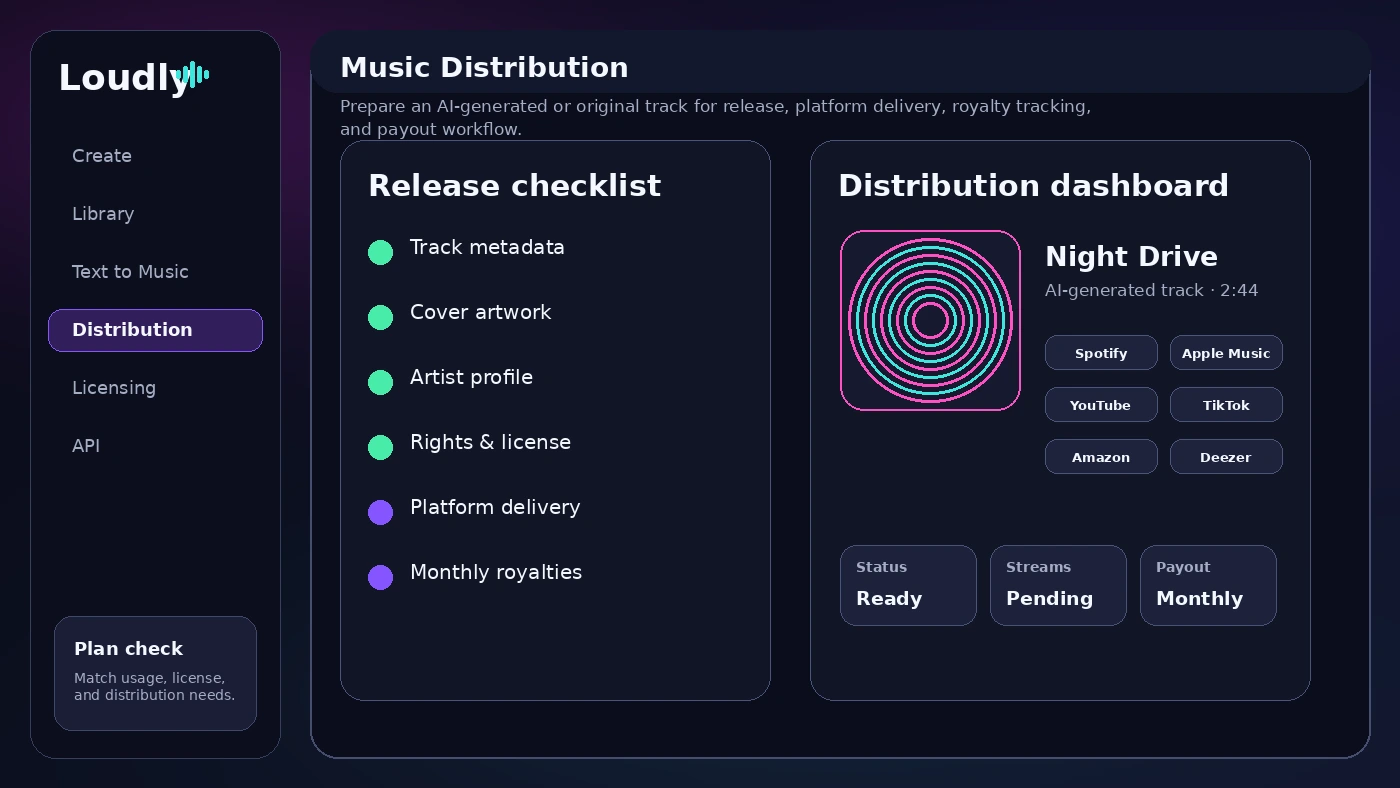
I would consider Loudly if you regularly need royalty-free instrumental music and want a faster way to create, customize, and possibly release tracks without starting from a blank DAW session or browsing a large stock library every time.
I would skip it if you only need one track, if you need exclusive human-composed music, if your project has complex licensing needs, or if you are not comfortable with limited refund flexibility after subscribing.
I would compare Loudly with Mubert if AI music generation and API-style workflows are the main job. I would compare it with Thematic if licensing and creator-safe music discovery matter more than generation. I would compare it with Freebeat if short-form social video is the center of the workflow. I would compare it with Unchained Music if distribution is the real problem.
The safest next step is simple: generate music for one real project first. If the output fits, read the license, check the billing cycle, verify plan limits, and choose the smallest plan that covers your actual use. If the output does not fit, do not let a coupon or annual discount talk you into a tool you will not use.
