Quick verdict
Gallabox is worth a serious look if WhatsApp is already part of your sales, support, or customer follow-up workflow. It is not the kind of tool I would buy just because the homepage shows automation, AI, broadcasts, and chatbots in one place.
The real question is narrower: does your business have enough WhatsApp volume, team handoff, campaign structure, and connector need to justify a dedicated WhatsApp automation platform?
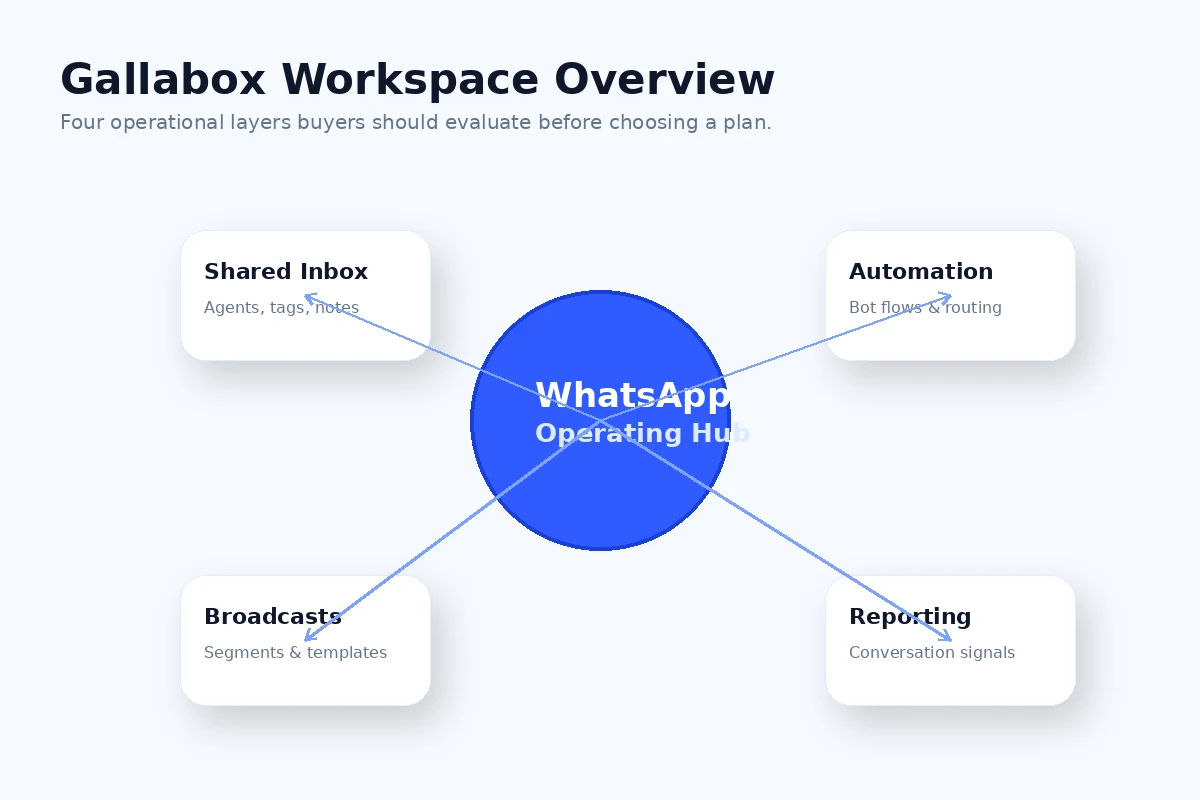
If the answer is yes, Gallabox can make sense. It brings together a shared WhatsApp inbox, no-code chatbots, WhatsApp broadcasts, Flows, drip campaigns, payments, catalogs, contacts, analytics, and connectors around one WhatsApp-first operating layer. That is useful for a business where WhatsApp is not just a side channel, but a place where leads arrive, customers ask questions, orders move forward, and support issues get resolved.
If the answer is no, Gallabox may feel heavier than necessary. A solo operator who can reply manually in the WhatsApp Business app probably does not need this level of structure. A buyer who wants a generic website chatbot may be better served elsewhere. And a team that cannot estimate WhatsApp message costs, user needs, or connector requirements should slow down before choosing annual billing.
The biggest caution is pricing shape. The subscription is only the base platform cost. WhatsApp template and conversation charges can sit separately, and the terms deserve review before payment. For my money, Gallabox should be tested with one real WhatsApp workflow before a team treats it as the new customer communication backbone.
Next step: If Gallabox fits your WhatsApp sales or support workflow, verify the current plan, trial route, and message-cost exposure before checkout.
Review snapshot
| Review point | Practical take |
|---|---|
| Best for | SMBs and teams that use WhatsApp for leads, sales, support, bookings, ecommerce, or follow-up |
| Not ideal for | Solo users, occasional manual responders, or buyers who only need a simple website chatbot |
| Main use case | Turning WhatsApp into a shared, automated sales and support workflow |
| Pricing note | Public pricing starts at Growth, with Scale and Pro for deeper automation, but WhatsApp charges need separate attention |
| Free path | Trial and demo routes are the safer first step before annual billing |
| Main strength | WhatsApp-first inbox, bots, broadcasts, Flows, payments, and connectors in one workspace |
| Main concern | Subscription cost, message charges, connector tiering, refund terms, and rollout complexity |
| Internal adjacent routes | ActiveCampaign for broader marketing automation, ChatBot for website chatbot needs, Sleek for broader communication workflow comparison |
| Direct category comparisons | Wati, Interakt, Aisensy, Rasayel, Zoko, and similar WhatsApp Business API platforms |
| Best next step | Build one real WhatsApp workflow, estimate message charges, then compare plans |
What is Gallabox?
Gallabox is a WhatsApp-first conversational commerce and automation platform for small and mid-sized businesses. In plain buyer language, it helps a team manage WhatsApp conversations, build chatbots, send broadcasts, create WhatsApp Flows, collect information, route chats to team members, connect with CRM or ecommerce tools, and turn WhatsApp into a more structured revenue or support channel.
That positioning matters.
Gallabox is not just a chatbot builder. It is also not a generic CRM, email marketing platform, or website live chat widget. The center of gravity is WhatsApp Business API automation. The buyer is usually a business that already receives leads, support questions, appointment requests, order questions, or repeat customer messages through WhatsApp and now needs a more organized system than one phone, one inbox, and manual replies.
The official product materials frame Gallabox around WhatsApp automation, broadcasts, marketing, shared inboxes, payments, Flows, catalogs, Click-to-WhatsApp ads, and WhatsApp Business API management. The documentation also describes it as a no-code conversational commerce platform for SMBs.
Our review approach compares public product positioning, pricing, terms, documentation, buyer workflow fit, and nearby alternatives. I would not treat a free trial, annual discount, migration offer, or coupon route as proof that Gallabox fits the buyer. With WhatsApp platforms, the better judgment starts with the actual conversation workflow.
The common wrong expectation is thinking Gallabox is a quick add-on for sending more WhatsApp messages. That is too shallow. The product becomes more interesting when a team needs ownership, automation, segmentation, follow-up, reporting, and handoff across many customer conversations.
Who should use Gallabox?
Gallabox makes the most sense for businesses where WhatsApp already matters.
A sales team can use it when leads come from Click-to-WhatsApp ads, website buttons, QR codes, campaigns, or inbound messages and need qualification before a rep steps in. The fit is stronger when missed replies, duplicate follow-ups, or unclear ownership are already costing money.
A customer support team can use it when repetitive questions eat staff time and conversations need to be assigned, tagged, tracked, or escalated. The value is not only the chatbot. It is the combination of automation plus a shared inbox where humans can take over cleanly.
An ecommerce team may consider Gallabox if WhatsApp is part of product discovery, order updates, catalogs, payments, support, or post-purchase follow-up. The buyer should confirm plan-level access to catalog, payment, ecommerce, and connector features before assuming the entire commerce workflow is included.
Education, real estate, travel, healthcare, and local service businesses may also fit. These categories often depend on appointment reminders, admissions questions, lead qualification, follow-up nudges, document collection, and structured intake. WhatsApp Flows and chatbots can be practical here if the process is repeatable.
Growth and marketing teams can use Gallabox when broadcasts and drip campaigns are planned carefully. The important condition is segmentation. Broadcasts without audience logic can become noisy fast, and WhatsApp is a personal channel. The buyer should know what message types, opt-ins, and follow-up rules are needed before paying.
Who should avoid Gallabox?
I would avoid Gallabox if WhatsApp is not already a meaningful business channel. Buying a WhatsApp automation platform before the channel is proven is a common mistake.
Solo operators should be careful. If one person can handle customer messages manually through the WhatsApp Business app, Gallabox may add cost and setup work before it adds real leverage.
Buyers who only want a simple website chatbot should also compare alternatives first. Gallabox can support chatbot workflows, but its strongest use case is WhatsApp-based communication. A general website chatbot platform may be simpler if WhatsApp is not central.
Teams that cannot estimate message volume should slow down. WhatsApp template and conversation costs can change the real budget, especially for broadcast-heavy or multi-country campaigns. The subscription price is only one part of the decision.
Businesses that need generous post-payment flexibility should read terms carefully before choosing annual billing. When a tool has non-refundable subscription language, the trial and demo path become much more important.
I would also be cautious if the workflow depends on a specific connector, API action, payment flow, webhook, AI chatbot, or multiple WhatsApp numbers. Those details should be verified at the plan level. A feature existing somewhere in the ecosystem is not the same as being included in the plan you intend to buy.
How Gallabox fits into a real workflow
A realistic Gallabox workflow does not begin with the bot. It begins with the customer conversation.
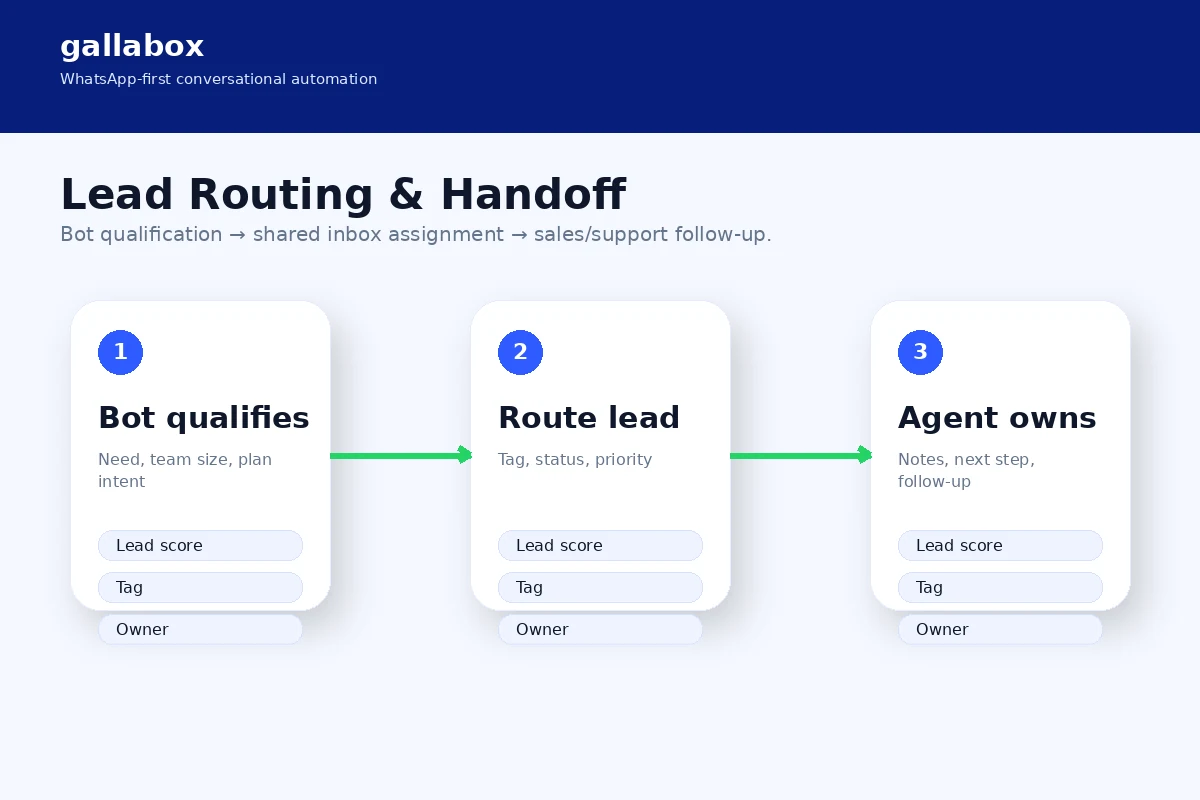
A buyer might start with a lead from a WhatsApp ad. Gallabox can collect basic details, ask qualification questions, route the conversation to the right team member, and keep the chat visible inside a shared inbox. If the lead is warm, a human sales rep can take over. If the lead is early-stage, a drip campaign or broadcast sequence may continue the conversation later.
For support, the workflow looks different. A customer asks a common question. A bot or canned response handles the simple part. If the issue needs a person, the conversation is assigned. Tags, contacts, message history, and ownership help the team avoid the classic WhatsApp mess: three people replying, nobody owning the issue, and context disappearing after the first response.
For ecommerce, Gallabox can sit closer to the buying journey. A customer can ask about a product, receive a catalog or link, share preferences, complete a form, or move toward payment depending on the setup. This is where connector verification matters. The more a buyer expects CRM, Shopify, WooCommerce, Razorpay, API calls, or OpenAI to participate, the more carefully the plan should be checked.
Where Gallabox helps is structure. Where it still needs human judgment is conversation design. Bad automation inside WhatsApp can feel more frustrating than a slow manual reply. The best use case is a repeated conversation path that staff already handles manually and can now be improved with routing, automation, and measurement.
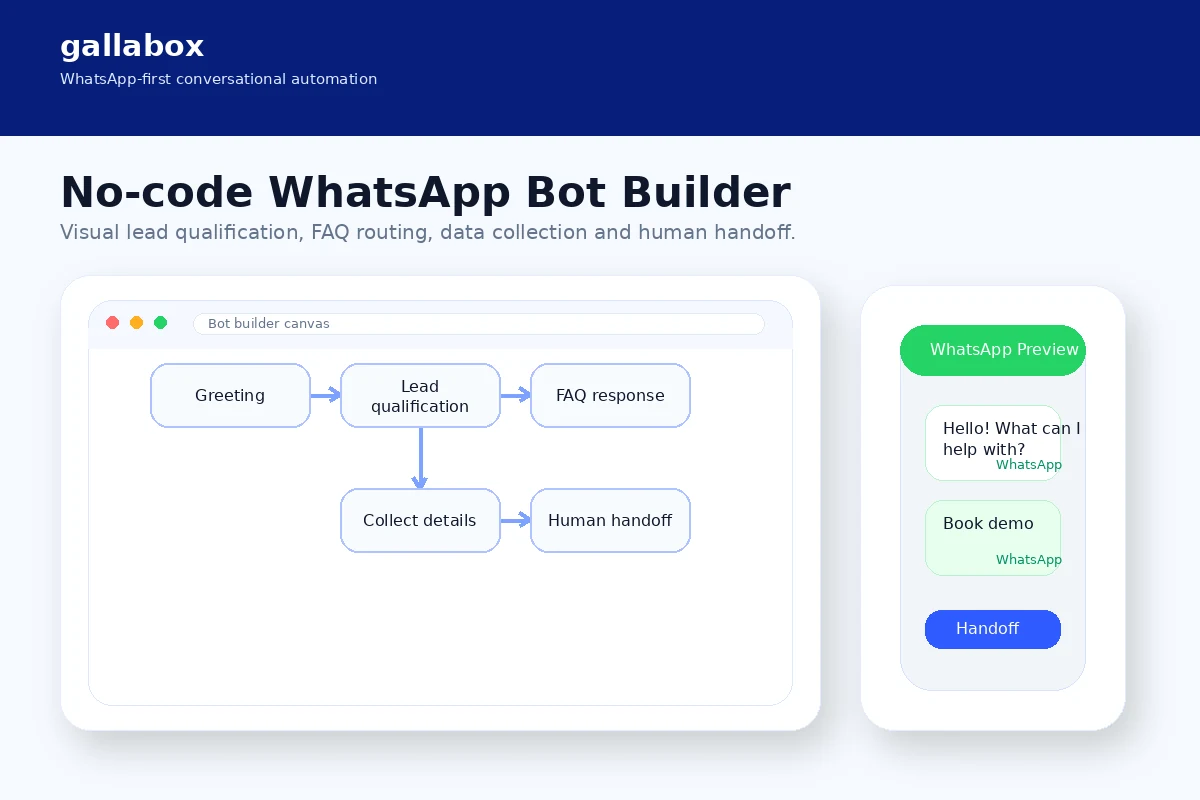
Workflow test: Before treating Gallabox as a full customer communication system, use the trial or demo route to test one real WhatsApp journey from inquiry to handoff.
Real-world buyer scenarios
A service business handling appointment leads
A clinic, coaching business, repair service, or local agency might receive WhatsApp messages from ads and referrals. Gallabox can help collect intent, route the conversation, send reminders, and keep follow-up visible to the team. The risk is overbuilding automation before knowing which questions actually repeat.
An ecommerce store using WhatsApp for product questions
An ecommerce buyer may want catalogs, product conversations, payment steps, and order support inside WhatsApp. Gallabox is more believable here if the store has enough message volume to justify the platform. The buyer should verify ecommerce connector access, payment workflow, and message charges before paying.
A sales team running Click-to-WhatsApp campaigns
When paid traffic sends leads into WhatsApp, speed and ownership matter. Gallabox can qualify leads and route them to reps. But this only works if the team already has a clear sales process. Without lead scoring, follow-up rules, and agent accountability, automation becomes decoration.
A support team trying to reduce repetitive replies
Gallabox can help with FAQs, canned responses, handoff, and conversation tracking. The buyer should check whether reporting is deep enough for the team’s needs, because third-party review patterns suggest users like ease of use and support, while some want stronger reporting or customization.
Key features that actually matter
Shared WhatsApp team inbox
The shared inbox is the operational center. It matters when more than one person handles WhatsApp conversations and the business needs assignment, visibility, tags, status, and follow-up ownership.
Buyer note: if one person can already manage WhatsApp manually, this feature may not justify the cost by itself.
No-code chatbots and automation flows
Gallabox lets teams build automated conversation paths for lead capture, FAQs, routing, qualification, and handoff. This is useful when the business has repeated questions or intake steps.
Buyer note: the bot is only as good as the conversation design. Test with real customer questions, not a perfect demo script.
Broadcasts, drip campaigns, and segmentation
Broadcasts and drip sequences can help with marketing and follow-up, especially for travel, ecommerce, admissions, service reminders, and lead nurturing.
Buyer note: WhatsApp is not email. Message relevance, opt-ins, and cost exposure matter more because the channel feels personal.
WhatsApp Flows, forms, catalogs, and payments
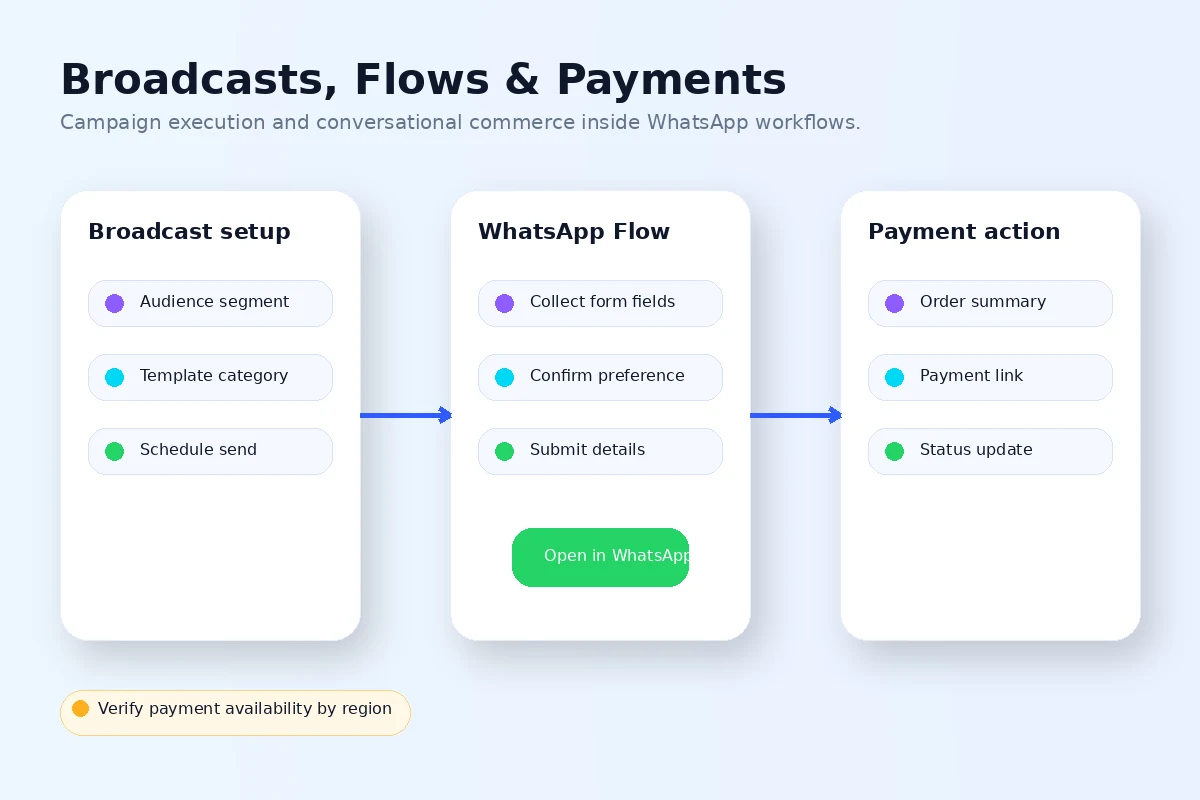
These features can turn WhatsApp into a more structured commerce or intake channel. They matter when the buyer wants customers to take action inside the conversation instead of jumping between disconnected tools.
Buyer note: verify plan access and live setup requirements before promising customers an in-chat payment or form experience.
Connectors, API calls, and CRM handoff
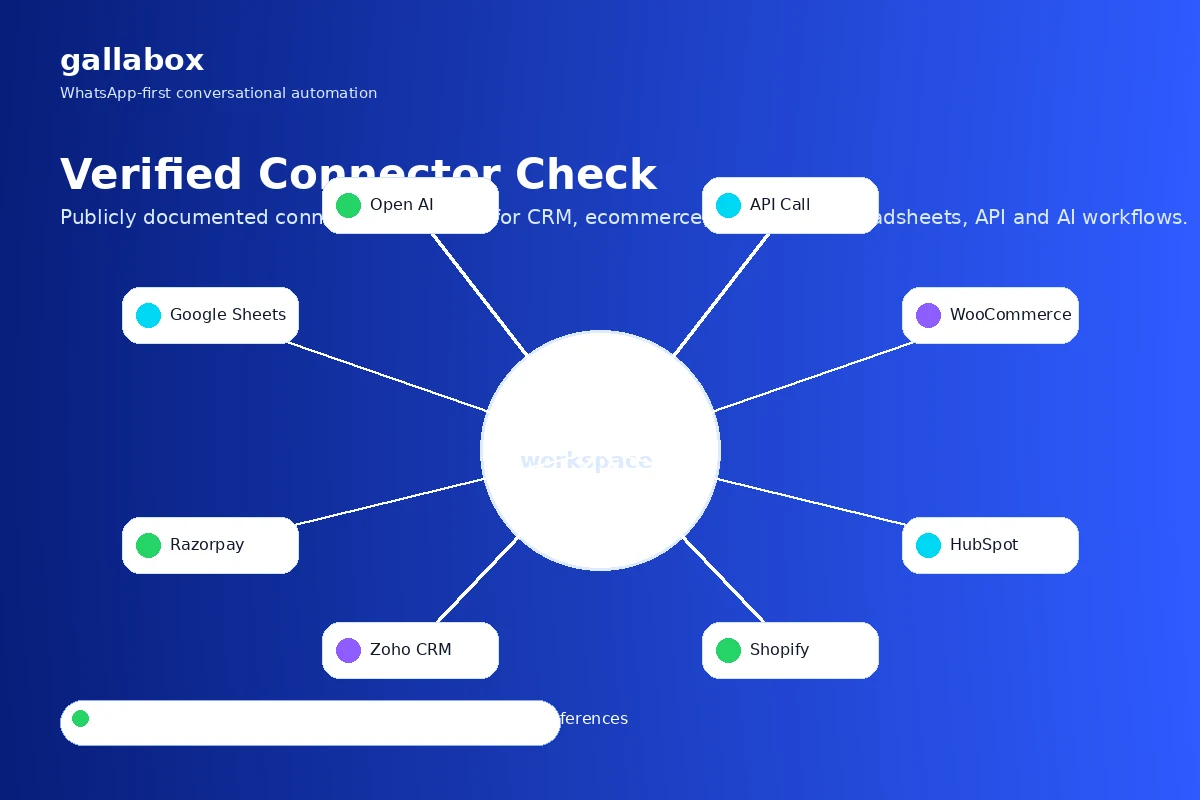
Gallabox documentation lists connectors such as Google Sheets, Razorpay, Zoho CRM, Shopify, HubSpot, WooCommerce, API Call, OpenAI, Zoom, and more. This can make Gallabox more than an inbox if data needs to move into existing systems.
Buyer note: connector existence is not enough. Check whether the connector is included in the selected tier and whether the workflow needs Scale, Pro, or additional setup.
Pricing and plan value
Gallabox pricing is not a simple “is the monthly price cheap?” decision.
At the time of review, public pricing and third-party pricing references show Gallabox plans starting around the Growth tier and moving up through Scale and Pro. The internal commercial data for this review points to Growth at $89 per month when billed yearly, Scale at $197 per month, and Pro at $377 per month at the latest check. Buyers should still verify the current pricing page and live checkout because SaaS pricing and plan packaging can change.
The important part is not only the plan price. WhatsApp API costs can vary by country, conversation type, and usage. Gallabox also references WhatsApp API cost estimation and template or conversation charges separately. That means a buyer should model the platform subscription and message exposure together.
For a small team, Growth may be enough if the core need is basic WhatsApp inbox, chatbot, and entry automation. Scale becomes more relevant when advanced connectors, multiple channels, APIs, custom roles, payments, webhooks, or deeper automation matter. Pro is more realistic when AI chatbot capabilities, stronger automation depth, or larger operational needs are part of the plan.
The cheapest plan is not automatically the safest deal. If the entry tier lacks the connector or workflow the buyer needs, it can become a false economy. On the other hand, choosing Pro before proving message volume and team adoption can create avoidable risk.
My practical view: use the trial or demo path first, build one workflow, estimate message volume, list required connectors, then choose the plan. Annual billing should come after proof, not before.
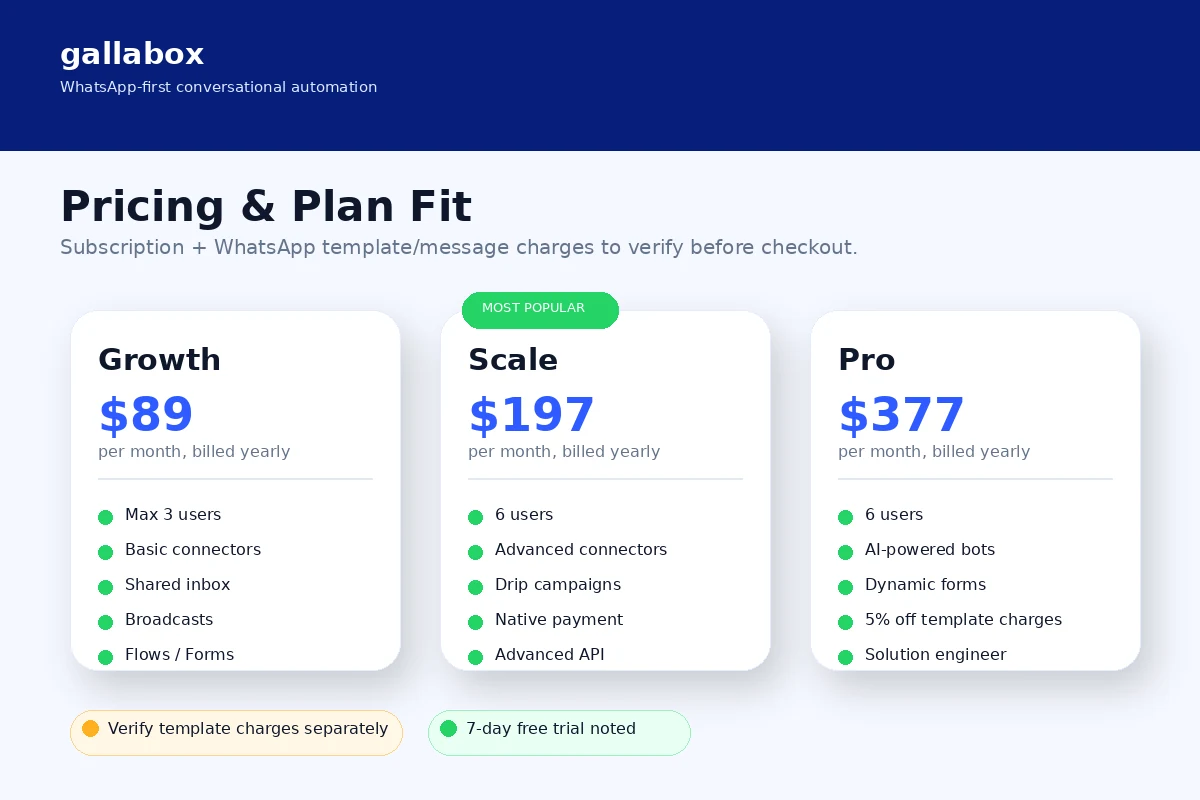
Pricing check: If Gallabox still fits, compare current plans against your WhatsApp volume, team size, connector needs, and message-cost assumptions before paying.
Free plan, trial, coupon, and checkout notes
A permanent free plan was not clear enough to treat as the main evaluation path. The safer public path is the trial or demo route. Gallabox’s pricing page references a 7-day free trial with free message credits, which is exactly where a cautious buyer should start.
The trial should not be used for casual browsing only. Use it to build one real workflow: a lead capture path, a support FAQ flow, an agent handoff, a broadcast segment, or a connector-dependent process. If the team cannot build something realistic during the trial, that is useful information before payment.
A coupon or offer route can improve the buying path, but it should not drive the decision. Gallabox is too operational for that. The wrong move is buying because an annual plan, migration offer, or reported deal looks attractive before the WhatsApp workflow is proven.
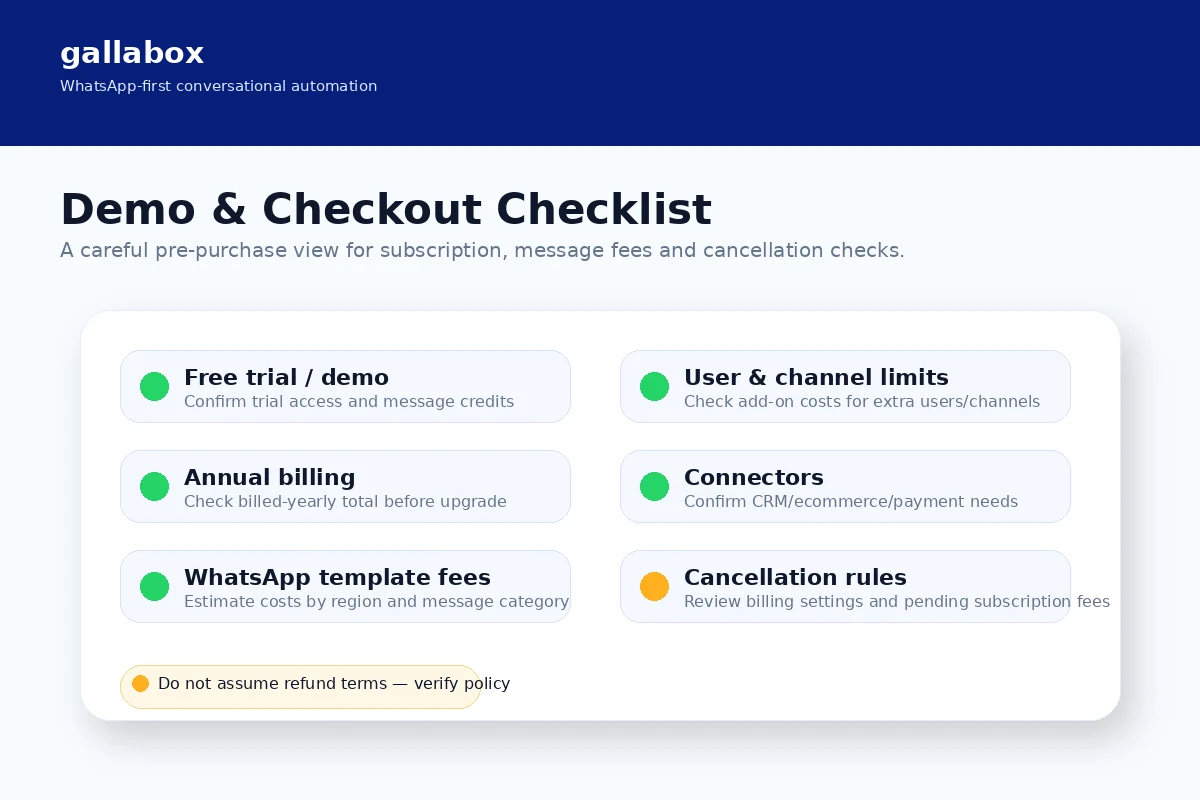
Checkout deserves extra attention. Buyers should verify:
- current plan pricing
- billing period and renewal terms
- WhatsApp template or conversation charges
- included users and additional user pricing
- connector and API access
- AI chatbot availability
- cancellation and refund terms
- taxes, onboarding, or add-on costs when relevant
With a platform like this, the safest savings path is not “find the biggest discount.” It is “avoid buying the wrong tier.”
What I would check before buying Gallabox
If I were buying Gallabox for a real team workflow, I would check these items before entering payment details:
- WhatsApp volume — how many customer conversations, template messages, broadcasts, and support chats happen each month?
- Team ownership — how many people need access, assignment, roles, or shared inbox visibility?
- Connector dependency — does the workflow require HubSpot, Zoho CRM, Shopify, WooCommerce, Razorpay, API calls, OpenAI, or another connector?
- Plan-level access — are the required connectors, roles, channels, APIs, and automation features included in Growth, or do they require Scale or Pro?
- Message-cost exposure — what will WhatsApp template or conversation charges look like in the target countries and use cases?
- Refund and renewal terms — what happens if the workflow does not work after payment, especially with annual billing?
- Alternative fit — would a broader CRM, a simpler chatbot, or a different WhatsApp platform fit better?
A simple test before paying
Before paying, I would run a small test like this:
- Pick one real WhatsApp workflow that already creates friction, such as lead qualification, appointment follow-up, ecommerce product questions, or customer support FAQs.
- Build the first version in Gallabox using the trial or demo route.
- Test the chatbot or Flow with real customer-style questions, not only clean internal examples.
- Hand off at least one conversation from automation to a team member and check whether ownership is clear.
- Try one required connector or data movement step if the workflow depends on CRM, ecommerce, payments, API, or AI.
- Estimate monthly WhatsApp message charges based on the campaign or support volume.
- Compare Growth, Scale, and Pro only after the workflow shows practical value.
This test does not need to be perfect. It needs to reveal whether Gallabox removes real operational friction.
Pros explained
Gallabox’s first real advantage is focus. It is built around WhatsApp as a business workflow, not as an afterthought inside a broader marketing tool. That matters for teams that live in WhatsApp every day.
The second advantage is workflow breadth. Shared inbox, bots, broadcasts, Flows, payments, contacts, campaigns, and connectors can sit together. When these pieces are used well, Gallabox can reduce handoff problems and repeated manual replies.
The third advantage is no-code usability. A business should not need a developer for every basic WhatsApp automation. Gallabox is more attractive when a sales, support, or operations person can build and adjust workflows without waiting on engineering.
The fourth advantage is connector potential. CRM, ecommerce, payment, API, and AI connectors can make WhatsApp data more useful outside the chat window. That is important for teams that need customer conversations to connect with the rest of the business.
The fifth advantage is pricing visibility. Gallabox is not completely hidden behind sales calls. Public pricing and a trial route make early evaluation easier, even though the final cost still needs careful checking.
Cons explained
The first drawback is cost complexity. Subscription pricing is only the platform layer. WhatsApp message charges, add-ons, additional users, channels, and connector requirements can affect the real cost.
The second drawback is plan dependency. A buyer may see a feature on the website or in docs and assume it is included. That can be risky. Connector access, API workflows, multiple channels, AI chatbot capabilities, custom roles, and advanced automation should all be checked by plan.
The third drawback is that Gallabox may be too much for simple use cases. If the business does not have repeated WhatsApp workflows, team handoff, or campaign needs, the structure may not pay for itself.
The fourth drawback is refund and renewal risk. Non-refundable subscription language makes it important to test before paying. I would not treat annual billing as safe until the team has validated one real workflow.
The fifth drawback is that reporting depth may not satisfy every team. Third-party review summaries tend to praise ease of use and customer support, but some users mention reporting, customization, or dashboard limitations. That does not make Gallabox weak, but it does mean analytics-heavy teams should test reporting before committing.
Green flags and red flags
Green flags:
- WhatsApp already drives meaningful leads, support, or revenue.
- More than one person handles customer conversations.
- The team has repeated questions or follow-up paths that can be automated.
- CRM, ecommerce, payments, or API workflows need to connect with WhatsApp.
- The business can estimate message volume before buying.
- The trial confirms better handoff, faster response, or cleaner follow-up.
Red flags:
- The buyer is choosing Gallabox mainly because of a deal or annual discount.
- WhatsApp is not yet a proven business channel.
- The team cannot name the workflow it wants to automate.
- The required connector is assumed but not verified on the selected plan.
- Message charges are ignored during budget planning.
- The buyer expects refund flexibility after choosing the wrong tier.
Gallabox vs alternatives
Gallabox should be compared in two ways: direct WhatsApp automation platforms and adjacent customer communication routes.
Wati vs Gallabox
Wati is one of the more direct comparisons if the buyer wants a WhatsApp Business API platform for inbox, broadcasts, automations, and team use. Compare Wati if your main question is which WhatsApp-specific provider has the better pricing, onboarding, interface, and regional fit.
Gallabox may still make sense if its Flows, connectors, shared inbox, or commerce workflow better match your use case.
Interakt vs Gallabox
Interakt is another direct WhatsApp commerce and automation comparison, especially for businesses evaluating WhatsApp sales, notifications, support, and ecommerce workflows. It may be worth comparing if your business is commerce-heavy or already knows it wants WhatsApp as a primary channel.
Gallabox may be stronger if its no-code automation and workflow structure feel easier for your team.
Aisensy vs Gallabox
Aisensy is relevant for WhatsApp marketing, broadcasts, automation, and customer engagement. Compare it when broadcast cost, campaign controls, and WhatsApp marketing execution are central.
Gallabox may be the better fit if shared inbox operations, chatbot handoff, connectors, and team workflows matter as much as campaigns.
ActiveCampaign vs Gallabox
ActiveCampaign is an adjacent route, not a direct WhatsApp replacement. It is stronger when email marketing, CRM automation, multi-channel campaigns, and broader customer journey automation matter more than WhatsApp-first conversation management.
If WhatsApp is the center of the workflow, Gallabox is more targeted. If WhatsApp is only one small channel in a wider marketing stack, read the ActiveCampaign store guide before choosing.
ChatBot vs Gallabox
ChatBot is also adjacent. It is a better comparison when the buyer wants a general chatbot for website or customer support automation rather than a WhatsApp Business API platform.
Gallabox makes more sense when the customer conversation actually happens in WhatsApp. If the buyer’s main need is a site chatbot, compare the ChatBot store guide first.
Trust, refund, and buyer-risk notes
The trust picture for Gallabox is mixed in a normal SaaS way: useful product category, clear enough public positioning, meaningful customer stories, and third-party review patterns that generally praise ease of use and support, but still enough pricing and plan complexity to require caution.
The first risk is billing. Public terms describe automatic renewal unless the account is terminated or non-renewal notice is given in the required window. They also state that payment obligations are non-cancelable and subscription fees paid are non-refundable except as expressly permitted. That is not a small detail for a buyer considering annual billing.
The second risk is WhatsApp cost exposure. Gallabox’s terms and pricing information separate platform subscription fees from WhatsApp Business API template or conversation charges. A team that sends many broadcasts or works across multiple regions should estimate these costs before judging the plan affordable.
The third risk is implementation. Gallabox can look simple because it is no-code, but no-code does not mean no planning. Someone still needs to design flows, write message templates, decide routing rules, manage opt-ins, check compliance, and monitor whether automation improves the customer experience.
The fourth risk is plan fit. If the workflow depends on API calls, OpenAI, HubSpot, Zoho, Shopify, WooCommerce, Razorpay, multiple WhatsApp numbers, custom roles, or advanced automation, do not assume the entry plan is enough.
The safest buying posture is simple: use the trial or demo, test one workflow, estimate total cost, then pick a plan. Treat any coupon or migration offer as secondary.
Final verdict
Gallabox is a strong candidate if WhatsApp already sits close to your revenue, support, or customer follow-up process. It is especially relevant for teams that need shared ownership, bot-to-human handoff, broadcasts, Flows, payments, CRM or ecommerce connectors, and repeatable WhatsApp automation.
I would consider Gallabox if your business already has WhatsApp traffic and the current process is messy: missed replies, slow lead qualification, poor handoff, repeated FAQs, manual broadcast work, or disconnected customer data.
I would skip it if WhatsApp is still experimental, if one person can handle messages manually, or if the real need is just a generic website chatbot. I would also slow down if the buyer cannot estimate message charges or cannot confirm the plan includes the connectors the workflow depends on.
For direct comparison, look at other WhatsApp Business API platforms such as Wati, Interakt, Aisensy, Rasayel, or Zoko. For adjacent routes, compare ActiveCampaign if broader marketing automation matters more, or ChatBot if the buyer mainly needs website chatbot automation.
The safer path is trial first, workflow proof second, pricing check third, and offer route last. Gallabox can be a useful WhatsApp operating layer, but only when the buyer has a real conversation process worth automating.