Quick verdict
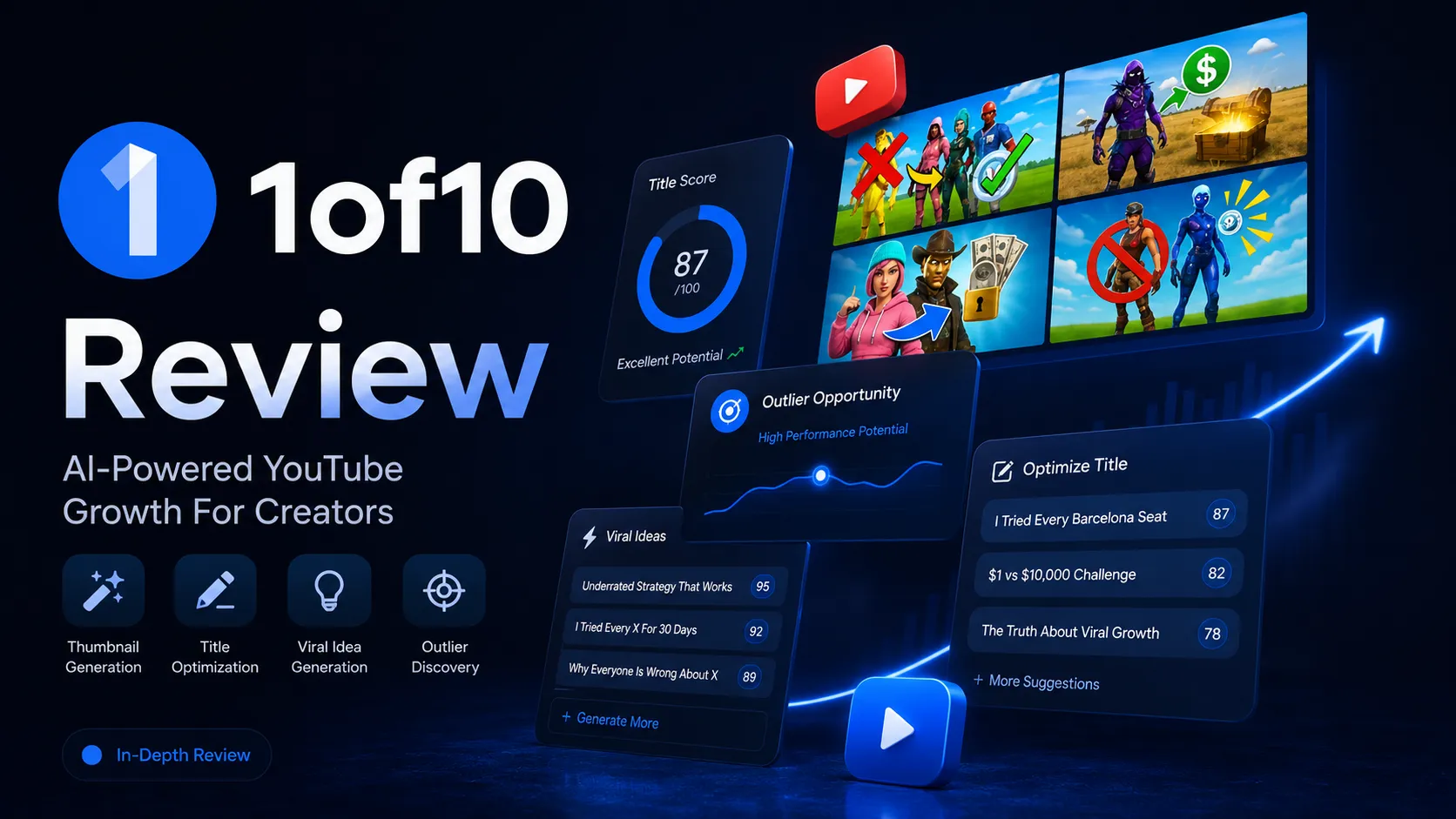
1of10 is worth considering if your YouTube bottleneck is not just “I need a thumbnail,” but “I need better ideas, titles, and thumbnails before I publish another video.”
That difference matters.
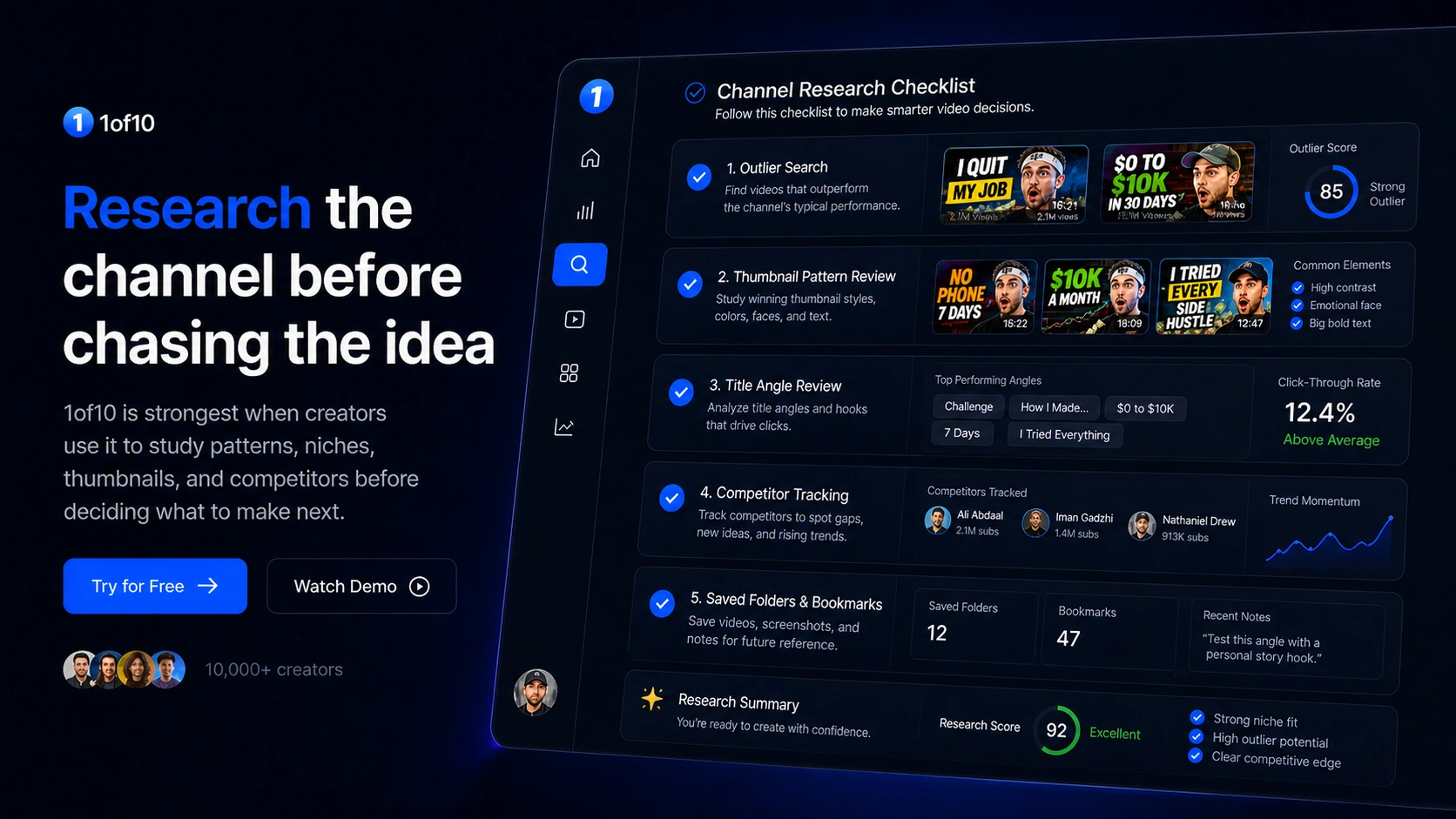
A lot of creator tools promise more views, but the real buying question is narrower: will this tool change your next upload decision? 1of10 is most interesting when it becomes part of the planning loop — study outliers, save patterns, generate a few packaging angles, compare titles, review thumbnail directions, then decide what is actually worth producing.
I would not treat it as a magic CTR machine. AI thumbnails can look clickable and still be wrong for your audience. Title ideas can be punchy and still feel off-brand. Outlier videos can reveal patterns, but they do not automatically prove that your channel can repeat the same result.
The strongest reason to consider 1of10 is focus. It is built around YouTube packaging: outlier research, competitor tracking, thumbnail search, title generation, idea generation, and AI-assisted creative iteration. The main caution is plan fit. The Free plan is useful for testing the workflow, Basic is more research-oriented, and Pro is the path where the AI generation tools and monthly AI credits become the real purchase decision.
The safest next step is simple: test the free path first, then decide whether your workflow needs Basic research tools or Pro-level AI generation. If the product still fits, use the 1of10 store page or the current offer route only after the workflow question is clear.
Next step: If 1of10 sounds useful for your YouTube workflow, test the current route before choosing Basic or Pro.
Review snapshot
| Review point | Practical take |
|---|---|
| Best for | YouTube creators who need repeatable idea, title, and thumbnail research |
| Not ideal for | Occasional uploaders, pure design users, or buyers needing a full SEO analytics suite |
| Main use case | Studying outlier videos and turning patterns into packaging options |
| Free path | Free plan with outlier search, bookmarks, channel tracking, and limited AI credits |
| Paid path | Basic for research; Pro for AI thumbnails, titles, ideas, repackaging, and monthly credits |
| Main strength | YouTube-specific packaging workflow instead of a generic AI image tool |
| Main concern | Pro value depends on real publishing volume and AI credit usage |
| Best direct comparison | Pikzels if thumbnail generation is the main need |
| Adjacent comparisons | TubeBuddy, vidIQ, TubeLab, OutlierKit, Aitubo, ArtSpace.ai depending on the buyer’s bottleneck |
| Best next step | Test a real upcoming video idea before annual billing |
What is 1of10?
1of10 is best understood as a YouTube idea and packaging research platform for creators who want to study what is already working before choosing their next video angle, title, or thumbnail.
It is not just a generic AI image generator. It is also not a full YouTube SEO platform in the same sense as tools built heavily around keyword research, rank tracking, channel audits, and metadata optimization. The core promise is more specific: find outlier videos, understand winning packaging patterns, and turn those patterns into better ideas, titles, and thumbnails.
That makes the product more useful than a blank-prompt AI tool for some creators. Instead of asking a general AI model to “make a viral thumbnail,” 1of10 tries to anchor the creative process in YouTube patterns: videos that overperformed, titles that caught attention, thumbnails that worked in a niche, and channels worth tracking.
Our review approach compares public product pages, pricing details, terms, privacy notes, feature pages, third-party comparisons, and practical workflow fit. I do not treat a coupon, a creator testimonial, or a low-looking monthly price as proof that the product fits every buyer. With a tool like 1of10, the better test is whether it helps you make smarter packaging decisions for videos you were already planning to publish.
The common wrong expectation is thinking 1of10 can replace taste. It cannot. A creator still has to judge whether an idea fits the channel, whether a title is honest enough to keep trust, and whether a thumbnail attracts attention without damaging the brand.
Who should use 1of10?
1of10 makes the most sense for creators who publish often enough that better packaging decisions compound.
A weekly YouTuber can use it to study outliers before choosing the next topic. In that workflow, 1of10 is not just an inspiration board. It becomes a planning checkpoint: what broke out, what title format repeated, what visual hook appeared across similar thumbnails, and which idea is worth turning into a script.
A thumbnail designer or strategist may also find it useful. If the job is to create better YouTube packaging for clients, then thumbnail search, similar titles, competitor tracking, and saved folders can become part of a repeatable research process. The buyer should still check whether the outputs are deep enough for the niches they serve.
A faceless channel operator may benefit if the channel depends on volume and iteration. The tool can help generate multiple title and thumbnail directions faster, but the operator still needs a clear editorial rule for rejecting generic or overused ideas.
A small creator team may consider 1of10 when multiple people are involved in research, titles, thumbnails, and upload planning. In that case, the team should check plan access, team-seat pricing, and whether Pro or Enterprise is a better fit before assuming one seat covers the whole workflow.
A beginner can use the free plan to understand the logic of outliers and packaging. But I would be careful about jumping straight into Pro before knowing whether the creator will actually turn research into better videos.
Who should avoid 1of10?
I would be cautious with 1of10 if you only upload a few times per year. A tool built around repeated research and packaging decisions loses value when the publishing cadence is too light.
I would also skip it if your main need is a pure design editor. If you want layers, brand kits, detailed layout control, or broad design templates, a dedicated design tool may be a better fit. 1of10 may help with thumbnail concepts, but it is not trying to replace a full creative suite.
Creators who need deep YouTube SEO should compare carefully. 1of10 can help with ideas and packaging, but if your bottleneck is keyword research, metadata optimization, rank tracking, or channel audit workflows, tools like TubeBuddy, vidIQ, TubeLab, or OutlierKit may deserve a closer look.
I would also avoid buying Pro only because AI thumbnails sound exciting. The Pro plan is most defensible when AI thumbnails, titles, ideas, repackaging, and credits are used in a regular upload routine. If you only need occasional inspiration, the Free or Basic path may be enough.
Finally, teams with strict data or privacy requirements should read the privacy policy and YouTube connection details before linking accounts. That does not mean the product is unsafe. It means the buyer should understand what data is involved before building a workflow around it.
How 1of10 fits into a real workflow
The best 1of10 workflow starts before the AI tools.
I would use it like this:
- Start with a niche, topic, or channel direction.
- Search for outlier videos that performed better than expected.
- Save examples that are actually relevant to your audience.
- Compare titles and thumbnail patterns.
- Generate a few idea, title, or thumbnail directions.
- Reject anything that feels generic, misleading, or off-brand.
- Build the video around the strongest angle.
- Revisit performance after publishing and update the swipe file.
The key is the loop. Research is only useful if it improves the next decision. If 1of10 becomes a place where you browse interesting videos for an hour and then publish the same old ideas, it is not doing enough.
For a creator with a consistent schedule, 1of10 can sit between content planning and production. Before recording, the creator checks outliers. Before editing, they decide the hook. Before upload, they compare titles and thumbnails.
For a team, the workflow can be more structured: strategist finds outliers, writer builds the angle, designer uses thumbnail patterns, editor checks whether the packaging still matches the actual video. That is where 1of10 can become operational rather than just inspirational.
Workflow check: Before upgrading, use 1of10 on one real upcoming video and see whether it changes the title, thumbnail, or topic decision.
Real-world buyer scenarios
A solo creator planning weekly videos
A solo creator who publishes weekly may get real value from 1of10 because the research habit repeats. If every upload needs a title, thumbnail, and angle, the tool has enough chances to help.
The risk is imitation. Studying outliers is useful, but copying surface patterns can make a channel feel derivative. The right use is to understand why a format worked, then adapt it honestly to your own audience.
A thumbnail designer working with creator clients
A thumbnail designer may use 1of10 as a swipe-file and research companion. Similar thumbnails, outlier research, and saved folders can make client work faster because the designer is not starting from a blank canvas.
The limit is execution. A thumbnail concept still needs design taste, brand fit, and sometimes manual editing outside the tool. If the client expects polished custom design, 1of10 may support the process but not replace the designer.
A small creator team choosing between Basic and Pro
A small team should decide whether its bottleneck is research or generation. If the team mainly needs competitor tracking, saved folders, thumbnail search, and filters, Basic may be enough. If the team wants AI thumbnails, title ideas, repackaging, and more AI credits every month, Pro becomes more relevant.
The buyer should check team access and seat costs before assuming a plan will fit the whole team.
A beginner trying to grow a new channel
A beginner may like the free entry point because it teaches the habit of studying what works. That is valuable.
But a beginner should not overbuy. Early on, it may be more useful to learn packaging principles, publish consistently, and test a few ideas than to pay for a plan that creates more research than action.
Key features that actually matter
Outlier research
Outlier research is the heart of 1of10. The idea is simple: find videos that performed unusually well compared with a channel baseline, then study the topic, title, thumbnail, and packaging pattern.
This matters because many creators choose ideas from instinct. Instinct is useful, but it can be noisy. Outlier research gives the creator a more grounded place to start.
Buyer note: do not treat every outlier as a template. A video can overperform because of timing, personality, audience trust, controversy, or niche conditions that are hard to copy.
Thumbnail search and AI thumbnail generation
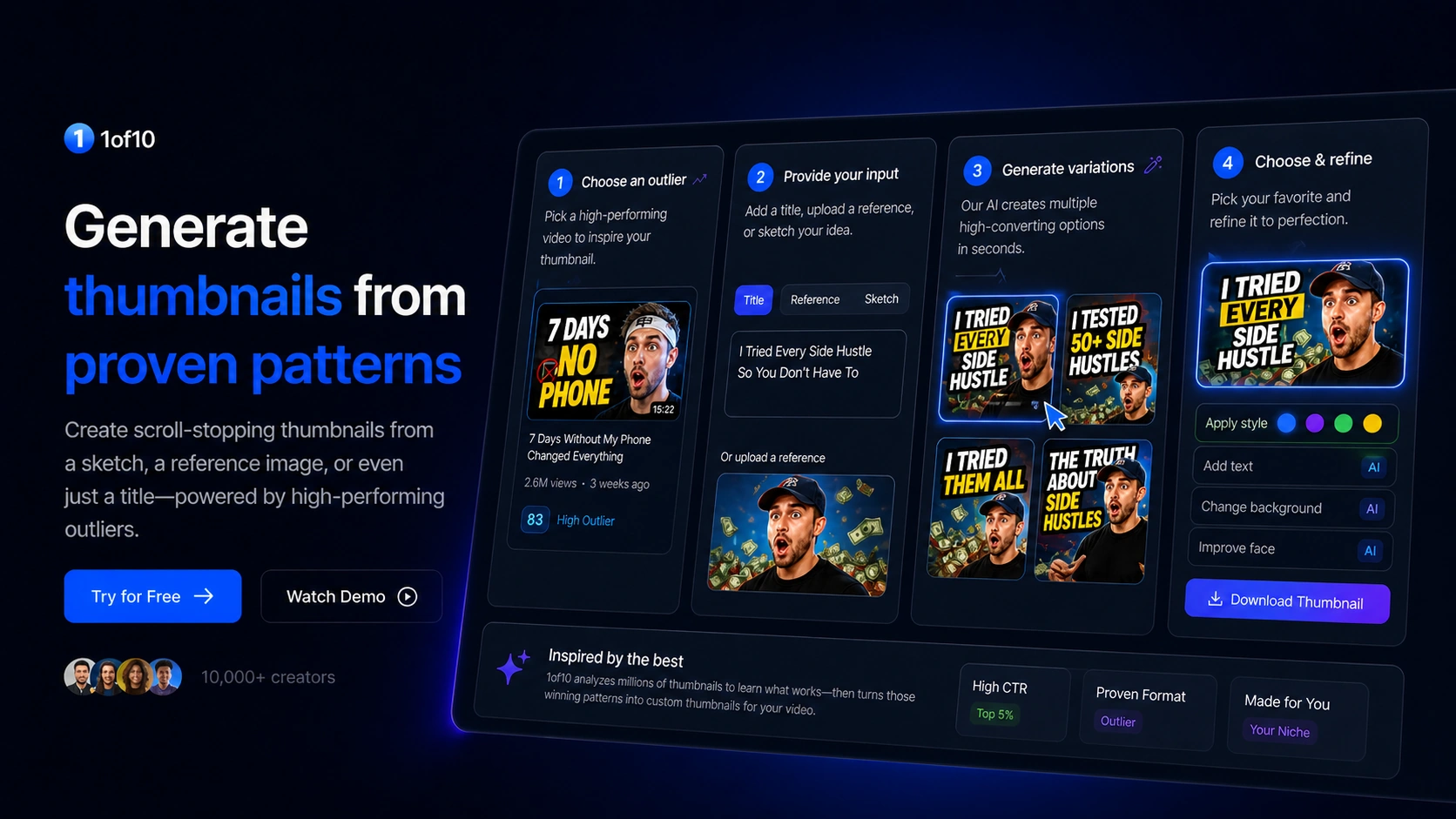
1of10’s thumbnail angle is stronger than a generic AI image workflow because it is tied to YouTube packaging. The point is not just to make an attractive image. The point is to make a thumbnail that competes in a feed.
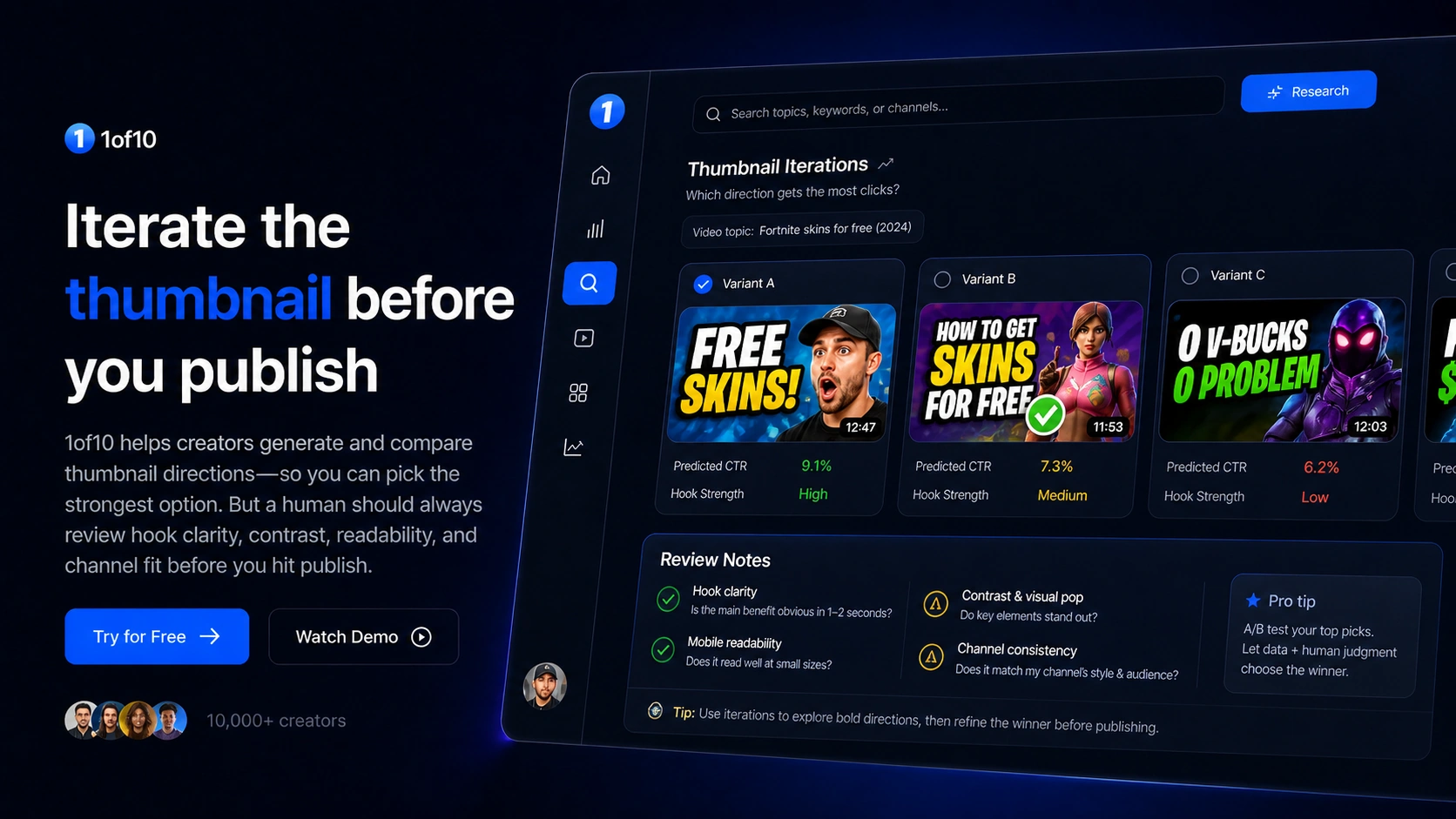
That said, thumbnail generation should be treated as concept development, not final approval. Creators should still review facial expressions, text size, contrast, promise, brand consistency, and whether the thumbnail accurately represents the video.
Buyer note: if you need advanced design control, you may still want a dedicated design tool or thumbnail-focused alternative.
Title generation
The title generator can help creators get unstuck. A good title often needs curiosity, clarity, and tension. Having several options can make the editing process faster.
The danger is over-optimization. A title can be clickable and still create the wrong expectation. If viewers click and feel misled, retention and trust can suffer.
Buyer note: use generated titles as drafts, then rewrite them in your channel voice.
Idea generation and repackaging
The idea generator is useful when it starts from proven patterns instead of random prompting. For creators who constantly need new angles, this can reduce blank-page thinking.
Repackaging is especially interesting because many YouTube wins come from finding a familiar idea and presenting it in a fresher way. But repackaging should not become lazy copying.
Buyer note: if a generated idea does not fit your audience, discard it quickly. The goal is better direction, not more ideas for their own sake.
Chrome extension and competitor tracking
The Chrome extension matters because it brings research closer to where creators already browse: YouTube itself. That can reduce tab-switching and make spotting outliers more natural.
Competitor tracking can help teams watch what is breaking out without manually checking the same channels every day. It is most useful when the buyer has a clear niche list and knows what signals matter.
Buyer note: tracking competitors is helpful only if it leads to decisions. Watching more channels is not the same as improving your own channel.
Pricing and plan value
The public pricing path is clearer than many creator tools, but the plan choice still deserves attention.
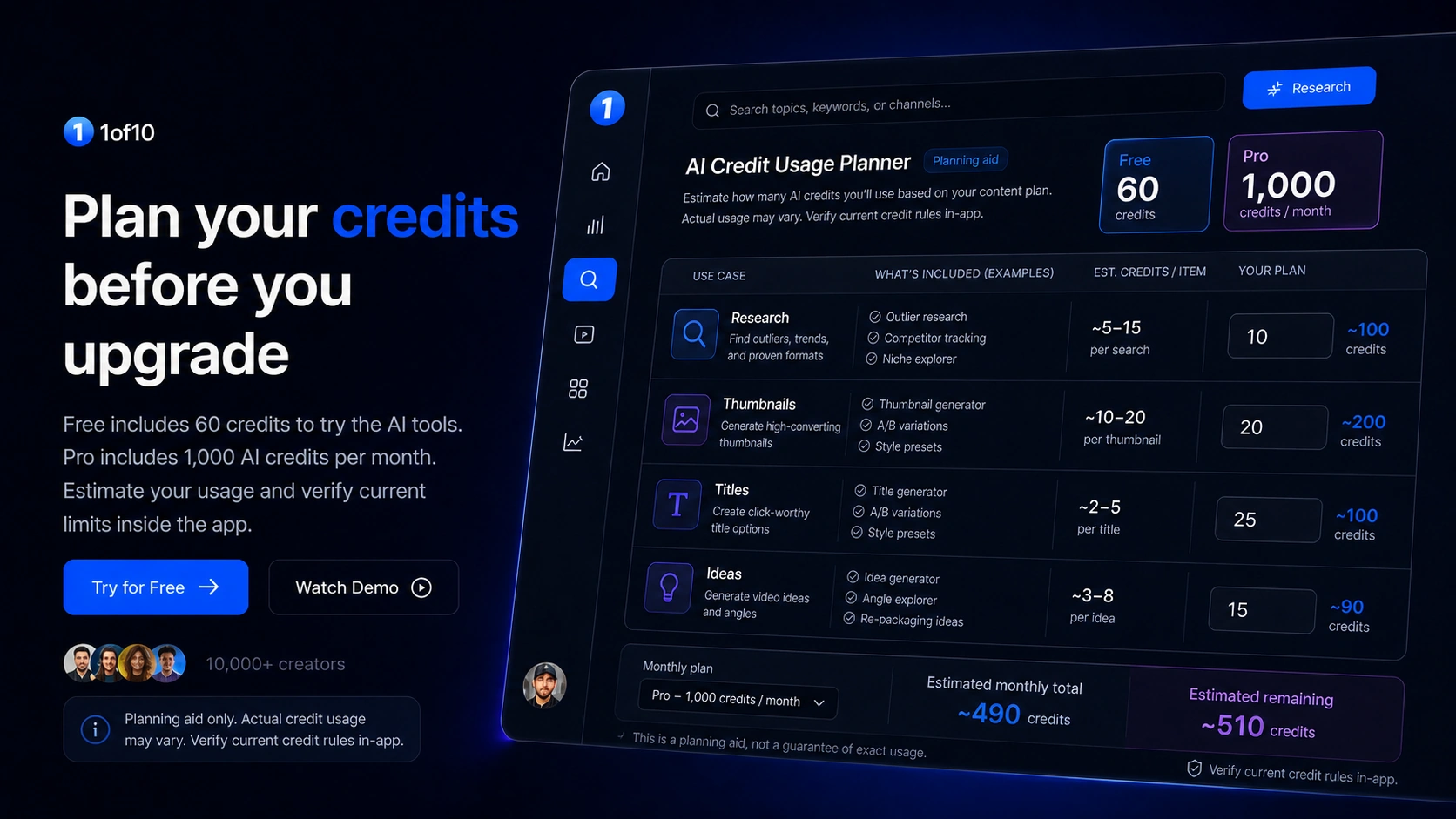
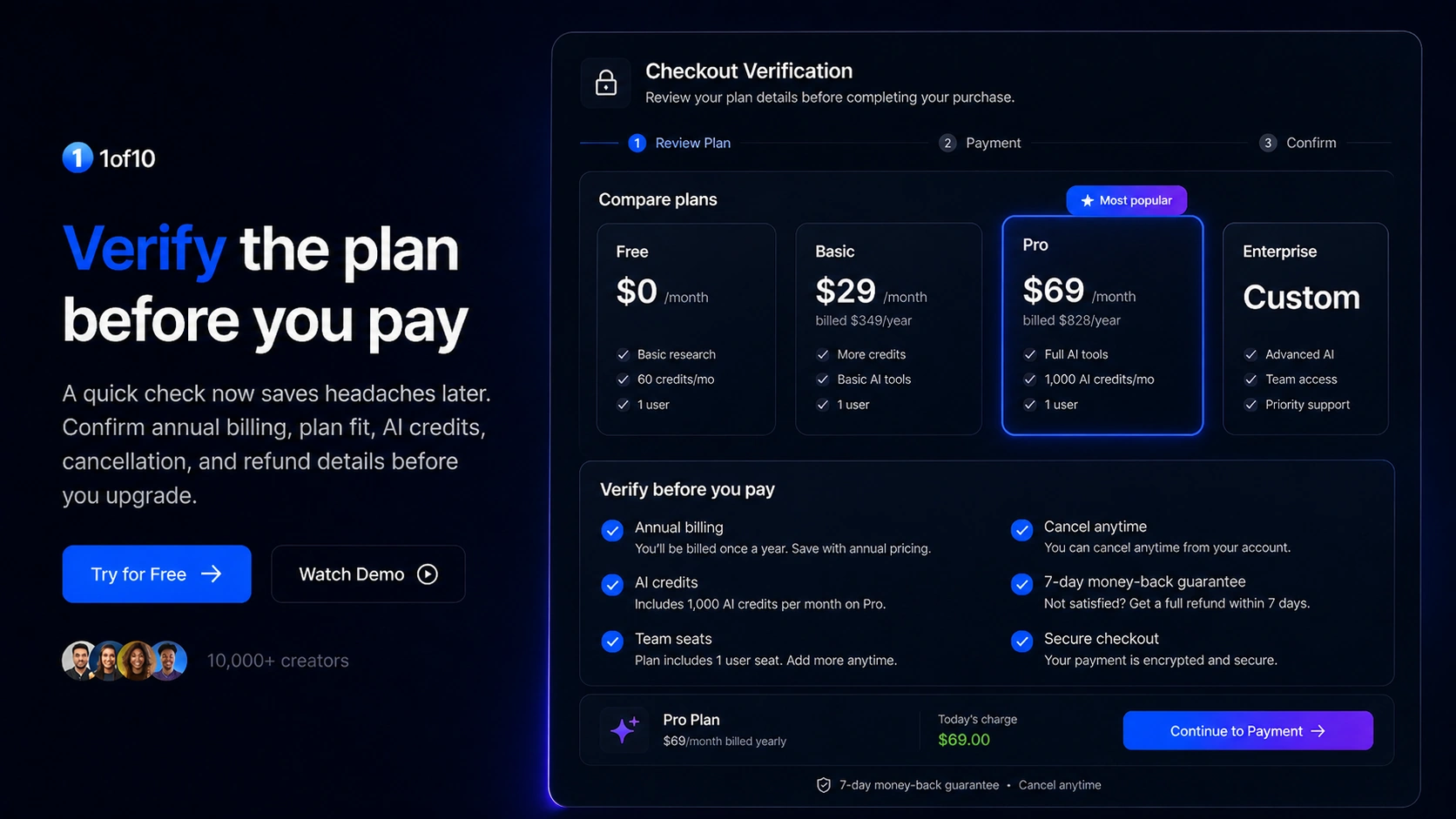
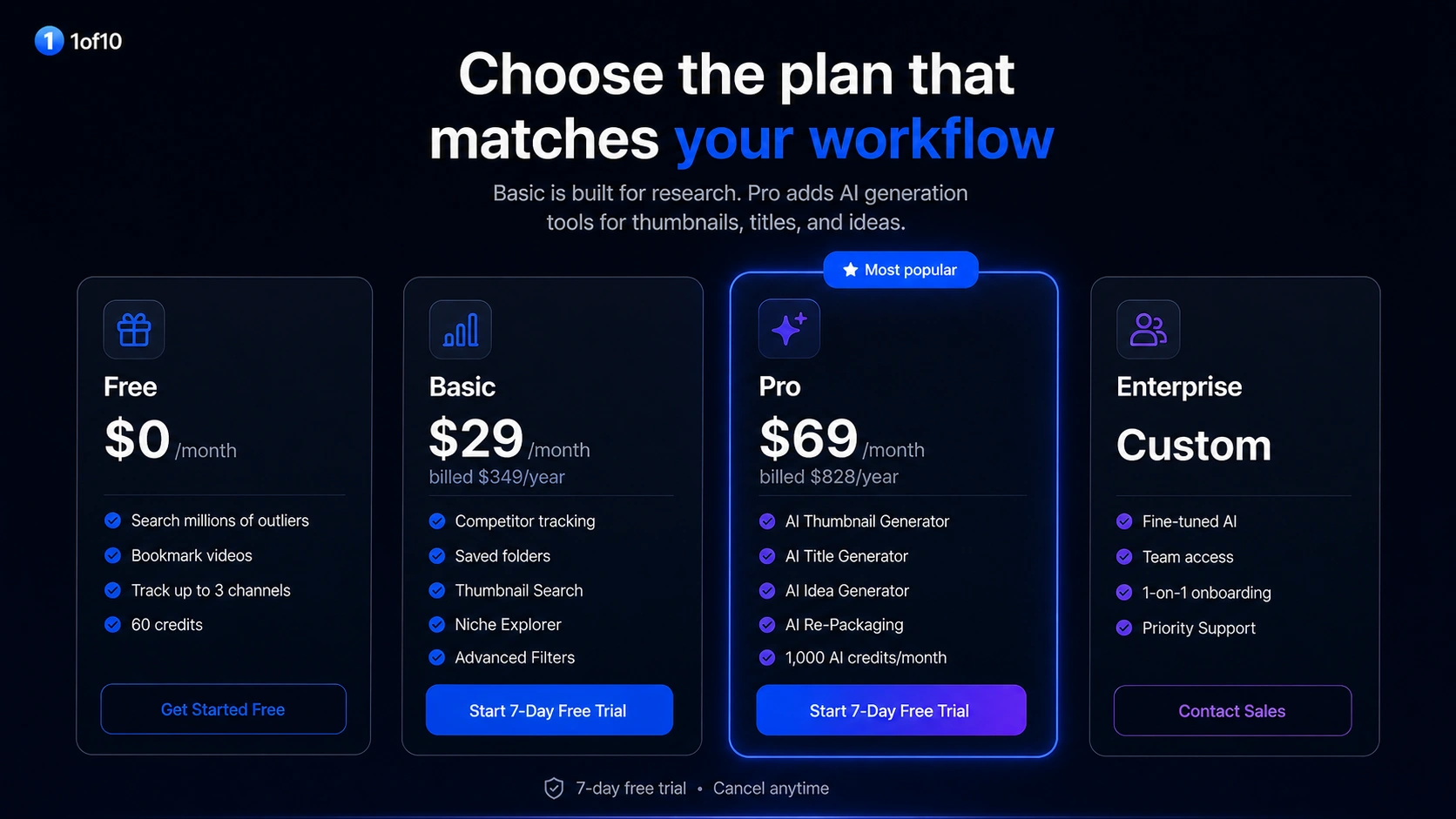
At the latest review check, 1of10 showed a Free plan at $0/month. The Free plan includes outlier search, bookmarks, tracking up to 3 channels, and 60 credits to try the AI tools. That is the right starting point for most buyers because it lets you test whether the research workflow is actually useful before paying.
The Basic plan was shown at $29/month when billed yearly, with $349 billed annually. Basic adds the research and organization layer: competitor channel tracking, saved folders, thumbnail search, niche explorer, virality monitoring, and advanced filters.
The Pro plan was shown at $69/month when billed yearly, with $828 billed annually. Pro adds the AI generation layer: AI thumbnail generator, AI title generator, AI idea generator, AI repackaging, 1,000 AI credits per month, and team members on a pay-per-seat basis.
Enterprise is a contact path for creators and teams who want more support, including fine-tuned AI, team access, onboarding, and priority support.
My pricing take is this: Free is for workflow testing, Basic is for repeated research, and Pro is for creators who will use AI generation every month.
The easy mistake is choosing Pro because it looks complete. The better question is whether you will generate enough thumbnails, titles, ideas, and repackaging options to make the credit allowance and higher price worthwhile.
Annual billing can make the monthly-equivalent number look cleaner, but it also raises commitment risk. I would not move to annual billing until the tool has changed at least one real planning session in a useful way.
Pricing check: Compare Free, Basic, and Pro against your real upload cadence before paying for annual billing.
Free plan, trial, coupon, and checkout notes
The free plan is the safest starting point because it lets you test the workflow without treating a paid plan as a shortcut to better videos.
Use the free path to answer practical questions:
- Does outlier search reveal ideas you would not have found manually?
- Do saved examples help you plan faster?
- Do the AI credits give you enough signal about thumbnail, title, and idea quality?
- Do the outputs fit your niche or require heavy rewriting and redesign?
- Does the tool make you more decisive or just give you more tabs to browse?
The coupon path should come later. 1of10’s clearest public savings route appears to be plan selection and annual billing, not a stable public coupon-code system. Deal and offer pages may still be useful, but they should not drive the decision before product fit is clear.
Refund wording deserves a careful look. The pricing FAQ presents a 7-day money-back guarantee, while the Terms and Conditions describe refund requests as case-by-case and generally non-refundable unless required by law. I would not panic over that, but I would check the active checkout language before paying annually.
Checkout order: Test the free workflow first, then check current offers only after 1of10 fits your creator routine.
What I would check before buying 1of10
If I were buying 1of10 for a real creator workflow, I would check seven things before paying.
First, I would test one real upcoming video idea in the Free plan. Random prompts do not prove much. A real video concept will show whether the research and AI tools improve an actual decision.
Second, I would decide whether the bottleneck is research or generation. Basic is easier to justify when you need discovery and competitor tracking. Pro is easier to justify when AI thumbnails, titles, ideas, and repackaging are used repeatedly.
Third, I would estimate AI credit usage. If you generate many thumbnail and title variations for every upload, credits matter. If you only publish occasionally, Pro may be more than you need.
Fourth, I would check billing cadence. Monthly-equivalent pricing can look attractive, but annual billing means paying upfront.
Fifth, I would read refund and cancellation wording at checkout. The pricing FAQ and terms do not express the refund path in exactly the same way, so rely on the current checkout terms rather than memory.
Sixth, I would check team needs. If designers, editors, strategists, or clients need access, seat pricing and Enterprise options matter.
Seventh, I would compare alternatives based on the real bottleneck: thumbnail creation, keyword research, YouTube SEO, outlier discovery, or broad visual design.
A simple test before paying
Before paying, I would run a small test like this:
- Pick one real video you plan to publish.
- Use 1of10 to find relevant outliers in that niche.
- Save 5 to 10 examples that genuinely match your audience.
- Generate several title options and rewrite the best ones manually.
- Generate thumbnail directions, then reject anything that feels generic or off-brand.
- Compare the final title and thumbnail against your original idea.
- Ask whether the tool made the decision clearer, faster, or stronger.
That last question is the purchase decision.
If the tool only produced interesting inspiration, the free plan may be enough for now. If it changed the topic, title, or thumbnail in a way you would confidently publish, Basic or Pro may be worth a closer look.
Pros explained
The first major pro is focus. 1of10 is built for YouTube packaging, not general AI creativity. That makes the workflow more relevant for creators who care about ideas, titles, thumbnails, and outliers.
The second pro is the free entry point. A free plan does not prove paid value, but it gives cautious buyers a way to test the research feel before committing. That is especially useful because creator tools can look exciting in demos and still fail to become a habit.
The third pro is the separation between research and AI generation. Basic and Pro are not just price labels. They point to different buyer jobs. Basic is more about research and discovery. Pro is more about turning research into AI-assisted packaging output.
The fourth pro is the browser-extension angle. Bringing outlier scores, rankings, similar titles, thumbnails, and tracking closer to YouTube can make the research process feel less disconnected.
The fifth pro is creator specificity. A generic AI image tool may produce nice visuals. 1of10 is trying to answer a narrower question: what packaging might work on YouTube?
Cons explained
The first con is that 1of10 is not a full SEO or analytics suite. If the buyer needs keyword depth, metadata optimization, rank tracking, or more advanced channel diagnostics, 1of10 may need to sit beside another tool.
The second con is that Pro can be overbought. AI generation tools are attractive, but they only justify the higher plan when used repeatedly. A creator who publishes once a month may not get enough value from Pro credits.
The third con is refund clarity. The public pricing FAQ and terms create a buyer-check moment because one presents a first-week money-back guarantee while the terms describe refunds more cautiously. That is not unusual in SaaS, but it is worth verifying before annual billing.
The fourth con is originality risk. If creators use outlier research too literally, their channel can start to look like everyone else in the niche. 1of10 should support judgment, not replace it.
The fifth con is that generated packaging still needs review. A thumbnail can be visually loud and still fail. A title can be catchy and still damage trust. The buyer still owns the final editorial decision.
Green flags and red flags
Green flags are easy to spot here.
1of10 is a better fit when you already publish consistently, when packaging decisions slow you down, when you study competitors anyway, and when outlier research can feed a weekly planning process. It is also a stronger signal if the free plan helps you improve a real upcoming video instead of just entertaining you with examples.
Red flags are just as important.
Slow down if you are buying only because the AI thumbnail generator looks fun. Slow down if you cannot explain whether Basic or Pro matches your workflow. Slow down if you expect the tool to guarantee views. Slow down if your channel does not yet have enough publishing consistency for research habits to matter.
The biggest buyer mistake is treating more inspiration as the same thing as better strategy.
It is not.
A good creator tool should make your next decision clearer. If it only gives you more things to look at, it may become another productivity trap.
1of10 vs alternatives
Pikzels vs 1of10
Pikzels is the cleaner internal comparison if thumbnail creation is the main bottleneck. It is closer to a thumbnail-focused creator tool, while 1of10 is broader because it includes outlier research, title generation, idea generation, tracking, and packaging workflow.
Choose Pikzels if visual output is the central problem. Choose 1of10 if you need to connect research, titles, ideas, and thumbnails before deciding what to publish.
TubeBuddy vs 1of10
TubeBuddy is a stronger comparison if the buyer wants YouTube SEO utilities, optimization checklists, and channel-management style tooling. It is more established in the YouTube optimization space.
1of10 may still make more sense if the buyer is less focused on metadata and more focused on packaging research: what video idea to make, how to frame it, what title to test, and what thumbnail direction to explore.
vidIQ vs 1of10
vidIQ is better to compare when the creator wants a broader YouTube growth platform with keyword ideas, competitor views, daily ideas, and educational support. It may be especially useful for beginners who want general YouTube optimization guidance.
1of10 is more focused. It is less about becoming a complete YouTube command center and more about helping creators study outliers and build better packaging.
TubeLab or OutlierKit vs 1of10
TubeLab and OutlierKit are relevant if the buyer wants deeper outlier discovery, keyword research, or broader data-led YouTube research. Some comparison sources argue that these tools may offer stronger research depth or better value for certain creators.
Because some of those comparisons come from competing vendors, I would treat them as useful signals, not neutral final judgments. The fair question is: do you need deeper analytics and keyword context, or do you need a more streamlined idea-title-thumbnail loop?
Aitubo and ArtSpace.ai as adjacent routes
Aitubo and ArtSpace.ai are adjacent routes, not direct 1of10 replacements. They make more sense if the buyer wants broader AI image generation beyond YouTube packaging.
That distinction matters. If your real need is “make lots of AI visuals,” an image generator may fit. If your real need is “decide what YouTube idea, title, and thumbnail should ship next,” 1of10 is more category-specific.
Trust, refund, and buyer-risk notes
My confidence is strongest around 1of10’s product role: it is clearly positioned around YouTube outlier research, ideas, titles, thumbnails, and creator packaging. My caution is stronger around long-term value because that depends on usage frequency, plan choice, AI credit consumption, and whether the outputs fit your channel style.
The refund point is worth repeating. The pricing FAQ describes a 7-day money-back guarantee, while the Terms and Conditions say refund requests are handled case by case and payments are generally non-refundable unless required by law. Before annual billing, I would save or review the active checkout wording.
Privacy is another normal but real checkpoint. If you link a YouTube account, the privacy policy describes collection of permitted YouTube data such as channel information, video metadata, performance statistics, and analytics reports depending on API scopes. Creators working with client channels should make sure that fits their own agreements.
The Chrome extension has public marketplace signals, including users and ratings, but I would still judge extension value by workflow. Does it help you spot patterns while browsing YouTube, or does it become another overlay you ignore?
The safest buyer posture is not suspicious. It is deliberate.
Do not buy on headline price alone. Do not choose Pro just because the feature list is longer. Do not treat a coupon path as proof of product fit. Test one real planning session first, then decide whether 1of10 deserves a place in your publishing routine.
Final verdict
I would consider 1of10 if YouTube packaging is already a repeated problem in your workflow. If you publish often, study competitors, care about titles and thumbnails, and want a faster way to turn outlier research into creative options, the product has a clear role.
I would start with Free if you are still unsure. I would consider Basic if the research tools are enough. I would consider Pro only if AI thumbnails, titles, ideas, repackaging, and monthly credits are likely to be used every month.
I would skip 1of10 if you only upload occasionally, if you want a pure design editor, or if you need a deeper SEO and analytics platform first. I would compare it with Pikzels for thumbnail-focused work, TubeBuddy or vidIQ for broader YouTube optimization, and TubeLab or OutlierKit if outlier research depth matters more than the integrated packaging workflow.
The simplest verdict is this: 1of10 is not a shortcut to guaranteed views, but it can be a useful planning tool for creators who are serious about packaging. Test it with one real upcoming video before paying. If it makes that decision clearer, the paid plan conversation becomes much more reasonable.