
Quick verdict
Jasper is worth considering if your team needs a serious marketing AI workspace, not just another place to ask an AI model for a first draft.
That difference matters more than the brand name.
The strongest reason to consider Jasper is its focus on marketing work: brand voice, campaign assets, shared knowledge, audience settings, collaboration, browser-based writing help, and a Business path for larger teams that need more control. If your content operation already has campaigns, reviewers, brand rules, and repeatable deliverables, Jasper has a clearer job to do.
I would be more cautious if you are a solo writer, a casual blogger, or a buyer mainly looking for the cheapest way to generate text. Jasper’s Pro plan is not priced like a lightweight writing toy, and the Business path is even more serious. For my money, the product only makes sense when it saves time inside a workflow your team repeats every week.
The safest path is simple: test the 7-day Pro trial with real campaign work, check whether Brand Voice and campaign organization reduce editing friction, then decide whether monthly flexibility, annual savings, or a Business quote fits the risk. A coupon or discount route can improve the purchase, but it should not be the reason you choose Jasper.
Next step: If Jasper still looks like a fit, test the current buyer route before choosing monthly, annual, or Business.
Review snapshot
| Review point | Practical take |
|---|---|
| Best for | Marketing teams, agencies, and content operations that need brand-aware campaign output |
| Not ideal for | Casual solo writers, hobby users, or buyers who only need the lowest-cost AI drafting tool |
| Main use case | Turning brand, audience, and campaign context into repeatable marketing content workflows |
| Starting price | Pro is publicly listed at $69/month per seat monthly, or $59/month per seat when billed yearly |
| Free path | 7-day Pro trial; no permanent full-featured free plan is the main buyer assumption to avoid |
| Business path | Custom pricing for stronger team controls, API access, governance, support, and rollout needs |
| Main strength | Marketing-specific structure around Brand Voice, Jasper IQ, campaigns, agents, and team use |
| Main concern | The value depends on repeated marketing workflow use, not raw text generation alone |
| Alternatives to compare | Writesonic, Copy.ai, GravityWrite, and broader general AI tools if marketing structure is not essential |
| Safest next step | Run one real campaign test before choosing annual billing or a Business quote |
What is Jasper?
Jasper is best understood as a marketing AI workspace for teams that need to create on-brand content across campaigns, channels, and repeated business workflows.
It is not just a generic writing assistant. The current public positioning is much more specific: Jasper wants to help marketing teams orchestrate AI agents, keep brand and audience context organized, and move content from idea to execution with more control. That makes it more interesting than a blank AI chat screen, but also easier to overbuy if you do not need that structure.
A simple way to judge Jasper is this: if your biggest problem is “I need a quick paragraph,” Jasper may be more platform than you need. If your problem is “our team keeps producing scattered campaign assets that do not sound aligned,” Jasper becomes a much more relevant comparison.
Our review approach: we compare public product pages, pricing details, help documentation, buyer workflow fit, and nearby alternatives. We do not treat a coupon, trial, or low monthly equivalent as proof that a product fits the buyer. The product still needs to reduce real work.
The common wrong expectation is that Jasper will replace strategy, editing, fact-checking, and brand judgment. It will not. Jasper is better treated as a structured production layer. It can help draft, adapt, organize, and accelerate marketing content, but the final quality still depends on the human team using it.
Who should use Jasper?
Jasper makes the most sense for marketing teams with repeated content needs.
A team running campaigns across email, ads, landing pages, social, and blog content may benefit from Jasper because the product is built around brand and campaign context. If your team needs a consistent voice across multiple assets, Brand Voice and audience settings are more relevant than a simple blank writing screen.
Agencies may also find Jasper useful when they manage multiple clients or repeat similar campaign workflows. The value is not that Jasper magically writes perfect content. The value is that it can help standardize a first-pass production process while keeping each account closer to its own style and campaign goals.
Content managers who already spend time reviewing, editing, and coordinating writers can also consider Jasper. The platform can help when the team needs shared context and repeatable workflows. It is weaker if the manager only needs one-off ideation or casual draft support.
Business buyers with integration or governance needs should look at Jasper differently. For them, the question is not just “Can Pro write marketing content?” The question is whether Business features such as API access, custom agents, governance controls, support, and training are worth a sales-led plan.
Jasper also fits buyers who want AI assistance inside the places they already work. The Chrome and Edge extension can matter when writing happens across Gmail, Docs, CMS tools, CRM pages, or social platforms. That said, extension fit should be tested, not assumed.
Who should avoid Jasper?
I would avoid Jasper if you only need occasional drafting help.
There are cheaper and broader general AI tools that can handle lightweight writing, brainstorming, rewriting, and outlines. Jasper becomes easier to justify when marketing structure matters. Without that need, the platform price can feel heavy.
Solo bloggers should be cautious too. Jasper can help with content production, but if your workflow is mostly long-form research, expert judgment, and original editorial thinking, the main bottleneck may not be the first draft. You may get more value from a research workflow, SEO tool, editor, or lower-cost AI assistant.
Small teams should also avoid annual billing as a first test. The annual price can look more attractive, but a 12-month commitment is not where I would start unless the trial has already proved repeat value.
Buyers who need API access should not assume Pro is enough. Jasper’s API belongs to the Business-plan conversation, so technical buyers should confirm access, support, security expectations, and commercial terms before planning an integration.
Finally, I would avoid buying Jasper because of a public coupon-code claim. The cleaner savings paths are the official trial, annual billing after proof of use, proof-based discounts when eligible, and Business negotiation when the team actually needs that level of rollout.
How Jasper fits into a real workflow
A good Jasper workflow starts before the first instruction.
The team should define the campaign, audience, voice, required formats, review rules, and final publishing standard. Jasper is more useful when it receives real marketing context. It is less useful when buyers expect the tool to invent strategy from a vague instruction.
A practical workflow might look like this:
- Define the campaign goal and target audience.
- Load or select the relevant brand voice, style guidance, and knowledge assets.
- Generate rough assets for the campaign, such as emails, ads, social posts, or landing-page sections.
- Review the output against brand rules and factual requirements.
- Edit for clarity, specificity, and final channel fit.
- Reuse the campaign structure for variations, follow-ups, or related formats.
- Decide whether Jasper saved enough production time to justify the plan.
The important point is that Jasper should reduce coordination and first-draft friction. It should not remove human review. A marketing team still needs to check claims, positioning, tone, compliance, offer details, and whether the content actually persuades the right audience.

Workflow check: If your team already has a campaign process, test Jasper with that real process before judging the price.
Real-world buyer scenarios
Small marketing team with inconsistent brand voice
This is one of Jasper’s better-fit scenarios. A small team may have multiple people writing campaign copy, email drafts, paid social ads, and website updates. The problem is not only speed. The problem is consistency.
Jasper can help if Brand Voice, audiences, and shared knowledge reduce the amount of rewriting needed after the first draft. The team should verify that the output sounds closer to the brand, not just faster.
Agency producing campaign variations for clients
An agency may find Jasper useful when it needs multiple variations of campaign assets. The platform can support more repeatable production if the agency sets up brand context carefully.
The risk is client quality control. Agencies should not send AI-generated campaign drafts without human review. Jasper may speed up early production, but account strategy, offer accuracy, and final approval still belong to the agency.
Solo creator comparing Jasper with cheaper AI tools
A solo creator should be careful. Jasper can be useful, but the price has to be compared with the actual job. If the creator mainly needs outlines, rough drafts, and occasional copy help, a general AI assistant or lighter writing tool may be more economical.
Jasper becomes more defensible only if the creator has a serious business around repeat marketing assets, multiple offers, or brand systems.
Larger team considering Business
A larger team should not judge Jasper only through Pro. If the buying requirement includes API access, SSO, custom agents, governance, training, support, and workspace controls, the Business conversation matters more than the Pro checkout.
The practical check is whether Business solves a real rollout problem. If the team does not need those controls, Pro may be enough for testing. If it does, pricing needs to be evaluated through a quote, not guessed from the Pro page.
Key features that actually matter
Brand Voice and Jasper IQ
Brand Voice is one of Jasper’s clearest reasons to exist. The buyer value is not that the tool writes. Many tools write. The buyer value is that Jasper can be trained around voice, style, audiences, and knowledge so teams do not have to re-explain their brand every time.
Buyer note: this matters only if your team actually sets up the brand context and uses it consistently. A poorly configured brand voice will not rescue unclear instructions or unclear strategy.
Campaign and marketing workflow structure
Jasper’s current positioning leans into end-to-end marketing workflows and agents. That is different from a blank writing screen. The platform is more interesting when you need assets across channels and want the workflow to stay organized.
Buyer note: test a real campaign during the trial. Do not judge Jasper from a few sample requests that have nothing to do with your weekly workload.
Collaboration and Business controls
For teams, Jasper’s Business plan can matter because it adds a stronger workspace path: more control, governance, custom agents, support, training, and API access. That makes Jasper more enterprise-friendly than a simple solo writing tool.
Buyer note: Business should be justified by rollout needs. If you do not need governance, support, or API access, the quote path may be more than you need.
Browser extension support
The Jasper extension can help when marketing work happens outside Jasper. Writing inside Gmail, Google Docs, CMS screens, social tools, or other browser surfaces can reduce copy-paste friction.
Buyer note: verify browser fit. Jasper’s extension support is centered on current Chrome and Edge versions, so teams using unsupported browsers should not make the extension a core buying reason.
API access for integrated workflows
Jasper does offer an API path, but this belongs to Business. That matters for teams that want generative marketing content connected to internal platforms, production systems, or custom content tools.
Buyer note: do not build an integration plan around Pro unless Jasper confirms the access you need. API access should be verified through the Business conversation.
Pricing and plan value
Jasper is not cheap enough to buy casually.
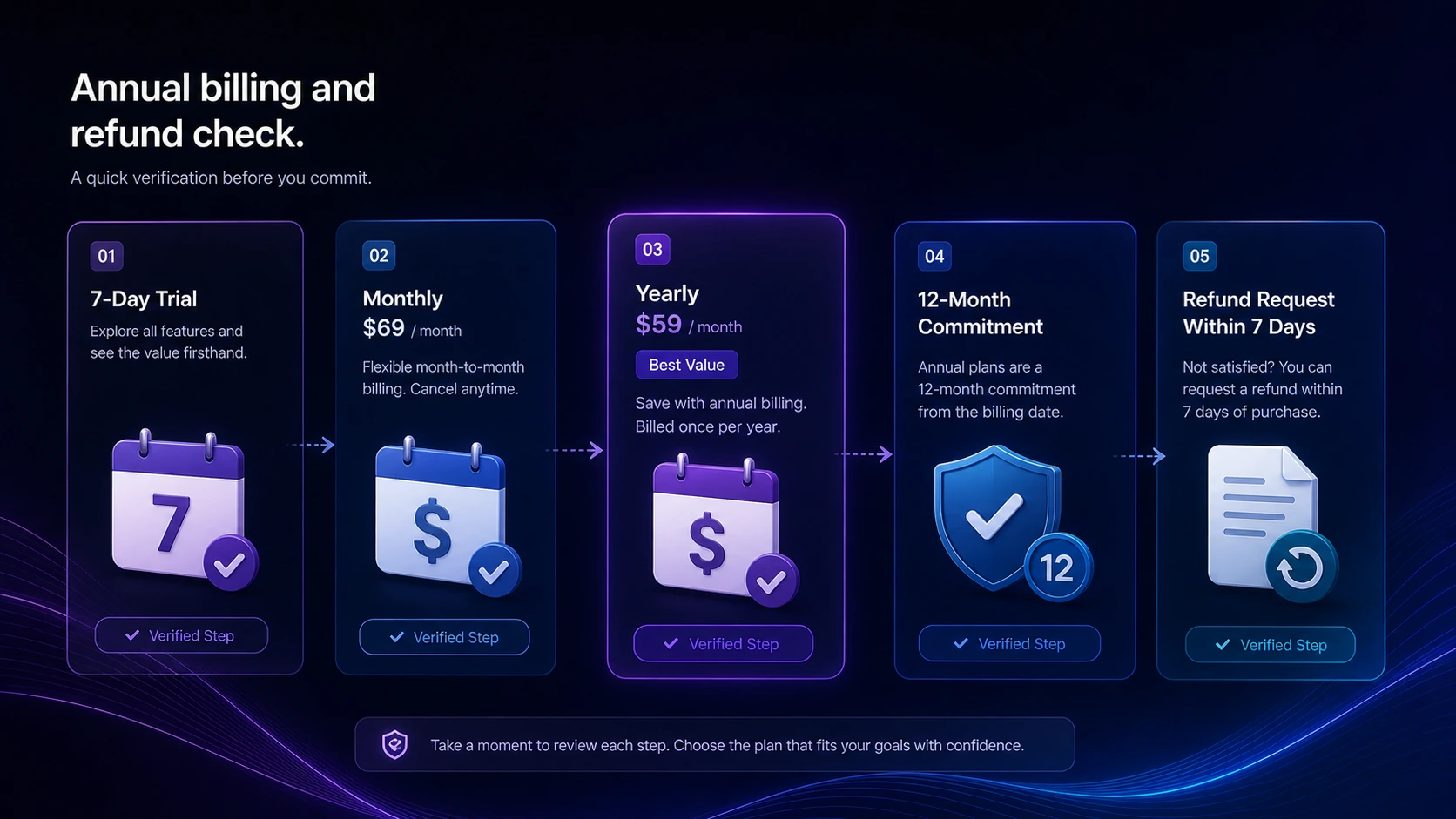
The current public pricing page lists Pro at $69 per month per seat when billed monthly, or $59 per month per seat when billed yearly. Business uses custom pricing. Jasper also presents a 7-day Pro trial as the main way to test the product before committing.
That gives buyers a clean starting point, but not an automatic answer.
The Pro plan is the practical first test for most teams. It is visible, it has a trial path, and it includes the core marketing workspace features most buyers want to evaluate first. The right question is whether Pro improves the work you already do: campaign drafts, brand-consistent content, audience-specific assets, and collaboration.
Annual billing is different. The lower monthly equivalent can make sense after Jasper proves value, but it also creates a 12-month commitment. I would not choose annual billing as the first serious experiment unless the trial has already shown that Jasper belongs in your weekly workflow.
Business should be treated as a separate buying decision. It is not just a more expensive version of Pro. It is the route for custom pricing, more advanced marketing agents, API access, stronger controls, support, training, and enterprise-style rollout. If those are not real requirements, Business may be unnecessary. If those are required, Pro may be the wrong place to stop.

Pricing check: Confirm current pricing, trial timing, and Business requirements before treating Jasper as a long-term marketing platform.
Free plan, trial, coupon, and checkout notes
Jasper’s buyer path starts with the 7-day Pro trial, not a permanent full-featured free plan.
That is a meaningful distinction. A trial is useful for testing fit, but it also creates a short decision window. If you start the trial with no plan, the week can disappear before you learn anything important. The better approach is to prepare one real campaign, one brand voice test, and one everyday writing surface test before signing up.
The coupon question should come later. Jasper may have proof-based discounts for eligible students, teachers, military members, veterans, and nonprofits, but public coupon-code claims should be treated as uncertain until checkout. Discounts also should not be stacked unless Jasper’s current policy allows it.
Refund timing matters. Jasper’s help center says refunds are not automatic and must be requested within the policy window after a charge. That means buyers should not assume cancellation and refund are the same thing. Canceling may stop future billing, but refund eligibility still depends on the current policy and request timing.
The safest checkout order is this:
- Confirm that Jasper fits a real marketing workflow.
- Use the Pro trial with a prepared test.
- Decide whether monthly billing is enough while usage is still uncertain.
- Move to annual only after Jasper proves repeat value.
- Consider Business only when API access, governance, support, training, or team rollout justify it.
- Check the coupon page only after the product fit is already clear.
Deal path: Treat active offers as a checkout check, not as the reason to choose Jasper.
What I would check before buying Jasper
If I were buying Jasper for a real marketing workflow, I would check seven things before paying.
First, I would test Brand Voice with real source material. A brand system only matters if the output actually sounds closer to the company, not just cleaner or more polished.
Second, I would run one full campaign workflow during the trial. That means multiple assets, not a single blog intro. Jasper is a better buy when it helps across connected marketing work.
Third, I would compare monthly billing against annual billing after the trial, not before. The annual savings are useful only if the product already earns its place.
Fourth, I would verify whether the team needs Business. More seats, API access, governance, support, training, and advanced agents can change the decision quickly.
Fifth, I would test the browser extension in the team’s actual writing surfaces. If writers live in unsupported browsers or sensitive systems, extension value may be lower than expected.
Sixth, I would read the refund and cancellation process before the first charge or renewal. The practical risk is missing the request window because you assumed cancellation was enough.
Seventh, I would compare Jasper with at least two nearby tools. If the buyer does not need Jasper’s marketing-specific structure, a cheaper or broader alternative may be easier to justify.

A simple test before paying
Before paying for Jasper, I would run a focused trial test instead of playing with random writing requests.
Use this process:
- Pick one real campaign your team already needs to produce.
- Prepare brand voice material, audience notes, offer details, and channel requirements.
- Create three to five assets, such as an email, paid ad, landing-page section, and social post.
- Compare the first drafts against your normal process: quality, editing time, consistency, and speed.
- Ask one reviewer to mark what still needs human judgment or rewrite work.
- Test the browser extension in one real writing surface if that matters to your workflow.
- Decide whether Jasper saved enough time to justify monthly billing before considering annual or Business.
The mistake buyers make is testing AI tools with throwaway requests. That makes almost any product look interesting. Jasper should be judged on whether it improves the work you actually repeat.
Pros explained
Jasper is built around marketing, not generic writing
This is the biggest pro. Jasper has a clearer position than many AI writing tools because it focuses on marketing workflows, brand voice, campaign assets, and team use. That makes the product easier to understand for the right buyer.
It stops being enough if the buyer does not need a marketing workspace. A solo user who only wants text generation may not get enough extra value from the structure.
Brand Voice can reduce repeated editing
Brand Voice is useful when multiple people create content for the same company or client. It can reduce the amount of re-explaining required before every draft.
It stops being enough if the team does not maintain the brand inputs or still needs heavy rewriting on every asset.
The 7-day trial gives buyers a safer test path
A short trial is better than forcing buyers straight into paid usage. It gives teams a chance to test Jasper before monthly or annual billing.
It stops being enough if the buyer starts the trial without a clear test plan. Seven days is not long if the team is unprepared.
Business creates a serious rollout path
For larger teams, Jasper’s Business path gives a more credible route for API access, governance, training, support, and enterprise-style controls.
It stops being enough if the quote mainly adds cost without solving a real rollout problem.
Cons explained
Jasper can be expensive for casual users
The Pro price is easier to justify for marketing teams than for hobby users. If you only need occasional AI drafting, cheaper tools may be enough.
Who should care most: solo bloggers, freelancers with light usage, and small businesses without repeated campaign workflows.
Annual billing raises the commitment risk
The annual path lowers the monthly equivalent, but it also turns a flexible test into a longer commitment. That can be fine after proof of value. It is riskier before the team knows whether Jasper will be used every week.
How to avoid the issue: start with the trial, then monthly if you are still unsure.
Business requirements can change the real cost
API access, additional control, custom agents, governance, and support can push buyers into Business. That may be the correct path, but it means the Pro price does not tell the whole story for larger teams.
How to verify: list your Business requirements before the sales call, especially API access, security, support, and rollout needs.
Output still needs human review
Jasper can help produce marketing drafts, but it cannot replace strategy, legal review, fact-checking, or final editorial judgment. This matters for campaigns where claims, offers, and positioning need to be exact.
How to avoid the issue: treat Jasper as a production assistant, not the final publisher.
Green flags and red flags
Green flags
Jasper is a stronger fit when your team has repeated marketing workflows and the trial proves real time savings.
It is also a good sign if Brand Voice reduces editing friction across multiple writers or campaigns. That is one of the clearest reasons to choose Jasper over a more generic AI assistant.
Another green flag is a genuine Business requirement. If your organization needs API access, governance, support, security, or rollout help, Jasper’s Business path is more relevant than a simple writing subscription.
Red flags
A red flag is buying Jasper only because the homepage looks polished. The product is serious enough that workflow fit should come before excitement.
Another red flag is choosing annual billing before proving usage. Annual savings are useful only if the team will actually use Jasper throughout the year.
A third red flag is expecting Jasper to remove human editing. Marketing AI can speed up draft production, but your team still owns claims, tone, offer accuracy, audience fit, and final approval.
The last red flag is treating public coupon claims as the main decision. A discount can lower cost, but it cannot fix weak workflow fit.
Jasper vs alternatives
Jasper’s direct alternatives are other AI writing and marketing workflow tools. General AI chatbots and design platforms can be adjacent routes, but they are not always one-to-one replacements.
Writesonic vs Jasper
Writesonic is a better comparison if you want broader AI writing, chatbot, and SEO-adjacent workflows with a different pricing feel. It may appeal to buyers who want more writing flexibility without committing to Jasper’s heavier marketing-platform positioning.
Jasper may still make more sense if brand voice, campaign consistency, and team marketing workflows are the central job. The tradeoff is price and structure: Jasper asks you to buy into a more specific marketing system.
Copy.ai vs Jasper
Copy.ai is a closer comparison for go-to-market and campaign workflows. Buyers who care about sales content, outbound workflows, and GTM automation should compare it carefully with Jasper instead of assuming every AI writing tool is the same.
Jasper may be stronger if your team cares more about brand voice and marketing-wide content consistency. Copy.ai may be more relevant if the workflow leans toward GTM motion and automation.
GravityWrite vs Jasper
GravityWrite may fit buyers who want a lighter AI writing workflow before paying for a more expensive marketing workspace. It can be a sensible comparison for smaller buyers who do not need Business controls, API access, or a deep campaign system.
Jasper may still be better for teams that need a more structured brand and campaign environment. The tradeoff is whether the added structure creates enough value to justify the higher commitment.
General AI assistants as adjacent routes
ChatGPT, Claude, Gemini, and similar tools are adjacent routes for buyers who need broad AI help rather than a marketing-specific workspace. They can be cheaper or more versatile for research, ideation, analysis, technical writing, or general drafting.
They are not direct replacements if the buyer specifically needs Jasper’s brand voice, shared marketing context, campaign workflow, and Business controls. The comparison should start with the job, not the logo.

For a broader route through this category, you can also start from the AI writing hub or compare nearby store guides such as Writesonic, Copy.ai, and GravityWrite.
Trust, refund, and buyer-risk notes
Jasper has enough public information to understand the product role, but buyers should still be careful around billing, refund timing, Business requirements, and long-term value.
My confidence is strongest around Jasper’s category fit: it is clearly a marketing AI workspace with brand, campaign, and team positioning. I am more cautious around checkout timing, discount claims, and Business-plan economics because those can change faster than editorial copy.
The refund point deserves attention. Jasper’s refund policy says refund requests are not automatic and must be made within the policy window. That means buyers should not wait until later to understand how cancellation and refund requests work.
Data and security also matter for teams. Jasper publishes privacy, security, and legal information, but buyers working with sensitive brand, client, or regulated content should review those pages before uploading internal materials or planning a rollout.
The Business path should be treated as a real procurement step. If API access, governance, support, and security are central, ask direct questions before committing. If they are not central, do not let enterprise features distract from the simpler Pro-plan question: does this tool improve your actual marketing workflow?
Final verdict

I would consider Jasper if your team needs a marketing AI workspace for brand voice, campaign production, collaboration, and repeatable content workflows.
I would not choose it just because you want an AI tool that writes text. That is a much broader and cheaper problem now. Jasper is easier to justify when the workflow is specific: multiple marketing assets, consistent brand voice, team review, campaign structure, and enough usage to make the subscription earn its place.
I would skip Jasper if you are a casual writer, a hobby blogger, or a buyer who mainly wants the lowest-cost AI drafting path. I would also slow down if annual billing looks tempting before the trial has proved weekly value.
I would compare it with Writesonic if you want broader writing and SEO-adjacent flexibility, Copy.ai if your work leans toward go-to-market workflows, and GravityWrite if you want a lighter writing assistant before paying for a structured marketing platform.
The safest next step is to test Jasper with one real campaign, not a few sample requests. If it reduces editing, keeps content closer to your brand, and fits the way your team already works, it deserves a closer look. If the trial mostly produces drafts your team still has to rebuild, the cheaper or more flexible alternative may be the smarter buy.