Quick verdict
GrumpyHare is worth a serious look if you are building a real estate lead-generation website, not just shopping for ordinary web hosting.
That distinction matters more than the pricing table.
On the surface, GrumpyHare can look like another hosted website builder with templates and a monthly subscription. The more useful way to judge it is narrower: does your real estate business need a packaged website system with motivated seller or agent-style templates, lead capture, lead management, education, and SEO-oriented tools in one place?
If the answer is yes, GrumpyHare can make sense. It is built for real estate investors, agents, and brokers who would rather start from a niche website stack than assemble hosting, a theme, forms, CRM routing, SEO tools, and training from scratch.
If the answer is no, the subscription may be too specialized. A buyer who only needs a basic WordPress site may be better served by a DIY route such as hosting plus a theme. A buyer who wants an agency-level custom brand site may need a different type of provider. A buyer who expects a website platform to create leads without offer, traffic, follow-up, or local SEO work should slow down.
The main pricing caution is simple: the lowest monthly-equivalent price is tied to annual billing. I would not treat that as the same thing as a low-risk month-to-month test. GrumpyHare does publish a 30-day guarantee structure, but annual billing still deserves extra care.
Next step: If GrumpyHare still fits your real estate lead-generation workflow, verify the current plan, billing interval, and checkout route before committing.
Review snapshot
| Review point | Practical take |
|---|---|
| Best for | Real estate investors, agents, and brokers building lead-generation websites |
| Not ideal for | General business sites, pure hosting buyers, or DIY users who want full plugin-level control |
| Main use case | Motivated seller, buyer, local authority, or real estate conversion websites |
| Starting price | Public pricing shows the Awesome plan from a lower annual monthly equivalent, with month-to-month pricing higher |
| Free plan or trial | No clear free plan or free trial verified; use the refund window carefully if buying |
| Main strength | Real estate-specific templates, lead manager, education, and SEO-oriented plan depth |
| Main concern | Annual billing, plan fit, refund timing, and whether the buyer will actually work the lead-generation system |
| Direct alternatives to compare | Carrot-style real estate website platforms, REsimpli-style real estate systems, real estate site builders |
| Adjacent DealBestDaily routes | Cloudways for hosting, GeneratePress for theme control, Podpage as a niche builder contrast |
| Safest next step | Start with workflow fit first, pricing second, coupon path last |
What is GrumpyHare?
GrumpyHare is a real estate website and lead-generation platform for investors, agents, and brokers. It is not best judged as plain hosting.
The product’s public positioning is built around customizable, high-conversion real estate websites, motivated seller lead generation, lead engagement, SEO tools, lead management, and training. In practical terms, the buyer is paying for a bundled real estate website system: templates, hosted site infrastructure, lead capture, a lead manager, builder workflow, community and education, and plan-based marketing or SEO features.
That makes the buying decision different from choosing a generic host.
With Cloudways, SiteGround, or another hosting provider, you are buying the place where your site runs. With GrumpyHare, you are buying a niche workflow for a specific business model. The tradeoff is that the platform may save setup time and reduce stack complexity, but it also narrows the buyer fit.
Our review approach compares public product pages, pricing details, terms, buyer workflow fit, and nearby alternatives. I would not treat a lower annual monthly equivalent, a template gallery, or a coupon route as proof that GrumpyHare fits. The better question is whether your real estate marketing workflow needs this kind of packaged system.
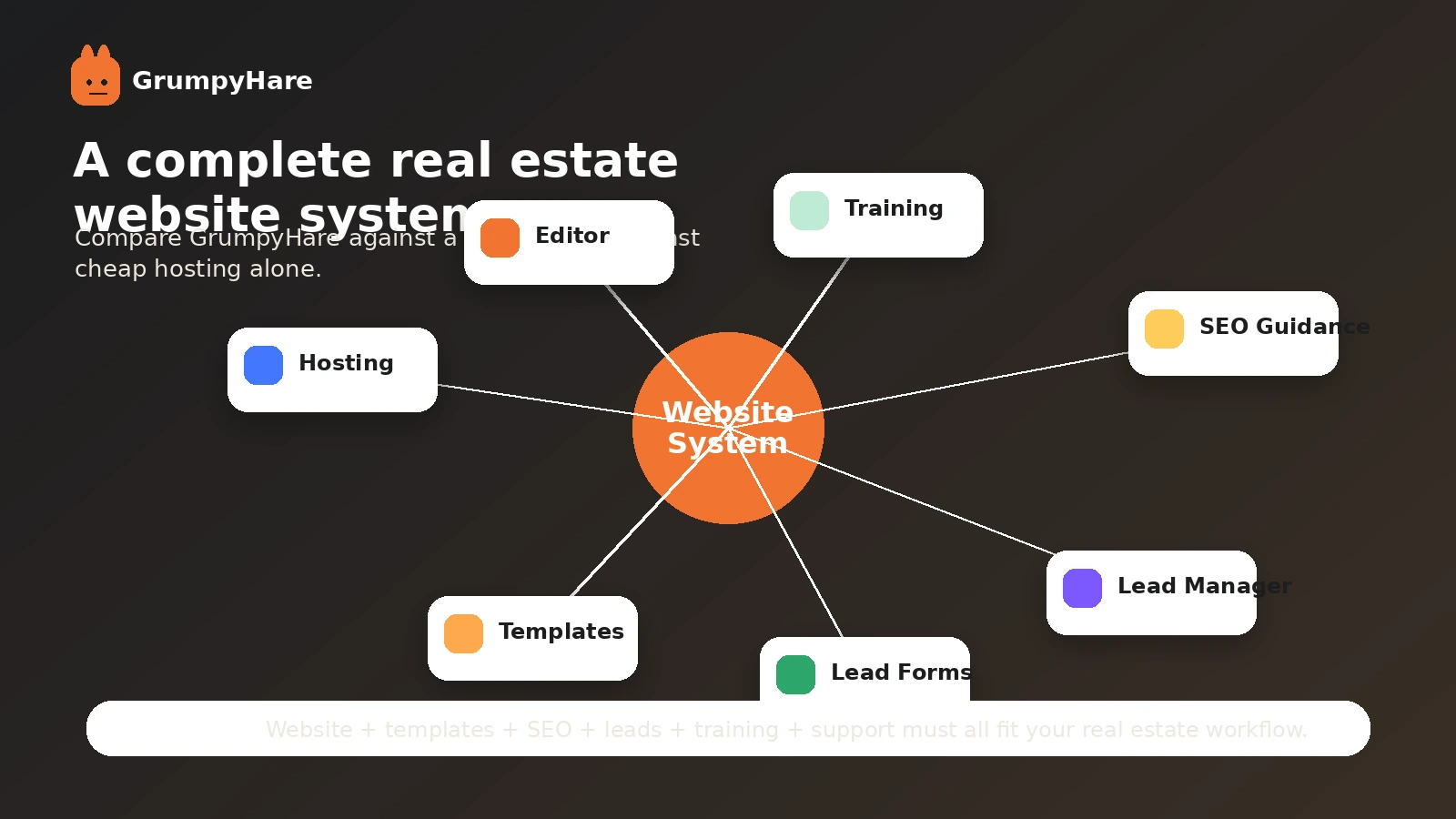
The common mistake is comparing GrumpyHare only against cheap hosting. That misses the point. The better comparison is against a complete real estate website setup: hosting, theme, forms, CRM, local pages, conversion copy, SEO work, reporting, and training.
Who should use GrumpyHare?
GrumpyHare fits buyers who have a real real estate lead-generation use case.
The first group is motivated seller investors. If your business needs landing pages, local authority pages, lead capture, and a website that is built around seller conversion rather than generic branding, GrumpyHare is a more natural fit than a blank WordPress install. The condition is that you still need traffic and follow-up. A template cannot create a seller pipeline by itself.
The second group is agents or brokers who want a real estate-specific site without assembling every piece. If you value a guided builder, templates, education, and lead-management workflow, GrumpyHare can reduce the blank-page problem. The thing to verify is whether the available designs, copy structure, and lead forms fit your market.
The third group is buyers comparing Carrot-style platforms. If you are already shopping for real estate investor websites, GrumpyHare belongs in the comparison set. The decision should come down to template quality, editing comfort, SEO support, training, lead handling, pricing, and refund terms.
The fourth group is local SEO-focused operators. Higher plans become more interesting when the buyer intends to publish, track rankings, work on local pages, and improve the website over time. If SEO is only a vague hope, paying more for SEO-oriented tools may not be enough.
Who should avoid GrumpyHare?
I would avoid GrumpyHare if you only need normal hosting.
A business owner outside real estate may be paying for a niche system that does not match the business. A generic WordPress stack, a standard website builder, or a simple landing page tool may be cleaner.
I would also be careful if you want full technical control. GrumpyHare is meant to package the website workflow. That can be helpful, but DIY WordPress users who want to choose every plugin, theme, integration, hosting setting, analytics setup, and technical detail may feel boxed in.
Buyers who need a free trial before spending money should slow down. The public data supports a 30-day refund structure, not a traditional free plan. That means the first month needs to be used like a real evaluation window.
I would also avoid annual billing if you have not previewed the builder, studied the plan differences, and mapped the site into your lead-generation process. The annual discount may be attractive, but a discount is not helpful if the platform is wrong for your business.
Finally, teams with a mature CRM, custom website, agency workflow, or paid acquisition system should be careful. GrumpyHare may still fit, but only if it improves the existing workflow rather than duplicating tools you already have.
How GrumpyHare fits into a real workflow
A useful GrumpyHare workflow does not start with choosing the prettiest template. It starts with the lead path.
Before opening the builder, the buyer should know the target visitor: motivated seller, homebuyer, listing lead, local investor audience, or broker brand visitor. Then the buyer can choose a template that matches the offer, not just the look.
A realistic workflow looks like this:
- Define the lead objective and local market.
- Choose a template that matches that objective.
- Customize the copy, images, service area, offer, and contact path.
- Connect forms and lead handling to a follow-up process.
- Use the lead manager or connect your existing intake workflow.
- Publish local pages or content if SEO is part of the strategy.
- Track whether visitors are turning into qualified leads.
- Adjust pages, offers, and follow-up based on the results.
This is where GrumpyHare has a believable role. It can reduce setup friction for real estate operators who do not want to engineer the entire stack. But it still needs buyer effort. A conversion-driven website is not the same as a conversion-producing business.
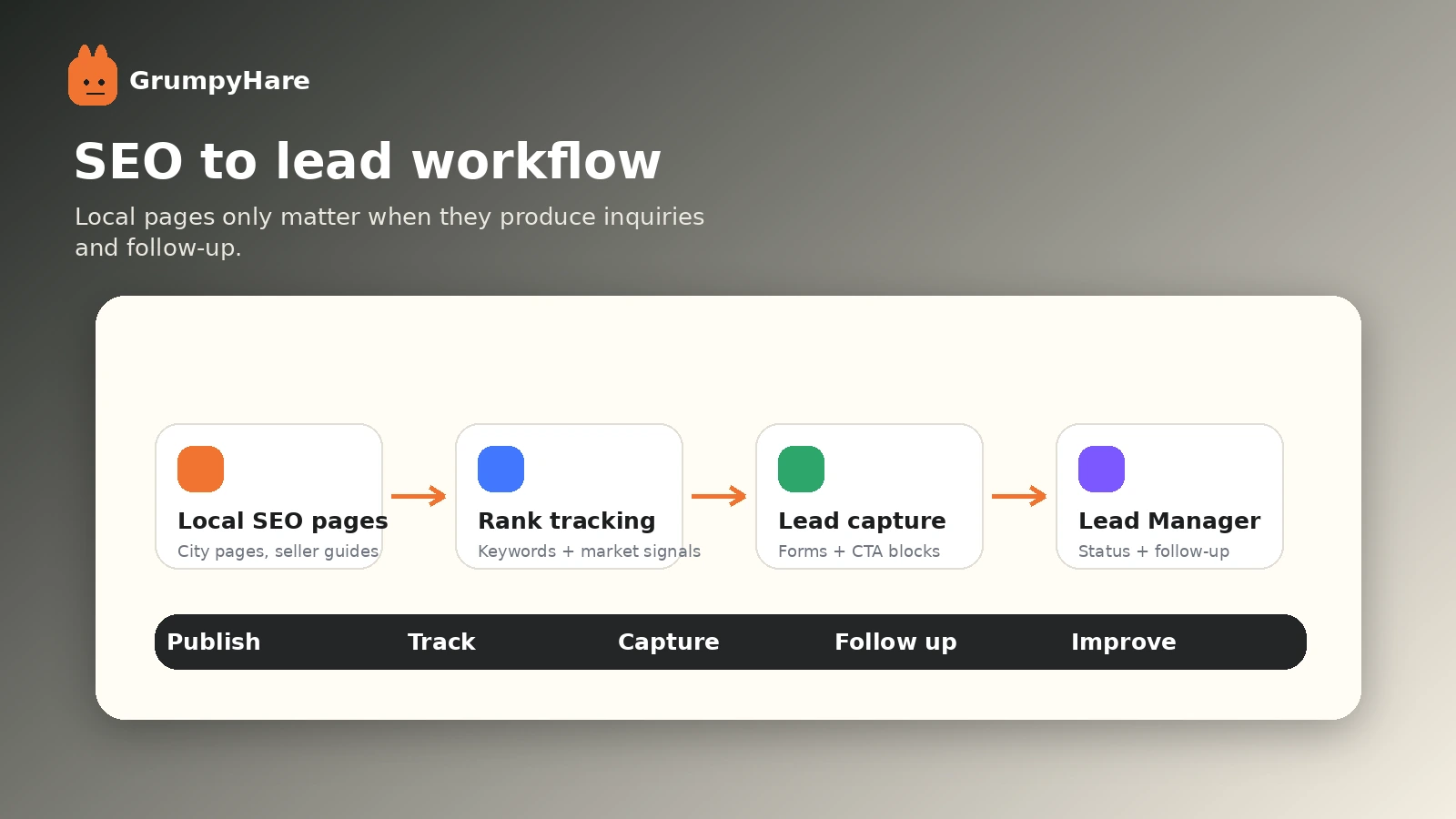
Workflow check: If the builder, templates, and lead path match your real estate process, review the current plan details before choosing monthly or annual billing.
Real-world buyer scenarios
A motivated seller investor is probably the cleanest GrumpyHare use case. This buyer needs credibility, local pages, conversion copy, forms, and a way to manage inbound leads. GrumpyHare may fit if the investor wants a niche platform instead of building WordPress from scratch. It may fail if the investor has no traffic plan, no follow-up process, or no intention of improving pages after launch.
A newer real estate agent may use GrumpyHare to avoid starting from a generic website builder. The appeal is the real estate context and template starting point. The risk is paying for a lead-generation platform before knowing whether the agent’s business needs seller pages, buyer pages, SEO work, or a simpler brand site.
A broker or small team may find the platform useful if it standardizes website setup and lead capture. The buyer check is whether GrumpyHare supports the team’s existing CRM and follow-up process well enough. If the team already has a mature site and CRM, GrumpyHare needs to replace friction, not add another tool.
A DIY WordPress user may be better off elsewhere. If you enjoy choosing hosting, themes, plugins, form tools, analytics, SEO plugins, CRM integrations, and custom designs, a packaged real estate platform may feel less flexible than the setup you can build yourself.
Key features that actually matter
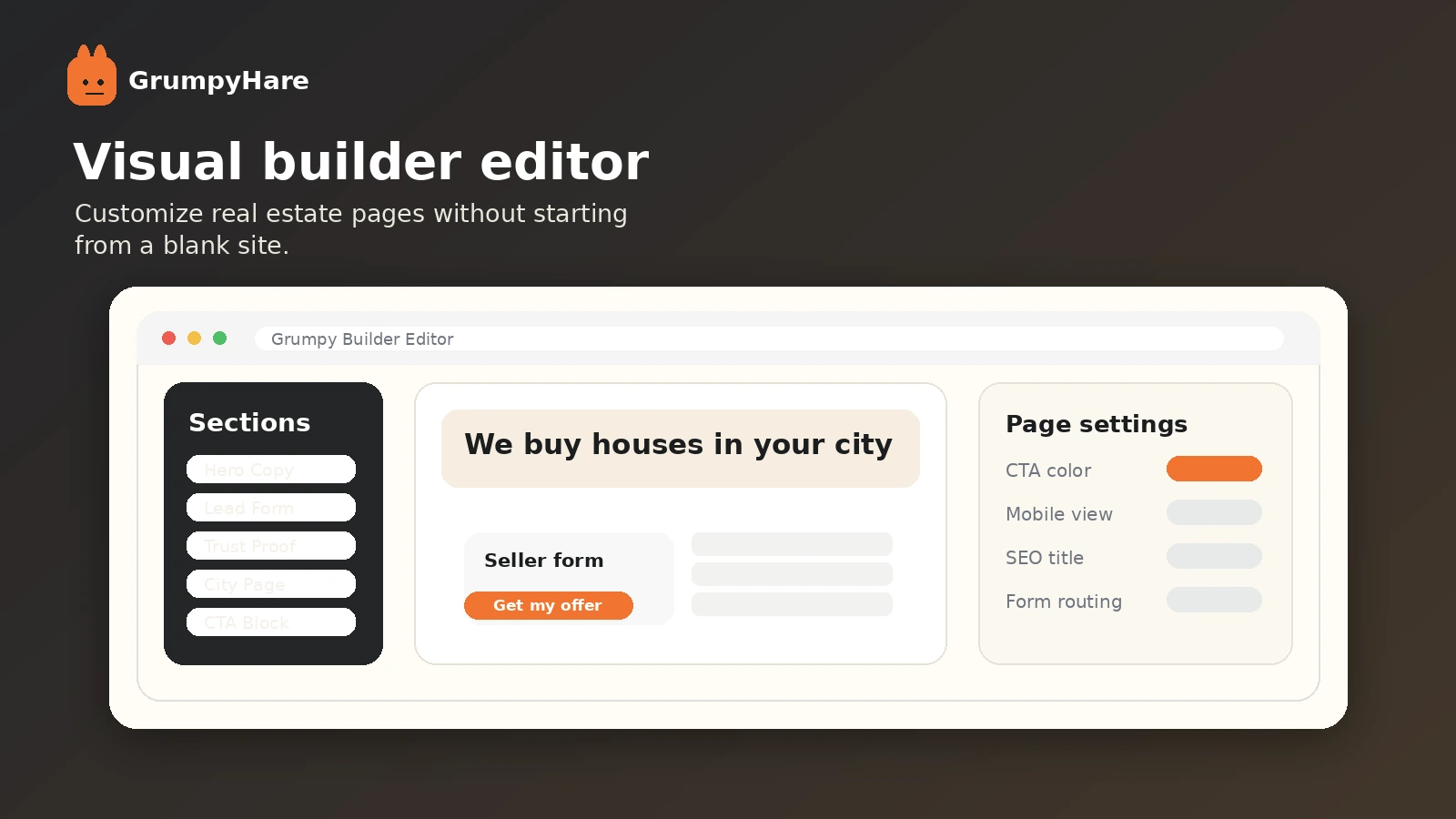
Real estate-specific website templates
Templates are the most visible part of the product, but the buyer should judge them by conversion fit, not just design. A good template should support the specific lead objective: seller inquiry, buyer interest, investor credibility, local market authority, or broker positioning.
Buyer note: preview templates as if you were a real lead. If the page structure does not match your offer, even a polished design may not help.
Lead manager and lead capture workflow
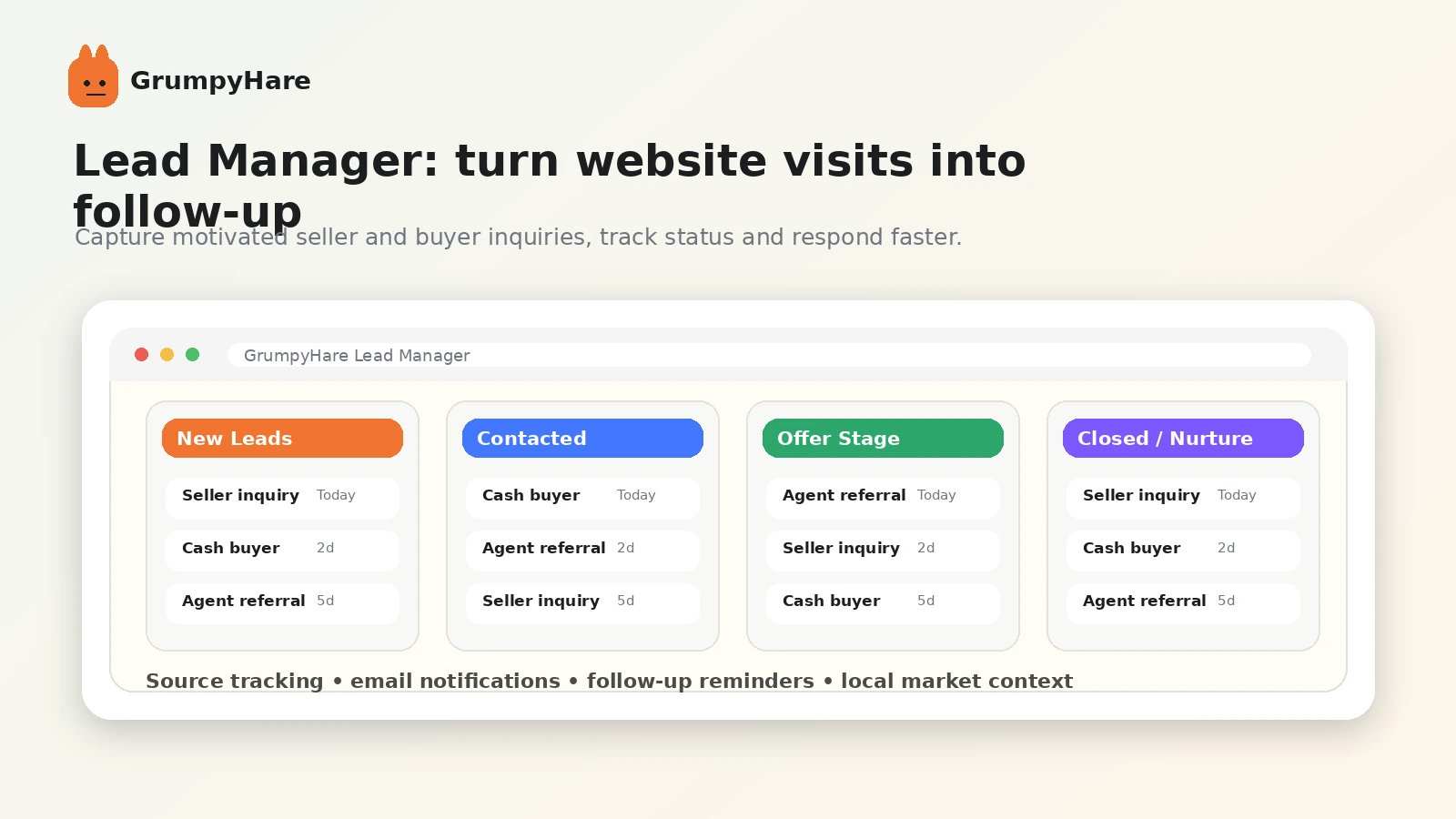
The lead manager matters because a real estate website is not only a design asset. It needs to capture and organize inquiries. GrumpyHare becomes more useful when the website connects naturally to follow-up.
Buyer note: confirm whether the lead manager replaces part of your workflow or only supports it. If you already use a CRM, check how the handoff works before relying on the platform.
Builder and customization workflow
The builder can be a strength if you want to adjust pages without hiring a developer every time. It can also become a weakness if you expect the site to be fully done without your input.
Buyer note: watch the builder education before checkout. If the editing process feels too hands-on, an agency or done-for-you route may be safer.
SEO and marketing features
Higher-tier SEO and marketing tools are only valuable when the buyer will actually use them. Ranking tools, local pages, audits, and content guidance can support a local real estate strategy, but they do not replace publishing, market knowledge, or follow-up.
Buyer note: do not pay more for SEO features unless SEO is a real part of your acquisition plan.
Community and education
Education is often underrated in a niche platform. A buyer who knows what to build may need fewer tutorials. A newer investor or agent may benefit from guidance that reduces confusion.
Buyer note: education has value only when it helps you launch, improve, and maintain the site. Do not treat it as a substitute for doing the business work.
Pricing and plan value
GrumpyHare’s public pricing shows an entry Awesome plan with a lower monthly equivalent when billed annually and a higher month-to-month path. The modern-classic pricing page also shows the annual path as “Get 2 Months Free,” with the Awesome plan listed at $56/month equivalent when billed annually at $670/year, and the month-to-month Awesome plan listed at $67/month.
That is clear enough to evaluate, but still worth reading carefully.
The mistake buyers can make here is comparing the annual monthly equivalent as if it were the same risk as a monthly plan. It is not. Annual billing can make sense when you already know the platform fits your workflow. Monthly billing is safer when you are still testing the builder, templates, lead manager, and plan depth.
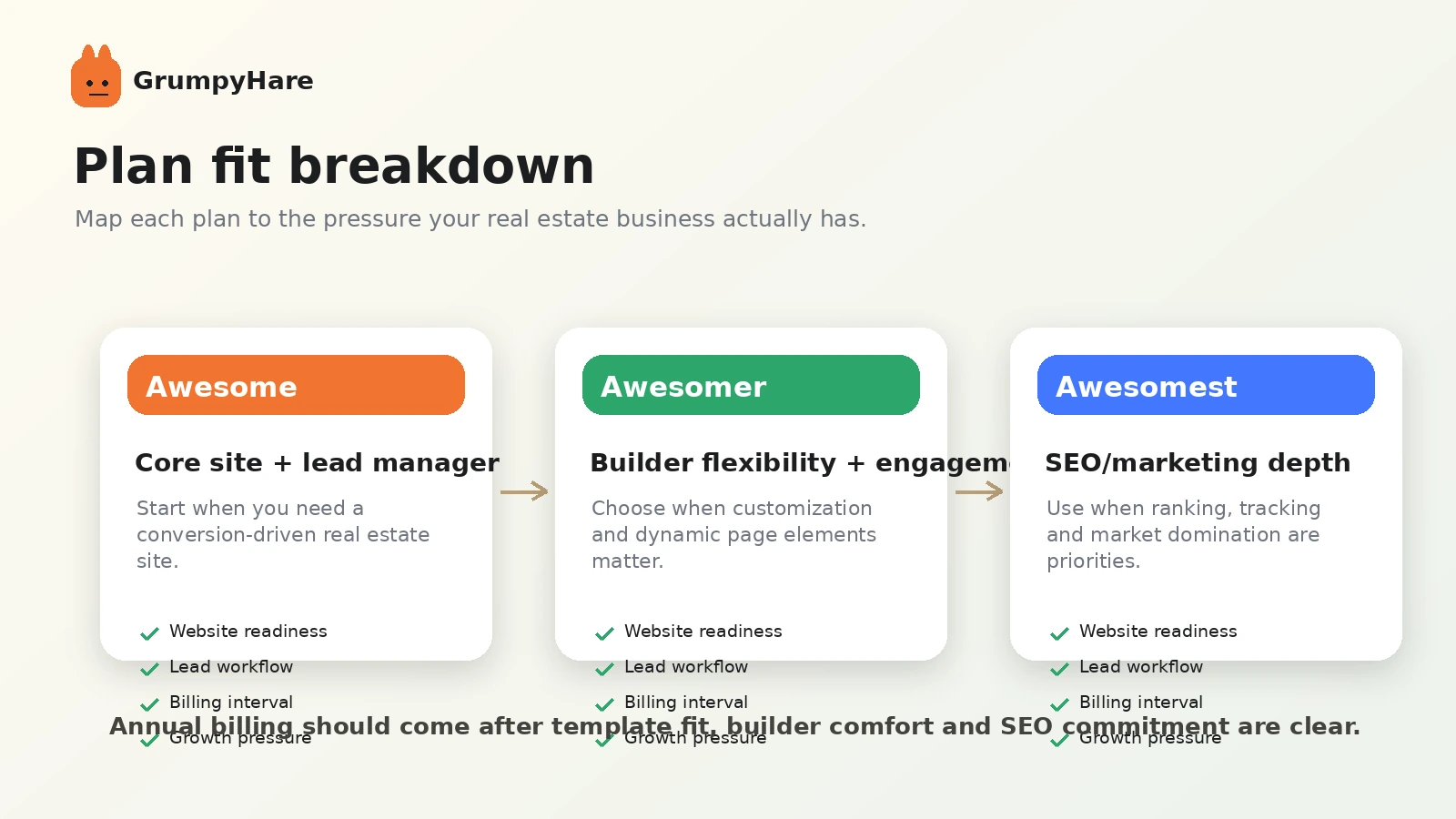
The entry plan is the cleaner starting point for a buyer who needs one conversion-driven real estate website, lead manager access, premium designs, and education. A higher plan becomes more logical when you know you need drag-and-drop flexibility, AudioNibbles, SEO tools, marketing essentials, or deeper plan features.
For my money, the plan choice should not start with the plan name. It should start with the job:
- Do you need one focused real estate website?
- Do you need more design flexibility?
- Do you need SEO and ranking tools?
- Will you actually maintain and improve the site?
- Is annual billing safe enough after the first month?
If the answer is uncertain, do not rush annual billing just because the monthly equivalent is lower.
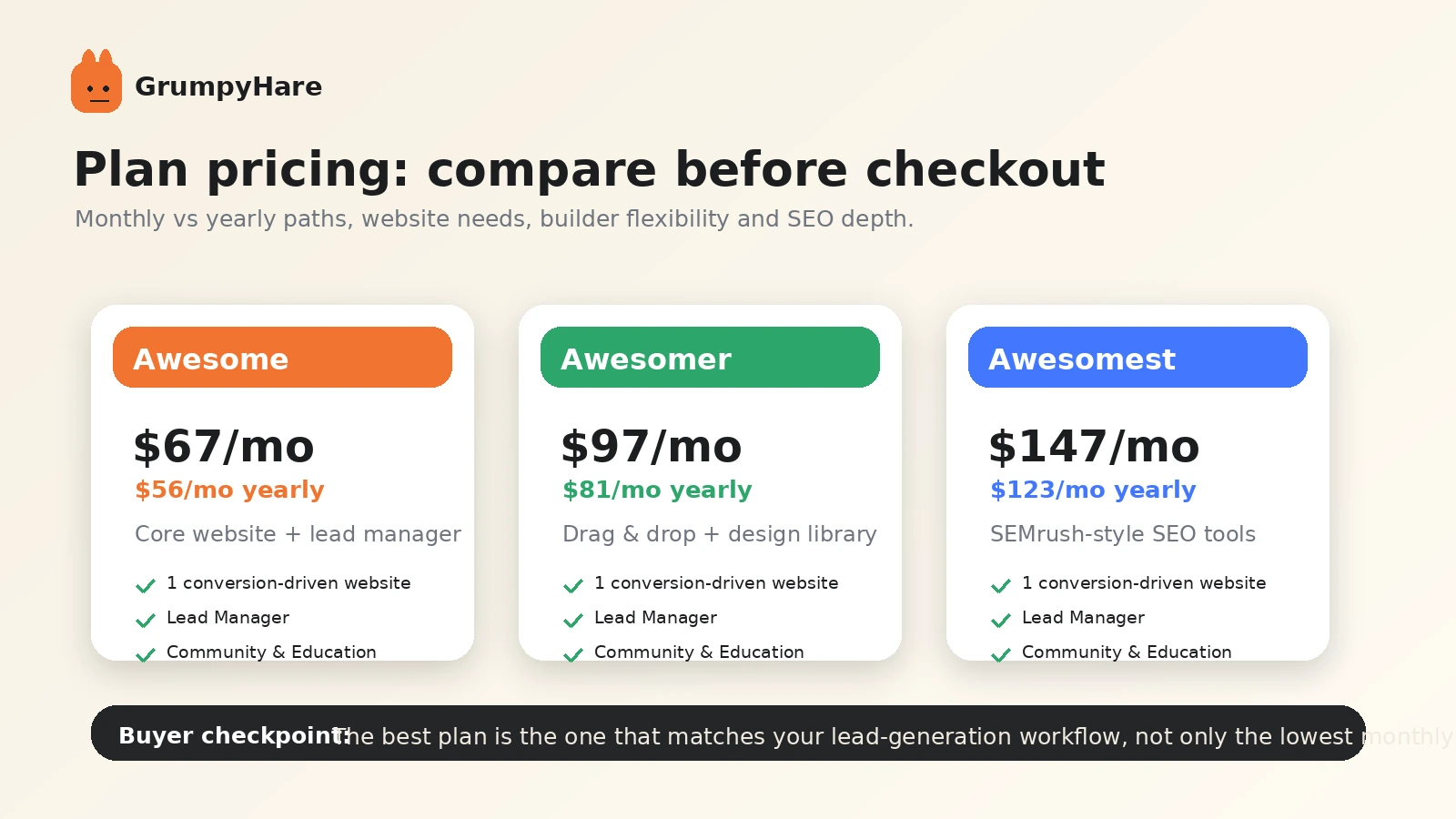
Pricing check: Before paying, compare the current monthly and annual plan totals, then choose the plan based on real estate workflow fit rather than the lowest displayed equivalent price.
Check GrumpyHare pricing Check current offers Read store guide
Free plan, trial, coupon, and checkout notes
I did not find a clearly verified free plan or traditional free trial path for GrumpyHare. The safer way to frame the evaluation is the 30-day guarantee described in the terms.
That is not the same as a no-risk free trial. It means the buyer should use the first 30 days deliberately. Choose a template, test the editor, map a lead flow, publish or preview a real page, inspect the lead manager, and decide whether the platform fits before the evaluation window is gone.
The coupon angle also needs restraint. A reliable public coupon code was not the strongest verified savings path in the store data. The clearer savings path is annual billing, which lowers the monthly equivalent. But annual billing should come after product fit, not before it.
The checkout order I would use is:
- Confirm GrumpyHare is the right type of product.
- Compare monthly and annual pricing.
- Check the current plan features.
- Read the refund and cancellation terms.
- Check the GrumpyHare coupon page only after workflow fit is clear.
A discount can improve a good purchase. It should not create the buying reason.
What I would check before buying GrumpyHare
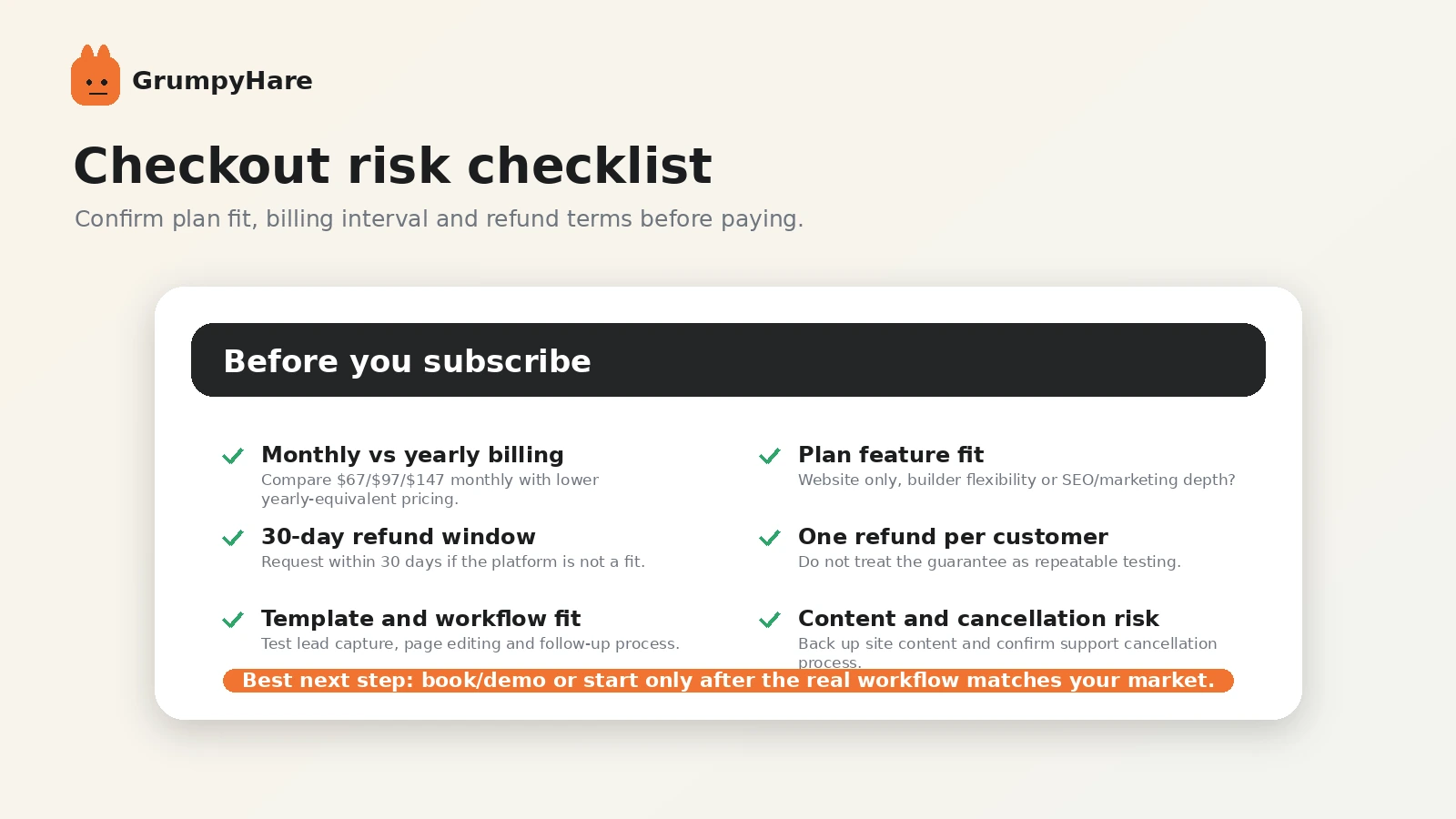
If I were buying GrumpyHare for a real real estate workflow, I would check seven things before paying.
First, I would confirm the billing interval. The lower monthly-equivalent price is tied to annual billing, while the month-to-month entry price is different.
Second, I would compare plan features by job, not by plan name. If the entry plan supports the actual website you need, paying more for extra features too early may not help.
Third, I would preview the template library against my market. A motivated seller site, agent brand site, and broker lead site do not need the same page structure.
Fourth, I would watch a builder tutorial before checkout. The platform may be simpler than assembling WordPress yourself, but it still requires hands-on work.
Fifth, I would verify the refund terms, especially annual billing and the one-refund limitation.
Sixth, I would decide whether the lead manager replaces anything in my existing follow-up process. If it does not, I would check whether it creates duplicate work.
Seventh, I would compare the platform against direct real estate website systems and a DIY WordPress stack before committing annually.
A simple test before paying
Before paying for a longer commitment, I would run a small evaluation like this:
- Pick one real lead objective, such as motivated seller leads or local buyer inquiries.
- Choose the template that most closely matches that objective.
- Map the lead capture path from visitor to form to follow-up.
- Edit enough page copy to judge whether the builder feels manageable.
- Check whether the lead manager fits your current sales process.
- Review the SEO or marketing tools only if you will actually use them.
- Decide whether monthly or annual billing makes sense after the workflow feels real.
This test does not require believing every marketing claim. It only asks whether the platform helps you build and manage the kind of real estate website you actually need.
Pros explained
The first major pro is focus. GrumpyHare is built for real estate website buyers, not everyone. That makes it more relevant for investors and agents who want motivated seller or real estate lead-generation templates. The same focus becomes less useful outside real estate.
The second pro is stack simplification. Instead of buying hosting, choosing a theme, adding forms, finding SEO tools, building pages, and figuring out lead handling separately, GrumpyHare packages much of that into one system. This matters for buyers who value speed and guidance more than full technical ownership.
The third pro is the plan-based depth. A buyer can start with a core website path and consider higher tiers when design flexibility, AudioNibbles, SEO, or marketing tools matter. That is useful as long as the buyer does not overbuy before knowing the workflow.
The fourth pro is the published refund structure. A 30-day evaluation window is better than a vague refund policy. But it needs to be used properly because annual billing and the one-refund limitation still matter.
Cons explained
The first con is specialization. GrumpyHare is not a general website platform. That is a strength for real estate buyers, but a poor fit for businesses that only need basic hosting or a simple brand site.
The second con is annual billing pressure. The lower monthly-equivalent price can make the annual plan look like the obvious deal. It may be the better deal only after fit is proven.
The third con is no clearly verified free plan or traditional free trial. Buyers who prefer testing before paying may need to rely on the first-month refund structure, which is less flexible than a true free trial.
The fourth con is platform fit. If you want full WordPress plugin control, custom development freedom, or an agency-designed site that looks nothing like a template, GrumpyHare may not be the cleanest path.
The fifth con is that lead generation still requires work. The platform can support templates, lead capture, and SEO workflow, but it cannot create a motivated seller pipeline without traffic, messaging, follow-up, and market execution.
Green flags and red flags
A green flag is when you already know the lead objective. If you can say, “I need a motivated seller site for this market, with this follow-up process,” GrumpyHare is easier to evaluate.
Another green flag is when you want a real estate-specific starting point. Templates, training, and lead tools are more useful when you do not want to assemble the entire stack yourself.
A third green flag is when you are willing to improve the site after launch. SEO, local pages, and conversion work take iteration.
The red flags are just as important.
It is a red flag if you are buying only because the annual equivalent looks cheaper. It is a red flag if you have no traffic plan. It is a red flag if you want a free trial and are not comfortable with a refund-based evaluation window. It is also a red flag if your real need is generic hosting, not a real estate lead-generation system.
GrumpyHare vs alternatives
GrumpyHare should be compared in two layers: direct real estate website alternatives and adjacent DealBestDaily routes.
Carrot-style platforms vs GrumpyHare
Carrot-style real estate website platforms are the most natural direct comparison. They target similar buyers: real estate investors and agents who want a lead-generation website without building the entire stack from scratch.
The tradeoff is product fit. GrumpyHare may appeal to buyers who like its templates, pricing structure, and real estate workflow. A Carrot-style platform may be stronger for buyers who prefer a more established ecosystem, training depth, or a familiar investor website category. The buyer should compare template quality, editing comfort, SEO workflow, lead handling, pricing, and refund terms.
REsimpli-style systems vs GrumpyHare
REsimpli-style real estate systems can be stronger if the buyer wants CRM depth, list management, marketing operations, or broader investor workflow beyond a website. GrumpyHare is easier to understand as a website-first platform.
The tradeoff is scope. If the website is the main gap, GrumpyHare may be cleaner. If the business needs a broader operating system for leads, follow-up, campaigns, and CRM, a more complete real estate platform may be worth comparing.
Generic real estate website builders vs GrumpyHare
Platforms like AgentFire, Placester, Real Geeks, Wix with real estate add-ons, and Sierra Interactive all serve different parts of the real estate website market. Some focus on agent branding, some on IDX, some on teams, and some on affordability.
GrumpyHare is more specific to conversion-focused real estate lead-generation websites. The buyer should compare whether IDX, CRM depth, brand design, SEO, done-for-you services, or investor-specific lead capture matters most.
Cloudways as an adjacent DIY route
Cloudways is not a direct GrumpyHare replacement. It is an adjacent route for buyers who want managed cloud hosting and are comfortable assembling WordPress, theme, forms, SEO plugins, analytics, and CRM tools separately.
Cloudways may be better if you want infrastructure flexibility. GrumpyHare may be better if you want a real estate-specific website workflow.
GeneratePress as an adjacent theme-control route
GeneratePress is also adjacent, not direct. It makes more sense for DIY WordPress users who want theme speed, design control, and plugin freedom.
The tradeoff is labor. GeneratePress plus hosting can be flexible, but you still need to build the lead-generation system yourself.
Podpage as a niche-builder contrast
Podpage is not a real estate alternative. It is useful only as a contrast: niche website builders can be valuable when the niche matches the buyer. Podpage fits podcasters. GrumpyHare fits real estate lead-generation websites.
Trust, refund, and buyer-risk notes
The main trust positive is that GrumpyHare publishes pricing and terms that buyers can inspect before paying. That is better than a sales-only route where every detail requires a call.
The main buyer risk is commitment timing.
The terms describe a 30-day evaluation and refund structure. Annual buyers also have the first 30 days to evaluate and cancel for a refund under the stated terms, but the terms say there are no prorated refunds on annual accounts after that period. They also say each customer is eligible for only one refund under the guarantee.
That does not mean GrumpyHare is unsafe. It means the buyer should treat the first 30 days as a real evaluation window.
I would also check data and lead handling. If the website becomes part of your intake workflow, make sure you understand where leads go, how notifications work, whether the lead manager replaces or supplements your CRM, and whether exports or integrations are enough for your process.
Finally, I would not treat public coupon hunting as the main savings strategy. The cleaner savings path appears to be official annual billing, but annual billing should come after fit is proven. The safer path is monthly first if you are unsure, annual only once the website system makes sense.
Final verdict
I would consider GrumpyHare if you are a real estate investor, agent, or broker who wants a focused website system with templates, lead capture, education, and SEO-oriented plan options.
I would be more cautious if you only need generic hosting, want full DIY plugin control, need a traditional free trial, or are tempted by annual billing before testing the workflow.
The product’s value depends on how clearly it replaces complexity in your real estate marketing stack. If GrumpyHare helps you launch a better seller or agent lead website faster, manage leads more cleanly, and stay focused on local market improvement, it can be a practical buy. If you are only looking for a cheap website or hoping a template alone will produce leads, the fit is weaker.
For my money, the safest decision is monthly evaluation first, annual billing only after the builder, templates, lead workflow, and plan features match the way your real estate business actually gets leads.