Quick verdict
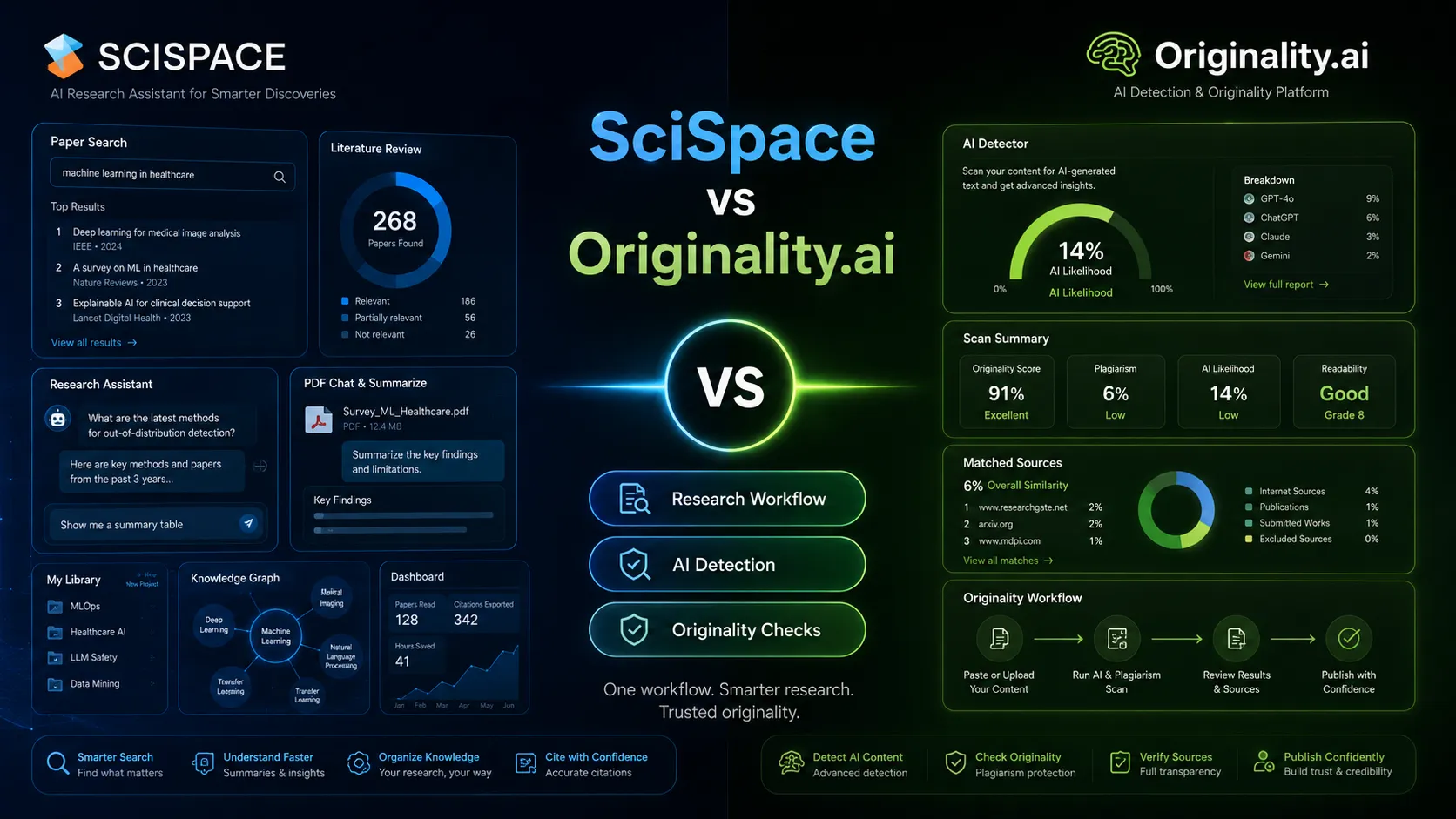
Choose SciSpace if the real job is academic research: finding papers, reading difficult PDFs, asking questions about methods, building literature context, summarizing findings, drafting research-adjacent text, and using an AI assistant before you worry about originality signals. SciSpace has an AI detector path, but the product makes the most sense when the research workflow matters first.
Choose Originality.ai if the real job is content QA: checking AI-assisted drafts, plagiarism risk, readability, grammar, fact support, shareable reports, WordPress content, Google Docs writing history, team review, or API-based scanning. Originality.ai is the cleaner fit when the buyer needs repeatable checking before publishing or submission.
The mistake is treating these as two identical AI detectors. They overlap around AI detection, but they are not solving the same primary problem. SciSpace is closer to an academic research workspace with detector support. Originality.ai is closer to an originality and publishing-quality review system.
Start with SciSpace if you are still inside the research process. Start with Originality.ai if the draft already exists and you need a tighter review layer before the work goes public.
SciSpace vs Originality.ai at a glance
| Decision point | SciSpace | Originality.ai |
|---|
| Best fit | Research reading, paper search, Chat PDF, academic workflow | AI detection, plagiarism, reports, publisher QA |
| Primary buyer | Students, researchers, academic teams, literature-review users | Publishers, SEO teams, agencies, educators, content teams |
| Pricing style | Free entry plus paid research-agent credit tiers | Pay-as-you-go, Pro subscription, Enterprise path |
| Free plan or trial | Free path available; verify current credit limits | No permanent free plan for the main paid workflow |
| Workflow strength | Helps before and during research drafting | Helps after a draft needs review or proof |
| Team fit | Better when teams need shared research support | Better when teams need review, reports, roles, plugins, or API |
| Main risk | Paying for credits without enough repeated research use | Buying credits or subscription volume without scan estimates |
| Best next step | Test the free research workflow on a real paper | Estimate monthly word volume before choosing a plan |
The real difference: research assistant vs originality workflow
SciSpace is useful when the document is not finished yet. You may be trying to understand a dense paper, compare sources, explain a method, summarize a finding, ask questions about a PDF, or create early research notes. In that workflow, AI detection is only one checkpoint. The larger value is that SciSpace can support the academic reading and research process before the final draft exists.
Originality.ai becomes more useful when the document is already moving toward review. You may have a blog post, client draft, student assignment, contributor article, SEO page, or edited AI-assisted draft that needs to be checked for AI signals, plagiarism, readability, and quality concerns. In that workflow, the product is not trying to replace your research process. It is trying to create a repeatable review step.
That difference matters because the buyer risk is different.
With SciSpace, the question is: will you actually use the research workspace often enough to justify paid credits and annual billing? With Originality.ai, the question is: do you scan enough words, pages, writers, or client drafts to justify a credit-based QA system?
Choose SciSpace if research is the bottleneck
SciSpace makes more sense if your pain starts before content QA.
A student may need help understanding a paper. A researcher may need faster literature review support. A thesis writer may want to ask questions about PDFs without jumping between tabs. A research-heavy writer may want source context before drafting. In these cases, a pure detector is too narrow because the problem is not only “Is this text AI-written?” The problem is “Do I understand the research well enough to write responsibly?”
SciSpace is also the better fit if you want one workspace that touches paper search, PDF explanation, academic writing support, AI detection, citation-aware drafting, and research-agent tasks. That does not mean every buyer should pay immediately. It means the free path is the correct first test: upload or open a real paper, ask real questions, compare summaries against your own reading, and check whether it saves time without flattening the nuance.
The caution is pricing and refund tolerance. SciSpace’s paid value depends on repeated use of research-agent credits, not on one or two impressive paper chats. The refund language is also narrow enough that buyers should read it before running paid tasks. If you only need a detector score, SciSpace can feel like too much product for the job.
Start with the /store/scispace/ page if you want the broader buying context, then use /review/scispace-review/ if you need a deeper workflow judgment before checking /coupon/scispace-coupon-code/ as a final savings step.
Choose Originality.ai if content QA is the bottleneck
Originality.ai makes more sense if the draft already exists and the next job is review.
That buyer may be an editor checking contributed articles, an SEO team reviewing outsourced content, a publisher scanning pages before upload, an agency checking client deliverables, or an educator who needs clearer reporting around originality. In these cases, the strength is not just a one-off AI score. It is the broader QA workflow: AI detection, plagiarism checking, shareable reports, scan tagging, team management, Chrome and Google Docs support, WordPress workflow, Moodle path, and API access for more structured operations.
The pricing decision should start with scan volume. A light user who checks one paragraph every few weeks may not need a paid system. A publisher reviewing thousands of words each month should compare pay-as-you-go credits with Pro or Enterprise subscription paths. The current public pricing model explains credits, monthly expiry for subscription credits, and annual billing savings, but buyers should still verify the live plan page before choosing.
The caution is that detector results should not be treated as courtroom proof. They are useful risk signals. They can support editorial review, but they still need human judgment, especially for academic or high-stakes decisions.
Start with /store/originality-ai/ if you want the commercial overview, then read /review/originality-ai-review/ if workflow fit is still unclear before using /coupon/originality-ai-coupon-code/ as a checkout verification step.
Avoid both if you want a shortcut around judgment
Avoid both tools if you want software to make the final ethical, academic, or editorial decision for you.
AI detectors can be useful, but they are not perfect truth machines. A high score should invite review, not panic. A low score should not automatically prove quality or originality. This is especially important for schools, publishers, and teams reviewing sensitive work.
You may also want to avoid both if your real need is a citation manager, a dedicated plagiarism-only institutional platform, a full LMS integrity system, or a writing coach. SciSpace and Originality.ai can sit near those workflows, but they are not always the cleanest replacement.
And if the only buying reason is “there might be a coupon,” pause. Discounts should come after product fit, not before it. The better sequence is workflow first, pricing second, checkout route last.
Pricing and plan fit
SciSpace is easier to start if you want a free research path. The safer first step is to test the actual research workflow before paying: search a real topic, open a real paper, ask real PDF questions, try the writing support, and see whether credits become a recurring need. Public pricing currently presents paid tiers around research-agent usage and annual savings, so the live checkout should be checked for current monthly price, annual commitment, credit allocation, and renewal terms.
Originality.ai is more direct if you already know you need scans. The buyer decision is whether pay-as-you-go credits are enough, whether Pro matches recurring review volume, or whether Enterprise makes sense for larger teams and API-style workflow. Public pricing currently describes one credit as 100 words, Pro monthly credits, and Enterprise volume, but teams should still confirm the live credit rules, billing interval, top-up behavior, and expiry before payment.
Here is the practical split:
| Pricing question | Better fit |
|---|
| “Can I test research help before paying?” | SciSpace |
| “Can I buy credits for detection and QA volume?” | Originality.ai |
| “Do I need annual billing savings?” | Both, but verify live checkout |
| “Do I need a simple free occasional detector?” | Neither may be ideal as the final paid choice |
| “Do I need team or API review workflow?” | Originality.ai is usually the stronger fit |
Workflow fit: where each one belongs
SciSpace belongs near the beginning of the research process. Use it when the task is still exploratory: literature review, paper explanation, PDF questions, source understanding, early synthesis, and research-heavy drafting. The detector layer can help later, but it is not the main reason to choose the product.
Originality.ai belongs closer to the end of the publishing or submission process. Use it when you already have text and need a quality gate. The stronger workflow is editorial review: scan a draft, check AI and plagiarism signals, use reports, organize scans, involve collaborators, and decide whether the draft needs more human revision.
For a student, SciSpace may be more useful on Monday when reading papers and Originality.ai may be more useful on Friday when checking the final draft. For an SEO team, SciSpace may be too academic, while Originality.ai fits the recurring content QA step better. For a research-heavy publisher, both can make sense, but they should sit at different stages of the workflow.
Buyer checklist before checkout
Before paying for either product, check these points:
- For SciSpace, confirm whether the free path is enough for your real research workflow.
- Check the current SciSpace credit allocation, annual billing amount, renewal terms, and refund language before running paid research-agent tasks.
- For Originality.ai, estimate how many words or pages you expect to scan each month.
- Compare pay-as-you-go, Pro, and Enterprise based on real scan volume, not only the visible monthly price.
- Verify whether you need Google Docs, Chrome, WordPress, Moodle, API access, shareable reports, scan history, or team roles.
- Treat coupon and deal routes as checkout checks, not as the reason to choose either product.
- Do not rely on either detector as final proof of authorship, misconduct, or publication safety.
Coupon, deal, and next-step path
Both products can have savings paths, but the savings logic should not drive the decision.
For SciSpace, the safer route is to test the free research workflow first, then compare paid tiers by credit use and annual billing. Only after that should you check /coupon/scispace-coupon-code/ to see whether a current coupon route or no-code deal changes the checkout total.
For Originality.ai, the better route is to choose the right buying model first. Pay-as-you-go can fit uncertain scan volume. Pro can fit recurring review. Enterprise can fit teams, agencies, API needs, and larger operations. After that, /coupon/originality-ai-coupon-code/ can be used as a final verification path.
Do not choose SciSpace because it has detector language. Do not choose Originality.ai because it has a coupon route. Choose the product that matches the job, then verify price and savings before paying.
Final verdict
Choose SciSpace if you are still inside the research process. It is the better fit for students, researchers, academic writers, and teams that need help reading papers, understanding PDFs, developing literature context, and moving from research to draft with less friction. Its detector feature is useful, but it should be treated as one part of a broader research workflow.
Choose Originality.ai if your work already reaches review stage often enough to need a dedicated QA layer. It is the better fit for publishers, SEO teams, agencies, educators, WordPress site owners, and platforms that need AI detection, plagiarism checks, shareable reports, scan organization, integrations, or API access.
The safest decision is simple: if you are asking questions about papers, start with SciSpace. If you are checking completed drafts before they go live, start with Originality.ai.
FAQ
Is SciSpace better than Originality.ai for AI detection?
Not for detection-only buyers. SciSpace has an AI detector path, but its stronger value is research support. Originality.ai is usually the better fit when the buyer mainly needs recurring AI detection, plagiarism checks, reporting, and editorial QA.
Is Originality.ai useful for academic research?
It can help check drafts, but it does not replace a research assistant. If you need to understand papers, ask PDF questions, summarize sources, or build a literature review, SciSpace is the more natural first choice.
Which one is better for students?
SciSpace is usually better while students are reading and researching. Originality.ai may be more relevant near final draft review, especially when a teacher, editor, or institution expects originality documentation.
Which one is better for publishers and SEO teams?
Originality.ai is usually the better fit for publishers and SEO teams because it is built around repeatable checks, reports, team workflow, Chrome, Google Docs, WordPress, site scans, and API access.
Should I check coupon pages before choosing?
Check coupons only after choosing the right product. Start with workflow fit, verify pricing and limits, then use the coupon route as a final checkout check. A discount cannot fix the wrong workflow.