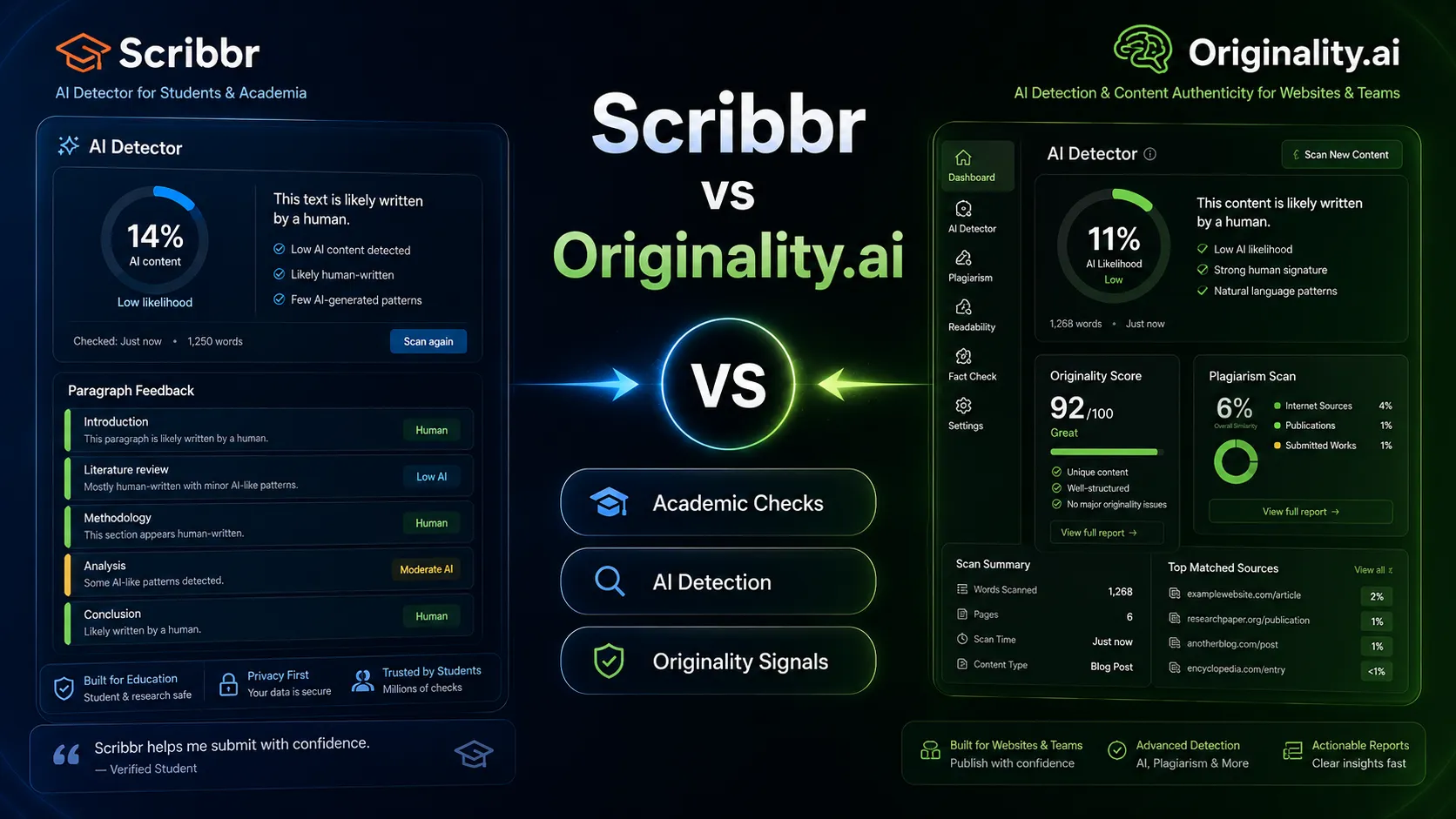
Quick verdict
Choose Scribbr if your real job is academic writing support: checking an essay, paper, thesis section, application essay, or student draft for AI signals, plagiarism risk, citation issues, and proofreading problems without committing to a monthly detector subscription.
Choose Originality.ai if your real job is repeatable content QA: checking writer submissions, outsourced drafts, SEO articles, web pages, Google Docs, WordPress content, or agency deliverables before they go live.
That is the cleanest way to separate this comparison. Scribbr is friendlier for students and occasional academic checks. Originality.ai is stronger for publishers, agencies, SEO teams, and content operators that need a process.
Neither tool should be treated as final proof of authorship. AI detection is a signal, not a courtroom. The safer buyer decision is to ask what happens after the scan. If the answer is “I need to revise one academic document,” Scribbr is the easier first click. If the answer is “I need to manage repeated originality checks across many pieces of content,” Originality.ai is usually the better fit.
Scribbr vs Originality.ai at a glance
| Decision point | Scribbr | Originality.ai |
|---|
| Best fit | Students, educators, academic writers, occasional checkers | Publishers, SEO teams, agencies, content managers |
| Main workflow | Free AI detector plus paid plagiarism and academic writing checks | AI detection, plagiarism, readability, reports, team workflow, plugins, API |
| Pricing logic | Free AI checker plus pay-per-document plagiarism checks | Pay-as-you-go credits or monthly/annual subscriptions |
| Team fit | Better for individual academic use and occasional institutional volume checks | Stronger for teams, reports, scan history, roles, API, and site workflows |
| Main risk | Paid checks are not a flexible SaaS subscription; refund flexibility is limited | Credit expiry and plan selection matter if monthly scan volume is uncertain |
| Safer first step | Run a free AI check, then decide whether a paid plagiarism report is worth it | Estimate monthly word volume before choosing credits or a subscription |
Choose Scribbr if academic context matters most
Scribbr makes more sense when the writing context is academic. A student trying to check an essay before submission does not usually need a dashboard, API, team roles, or WordPress scanning. They need a simple answer: does this draft look risky, are there plagiarism concerns, and what should be cleaned up before submission?
That is where Scribbr’s positioning is clearer. Its AI detector is built around academic use cases like students, educators, and bloggers. The free AI detector path is also easier to start because it does not require a complicated plan decision before the first scan.
Scribbr also makes sense if plagiarism checking is tied to one document rather than an ongoing content operation. A thesis chapter, admission essay, research paper, or final draft is usually a one-off check. Paying per document may feel more natural than starting a monthly detector subscription.
The catch is volume. Scribbr is not the cleaner choice if you need to scan dozens of articles every month, organize writer reports, manage tags, or connect detection to a publishing workflow. It can help with academic originality, but it is not trying to be a content operations platform.
Choose Originality.ai if QA is a recurring workflow
Originality.ai is the stronger pick when originality checking is part of a repeatable publishing process. That includes agencies reviewing outsourced drafts, SEO teams checking AI-assisted articles, publishers auditing content before it goes live, and site owners who need more than a one-off detector result.
The key difference is workflow depth. Originality.ai combines AI detection with plagiarism checking, readability checks, grammar and spelling support, fact-checking aid, SEO content optimization, Chrome and Google Docs workflow, WordPress scanning, full-site scans, scan history, shareable reports, team management, tags, and API access depending on the plan.
That is overkill for many students. It is useful for teams.
Originality.ai is also easier to evaluate when the buyer knows approximate monthly volume. If you scan a predictable number of words every month, the credit model becomes a real planning decision. If you scan content only once in a while, pay-as-you-go may be safer than jumping straight into a subscription.
The main caution is credit behavior. Subscription credits can expire at the end of the monthly billing cycle, so a buyer should not judge only by the visible monthly price. Estimate real scan volume first.
Pricing and plan fit
Scribbr and Originality.ai look similar on the surface because both touch AI detection and plagiarism. Commercially, they behave differently.
Scribbr is easier to treat as an academic service. The AI detector has a free entry path, while the more serious paid decision is usually the plagiarism check. Scribbr’s plagiarism checker is priced per document rather than as a recurring monthly subscription, with public price bands based on document size. That works well when you have one important document and do not want a SaaS plan.
Originality.ai is closer to a content QA platform. It has a pay-as-you-go path and subscription paths. The pay-as-you-go plan can fit occasional scanning, while Pro or Enterprise becomes more relevant when you have recurring word volume, team workflow, reports, file uploads, site checks, or API needs.
So the pricing question is not simply “which is cheaper?”
Ask this instead:
- Are you checking one academic document or a stream of content?
- Do you need plagiarism reporting once, or every week?
- Do you need a free first check, or a repeatable operational dashboard?
- Will unused credits become wasted budget?
- Does your team need reports, roles, scan history, or API access?
For one paper, Scribbr can be the cleaner purchase. For a content team, Originality.ai is usually easier to operationalize.
Workflow fit: student review vs publishing process
Scribbr fits a simpler document-review moment. You paste or upload text, look at the signal, and decide whether the draft needs revision or a paid plagiarism report. The workflow is approachable for students and educators because the surrounding product ecosystem includes citations, proofreading, plagiarism, AI detection, and academic writing help.
Originality.ai fits a multi-step content QA process. A team can check a writer’s draft, create or share reports, keep scan history, review plagiarism and AI signals together, use browser or Google Docs workflow, and connect checks to publishing systems when the plan supports it.
That difference matters because a comparison article can easily overfocus on detector accuracy. Accuracy matters, but workflow fit decides whether the product will actually be used.
A student does not need a heavy QA stack to submit a better essay. A publisher does not want a one-document academic workflow when checking hundreds of thousands of words over time.
AI detection risk: do not treat either result as final proof
This is important for both tools.
AI detectors can be useful, but they can also be misunderstood. A score should start a review, not end one. False positives, edited AI-assisted text, translated text, formulaic writing, and non-native writing patterns can all make interpretation harder.
For academic use, that means Scribbr should be used as a revision signal and policy check, not as automatic proof that a student cheated. For publishing use, Originality.ai should be part of an editorial QA process, not the only reason to reject a writer’s work.
The safer workflow is:
- Run the check.
- Look at the flagged sections.
- Compare the result against the writing context.
- Review citations, originality, and editing history when possible.
- Make a human decision before accusing, rejecting, or publishing.
That buyer-protective view is especially important in this category because the downside of misreading a detector score can be bigger than the subscription cost.
Team and business use
Originality.ai is the stronger business pick when team workflow matters. Scan tagging, team management, reports, site scans, Chrome or Google Docs usage, WordPress workflow, and API access are more relevant to publishers and agencies than to most individual students.
Scribbr can still be useful for institutions or academic users, especially when the task is document-specific. But if the buyer is running a content operation, the lack of a broader operational dashboard becomes the bigger limitation.
The practical rule:
- Use Scribbr when the job is academic document confidence.
- Use Originality.ai when the job is repeatable originality QA before publishing.
That single distinction prevents most bad purchases in this pair.
Checkout and savings path
Do not choose either product because of a coupon page first.
For Scribbr, start with the free AI detector if that fits the job. If you need a plagiarism report, verify the current per-document price, word-count band, what the premium report includes, and the refund/cancellation language before paying.
For Originality.ai, estimate monthly scan volume before choosing pay-as-you-go, Pro, or Enterprise. Then verify credit expiry, file upload needs, site scan needs, team features, API access, annual billing savings, and refund terms before checkout.
After the product fit is clear, the normal DealBestDaily path is simple:
A discount is useful only after the workflow makes sense.
Buyer checklist before checkout
Before choosing Scribbr, check:
- Is your document short enough for the free AI detector workflow, or will you need a paid plagiarism report?
- Do you need AI detection only, or plagiarism sources, grammar corrections, and a premium report?
- Are you comfortable with pay-per-document pricing instead of a subscription?
- Have you read the refund/cancellation limits for paid plagiarism checks?
- Are you using the result as a revision signal rather than final proof?
Before choosing Originality.ai, check:
- How many words will you realistically scan each month?
- Is pay-as-you-go safer than a subscription for your volume?
- Do you need reports, tags, scan history, team management, file uploads, WordPress, Google Docs, or API access?
- Will monthly credit expiry create waste?
- Have you verified the current checkout price and refund policy before annual billing?
Final verdict
Choose Scribbr if you are a student, educator, or academic writer who needs a simple first check and may only pay when a specific document needs deeper plagiarism review. Scribbr is the cleaner fit for academic confidence, citation-adjacent writing support, and occasional pay-per-document originality checks.
Choose Originality.ai if you are a publisher, agency, SEO team, or business buyer that needs recurring AI and plagiarism QA across many drafts. Originality.ai is the stronger fit when reports, team workflow, scan history, site checks, browser workflow, WordPress, or API access matter.
Avoid both if you need a legally definitive authorship judgment. These tools can support review, but neither should replace human context, policy judgment, or a fair editorial process.
FAQ
Is Scribbr better than Originality.ai for students?
Usually, yes. Scribbr is more naturally aligned with academic writing, plagiarism checks, citations, proofreading, and occasional document review. Originality.ai can still detect AI and plagiarism, but its platform makes more sense for recurring publisher or team workflows.
Is Originality.ai better than Scribbr for publishers?
Usually, yes. Originality.ai is stronger for recurring editorial QA because it supports broader workflow needs such as reports, scan history, team features, site scans, browser workflow, WordPress use, and API access depending on the plan.
No. Scribbr’s AI detector is for AI-generated, AI-refined, and human-written signals. Plagiarism checking is a separate workflow, and the premium plagiarism report is the paid path when you need detailed source matching.
It depends on usage. Scribbr can be cheaper for one important academic document because it uses a free AI detector plus pay-per-document plagiarism pricing. Originality.ai can be more practical for teams that scan recurring content because pay-as-you-go and subscriptions map better to ongoing volume.
Should I choose based on coupon availability?
No. Choose based on workflow first. After you know which product fits, check the current store or coupon route before checkout. A coupon path is not a good reason to buy the wrong originality checker.