Quick verdict
Scribbr is worth considering if your buying decision is academic first, software second.
That is the important distinction. Scribbr is not just another AI detector, and it is not a normal monthly plagiarism-checking SaaS product either. It is closer to an academic writing checkpoint system: plagiarism reports, AI-detection signals, citation help, grammar cleanup, essay checks, AI proofreading, and human proofreading all sit inside the same broader student-and-research workflow.
For my money, Scribbr makes the most sense when you are close to submitting something that actually matters: a paper, thesis, dissertation, application essay, research assignment, or citation-heavy academic document. In that situation, the value is not only whether a tool finds a match or flags a paragraph. The value is whether the result helps you decide what to revise before the document leaves your hands.
I would be more careful if you are shopping only for a cheap detector, a recurring team dashboard, or a bulk originality platform for content operations. Scribbr can help with AI and plagiarism checks, but its strongest lane is academic submission support, not publisher-scale workflow automation.
The easy mistake is treating Scribbr as one product with one price. It is not. Some tools are free. Plagiarism checks are priced per document. Human proofreading depends on word count, turnaround, education level, and add-ons. The safest next step is to choose the academic task first, then check the current buyer route.
Next step: If Scribbr fits your academic task, start by checking the current service path before choosing a paid report or editing order.
Review snapshot
| Review point | Practical take |
|---|---|
| Best for | Students, researchers, educators, and academic writers preparing work for submission |
| Not ideal for | Content teams needing API access, bulk checks, team dashboards, or recurring publishing workflows |
| Main use case | Plagiarism review, AI-detection signal, citation cleanup, grammar support, and proofreading before submission |
| Pricing model | Mixed: free tools, pay-per-document plagiarism checks, and service-based proofreading/editing |
| Free path | AI Detector, Citation Generator, Grammar Checker, Essay Checker, and other writing utilities can be useful before paying |
| Main strength | Academic context around originality, citations, and submission readiness |
| Main concern | Buyers may choose the wrong service or overlook cancellation limits |
| Direct alternatives | Originality.ai, Copyleaks, GPTZero |
| Best next step | Start with the free tool that matches the task, then pay only if the document needs a deeper report or human review |
What is Scribbr?
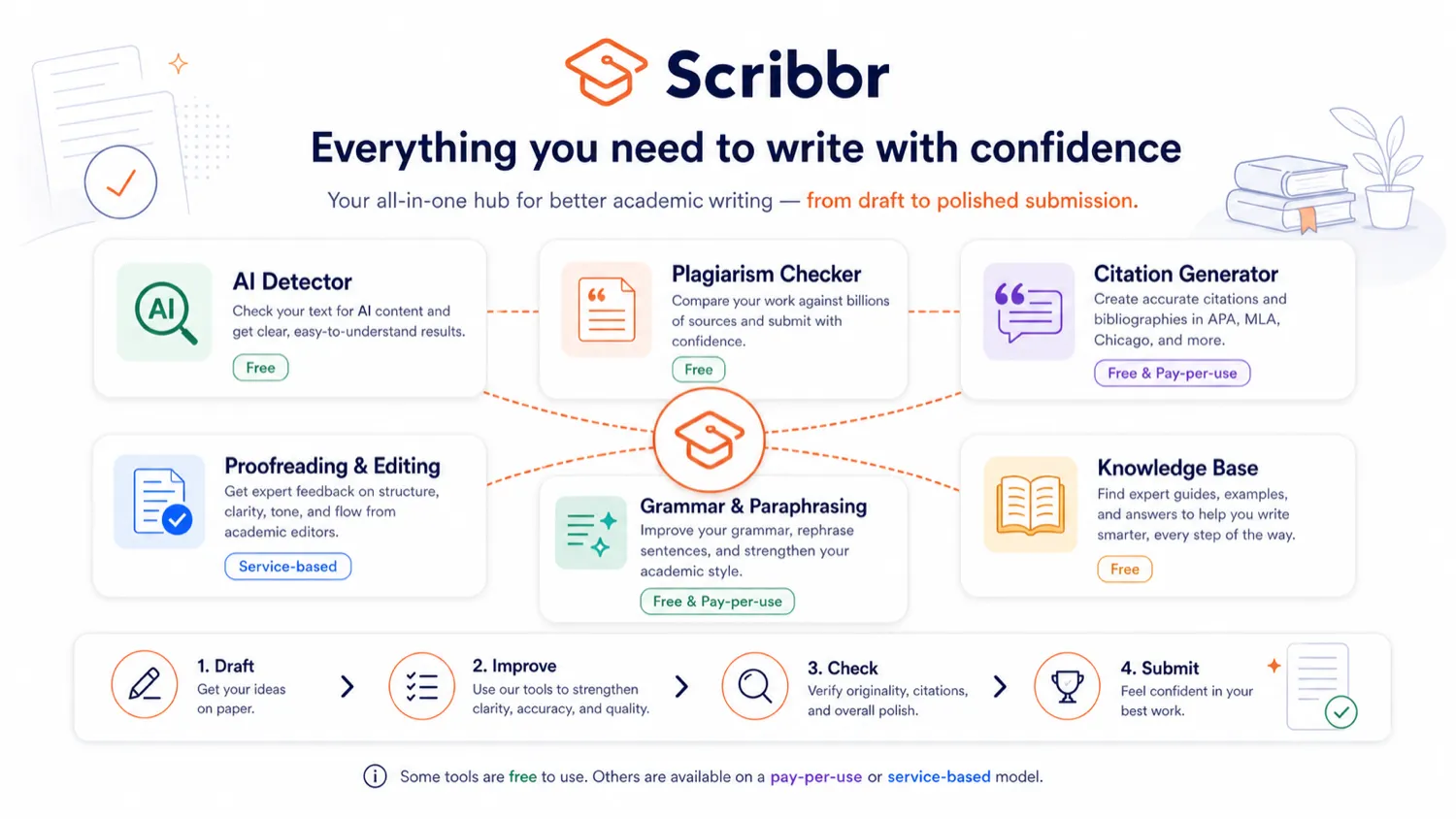
Scribbr is best understood as an academic writing and originality toolkit for people preparing student, research, or scholarly documents. Its public product map includes proofreading, plagiarism checking, citation generation, AI detection, AI proofreading, grammar tools, a knowledge base, and citation-style resources.
That makes Scribbr different from a single-purpose AI detector. A buyer might arrive because they want to know whether a paragraph looks AI-generated, but the broader Scribbr workflow is really about submission readiness: is the work original enough, cited correctly, written clearly, and ready to hand in?
It is also different from a publishing-team originality platform. If you are running large numbers of SEO articles, client drafts, or web pages through recurring checks, Scribbr may feel less natural than a tool built for content operations. Scribbr’s strongest context is academic work, where plagiarism interpretation, citation cleanup, and proofreading all matter together.
The wrong expectation is to treat Scribbr as a magic pass/fail authority. A plagiarism report still needs interpretation. An AI detection result is still a signal, not proof of authorship. A citation tool can help format references, but it does not guarantee that every source is used correctly in the paper.
Our review approach compares public product pages, pricing details, service terms, privacy expectations, academic workflow fit, and nearby alternatives. We do not treat a free tool, a paid check, or a coupon route as proof that Scribbr is the right fit for every buyer.
Who should use Scribbr?
Scribbr fits students who are close to submitting academic work and want one place to check plagiarism risk, AI-writing signals, citations, grammar, and final wording. The condition is that the document is far enough along for a check to matter. If the paper is still in outline form, free citation and writing tools may be enough for now.
It also fits graduate students and researchers working on theses, dissertations, journal-style papers, or citation-heavy documents. In that workflow, a plagiarism report can be useful because the buyer needs to inspect matched sources, paraphrasing quality, quotations, and references before submission. The buyer still needs to interpret the report manually.
Scribbr can make sense for students who struggle with references. The Citation Generator and Chrome extension are useful when the immediate problem is APA, MLA, Chicago, Harvard, or another citation style. This is one of the safer buyer paths because citation cleanup may solve the problem before a paid originality report is needed.
Human proofreading is the stronger path when the issue is not only originality but writing quality. Non-native English academic writers, thesis students, application writers, and students under deadline pressure may find expert editing more useful than another automated check. The buyer should calculate the price before uploading, because word count, deadline, education level, and add-ons can change the total.
Educators or academic support teams may also use Scribbr as a reference point when explaining plagiarism, AI detection, or citation practices. I would still avoid using any AI detector result as a standalone disciplinary decision. Academic policy and human review matter more than a single score.
Who should avoid Scribbr?
I would avoid Scribbr if your main need is bulk publishing workflow. A content agency checking hundreds of SEO drafts each month may want dashboards, team permissions, APIs, recurring credit pools, or workflow reporting. Scribbr is not positioned primarily around that kind of operation.
I would also be careful if you only need a quick grammar check. Scribbr has free tools that may help, but a paid plagiarism report or human proofreading order may be heavier than the task requires. The smarter move is to use the lightest tool first.
Scribbr is not ideal for buyers who expect AI detection to prove authorship. AI detection can point to patterns, but it should not become the only evidence in a high-stakes academic or professional decision. This matters because false confidence can hurt both the person submitting the work and the person reviewing it.
It is also not the cleanest choice for buyers who want a simple subscription. The plagiarism checker is pay per check, while proofreading is service-based. That can be flexible, but it can confuse buyers who expect one monthly plan with predictable usage limits.
Finally, I would slow down if you are buying only because an offer route exists. A discount can lower the price, but it does not tell you whether you need a plagiarism report, AI proofreader check, citation check, or human editor. The wrong service is more expensive than the wrong coupon.
How Scribbr fits into a real workflow
A good Scribbr workflow starts before the upload button.
First, decide what problem you are solving. If the issue is citation formatting, start with citation tools. If the issue is possible AI-written language, start with the free AI Detector and treat the result as a signal. If the issue is originality risk in a near-final paper, a plagiarism check becomes more relevant. If the issue is clarity, grammar, structure, or academic tone, proofreading may be the better path.
Second, prepare the document. A plagiarism report is most useful when the draft is close to final. If citations are incomplete, quotations are messy, and paragraphs are still being rewritten, the report may show problems you already know exist.
Third, run the appropriate check and interpret the result. Similarity does not always mean misconduct. Academic writing naturally includes citations, titles, technical terms, quoted phrases, and shared terminology. The point of the report is to help you review matches, not panic at a number.
Fourth, revise with judgment. Fix missing citations, paraphrase weak sections, check quotations, clean references, and review AI-detection signals as one part of the broader submission decision.
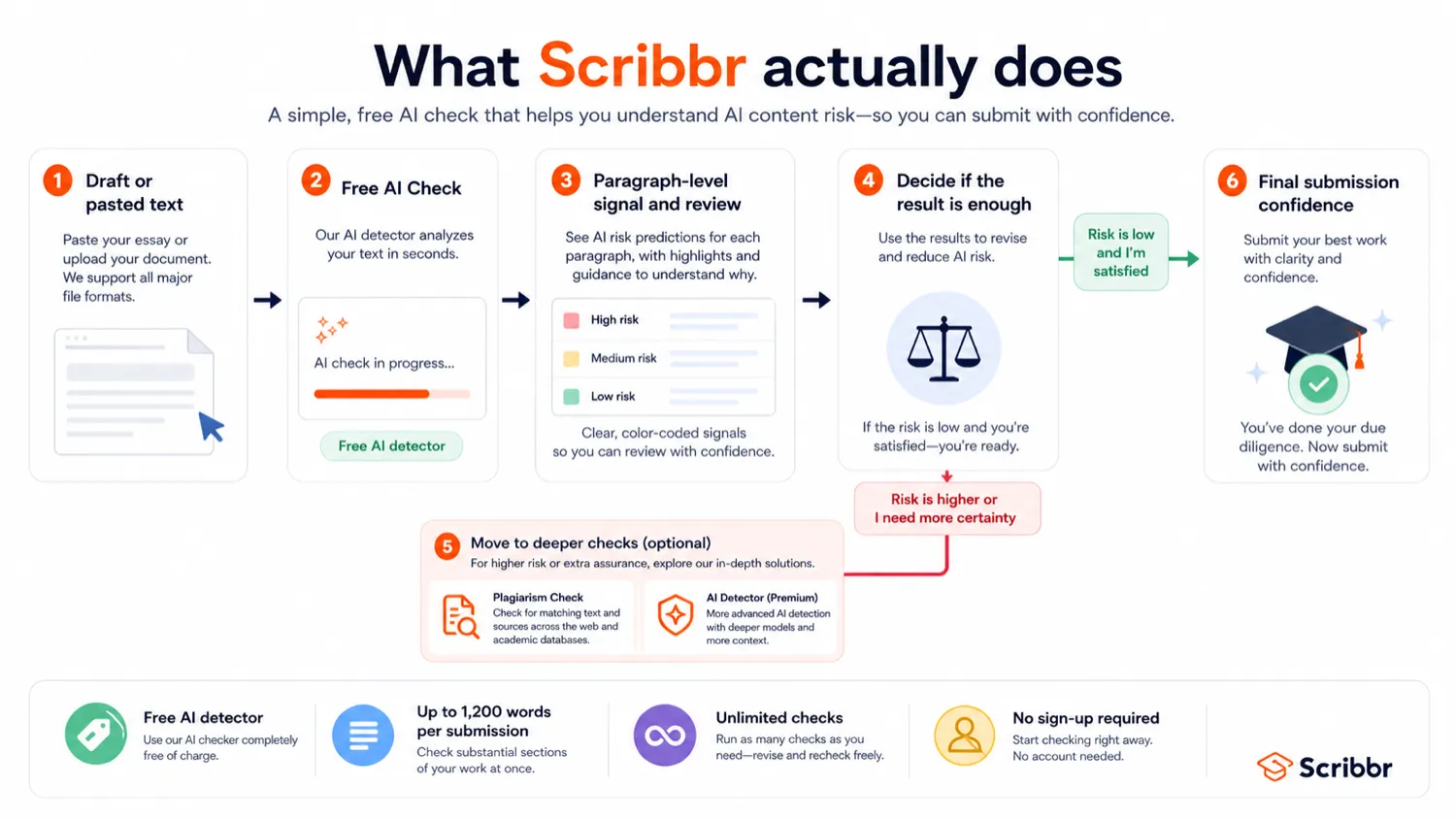
Workflow check: If you are unsure which Scribbr service fits, compare the free tool path with the paid report path before uploading a final document.
Real-world buyer scenarios
Student checking a paper before submission
A student with a near-final paper may use Scribbr to check plagiarism risk, AI-writing signals, grammar issues, and citation problems before submitting. This is a natural fit because the toolset matches the academic anxiety: “Will this paper cause a problem?”
The risk is overreading the report. A similarity match may be a properly cited source, a common phrase, or a quotation that needs formatting rather than a major originality issue. The student should use the report as a checklist for revision, not as a verdict on the paper’s worth.
Graduate student preparing a thesis or dissertation
A graduate student may need more than a quick scan. Long documents often involve many sources, repeated terms, methodology language, tables, appendices, and discipline-specific phrasing. Scribbr can help identify matches and writing issues, while proofreading may help polish the final document.
The caution is cost. Long documents and urgent turnaround can make proofreading meaningfully more expensive. I would calculate the editing cost early, not the night before the deadline.
Educator or advisor explaining originality risk
An educator may use Scribbr-style reports or resources to explain why citations, paraphrasing, and AI-writing policies matter. Scribbr’s academic context helps here because the language is built around student work rather than marketing content.
The limit is evidence. AI detection should not be treated as a standalone accusation tool. If the stakes are high, institutional policy, human review, and a broader evidence process should come first.
Content team comparing originality tools
A web publisher or SEO team may still look at Scribbr because it includes plagiarism and AI-detection checks. But this buyer should compare it with tools built for content operations. If the workflow involves batches, team members, dashboards, API access, or recurring publishing checks, Originality.ai or Copyleaks may be more aligned.
Scribbr can still be useful for an occasional academic-style document, but it is not the first tool I would choose for a production content pipeline.
Key features that actually matter
Plagiarism Checker
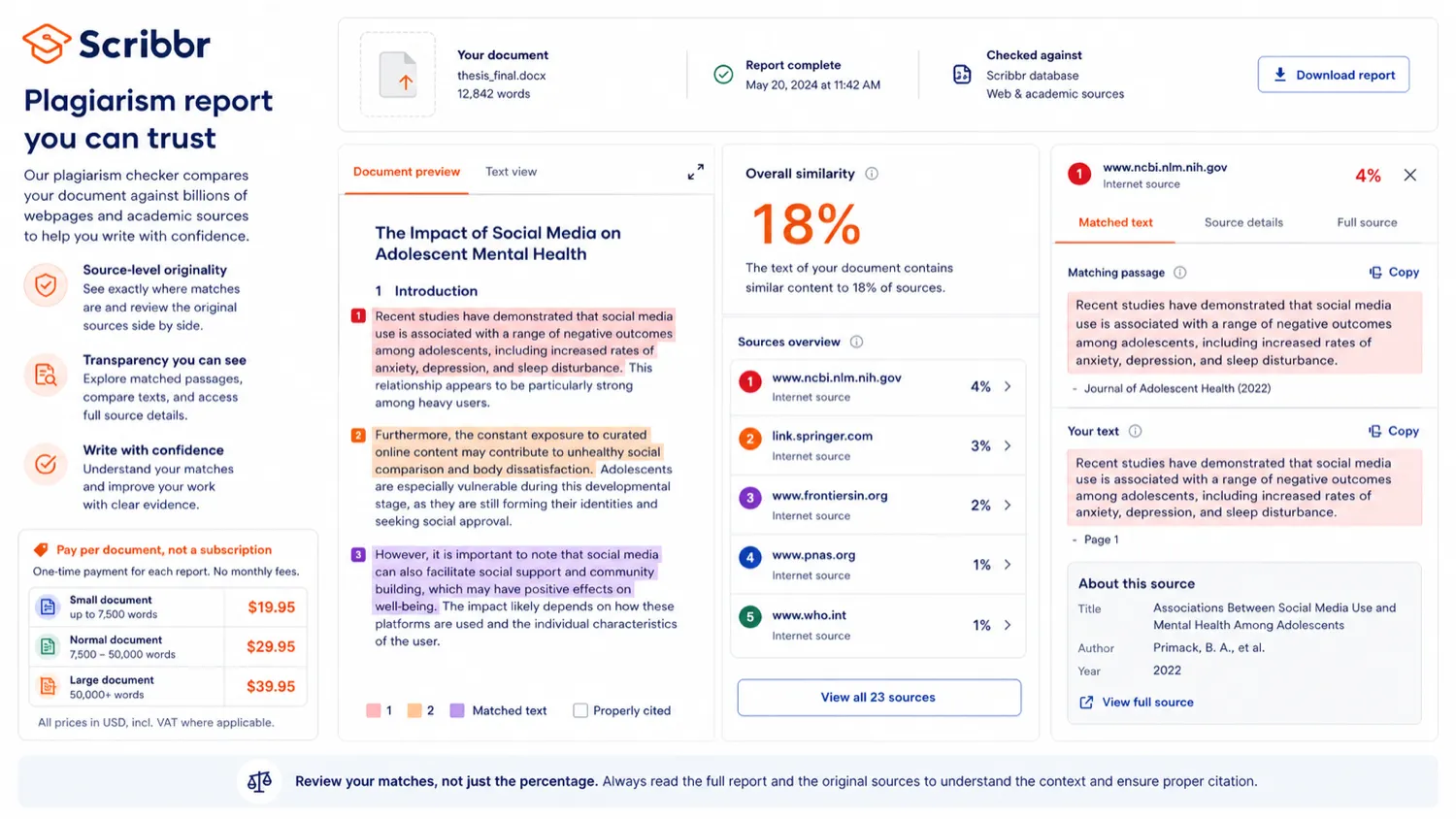
The Plagiarism Checker is the core paid originality feature. It helps buyers compare a document against sources, inspect similarities, review highlighted text, and decide where citations or wording need revision.
Buyer note: the useful part is not only the similarity percentage. The useful part is the review process after the result appears. If you will not inspect the matches, a report has limited value.
Free AI Detector
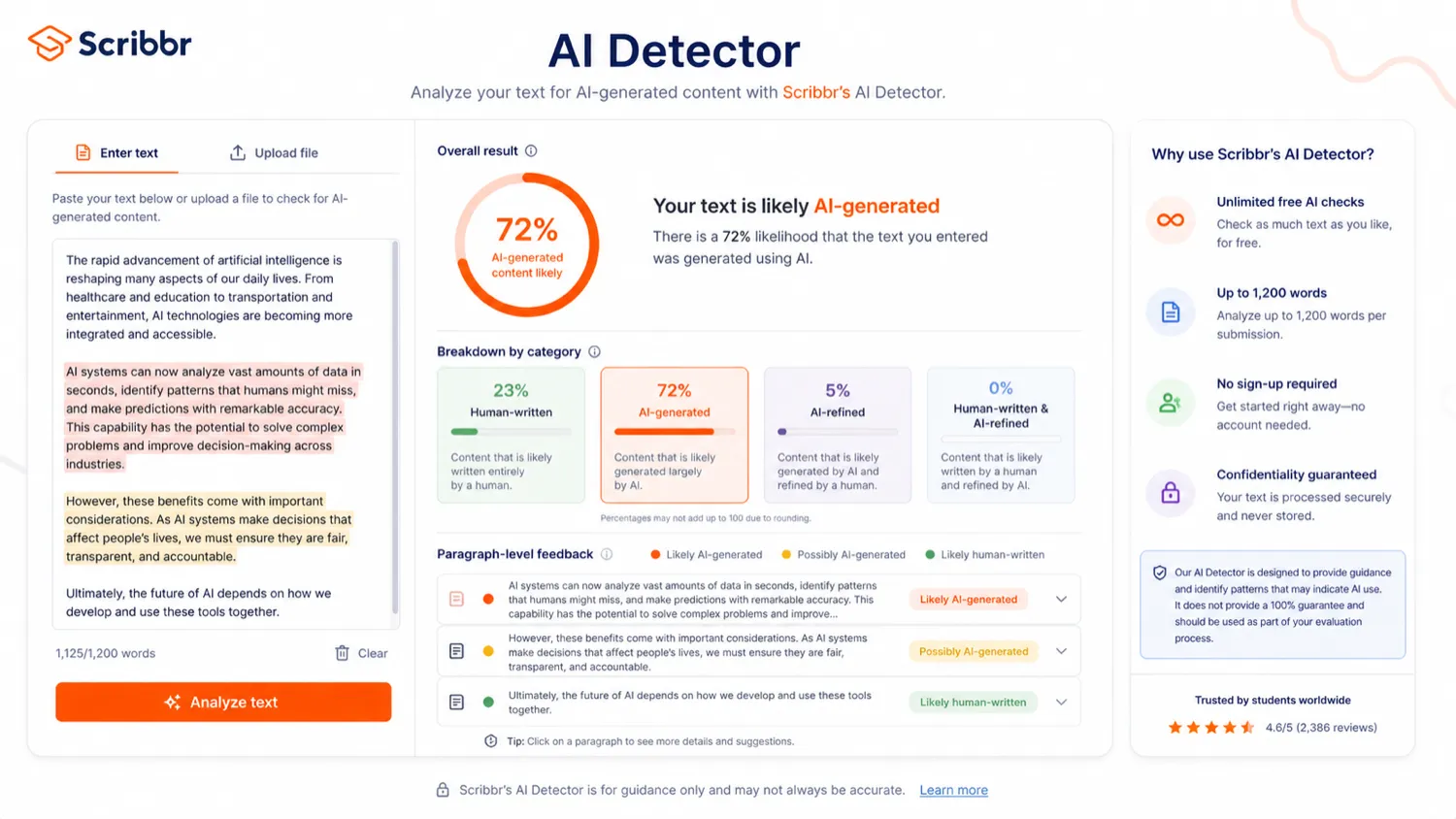
Scribbr’s AI Detector is useful as a low-friction first check, especially because it can be used before deciding whether a paid academic check makes sense. It is relevant for students, educators, and writers who want a quick authorship signal.
Buyer note: do not turn this into final proof. Use the result to decide whether a paragraph needs human review, not to make a high-stakes decision by itself.
Citation Generator and citation workflow
The Citation Generator is one of Scribbr’s strongest free utility paths. Many plagiarism problems are really citation problems: missing references, weak paraphrasing, inconsistent style, or unclear source use.
Buyer note: clean citations before paying for a deeper report. A cleaner reference list makes any originality check easier to interpret.
Grammar, essay, and AI proofreading tools
Scribbr also offers writing-improvement tools that help with grammar, essay quality, and AI-assisted proofreading. These can be useful when the problem is clarity or presentation rather than originality.
Buyer note: automated editing should be treated as draft support. If the document is high-stakes, human review may still be worth considering.
Human proofreading and editing
Human proofreading is the premium service path. It makes sense when a document needs expert language improvement, academic clarity, or final polish beyond automated checks.
Buyer note: calculate the total before ordering. Word count, turnaround time, education level, and add-ons can change the value equation quickly.
Pricing and plan value
Scribbr pricing is best judged by task, not by one headline price.
The free tools are the natural starting point. If you need AI detection, citation formatting, grammar checks, spell checks, essay checks, paraphrasing, or summarizing, you may be able to solve the immediate problem without paying. That is why I would not start with the coupon route first.
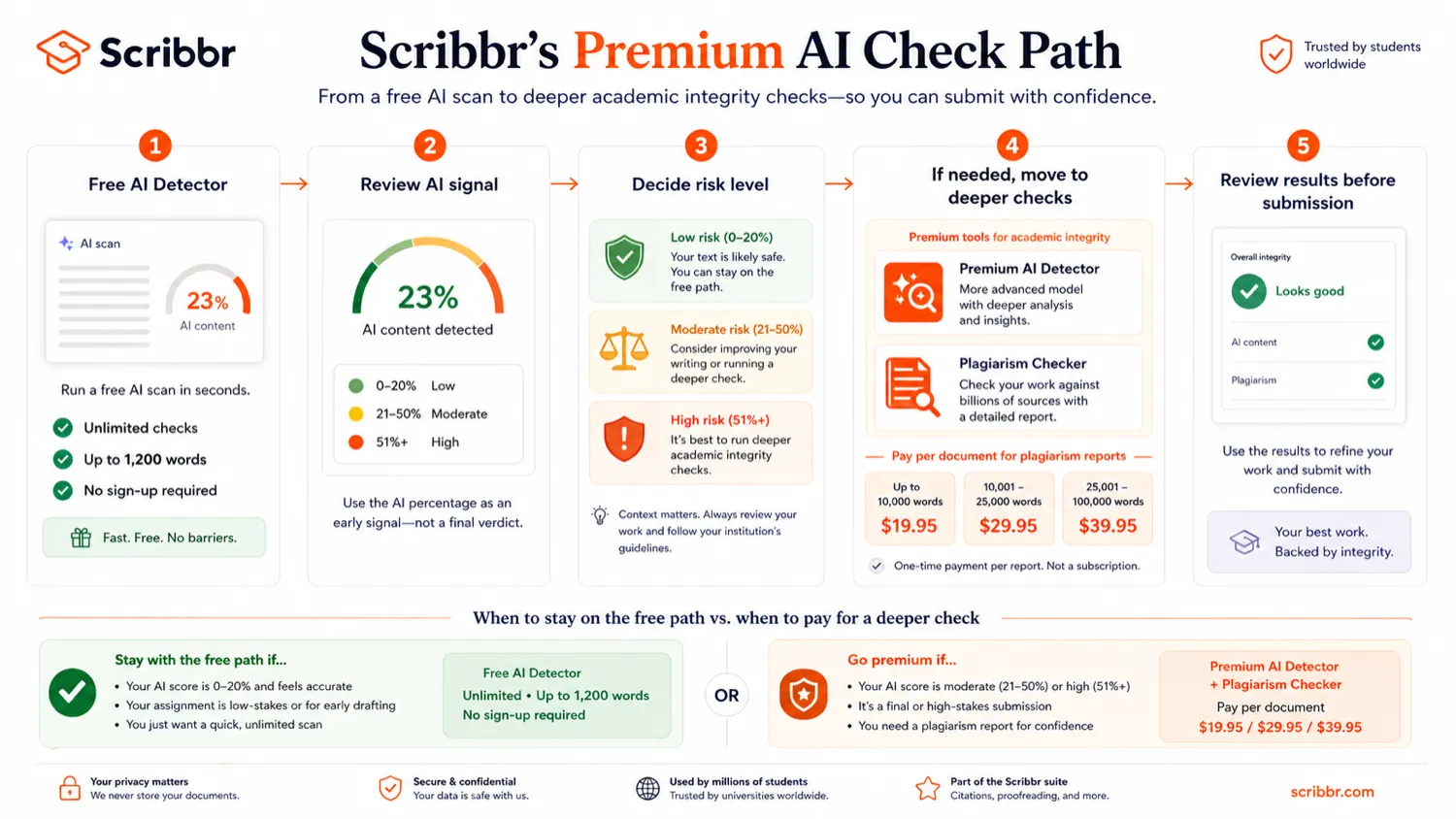
The plagiarism checker is different. Current public pricing presents it as pay per document, with pricing tiers based on document length. That can be a good model for occasional academic use because you are not locked into a recurring subscription. It can also be a poor fit if you need frequent checks, bulk use, or team-level workflow.
Proofreading and editing are a separate buying decision. Current public pricing depends on word count, deadline, education level, and selected services. Add-ons such as structure, clarity, formatting, or citation-related services can change the total. This is where buyers should slow down, especially for long documents.
I would treat Scribbr’s pricing as flexible but not simple. Free tools are low risk. Paid plagiarism checks are document-specific. Human proofreading can be valuable but must be priced against the importance of the document and the deadline.
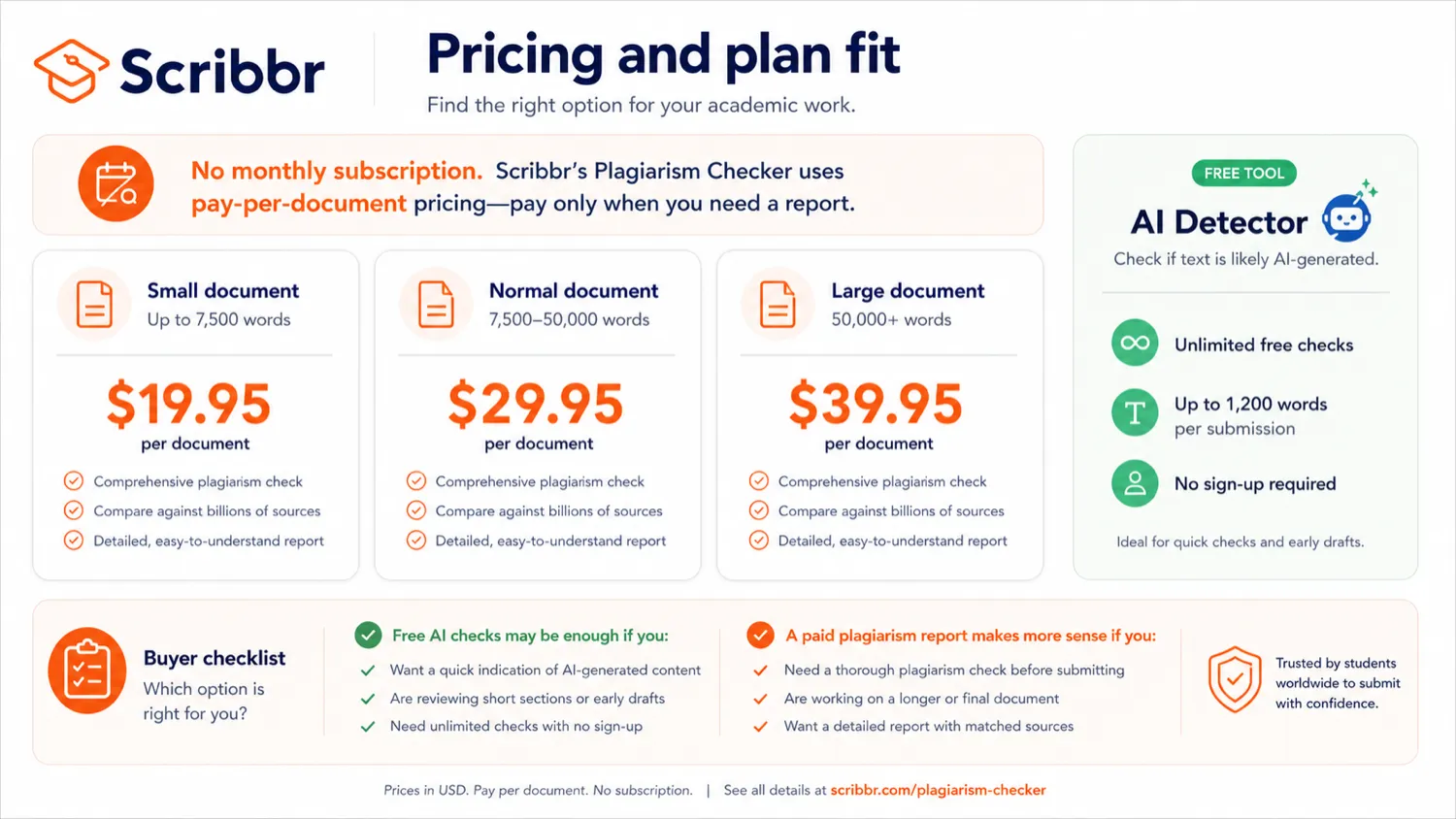
Pricing check: Use Scribbr’s free tools first when they solve the task, then verify the current paid service price only if a report or editor is genuinely needed.
Free plan, trial, coupon, and checkout notes
Scribbr is not a classic coupon-first SaaS product.
The safer order is free tool first, service fit second, pricing check third, offer route last. If the free AI Detector or Citation Generator solves the issue, paying for a plagiarism report may be unnecessary. If the document needs a deeper originality report, then the pay-per-document plagiarism path becomes relevant. If the document needs language improvement, proofreading may be the better service.
This is why public coupon claims should be treated carefully. A checkout code can reduce cost, but it cannot tell you whether you chose the right service. The most expensive mistake with Scribbr is not missing a discount. It is paying for a report, check, or editing order that does not match the document problem.
Before checkout, confirm the current service name, word count, file format, language support, included checks, turnaround time, add-ons, and cancellation terms. Do not assume every Scribbr service has the same refund or cancellation logic.
If you want to check live offers, use the Scribbr coupon page after you know which service you actually need.
What I would check before buying Scribbr
If I were buying Scribbr for a real academic workflow, I would check seven things before paying.
- The exact task. Am I checking citations, plagiarism, AI likelihood, grammar, essay quality, or final language polish?
- The free path. Can the AI Detector, Citation Generator, Grammar Checker, or another free tool solve enough of the problem?
- Document word count. If buying a plagiarism check or proofreading service, the word count can directly affect pricing.
- Service inclusions. Does the paid path include the report, AI check, proofreading, citation help, self-plagiarism option, or only part of what I need?
- Cancellation limits. Some check types are not easy to cancel once purchased, so the decision should be clear before payment.
- Turnaround and deadline pressure. Urgent proofreading may be worth it for a high-stakes document, but it should not be an impulse purchase.
- Alternative fit. If the job is bulk content checking, institutional review, or simple AI detection, compare alternatives before buying.
A simple test before paying
Before paying, I would run a small decision test like this:
- Take one real section of the document, not a random sample.
- Run the free tool that matches the task: AI detection, citation cleanup, grammar, or essay checking.
- Fix obvious citation, quotation, and paraphrasing issues manually.
- Decide whether a full plagiarism report would change your next revision step.
- If considering proofreading, price the actual word count and turnaround before uploading.
- Compare the cost against the stakes of the document.
- Only then check the offer route or paid checkout path.
This test matters because Scribbr can feel broader than the problem in front of you. The goal is to buy the smallest useful solution, not the most impressive service bundle.
Pros explained
Scribbr understands the academic context
The biggest advantage is context. Scribbr is built around academic writing, not generic marketing copy. That matters when the buyer is dealing with papers, theses, dissertations, applications, sources, citations, quotations, and submission anxiety.
This strength stops being enough when the buyer is not academic. A web publisher or agency may need a more operational originality workflow.
Free tools reduce early buying risk
The free AI Detector, Citation Generator, Grammar Checker, and related utilities give buyers a lower-risk entry point. That is useful because not every writing problem needs a paid report.
This strength matters most when the buyer is still diagnosing the problem. It matters less when the document clearly needs a full plagiarism report or expert proofreading.
Pay-per-document plagiarism pricing can be fair for occasional use
A recurring subscription is not always ideal for students. If you only need to check one paper or thesis, pay-per-document pricing can make more sense than paying monthly for a tool you will not use again.
This strength becomes weaker if you need many checks. At volume, a workflow-oriented alternative may be more efficient.
Human proofreading adds a real escalation path
Automated checks can show issues, but they do not fully replace human editing. Scribbr’s proofreading service gives academic buyers a way to escalate when the writing itself needs expert review.
This is valuable for high-stakes documents. It is less necessary for casual assignments or early drafts that still need major rewriting.
Cons explained
The service map can confuse buyers
Scribbr has many useful paths, but that also creates friction. AI detection, plagiarism checking, citation generation, AI proofreading, grammar checking, and human editing are not the same purchase.
The buyer risk is choosing a heavier service because the product ecosystem feels connected. The fix is to name the task before checking pricing.
Cancellation rules require attention
Some document checks are not flexible after purchase. That makes sense operationally, but it also means buyers should not click into a paid check casually.
This matters most when a student is under deadline pressure. A rushed checkout decision can become expensive if the wrong check is selected.
AI detection can be overtrusted
Scribbr’s AI Detector can be useful, but AI detection as a category has limits. A result should guide review, not replace human judgment or academic policy.
This matters especially for educators, advisors, and anyone dealing with high-stakes authorship questions.
Scribbr is not a bulk originality platform
Scribbr’s academic focus is a strength, but it also limits fit for some buyers. Teams that need API access, seat management, high-volume checks, or automated publishing workflows should compare other tools first.
For those buyers, the question is not whether Scribbr is good. The question is whether it matches the operating model.
Green flags and red flags
Green flags:
- You are preparing academic work for submission and need a final originality or writing-quality checkpoint.
- You can start with a free tool and only pay if the document clearly needs a deeper check.
- You need citation support alongside plagiarism or AI-detection signals.
- You are checking one important document rather than running a high-volume workflow.
- You understand that reports still require human interpretation.
Red flags:
- You are buying only because you found an offer route.
- You expect an AI Detector to prove authorship with certainty.
- You need bulk checks, team dashboards, API workflows, or institutional governance.
- You have not checked cancellation terms for the exact service you are buying.
- You are ordering proofreading without calculating the real word count, deadline, and add-ons.
Scribbr vs alternatives
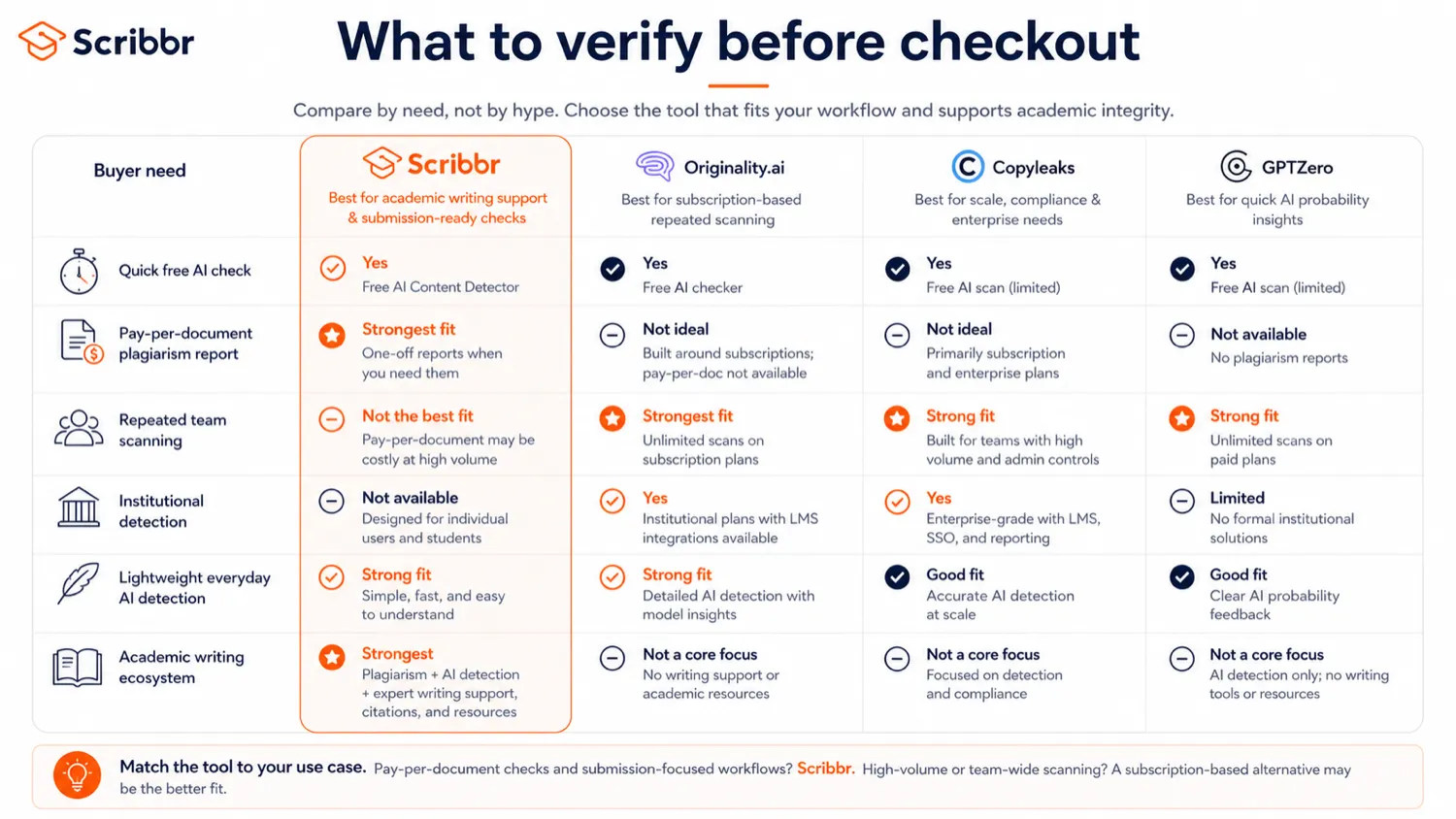
Scribbr’s direct comparisons depend on the job you are trying to solve. For academic submission support, Scribbr is stronger than many generic detectors because citations, plagiarism, AI signals, and proofreading are all part of the same buyer context. For publishing teams, that advantage may matter less.
Originality.ai vs Scribbr
Originality.ai is the stronger comparison for web publishers, SEO teams, and content operations that need recurring originality and AI-detection checks. It is more naturally aligned with online publishing workflows.
Scribbr may still be the better fit when the document is academic and citations matter. A student writing a thesis does not only need a content score. They need to understand sources, citations, similarity, and final submission risk.
Copyleaks vs Scribbr
Copyleaks is usually the stronger route for institutional, API-heavy, LMS, business, or team workflows. If the buyer needs broader deployment, governance, or automated originality checks, Copyleaks deserves a close look.
Scribbr makes more sense for individual students and academic writers who want a guided document-level check without building a technical workflow.
GPTZero vs Scribbr
GPTZero is a closer comparison when the buyer mainly wants AI-authorship signals. If the question is simply “Does this text look AI-generated?”, GPTZero may feel more focused.
Scribbr becomes more useful when AI detection is only one part of the academic problem. If plagiarism, citations, grammar, and proofreading also matter, Scribbr has a broader academic toolkit.
Adjacent route: proofreading-only services
A proofreading-only service can be the better route if the document’s main problem is language quality, not originality. In that case, a plagiarism report may not solve the issue.
Scribbr’s advantage is that proofreading sits near other academic checks. The tradeoff is that buyers must still choose carefully so they do not pay for tools they do not need.
Trust, refund, and buyer-risk notes
Scribbr has a stronger trust position than many lightweight AI-writing tools because it is clearly oriented around academic writing, has public service pages, visible legal terms, privacy language, and a long customer-review footprint. That said, trust is not the same thing as automatic buyer fit.
The first risk is service selection. A free AI Detector check, a premium plagiarism report, an AI proofreader check, a citation check, and human proofreading are different workflows. The refund and cancellation expectations are not identical.
The second risk is document privacy. Scribbr publishes confidentiality language and privacy practices, but students working with sensitive data should still read the current privacy policy and consider anonymizing details where appropriate. That is especially important for unpublished research, company data, interviews, or private participant information.
The third risk is overtrusting reports. Plagiarism reports require interpretation. AI detection results require caution. A similarity percentage, matched source, or AI likelihood signal should lead to review, not panic.
The fourth risk is cost escalation. Proofreading can be worth it for a thesis, dissertation, or urgent application, but the price should be checked before ordering. A long document with a short deadline is a different buying decision from a small paper with a flexible timeline.
Finally, do not treat offers as the main decision. Scribbr is most useful when the academic task is clear. The coupon or checkout route should come after that, not before.
Final verdict
I would consider Scribbr if I were preparing academic work and needed a practical checkpoint before submission. It is especially useful when the task involves plagiarism interpretation, citation cleanup, AI-detection signals, grammar support, or human proofreading.
I would skip Scribbr, or at least compare alternatives first, if the workflow is not academic. Content teams, agencies, institutions, and technical buyers may need tools built around volume, team controls, API access, or publishing operations.
I would also skip the paid path if a free Scribbr tool solves the problem. That is not a criticism. It is the buyer-friendly way to use the product. Start with the lightest useful check, then move into paid plagiarism or proofreading only when the document justifies it.
For my money, Scribbr’s real value is not that it has many tools. The value is that those tools sit close to the academic moments where mistakes are costly: missing citations, unclear paraphrasing, suspicious AI-style wording, grammar issues, and rushed final submissions.
Use it when that academic context matters. Compare alternatives when your workflow is broader, more technical, or less student-focused. And before paying, make sure the service you choose matches the document problem you actually need to solve.