Quick verdict
Tickeron is worth considering if you already understand trading risk and want AI-assisted market research, not a tool that tells you what to buy without judgment.
That distinction is the whole review.
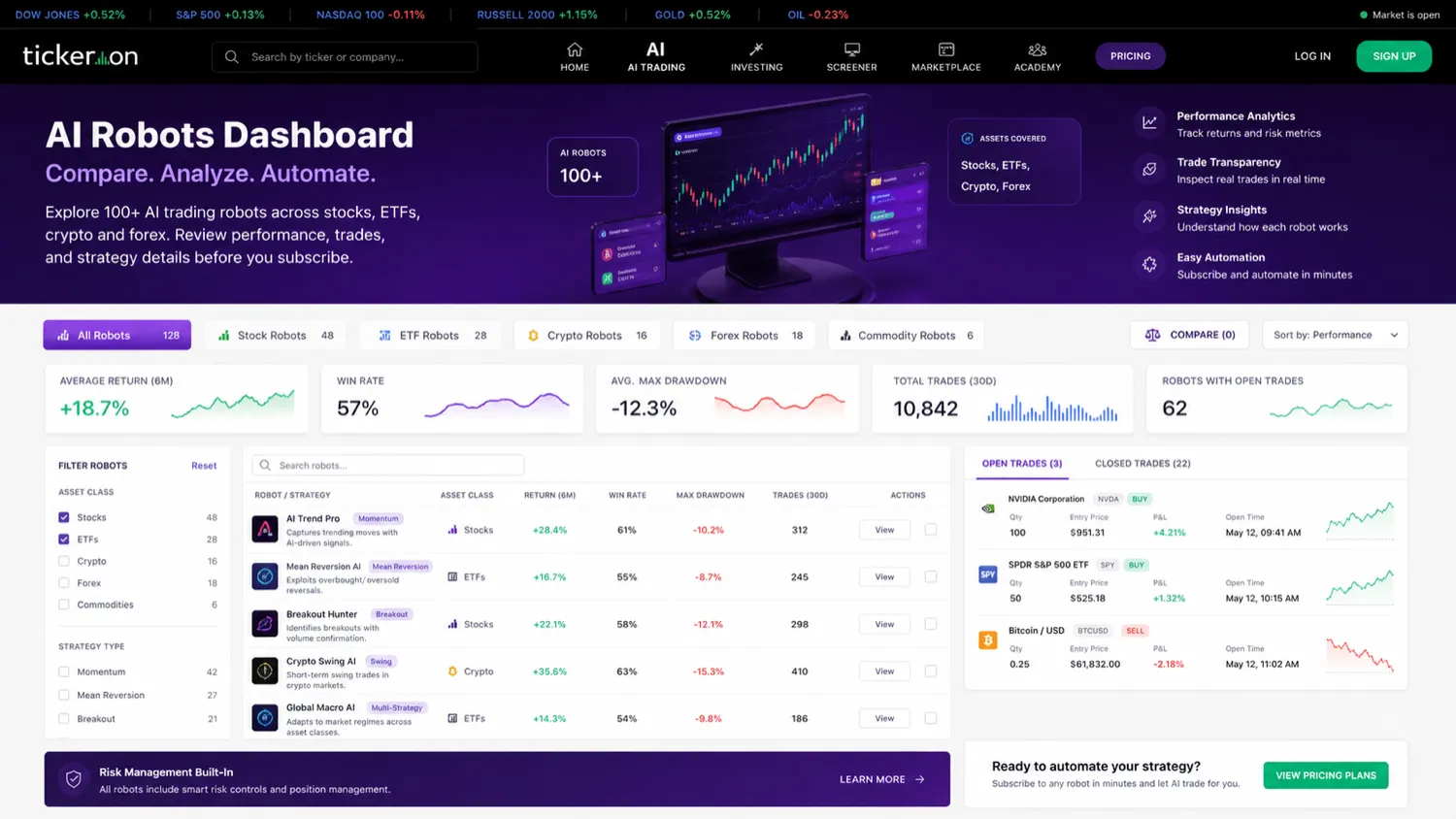
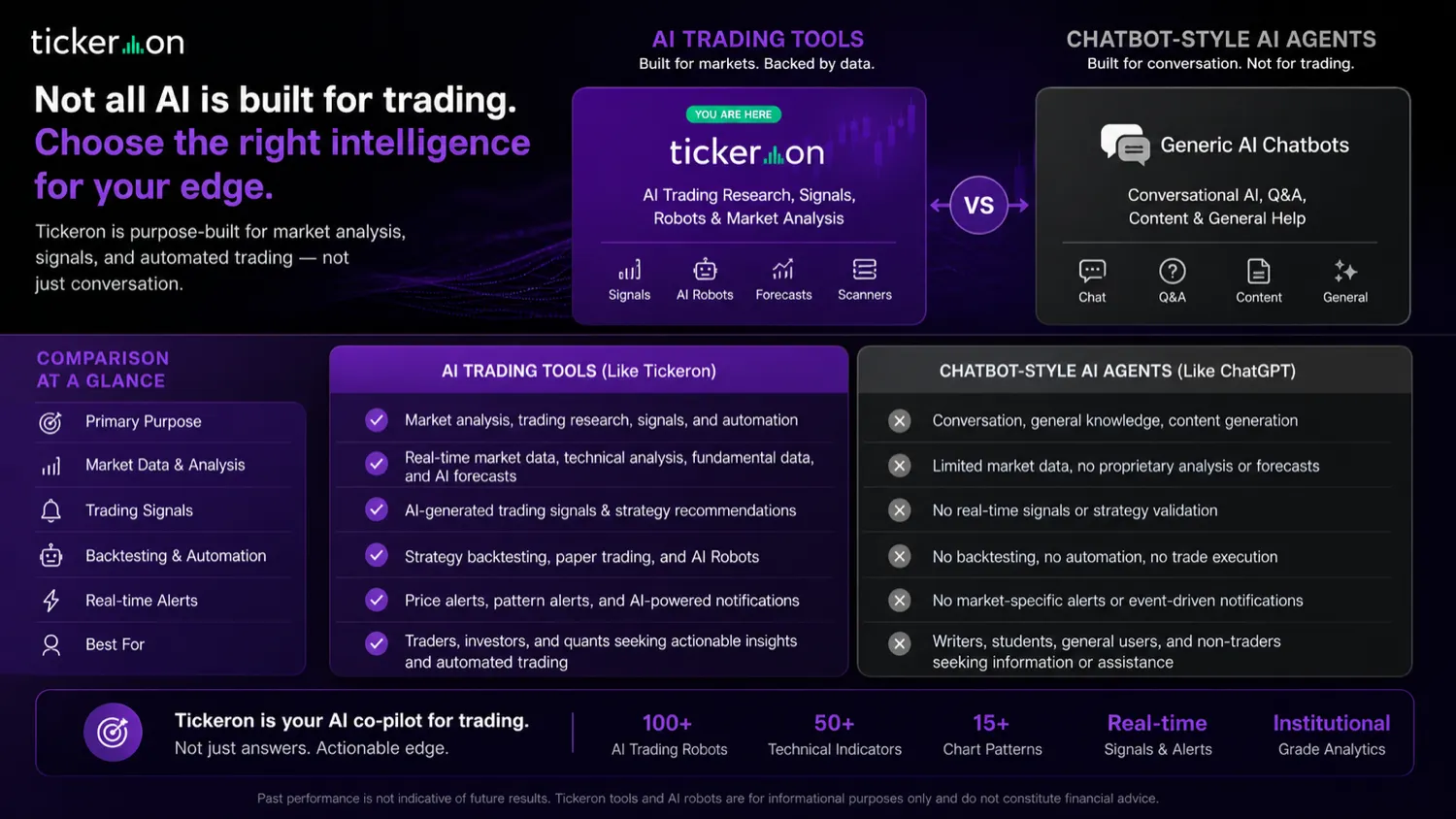
Tickeron is not a normal AI chatbot, and it should not be judged like one. The public product experience is built around AI trading agents, AI robots, buy/sell signals, stock and ETF forecasts, pattern tools, trend prediction, screeners, alerts, education, and performance-style robot statistics. That can be useful for active traders who know how to evaluate signals. It can also be dangerous for beginners who see a strong return number and mistake it for a promise.
For my money, Tickeron makes the most sense as a research and signal layer inside a trading process you already control. It is less convincing as an impulse purchase, especially because the plan structure is modular, trial eligibility can depend on the exact product, and the public refund FAQ is not flexible once payment is processed.
The strongest reason to consider Tickeron is tool depth. The main caution is buyer discipline. A stock screener, pattern engine, or AI robot can surface ideas faster, but it does not remove market risk. The safer path is to start free or trial-eligible where possible, understand one workflow at a time, and avoid annual or robot-heavy subscriptions until the tool proves useful in your own decision process.
Next step: If Tickeron still fits your trading workflow, verify the live plan, trial eligibility, and no-refund language before checkout.
Review snapshot
| Review point | Practical take |
|---|---|
| Best for | Active traders, swing traders, technical-analysis users, and self-directed investors who want AI-assisted trade ideas and research tools |
| Not ideal for | Beginners expecting guaranteed profit, casual stock-watchlist users, or buyers uncomfortable with no-refund subscription language |
| Main use case | Compare AI robots, screeners, pattern tools, trend prediction, and buy/sell signals before making independent trading decisions |
| Starting price | $0 member access appears publicly, while paid examples and individual tools vary by product and billing route |
| Trial path | 14-day trial messaging appears, but some categories may be excluded and must be checked at checkout |
| Main strength | Broad AI trading ecosystem rather than one narrow signal widget |
| Main concern | Pricing complexity, trading-risk psychology, product exclusions, and refund/cancellation rules |
| Direct alternatives | TradingView and Trade Ideas are stronger comparison routes for market-analysis and stock-scanning workflows |
| Best next step | Test one tool category first before paying for AI Robots, annual billing, or a larger bundle |
What is Tickeron?
Tickeron is an AI trading and market-analysis platform built around trade ideas, AI robots, screeners, pattern recognition, trend prediction, alerts, forecasts, education, and market dashboards.
The product is best understood as a decision-support platform for traders, not a general AI assistant. Its official pages talk about AI trading agents, AI-powered stock forecast tools, daily buy/sell signals, real-time patterns, AI screeners, robot categories, and learning resources. In plain English, Tickeron tries to help users discover trading ideas faster and evaluate them with AI-assisted signals and statistics.
That does not make it a financial advisor.
The common wrong expectation is to treat a trading robot like a money machine. Tickeron may show robot statistics, return figures, win rates, trade history, and confidence-style signals, but those are still inputs for judgment. Markets change. Signals fail. Fees, slippage, timing, position sizing, emotion, and risk management still matter.
Our review approach: we compare public product pages, pricing details, support and refund information, trading-risk context, buyer workflow fit, and nearby alternatives. We do not treat a coupon, trial message, robot statistic, or promotional discount as proof that the product fits a trader.
Who should use Tickeron?
Tickeron is most relevant for active traders who already spend time reviewing charts, watchlists, market moves, and trade setups. If you already have a routine and need better discovery, Tickeron’s screeners, pattern tools, and signal products may help you move faster.
Swing traders are another natural fit. The product includes end-of-day signal concepts, trend prediction, pattern search, and robot categories that map more naturally to traders who review setups and then decide whether to act.
Do-it-yourself traders may also benefit if they prefer using the AI Screener or pattern tools before following any robot. That is the path I would personally trust more at first: use the platform to generate ideas, then evaluate them manually instead of outsourcing the whole decision.
Experienced users comparing robot statistics may find Tickeron interesting. The platform’s AI robot pages emphasize statistics such as returns, win rates, drawdown, profit factor, Sharpe-style measures, closed trades, and alerts. Those metrics can be useful only if the buyer knows what they mean and what they do not prove.
Tickeron can also fit learners who want market education alongside tools. The academy, videos, articles, webcasts, and lessons make it more than a bare signal feed. Still, education should come before subscription confidence, not after.
Who should avoid Tickeron?
I would be careful with Tickeron if you are a beginner looking for a tool to tell you what to buy. That is the highest-risk buyer mindset. A signal can look clean on a dashboard and still be wrong for your time horizon, account size, risk tolerance, or execution style.
I would also avoid jumping into a robot-heavy plan if you cannot explain why one robot fits your strategy better than another. “The return number looks good” is not enough. You need to understand timeframe, trade frequency, drawdown, asset class, hedge behavior, alerts, position sizing, and whether the strategy matches how you actually trade.
Tickeron is not ideal if you only need a simple stock tracker or basic charting view. A lighter charting or watchlist platform may be easier and cheaper if you do not need robots, pattern engines, or AI signal layers.
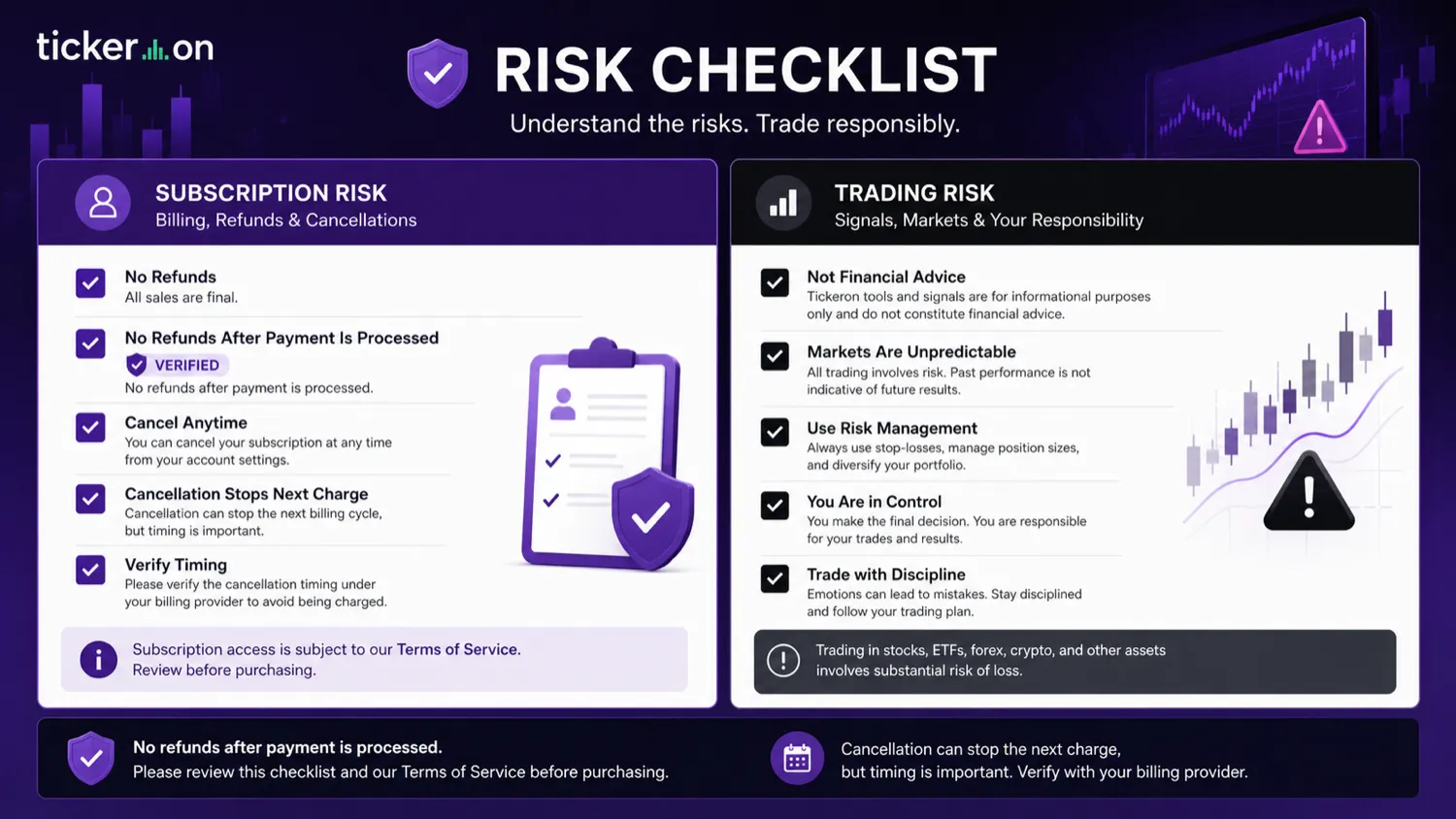
Buyers who rely on refunds as a safety net should slow down. Tickeron’s public refund FAQ says there is no refund once payment is processed. That changes the buying sequence. You need to do the careful checking before payment, not after.
I would also be cautious if you are buying because of a discount, sale row, or coupon path. A lower price does not reduce trading risk. It only reduces software cost.
How Tickeron fits into a real workflow
A sensible Tickeron workflow begins before opening the pricing page.
First, define the trading job. Are you looking for stock ideas? End-of-day signals? Pattern setups? A trend-confirmation tool? AI robots? Education? Real-time intraday alerts? Those are not the same use case.
Second, test the lowest-risk path that answers that question. If you need discovery, start with the screener or visible tool previews. If you need pattern support, compare Pattern Search Engine or Real Time Patterns. If you want robots, review robot statistics and trade behavior before subscribing.
Third, treat the output as a candidate idea, not a command. A trade idea should still go through your own risk filter: timeframe, stop logic, position size, sector exposure, market conditions, and whether the setup fits your plan.
Fourth, track whether Tickeron improves your process. Does it surface better candidates? Does it save research time? Does it make your decision clearer? Or does it simply produce more signals to worry about?
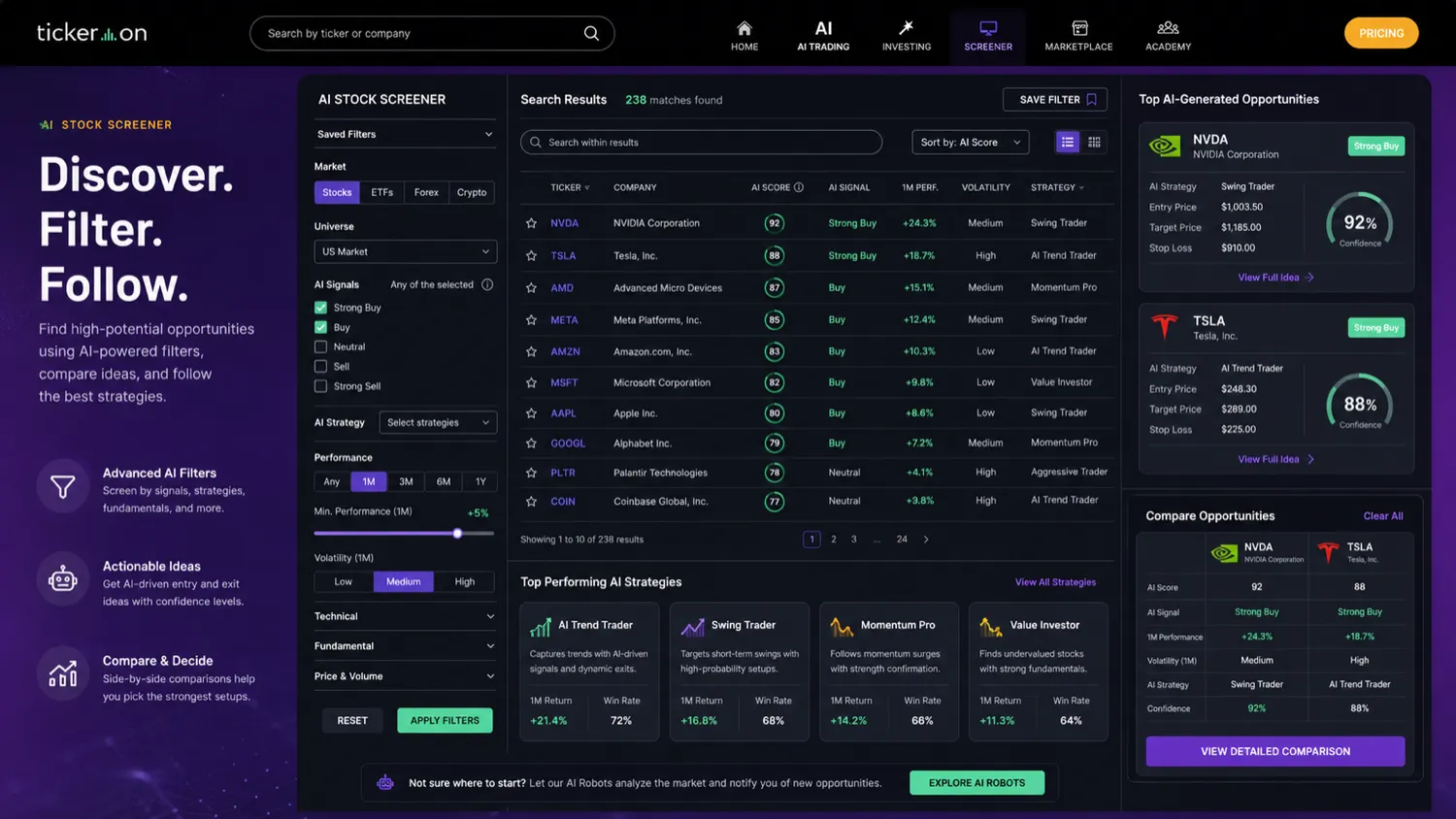
Workflow check: Tickeron is easier to evaluate when you test one trading workflow first instead of subscribing to the broadest plan too early.
Real-world buyer scenarios
Swing trader comparing end-of-day signals
A swing trader may use Tickeron to review daily buy/sell signals, trend tools, and pattern setups after the market close. The fit is strongest if the trader already has rules for entries, exits, and position sizing. The risk is blindly chasing signals without understanding why they appear.
DIY trader using the AI Screener first
A self-directed trader may get better value from the AI Screener than from an immediate robot subscription. A screener can help narrow the market into candidates while leaving the final decision with the trader. This is a safer first test because it teaches how Tickeron frames opportunities.
Active trader evaluating AI Robots
An active trader may be attracted to AI Robots because the statistics look concrete. This is where the buyer should slow down. Review the robot category, trade history, timeframe, drawdown, closed trades, and alert behavior before paying. A good-looking robot that does not match your execution style can still be a poor fit.
Beginner trying to learn trading tools
A beginner can use Tickeron’s education and free member path to learn the platform, but should be careful with paid signal products. The better first goal is understanding markets and risk, not copying outputs from a dashboard.
Key features that actually matter
AI Robots and trading agents
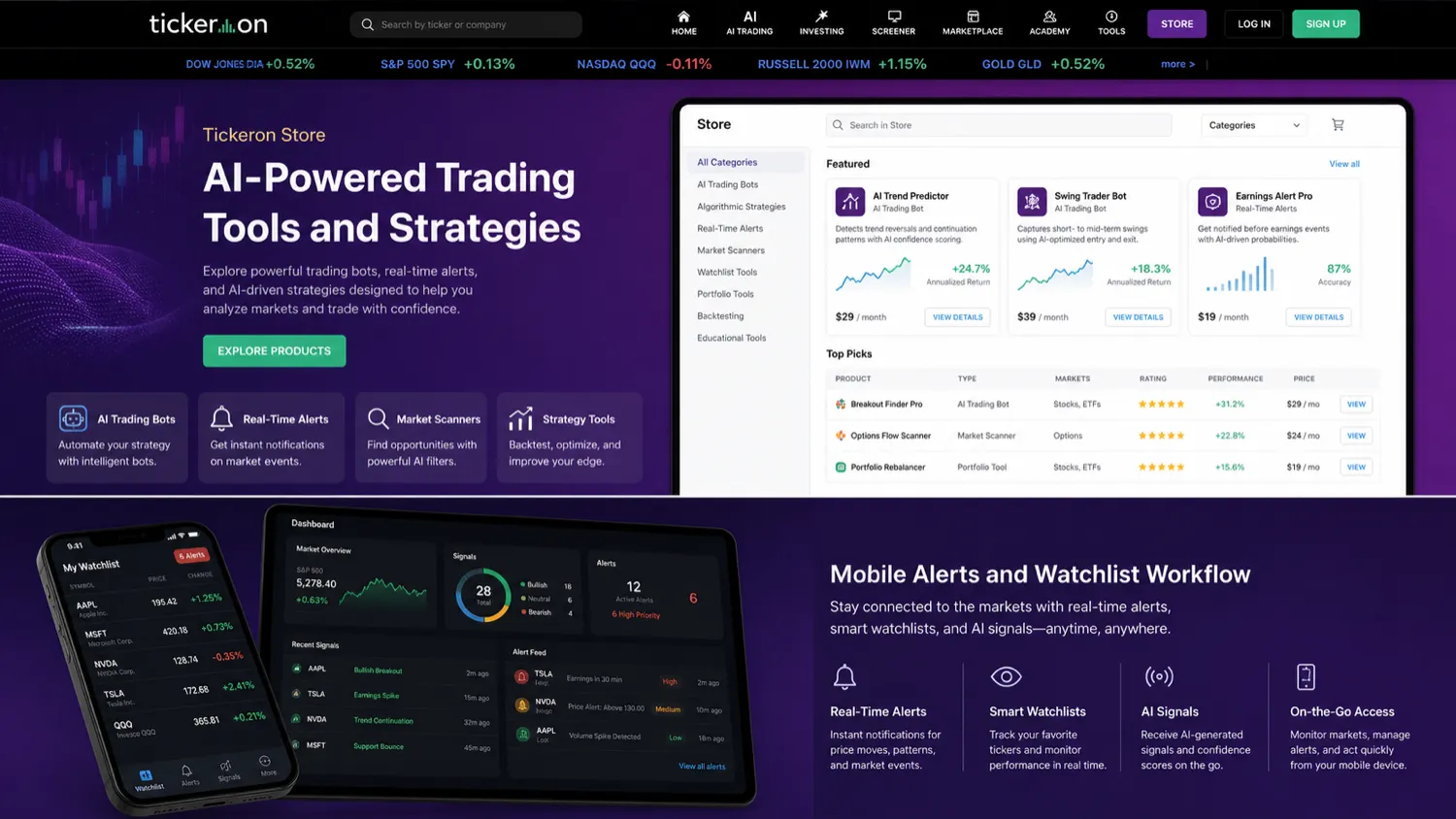
Tickeron’s AI Robots are the most attention-grabbing part of the platform. They are positioned around trade ideas, statistics, alerts, robot categories, and different trading styles.
Buyer note: review robot statistics as historical or forward-testing context, not as a promise. The useful question is whether you can explain the robot’s behavior well enough to decide when not to follow it.
AI Screener
The AI Screener can help traders filter stocks and compare market ideas. This may be the most practical starting point for cautious users because it supports research without forcing a full copy-style decision.
Buyer note: if the screener feels overwhelming, a robot subscription may not feel simpler. Complexity does not disappear when the product automates more of the process.
Pattern Search Engine and Real Time Patterns
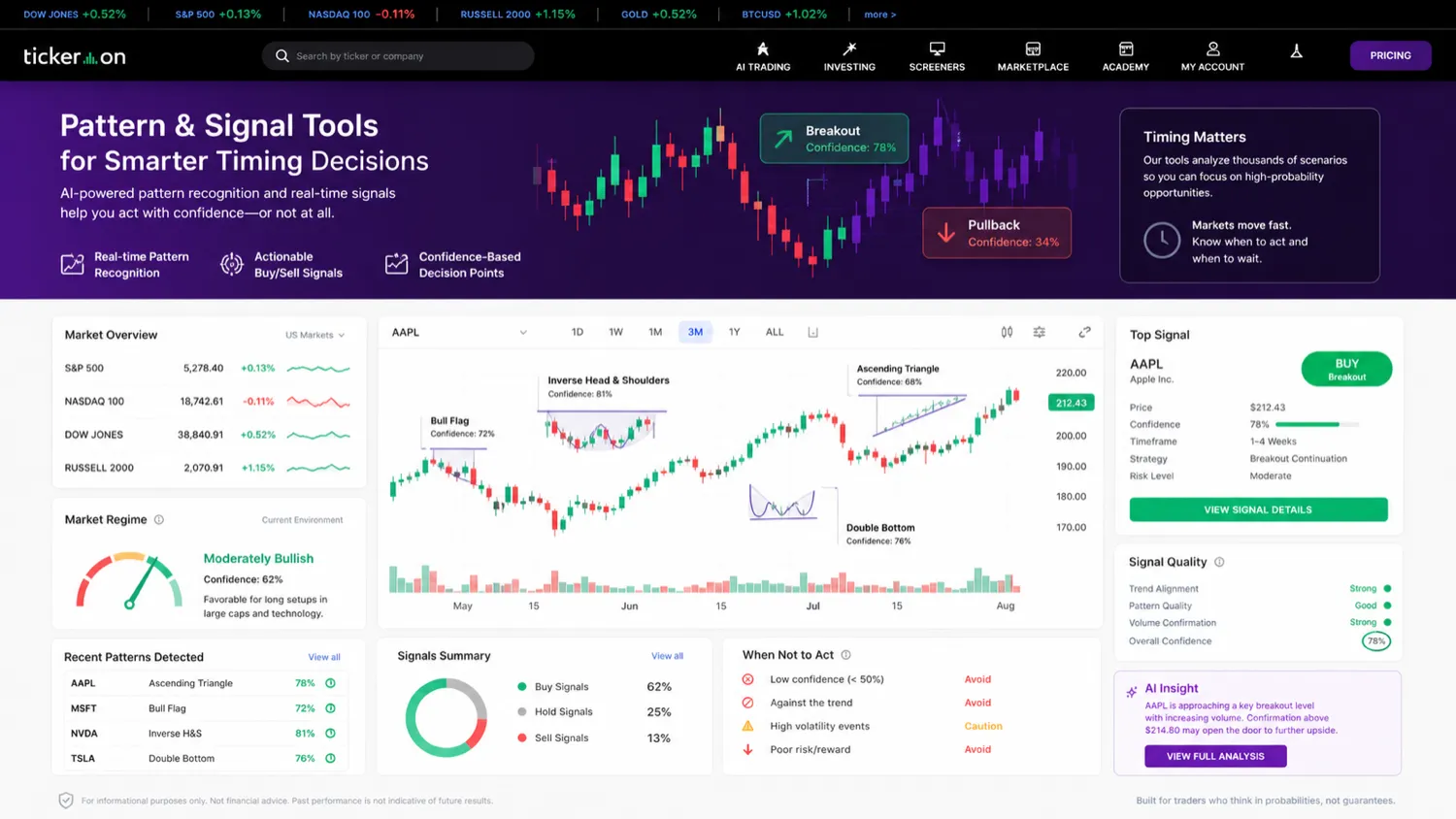
Pattern tools can help traders find setups faster than manual scanning. This matters for users who already use technical analysis and want more structured discovery.
Buyer note: a pattern is not a trade plan. You still need timeframe, risk rules, position sizing, and a reason to skip low-quality setups.
Trend Prediction Engine
Trend prediction can be useful for traders who already work with continuation or reversal logic. It can provide a second opinion on direction and setup quality.
Buyer note: do not use trend output as a shortcut for market understanding. The tool may help you focus attention, but it cannot make volatility disappear.
Daily buy/sell signals
Daily signals can be appealing because they are simple to understand. The danger is that simple signals can invite overconfidence.
Buyer note: verify whether signal access is included in your selected plan or excluded from trial messaging. Also decide how you will evaluate signal quality before putting real money behind it.
Education, videos, and lessons
Tickeron’s education layer is useful because trading tools become risky when buyers do not understand the underlying process. Webcasts, articles, videos, and 1-on-1 lessons can help buyers understand the platform before upgrading.
Buyer note: education is not a substitute for performance proof, but it can reduce the chance of buying a tool you do not understand.
Pricing and plan value
Tickeron pricing needs a careful read because it is not a simple one-plan SaaS product.
The public pricing page shows a $0 member path, visible paid examples such as Beginner at $80/month, Swing Trader at $90/month, and Day Trader at $250/month, plus a modular set of individual tools, robot options, annual rows, promotional rows, and product-specific trial language. Some individual tools appear around lower monthly amounts, while robot bundles and broader memberships can cost more. The exact price depends on what you select.
That complexity is not automatically bad. Modular pricing can be useful if you only need one tool. But it creates buying risk because the cheapest visible path may not include what you actually came for.
The 14-day trial messaging is also not enough by itself. Tickeron’s pricing page shows trial language, but it also notes exceptions for AI Robots, Expert Membership, Buy/Sell Signals, and annual subscriptions. That means the buyer should verify trial eligibility for the exact checkout item, not just remember the headline trial message.
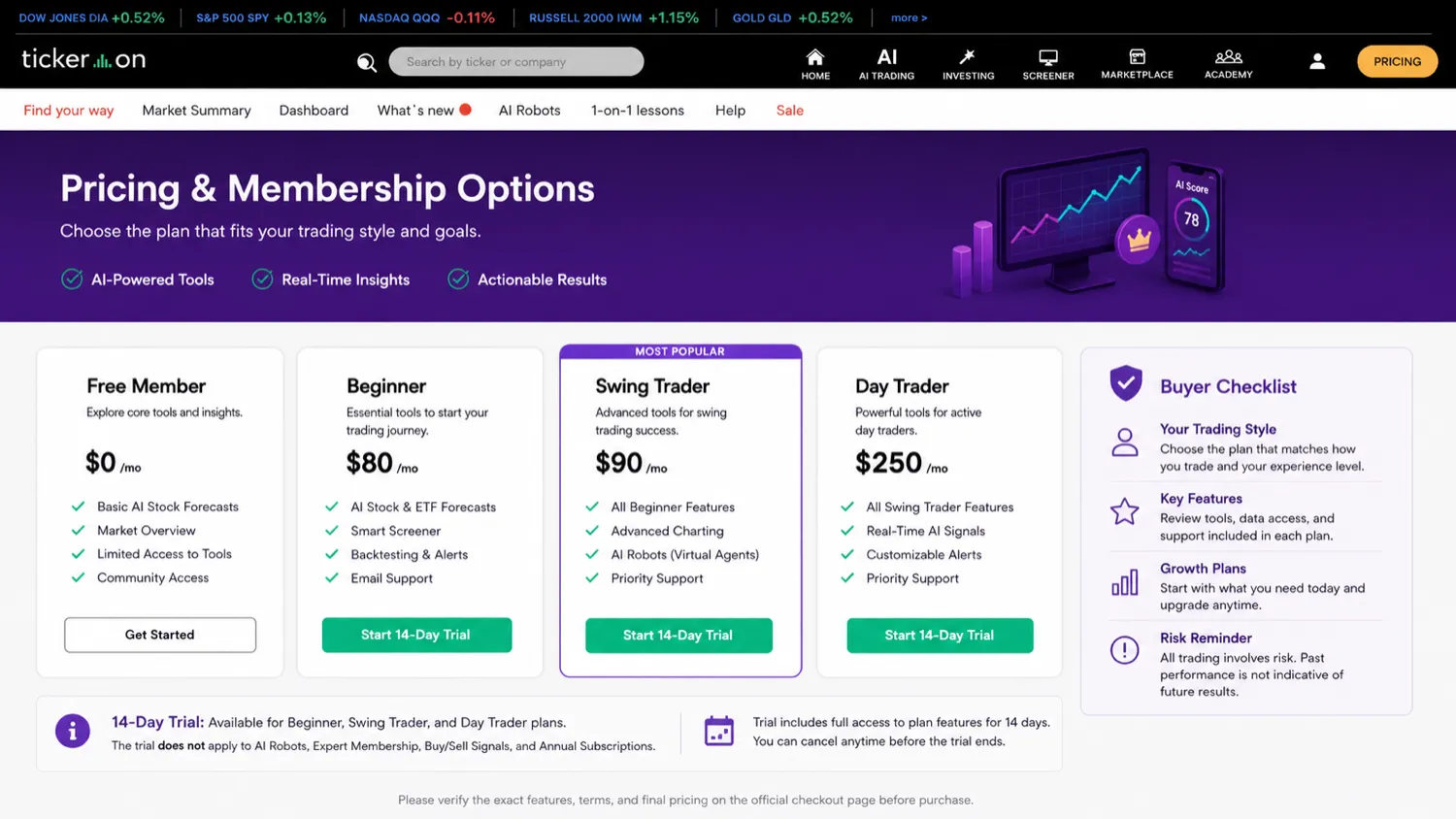
My pricing take is cautious: start with free member access or the narrowest useful tool, then move to a paid plan only when you know which workflow is improving. Annual billing should come later, after you have evidence from your own usage.
Pricing check: Before paying, confirm whether your selected Tickeron route is a membership, AI tool, robot subscription, signal product, annual plan, or promotional bundle.
Free plan, trial, coupon, and checkout notes
Tickeron’s free member path is the right place for many cautious buyers to begin. Use it to understand the interface, product categories, tool previews, and whether the platform’s language makes sense to you.
The trial path is useful, but only after you confirm eligibility. Trial language is visible, yet some product groups may be excluded. If your real interest is AI Robots, Expert Membership, Buy/Sell Signals, or annual billing, do not assume the headline trial applies.
The coupon path should be treated as the last commercial check, not the reason to buy. Tickeron is a trading platform. The main risk is not missing a small discount. The main risk is choosing a plan that influences real-money decisions before you understand the tool.
If you want to check current DealBestDaily routing after the product fit is clear, use the Tickeron coupon page. But I would make the buying order simple: understand the trading workflow first, confirm the plan second, check active offers third.
Checkout order: Treat any coupon or promotional route as secondary. First verify workflow fit, trial eligibility, no-refund language, and cancellation timing.
What I would check before buying Tickeron
If I were buying Tickeron for a real trading workflow, I would not start with the biggest robot claim. I would start with the boring checks.
- Which product am I actually buying: membership, screener, trend tool, pattern tool, signal product, robot, or bundle?
- Does the 14-day trial apply to that exact product and billing interval?
- What happens after the trial ends, and when will the card be charged?
- What does the selected plan include and exclude?
- Can I explain how I will use the tool before acting on any signal?
- What is my cancellation deadline before the next billing cycle?
- Am I comfortable with the public no-refund language after payment?
The easy mistake is to compare only performance claims. The better approach is to compare the tool against your own trading process. If you do not have a process yet, the first purchase should probably be education, not a large robot subscription.
A simple test before paying
Before paying for Tickeron, I would run a small test like this:
- Choose one market or ticker group you already follow.
- Use the free member path or visible tool access to inspect how Tickeron presents ideas.
- Pick one workflow only: screener, pattern search, trend prediction, signals, or robot review.
- Track a small sample of ideas without placing live trades immediately.
- Compare the tool’s outputs with your own research and risk rules.
- Check whether the tool saves time or just creates more decisions.
- Only then decide whether a paid monthly plan is worth testing.
This test will not prove future performance. It is not supposed to. It helps you answer a more practical question: does Tickeron improve your decision process enough to justify subscription risk?
Pros explained
Tickeron’s first real strength is breadth. The platform covers AI robots, screeners, trend prediction, pattern tools, real-time patterns, daily signals, mobile access, community-style views, and education. For a trader who wants one ecosystem for research and signal discovery, that is attractive.
The second strength is a visible free or lower-risk entry path. You can inspect parts of the platform before choosing a bigger paid commitment. That matters because trading tools are easy to overbuy.
The third strength is statistics. Robot pages and product copy emphasize performance-style details, trade history, win rates, drawdown, profit factor, and other metrics. These are useful inputs for experienced traders who know how to read them.
The fourth strength is education. Tickeron offers more context than a bare signal app. That does not make every paid plan safe, but it gives buyers more ways to understand the platform before deciding.
The fifth strength is mobile availability. Traders who monitor alerts and ideas away from a desktop may care about that. I would still avoid trading from notification pressure alone.
Cons explained
The biggest con is not a missing feature. It is the psychology of AI trading.
A platform that presents robots, signals, performance statistics, and confident trade ideas can make decisions feel cleaner than they are. That can be useful for disciplined traders and risky for beginners.
The second con is pricing complexity. Tickeron has memberships, individual tools, robot paths, signals, annual options, promotional rows, and exclusions. Buyers need to slow down and identify the exact product they are buying.
The third con is refund risk. The public refund FAQ says there is no refund once payment is processed. That does not mean nobody should buy. It means buyers should not use payment as the beginning of the evaluation process.
The fourth con is beginner fit. Tickeron may include educational resources, but the trading products themselves can still be too much for someone who does not yet understand technical analysis, risk management, and execution timing.
The fifth con is category confusion. Because Tickeron may sit inside broader AI tool or AI agent site architecture, buyers can accidentally compare it with chatbot products. That is the wrong lens. Tickeron should be judged as trading software.
Green flags and red flags
Green flags:
- You already have a trading process and want faster idea discovery.
- You can explain which Tickeron tool category you need before checkout.
- You are willing to test outputs without immediately risking real capital.
- You understand that robot statistics are not guarantees.
- You are starting monthly or free before considering annual billing.
Red flags:
- You want AI to tell you what to buy without doing your own analysis.
- You are choosing a plan because the return number looks exciting.
- You cannot tell whether you need a screener, signal product, robot, or pattern tool.
- You are relying on a refund if the tool disappoints.
- You are upgrading because of a sale row rather than proven workflow value.
Tickeron vs alternatives
Tickeron should be compared with trading and market-analysis tools first. AI-agent tools can be relevant inside site navigation, but they are not direct replacements for a trading platform.
TradingView vs Tickeron
TradingView is the stronger comparison if you mainly want charting, indicators, community scripts, alerts, and a familiar technical-analysis environment. It is not the same as Tickeron’s robot-led AI trading pitch, but many traders may prefer starting with charting discipline before adding signal automation.
Tickeron may make more sense if you want AI robots, pattern engines, and trade-idea products in one ecosystem.
Trade Ideas vs Tickeron
Trade Ideas is a closer direct comparison for active traders who want stock scanning, alerts, and AI-assisted market ideas. It may be the better comparison if you care heavily about stock-scanning workflow and real-time trading routines.
Tickeron may feel broader if you want robot categories, pattern search, trend prediction, academy content, and multiple AI product paths.
TrendSpider as an adjacent direct trading route
TrendSpider is worth comparing if your main need is automated technical analysis, charting, alerts, and backtesting-style workflow. It is not the same buying decision as Tickeron’s AI Robots, but it can be a more chart-analysis-centered route for traders who want automation without leaning into robot performance claims first.
Use this comparison if you want tools around your own strategy, not a platform that pushes you toward ready-made AI trading agents.
Chaindesk vs Tickeron
Chaindesk is not a direct Tickeron alternative. It is an adjacent AI-agent route for buyers who want knowledge-base chatbots or customer-support automation. If you came from an AI agents hub, this comparison clarifies the category mismatch.
Choose Chaindesk-style tools only if your actual need is chatbot automation. Choose Tickeron only if your actual need is market analysis and trading decision support.
Chatbase vs Tickeron
Chatbase is also adjacent, not direct. It belongs in website chatbot and customer-support automation workflows. It should not be used to judge whether Tickeron is good trading software.
This matters because a product can share an “AI agent” label while solving a completely different buyer problem.
Trust, refund, and buyer-risk notes
Tickeron’s trust picture is mixed in a normal, practical way.
On the positive side, the product has official pages, pricing information, product-specific help content, videos, mobile app routes, education pages, and many visible tool categories. That gives buyers enough material to understand the platform’s role.
The caution is that trading software creates two kinds of risk.
The first is subscription risk: paying for the wrong plan, misunderstanding trial eligibility, missing cancellation timing, or assuming a refund exists when the public FAQ says otherwise.
The second is trading risk: acting on signals too quickly, following robot outputs without understanding the method, confusing historical statistics with future certainty, or letting an AI dashboard override your own risk rules.
Those two risks should be handled separately. A good subscription decision does not make a trade safe. A good trade result does not prove the subscription will keep paying for itself.
My confidence is strongest around Tickeron’s product role: AI-assisted trading research, robots, screeners, pattern tools, signals, and education. I am more cautious around live pricing, trial exclusions, promotional rows, and buyer outcomes because those depend on checkout details and real-world trading behavior.
Final verdict
I would consider Tickeron if you already trade actively, understand risk, and want AI-assisted tools for idea discovery, robot review, pattern search, trend analysis, or signal monitoring.
I would skip it if you are looking for guaranteed returns, a simple stock tracker, or a tool that removes the need for your own judgment. I would also skip the bigger plans until you can explain exactly which product category fits your workflow.
I would compare Tickeron with TradingView if charting and analysis discipline matter most, and with Trade Ideas if stock scanning and active-trader alerts are the real priority. I would only compare it with Chaindesk or Chatbase if your real goal is chatbot automation rather than trading.
The safest next step is not to chase the biggest discount or the most exciting robot statistic. Start with the free member path or a narrow trial-eligible workflow, verify the selected plan and cancellation rules, and treat any signal as research support rather than financial advice.