Quick verdict
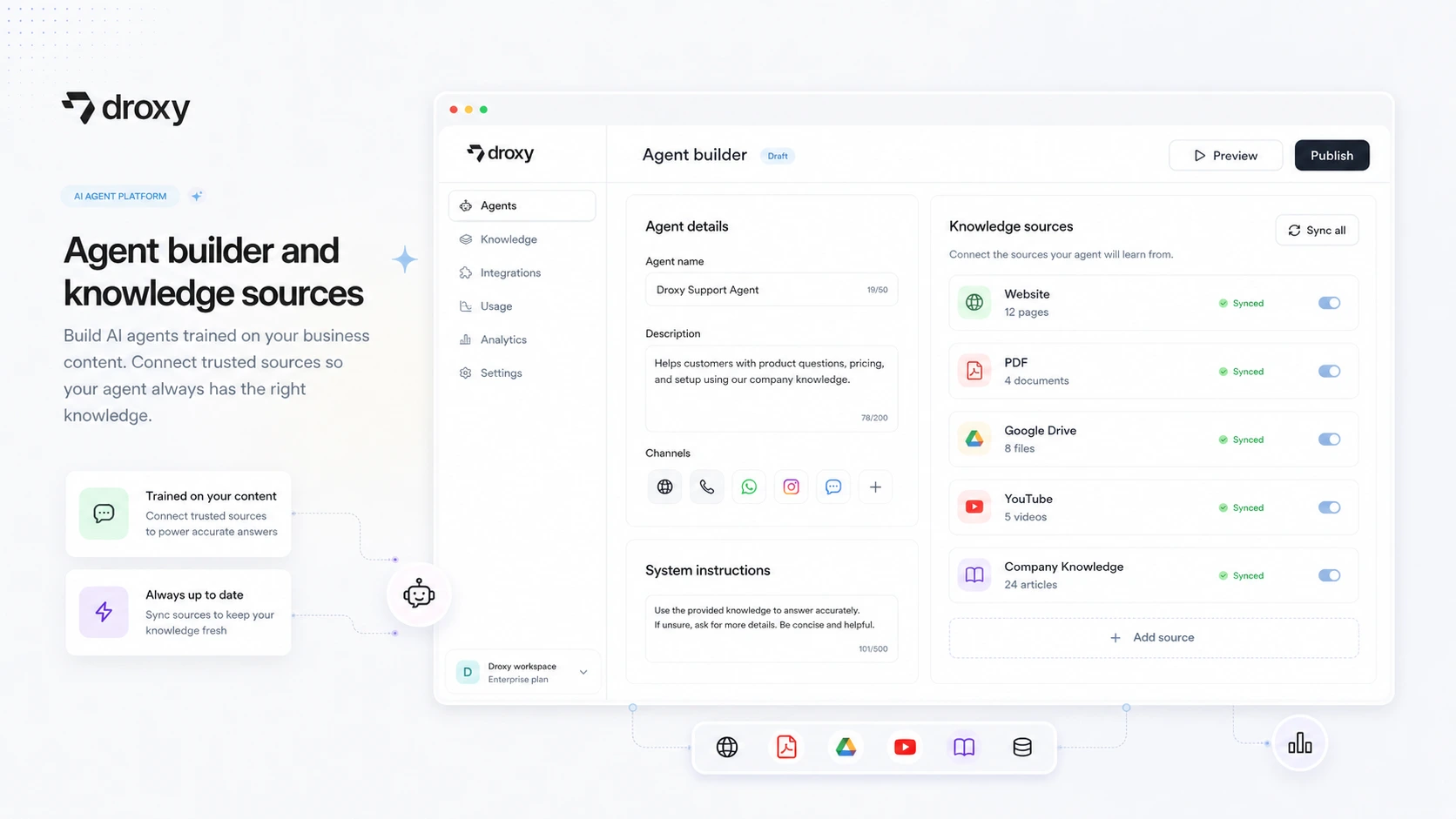
Droxy is worth considering if you are not just trying to add a small chat bubble to a website, but trying to build a customer-facing AI agent that can answer questions, collect leads, handle calls, work across messaging channels, and route harder conversations back to a human.
That is the buying tension.
The product looks simple from the outside: create an agent, train it on business knowledge, and deploy it where customers talk to you. The real decision is narrower. Do you have enough repeated customer interaction to justify a multichannel agent platform, and do the plan limits match the way your customers actually contact you?
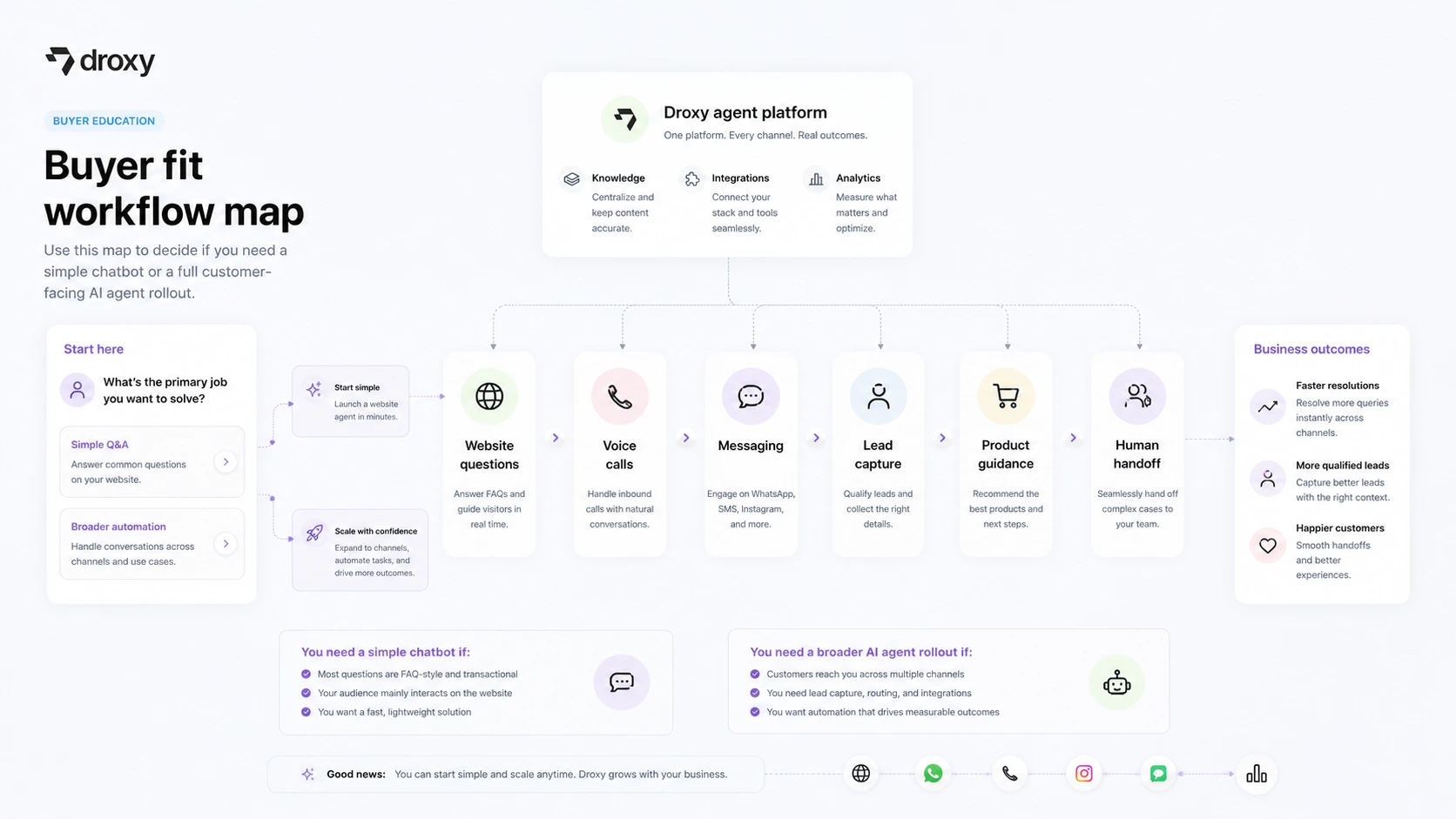
I would be careful if your use case is only a basic FAQ widget. Droxy can do more than that, but “more” is not always the same as “better value.” The strongest reason to consider it is the channel spread: website, phone, WhatsApp, Messenger, Instagram, Facebook, Shopify-style product guidance, lead collection, human handoff, Zapier, and API access. The main caution is that pricing is not only a monthly number. Knowledge tokens, message tokens, call minutes, knowledge items, storage, model access, and integration limits shape the real cost.
For my money, the safest path is to start with the free Starter route, build one agent with real business content, and test it against actual customer questions before looking at annual billing or active offers.
Next step: If Droxy still matches your customer-support or sales workflow, open the product first and verify the live plan limits before checkout.
Review snapshot
| Review point | Practical take |
|---|---|
| Best for | Businesses that want a no-code AI agent across website chat, phone, messaging, lead collection, ecommerce Q&A, and human handoff |
| Not ideal for | Buyers who only need a simple FAQ widget, a generic AI writing tool, or a low-risk refund window after purchase |
| Main use case | Turning approved business knowledge into customer-facing conversations across multiple channels |
| Free path | Starter is described as a free tier in the official docs |
| Paid path | Basic, Advanced, and Enterprise depend heavily on tokens, call minutes, knowledge items, storage, channels, models, and API or analytics needs |
| Main strength | Multichannel customer interaction in one buying path |
| Main concern | Non-refundable purchase language and usage limits make pre-checkout testing important |
| Direct alternatives to compare | Chatbase and Chaindesk |
| Adjacent route to compare | CustomGPT if the buyer mainly needs source-grounded business knowledge rather than a phone-and-messaging support layer |
| Best next step | Build one real Starter agent and test it with real customer questions before paying |
What is Droxy?
Droxy is best understood as a no-code platform for building customer-facing AI agents trained on business knowledge and deployed across channels where customers already ask questions.
That includes website chat, phone workflows, messaging apps, social channels, lead collection, product recommendations, and human handoff. The official positioning is closer to “AI agent for customer interaction” than “general AI assistant.” That distinction matters because the value is not only in generating answers. The value is in reducing repeated support, sales, and intake work without forcing every conversation into one widget.
The common wrong expectation is that Droxy is automatically useful because AI chatbots are popular. I would not judge it that way. A customer-facing agent is only as good as the business knowledge behind it, the channels it supports, the handoff path when it gets stuck, and the plan limits that control how much customer volume it can handle.
Our review approach: we compare public product pages, pricing details, help documentation, deal terms, buyer workflow fit, and nearby alternatives. We do not treat a free plan, coupon path, or low entry price as proof that the product fits the buyer.
In plain language, Droxy is for businesses that want to move from “customers keep asking the same things” to “an AI agent handles the first layer, collects useful context, and passes harder cases to a person.” It is not the first tool I would choose if the buyer only wants an internal knowledge assistant, a casual AI chat page, or a cheap one-question FAQ bot.
Who should use Droxy?
Droxy makes the most sense for businesses that already feel the pain of repeated customer questions.
A local service business may use it to answer pricing, hours, appointment, location, policy, or service-fit questions before a person steps in. The condition is that the business must have accurate source material. If the website is old, the PDFs conflict with current policies, or the team cannot agree on approved answers, the agent will be harder to trust.
An ecommerce operator may find Droxy useful when product questions, product recommendations, lead capture, and support messages happen across the website and social channels. The buyer should check Shopify support, product Q&A limits, message volume, and whether human takeover works cleanly before expecting it to reduce workload.
A small support or sales team may use Droxy as a first-response layer. This is where the tool becomes more interesting. If the team gets the same questions through website chat, WhatsApp, Messenger, Instagram, and phone, a single agent platform can be easier to manage than several disconnected tools.
An agency may consider Droxy for client-facing agent projects, especially when clients want simple deployment across websites and messaging channels. The agency should verify branding, custom domain, sharing, analytics, API access, and whether plan limits make sense for multiple clients.
A technical buyer may care about Zapier and API access. Droxy does have integration and API language in the official pricing and ecosystem material, but the buyer still needs to confirm exact access, plan requirements, and volume before building a workflow around it.
Who should avoid Droxy?
I would avoid Droxy if the problem is smaller than the product.
A business that only needs a static FAQ widget may not need phone agents, message tokens, call minutes, model choices, analytics, product recommendations, API access, or multichannel deployment. Paying for a broader agent platform before proving the need can create more setup than value.
I would also be cautious if your business knowledge is messy. AI agents need clean inputs. If your website says one thing, your internal document says another, and your team handles exceptions manually, Droxy may expose the problem rather than solve it.
Buyers who need refund flexibility should slow down. Droxy’s terms use non-refundable purchase language, with cancellation taking effect at the end of the current paid term. That does not make the product bad, but it makes the free Starter path and pre-checkout testing more important.
Very small projects should also check whether they will outgrow the free path but underuse the paid plans. The awkward middle is common: a buyer wants more than free, but not enough to justify channel-heavy or voice-heavy usage.
Finally, teams with strict compliance, data review, or support-governance needs should inspect privacy, access, exports, conversation logs, human takeover, and accountability before going live. A customer-facing AI agent is not just a tool purchase. It becomes part of how customers experience the business.
How Droxy fits into a real workflow
The best Droxy workflow starts before the agent is built.
First, gather the questions customers already ask. Not imagined questions. Real ones from email, chat, phone calls, comments, social messages, and support notes. Then collect approved sources: current website pages, PDFs, product information, policy documents, service descriptions, and any Google Drive material the team trusts.
After that, build one agent for one clear job. For example: answer pre-sale questions on the website, capture leads after hours, handle product questions, or route phone inquiries. The weaker approach is trying to automate every channel on day one.
A practical rollout looks like this:
- Pick one customer-facing problem.
- Train the agent on clean, current business knowledge.
- Ask real customer questions, including edge cases.
- Test escalation and human handoff.
- Check whether the answer style matches the brand.
- Review token, call-minute, and channel usage.
- Expand to phone, WhatsApp, Messenger, Instagram, Shopify, Zapier, or API workflows only after the first agent works.
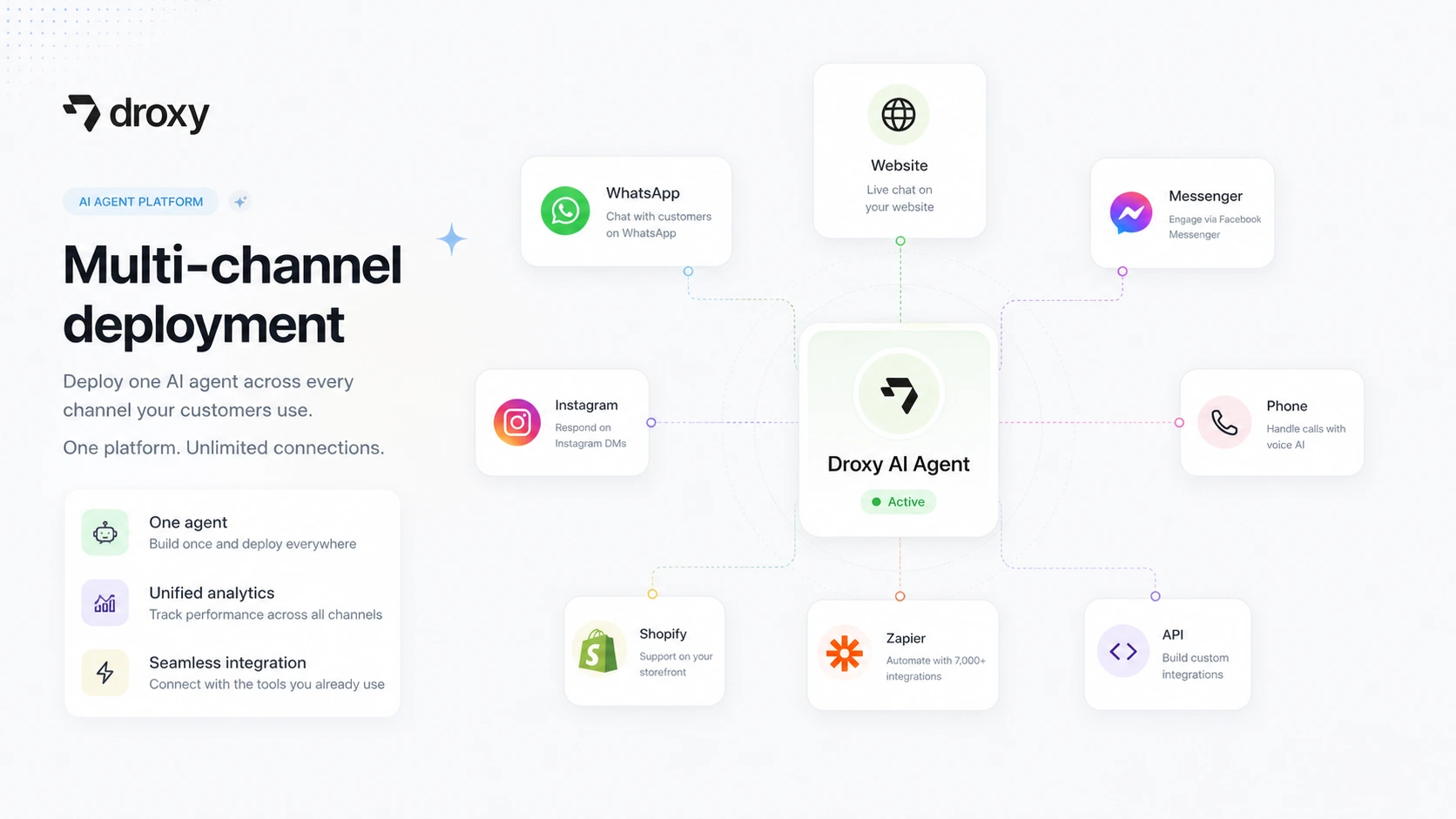
The strongest fit is a repeated process: customer asks a common question, the agent answers from approved knowledge, collects useful details, and hands off when needed. The weakest fit is treating Droxy as a magic customer-service replacement. It is better as a first-response and routing layer than as a fully independent support department.
Workflow check: If you need Droxy for website, phone, and messaging together, test one agent before expanding into every channel.
Real-world buyer scenarios
Local service business with missed calls
A local service business may want Droxy because customers keep calling after hours or asking the same pre-sale questions. Droxy can fit if the business has clear service pages, pricing ranges, appointment rules, and escalation instructions.
The failure point is vague knowledge. If the agent cannot tell when to hand off, or if the business has too many exceptions, phone and message automation can frustrate customers instead of helping them.
Ecommerce store with product questions
An ecommerce buyer may care about product recommendations, product Q&A, lead collection, and messaging channels. Droxy becomes useful when customer questions repeat often enough to justify automation.
Before paying, I would check product data quality, Shopify needs, message volume, image or voice message needs, and whether the plan supports the channel mix. Chatbase may be a cleaner comparison if the whole job is website support chat. Droxy becomes more relevant when phone, social, and multichannel coverage matter.
Small support team handling repeated questions
A small team may use Droxy to reduce first-response work. The product can help if the team has a consistent process for reviewing conversations, updating source material, and escalating edge cases.
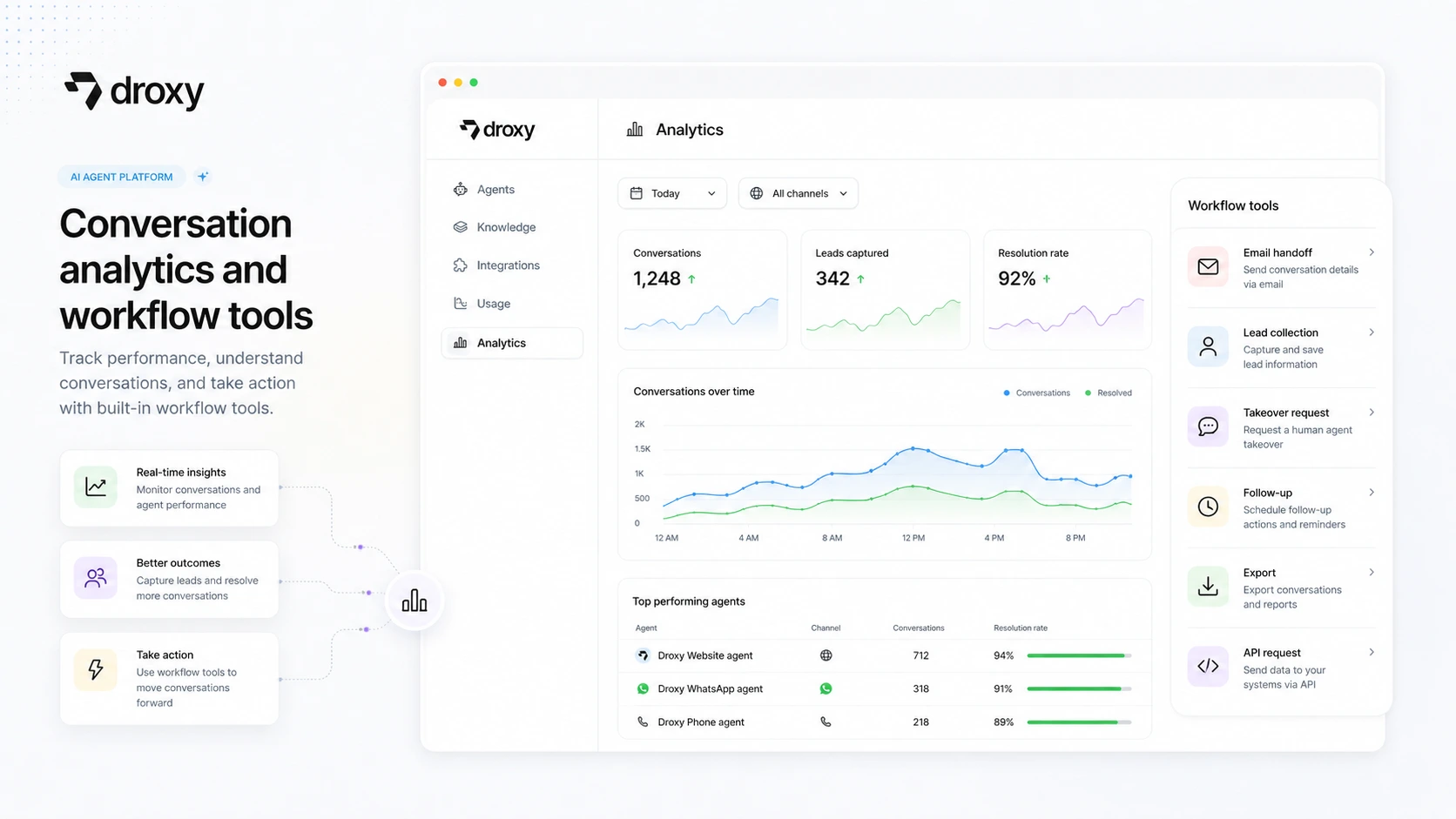
The buyer should not only ask, “Can it answer questions?” The better question is, “Can we monitor, improve, and govern the answers after launch?” Analytics, exports, conversation review, and handoff rules matter here.
Agency building AI agents for clients
Agencies may like Droxy because the no-code setup, channel coverage, branding options, sharing, and integrations can support client projects.
The caution is scale. Multiple clients can create multiple knowledge bases, agent limits, custom domains, handoff rules, and support expectations. The agency should verify plan limits, client access, branding, API access, and cancellation risk before selling it as a managed service.
Key features that actually matter
Multichannel deployment
Droxy’s most important feature is not that it can build a chatbot. Many tools can do that. The more important buying point is channel coverage: website, phone, messaging, social comments, and ecommerce-style support.
Buyer note: list the channels you actually need before comparing plans. If you only need website chat, a narrower alternative may be easier to justify.
Knowledge training from business sources
Droxy can be trained on business knowledge such as website content, documents, videos, Google Drive material, and other approved sources. This is the foundation of answer quality.
Buyer note: do not evaluate the product with random sample content. Use current, approved material from your real business. The agent’s quality depends on what you feed it.
Phone agent and call minutes
Phone support is one of the features that makes Droxy more than a typical website chatbot. It can matter for service businesses, local operators, and teams that still receive meaningful call volume.
Buyer note: call minutes and phone-number allowances should be treated as plan-critical limits. A website-only buyer can ignore this. A phone-first buyer cannot.
Lead collection and human handoff
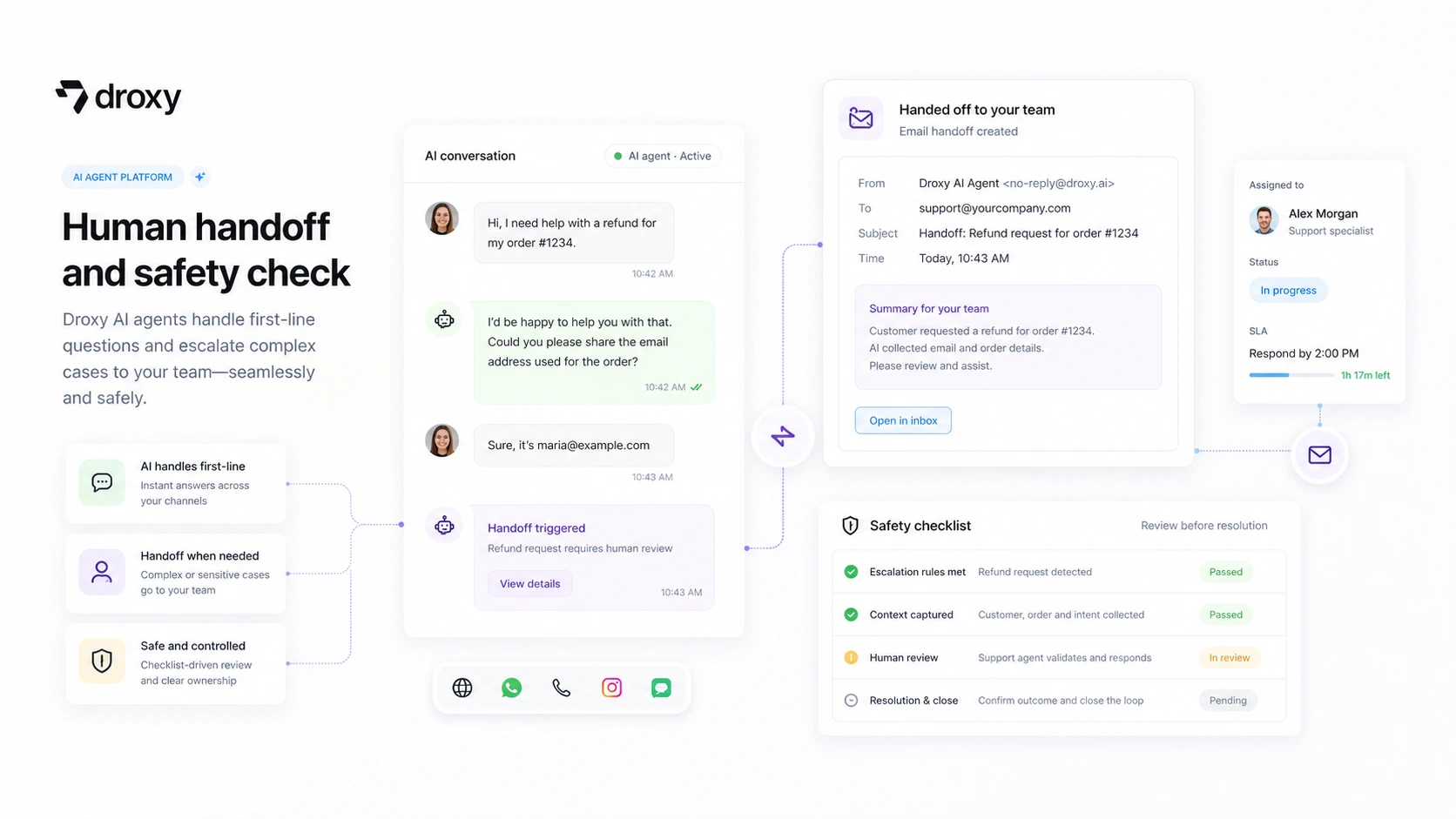
Lead capture, email handoff, takeover requests, appointment scheduling, and follow-ups can turn Droxy from an answer tool into an operational layer. This is where it may save time for sales and support teams.
Buyer note: test handoff behavior carefully. The customer experience depends on what happens when the agent is unsure, incomplete, or facing a high-value inquiry.
Analytics, exports, and conversation review
Conversation visibility matters after launch. If a business cannot review what customers asked and how the agent responded, it cannot improve the workflow.
Buyer note: check whether the plan you choose includes the analytics, exports, and conversation analysis you need. Launching the agent is only the first step.
Zapier and API access
Zapier and API access make Droxy more interesting for automation-heavy buyers. This can matter if customer messages need to become CRM updates, tickets, lead records, appointment actions, or internal alerts.
Buyer note: verify the exact plan requirements before building around automation. API access is useful only if the pricing and technical access fit the workflow.
Pricing and plan value
Droxy pricing should be evaluated as a usage-limit decision, not just a monthly price decision.
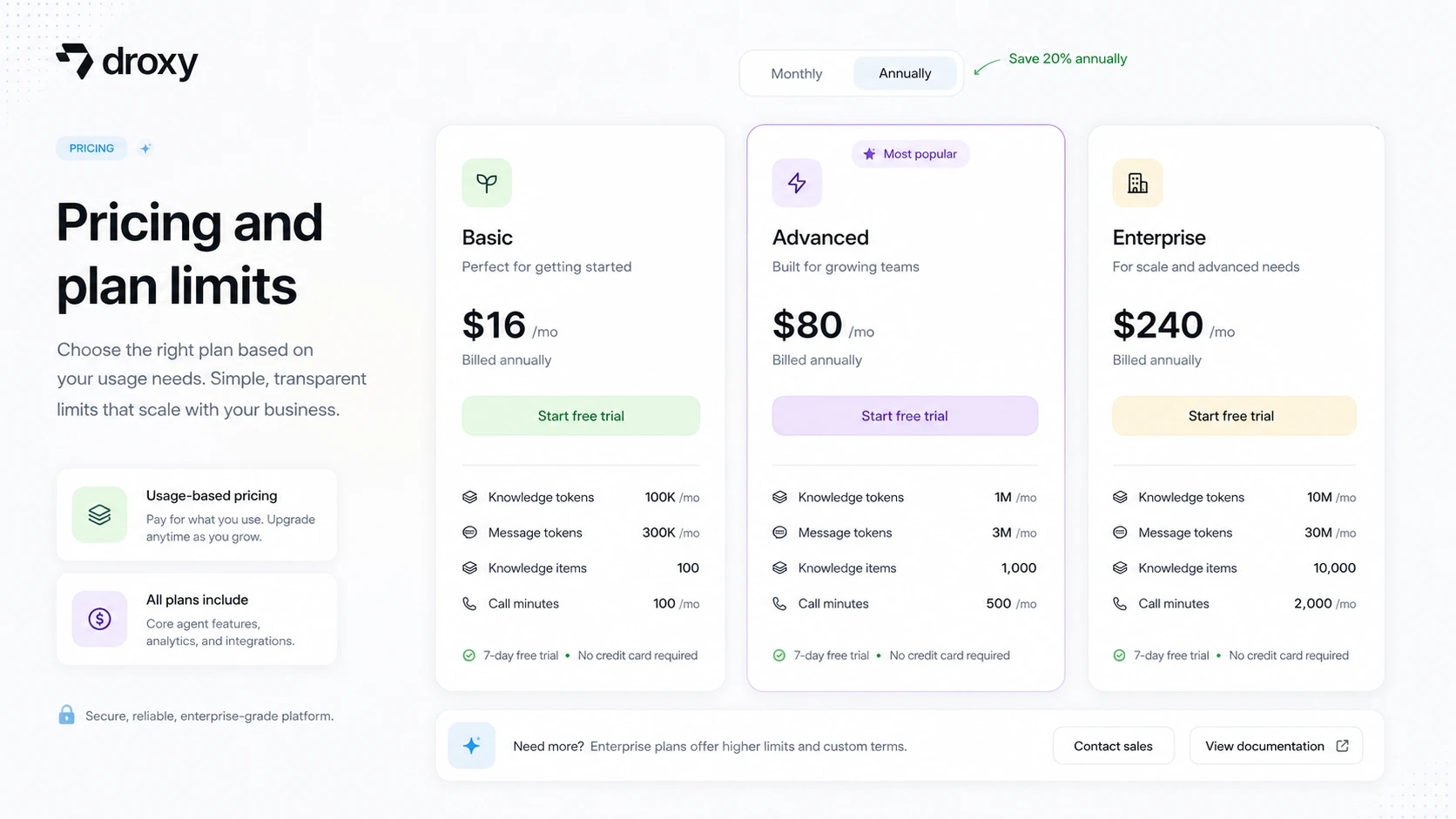
The current public pricing page presents paid tiers named Basic, Advanced, and Enterprise, with an annual billing toggle showing a 20% savings path. During this review, Basic was shown at $16 per month, Advanced at $80 per month, and Enterprise at $240 per month. The official docs also describe Starter as a free subscription tier.
That gives buyers a sensible test path: start free, prove the workflow, then compare paid limits.
The plan table matters because it exposes the real buying variables: knowledge tokens, transcription minutes, knowledge items per agent, storage, message tokens, website integration, messaging channels, call minutes, phone numbers, comment replies, model access, analytics, tools, Zapier, Droxy API, branding, sharing, and custom domain needs.
This is where buyers can easily underbuy or overbuy.
Basic may be enough for a small website agent or a first customer-support test. Advanced becomes more relevant when knowledge, message volume, call minutes, channels, analytics, or model access become serious. Enterprise is more plausible when the business needs expanded limits, unlimited knowledge items, more phone capacity, custom agent needs, or stronger operational coverage.
I would not move straight to annual billing unless the agent has already answered real customer questions well. Annual savings can improve a good purchase, but they can also lock in a plan before the buyer knows whether the agent, channels, and limits fit.
Pricing check: If Droxy fits the workflow, compare the live plan table against your expected conversations, call minutes, knowledge size, and channel needs.
Free plan, trial, coupon, and checkout notes
The free Starter path is the most important buyer-protection feature here.
Use it to build one real agent. Do not waste the test on a toy example. Add the kind of knowledge your business would actually use, then ask the kind of questions customers ask when they are impatient, confused, comparing options, or trying to reach a human.
A paid plan makes sense only after you know the agent is useful enough to become part of your customer-facing process.
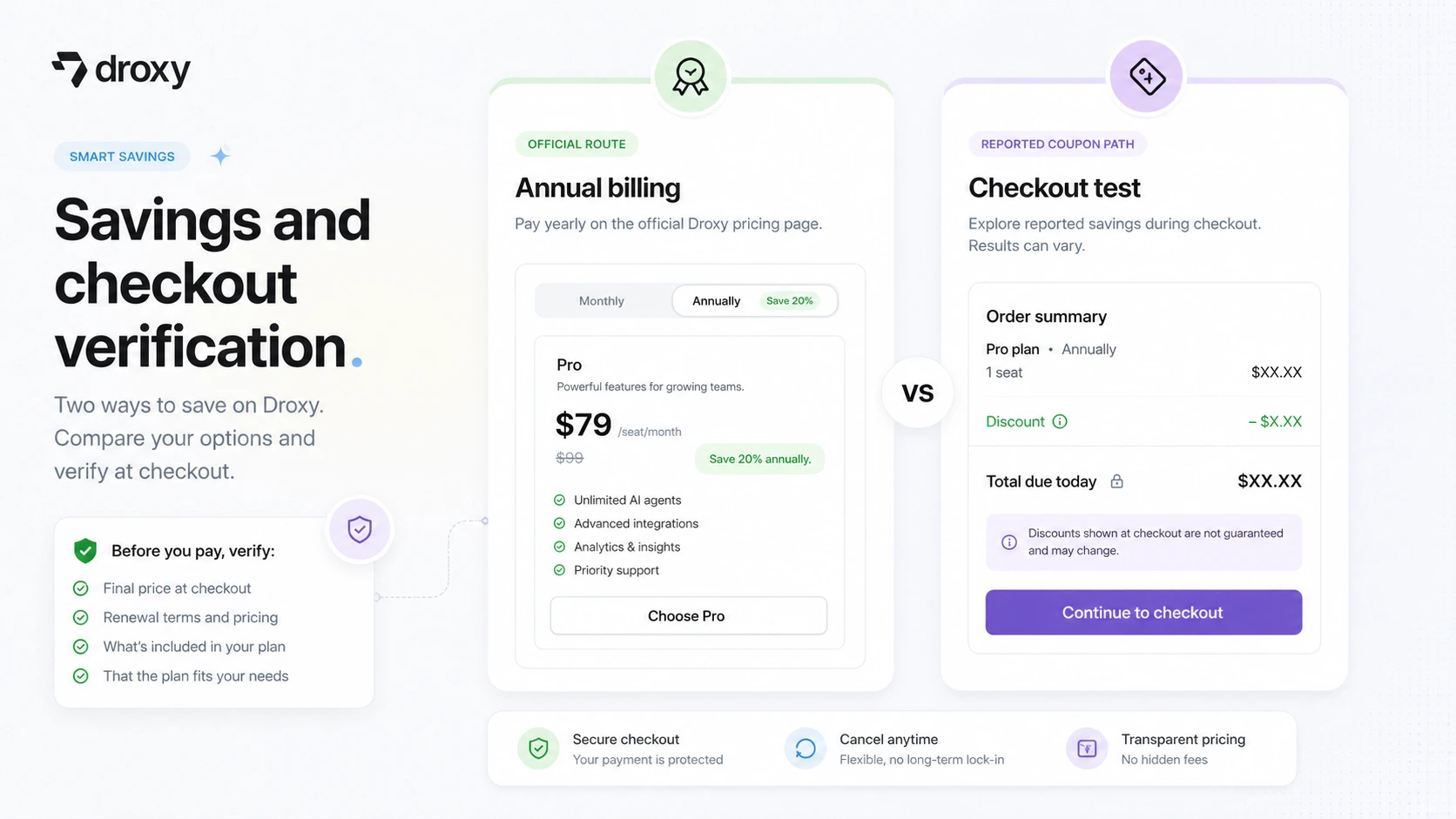
The official savings path is annual billing. The pricing page shows a 20% annual savings toggle, which is a real decision point because the terms use non-refundable purchase language. If you choose annual billing too early, the discount may not matter as much as the lock-in risk.
Public coupon sources may report Droxy offer paths. I would treat those as checkout tests, not as guaranteed savings. A reported coupon path should never be the reason to buy. It is something to check after the plan already fits.
If you check the Droxy coupon page, do it in this order: confirm workflow fit, compare plan limits, verify refund and cancellation language, then test the current offer path.
Checkout order: Treat the free Starter test as the first savings path. Check active offers only after the plan and channel fit are clear.
What I would check before buying Droxy
If I were buying Droxy for a real support or sales workflow, I would check seven things before paying.
- Customer volume: Estimate monthly website messages, social messages, WhatsApp or Messenger conversations, phone calls, and comment replies.
- Knowledge quality: Make sure the source material is current, approved, and clean enough for customer-facing answers.
- Channel requirements: Decide whether you need only website chat or also phone, WhatsApp, Messenger, Instagram, Facebook, Shopify, Zapier, or API access.
- Plan limits: Compare knowledge tokens, message tokens, knowledge items, storage, call minutes, phone numbers, model access, analytics, and branding.
- Human handoff: Test what happens when the agent cannot answer safely or when the customer needs a person.
- Billing risk: Read cancellation and non-refundable purchase language before choosing annual billing.
- Alternative fit: Compare Chatbase if you mostly need website chat, Chaindesk if support automation is central, and CustomGPT if source-grounded business knowledge is the bigger job.
A simple test before paying
Before paying for Droxy, I would run a small test like this:
- Choose one use case: website support, lead capture, product Q&A, phone intake, or message response.
- Add only current, approved business knowledge.
- Ask 20 real customer questions from past emails, calls, chats, or social messages.
- Include edge cases: pricing uncertainty, cancellation questions, complaints, product mismatch, urgent requests, and requests for a human.
- Check whether the agent answers clearly and knows when to hand off.
- Review usage against knowledge, message, and call limits.
- Decide whether Basic is enough or whether Advanced or Enterprise is needed because of channels, volume, analytics, or automation.
That test will teach more than any feature list.
The point is not to make the agent sound impressive. The point is to find out whether it can reduce real customer friction without creating new support problems.
Pros explained
The free Starter path reduces first-step risk
Droxy’s free Starter route matters because the product category is easy to overbuy. A customer-facing AI agent can look valuable in a demo, but the real test is whether it answers your actual customers well.
The free path gives buyers a safer way to test answer quality, knowledge setup, and handoff logic before paying.
It stops being enough when the business needs more knowledge volume, messages, channels, phone minutes, analytics, branding, or automation.
Multichannel support is the main reason to care
Droxy is more compelling when a business wants website chat, phone, social, messaging, and lead collection in one place. That is more useful than a narrow website-only chatbot if your customers contact you across several channels.
This matters for businesses that miss calls, repeat answers in social messages, collect leads manually, or need a first-response layer outside normal hours.
It stops being enough if the buyer only needs one simple embedded chat widget.
The pricing table gives useful limit visibility
I like that Droxy’s pricing table surfaces many of the limits buyers should compare: knowledge tokens, message tokens, call minutes, knowledge items, storage, channel access, analytics, tools, API access, and branding.
That does not make the decision simple, but it does make the tradeoff more visible.
The buyer still needs to do the volume math. A clear limit is only useful if you compare it against real traffic.
Automation and API access make it more operational
Zapier and API access make Droxy more interesting for buyers who want customer conversations to connect with other systems. Lead capture, handoff, appointment scheduling, and follow-up workflows can make the product more than a chatbot.
The caution is that automation adds responsibility. If an agent writes to a CRM, creates a ticket, or triggers a follow-up, the buyer needs review rules and fallback paths.
Cons explained
Plan value depends on usage assumptions
The biggest risk is not that Droxy has limits. Every SaaS plan has limits. The risk is choosing a plan before understanding your own volume.
If customer conversations, call minutes, or knowledge sources grow faster than expected, the buyer may need to upgrade sooner than planned. If usage is low, the buyer may pay for a platform broader than the actual need.
Non-refundable purchase language raises the stakes
Droxy’s terms state that purchases are non-refundable and cancellation takes effect at the end of the current paid term. That makes testing important.
I would not treat annual billing as a casual decision. Use the free tier first, then monthly if the business case is still forming, and consider annual only after the workflow proves repeated value.
Knowledge quality can make or break the agent
A customer-facing agent needs reliable source material. If the business has old pages, inconsistent policies, scattered documents, or unclear escalation rules, the agent may answer confidently from messy inputs.
This is not only a Droxy issue. It is a category issue. But Droxy buyers should take it seriously because the agent may interact directly with customers.
A simple buyer may not need the full platform
Some buyers only need a lightweight chat tool. Droxy’s broader feature set can be valuable, but it can also be more than the buyer needs.
If phone support, messaging channels, analytics, API access, and ecommerce workflows do not matter, compare a narrower alternative before upgrading.
Green flags and red flags
Green flags
- You already receive repeated questions across website, phone, social, or messaging channels.
- Your business has clean, current source material for the agent to use.
- You need lead capture, human handoff, appointment scheduling, or follow-up workflows.
- You want to test a free Starter agent before choosing a paid plan.
- You can estimate customer volume well enough to compare token, call, and channel limits.
Red flags
- You are buying only because a coupon path appears attractive.
- Your documentation is outdated or inconsistent.
- You need refund flexibility after purchase.
- You only need a simple FAQ widget.
- You plan to deploy across phone and messaging without testing escalation first.
- You cannot assign someone to monitor conversations and improve the agent after launch.
Droxy vs alternatives
Droxy should not be compared only by asking, “Which AI chatbot is best?” That question is too broad.
The better comparison is by buyer job: website support, customer-service automation, source-grounded business knowledge, or multichannel customer interaction.
Chatbase vs Droxy
Chatbase is usually the cleaner direct comparison if the buyer mainly wants a website-focused AI support chatbot trained on business sources.
Droxy may make more sense when the buyer needs broader channel coverage, especially phone, WhatsApp, Messenger, social, ecommerce guidance, and customer handoff. If your whole workflow lives inside a website widget, read the Chatbase review before assuming Droxy’s broader platform is necessary.
Chaindesk vs Droxy
Chaindesk is another direct comparison for support and automation-style AI agents. It may appeal to buyers who think in terms of support workflows, helpdesk-style routing, and automation around customer conversations.
Droxy’s edge is the wider customer-facing channel story. The tradeoff is that the buyer must pay closer attention to channels, call minutes, usage limits, and plan structure.
If support workflow depth matters more than phone and messaging breadth, compare the Chaindesk review before choosing.
CustomGPT vs Droxy
CustomGPT is an adjacent route, not a one-to-one replacement for Droxy.
It is more relevant if your main problem is source-grounded answers from business content, knowledge bases, documents, and web pages. Droxy is more relevant if the customer interaction layer matters: website, phone, messaging, lead capture, handoff, and operational follow-up.
If you want a business knowledge agent more than a multichannel support or sales agent, the CustomGPT review is worth comparing.
Simple live chat or helpdesk tools vs Droxy
A traditional live chat or helpdesk route can still be better if you need human support controls, ticketing, SLAs, role permissions, and mature support operations more than AI-first automation.
Droxy can sit near that workflow, but it should not be assumed to replace a full support stack without testing. A careful buyer should decide whether the agent is handling first response, lead capture, appointment intake, product guidance, or actual support ownership.
Trust, refund, and buyer-risk notes
My confidence is strongest around Droxy’s current public positioning, channel breadth, pricing structure, free Starter path, and non-refundable purchase language. I am more cautious around long-term support quality, real-world answer reliability, and whether a specific buyer’s volume will fit a given plan because those depend on usage and setup.
The refund note matters. Droxy’s terms state that purchases are non-refundable and that cancellation takes effect at the end of the current paid term. That should change the buying order. Test first, pay later, and treat annual billing as a commitment rather than a harmless discount.
Privacy also deserves attention because a customer-facing agent may process contact details, customer questions, and business knowledge. Droxy’s privacy notice says it collects information users provide and device data, and it includes rights around access, correction, deletion, and data handling. Buyers with sensitive customer conversations should read the privacy notice and decide what information should or should not be added to the agent.
The automation angle adds another layer. If Droxy connects to Zapier, API workflows, lead capture, or follow-up systems, a bad answer can become an operational action. That is why human handoff, conversation review, and escalation rules should be part of the buying decision.
I would not judge Droxy only by the entry plan. I would judge it by whether the agent can answer real questions, stay inside plan limits, hand off properly, and reduce workload without creating customer confusion.
Final verdict
I would consider Droxy if your business receives repeated customer questions across more than one channel and you want one AI agent layer for website chat, phone, messaging, lead collection, product guidance, and human handoff.
I would skip it if your problem is small: a simple FAQ widget, a one-page support bot, or a casual AI assistant. In that case, Droxy may be broader than the job.
I would compare it with Chatbase if website support is the main need, Chaindesk if support automation is the main need, and CustomGPT if source-grounded business knowledge is more important than customer-facing channel coverage.
The safest next step is not to chase the cheapest plan or the first coupon path. Build one free Starter agent with real customer questions, test the handoff, check the live plan limits, and only then decide whether Basic, Advanced, Enterprise, annual billing, or another tool is the better fit.