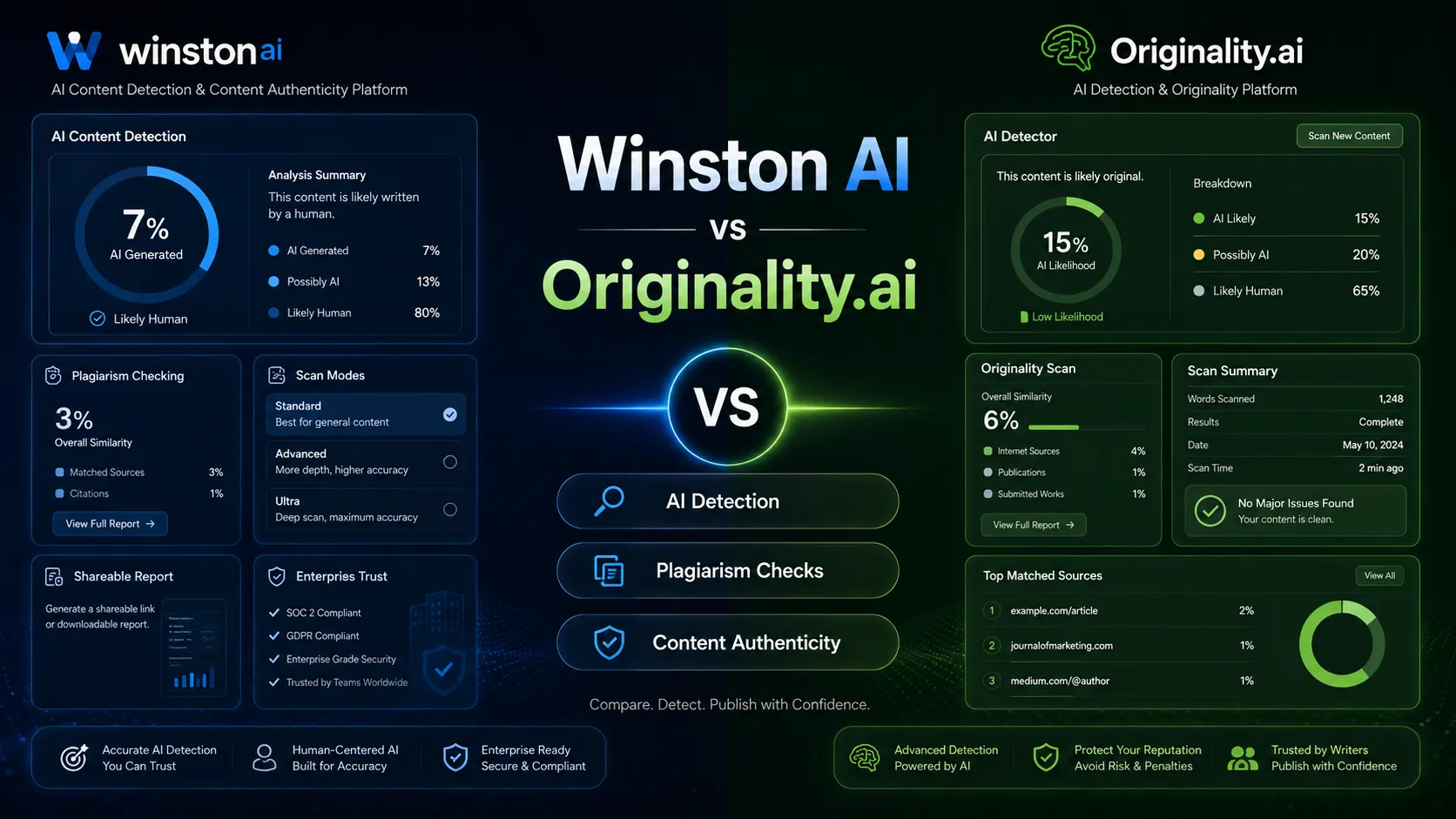
Quick verdict: Winston AI is easier to trial; Originality.ai is stronger for publishing operations
The practical difference between Winston AI vs Originality.ai is not simply “which AI detector is better.” Both tools sit in the same originality-checking category, but they are built for slightly different buyer moments.
Choose Winston AI if you want a more approachable review workflow for education, small content teams, client reports, OCR-supported checks, AI image detection, and a trial-first path. It feels like the cleaner first step when a teacher, editor, freelancer, or small team needs to check real documents before deciding whether paid credits are worth it.
Choose Originality.ai if your workflow is closer to publisher QA: recurring AI detection, plagiarism checks, readability, grammar, fact-checking support, site scans, team roles, WordPress or Google Docs usage, and API access. It is less about a quick “is this AI?” moment and more about building a repeatable content integrity process.
Avoid treating either tool as a final courtroom-style verdict. AI detection should support review, documentation, and editorial judgment. It should not become the only basis for accusing a writer, student, freelancer, or team member.
Winston AI vs Originality.ai at a glance
| Decision point | Winston AI | Originality.ai |
|---|
| Best fit | Educators, small teams, SEO reviewers, and buyers who want a trial-first detector workflow | Publishers, agencies, SEO teams, schools, and operators needing repeatable content QA |
| Core job | AI detection with plagiarism checks, reports, OCR, image detection, and writing feedback | AI detection plus plagiarism, readability, grammar, fact-checking support, SEO checks, site scans, and team workflows |
| First-step path | 14-day trial with limited credits | Free limited AI checker and Chrome extension path, but no full free trial for the paid platform |
| Pricing logic | Credit-based plans with monthly and annual billing options | Pay-as-you-go credits, Pro subscription, and Enterprise subscription |
| Team fit | Good for teams that need reports, seats, API, and classroom-style review | Stronger for agencies, publishers, and teams needing tagging, scan history, plugins, and API workflows |
| Main caution | Non-refundable purchase language and credit usage by scan type | Monthly subscription credits can expire if unused, and refunds are discretionary |
| Better next step | Test real documents during the trial | Estimate monthly word volume before choosing pay-as-you-go or subscription |
Choose Winston AI if you need a simpler integrity review workflow
Winston AI makes more sense when the buyer wants a focused originality-checking workflow without starting from a heavy publisher stack. That matters for teachers, tutors, schools, freelance editors, SEO reviewers, and content managers who need a clear answer to one question: “Can I review this draft, share the result, and move on with a reasonable audit trail?”
Its feature set is broad enough for serious review work. The platform publicly positions around AI text detection, plagiarism checking, sentence-level signals, shareable reports, document upload, OCR, AI image and deepfake detection, writing feedback, browser extensions, Google Classroom, Zapier, WordPress, and API routes. That makes it more than a free paste-box detector, but still easier to understand than a full content operations platform.
The main reason to start with Winston AI is the trial path. A buyer can test the tool with real documents before committing to a paid plan. That is useful because AI detection tools are very sensitive to workflow context. A teacher checking student essays, an editor reviewing SEO drafts, and a publisher screening outsourced content may all care about different scan types, report formats, and credit consumption.
The caution is commercial, not just technical. Winston AI’s current pricing uses credits, and different actions can consume credits differently. AI detection, plagiarism checking, OCR, image detection, and heavier review features should be tested against your actual documents before you assume the headline plan is enough. Its terms also use strict non-refundable purchase language, so do not treat paid checkout as a risk-free experiment.
Choose Originality.ai if your team needs a broader publisher QA system
Originality.ai becomes the better choice when the buyer is not only checking a single draft, but managing a repeatable content quality workflow. This is where agencies, SEO teams, editorial teams, schools, marketplaces, and publishers should pay closer attention.
The platform goes beyond AI detection. It publicly positions itself around AI checking, plagiarism checking, readability, grammar, fact-checking support, content optimization, bulk/site scanning, Chrome and Google Docs workflows, WordPress and Moodle routes, shareable reports, team management, scan tagging, scan history, and API access. That is a bigger operational footprint than most buyers need for occasional checks, but it can be valuable when content QA happens every week.
Originality.ai’s pricing structure also fits higher-volume buyers better if they estimate usage correctly. The pay-as-you-go path is useful when scan volume is irregular. The Pro subscription is more natural for individuals or small teams with recurring monthly checks. Enterprise is positioned for agencies and publishers with larger credit needs, longer scan history, priority support, and deeper operational requirements.
The tradeoff is that the paid platform is not the friendliest “try everything for free” path. Originality.ai does offer limited free checking and a Chrome extension workflow, but the main platform decision usually comes down to credits, subscription timing, and whether you will use enough monthly allowance to justify a plan. If your team only checks a few documents here and there, subscription credits may expire before you get value from them.
Pricing and credit fit: do not compare only the monthly label
This comparison can get misleading if you compare only the cheapest visible monthly price.
Winston AI currently shows a limited free trial path and paid credit-based plans. The monthly view shows paid tiers such as Essential, Advanced, and Elite, while annual billing may display lower monthly-equivalent pricing. That means the safer comparison is not “Which tool is cheaper?” It is: how many words, documents, reports, plagiarism checks, OCR scans, or image checks will you actually run each month?
Originality.ai is structured differently. Its public pricing includes a pay-as-you-go option with one-time credits, plus Pro and Enterprise subscription paths. One credit maps to a set word amount, and subscription credits renew monthly but can expire at the end of the billing month if unused. Pay-as-you-go credits last longer, but they still require planning if you are buying for a low-volume workflow.
For a light user, Winston AI’s trial may be the better first click because it lets you test real content before paying. For a recurring publisher or agency workflow, Originality.ai may be easier to budget because the pay-as-you-go, Pro, and Enterprise options make different scan-volume patterns clearer.
The checkout rule is simple: estimate your real monthly workload before paying. If you cannot estimate it, start with the lowest-risk route available instead of buying the plan with the most impressive feature list.
Workflow fit: classroom review vs editorial operations
Winston AI fits better when the workflow looks like this:
- A teacher, editor, reviewer, or content lead receives a draft.
- They need AI detection, plagiarism support, or a report.
- They may need to upload a file, scan an image, use OCR, or share a result.
- They need enough clarity to decide whether the draft needs a closer human review.
Originality.ai fits better when the workflow looks like this:
- A team receives many drafts from writers, students, freelancers, or clients.
- The team needs repeatable checks across AI detection, plagiarism, readability, grammar, fact support, SEO, or site-level scanning.
- Results need to be organized, tagged, shared, or connected to publishing workflows.
- The buyer may need WordPress, Chrome, Google Docs, Moodle, or API access.
Team and business use: both can work, but the buyer profile is different
Both products can support business use, but they solve different business problems.
Winston AI is the better fit for smaller teams that want an integrity checkpoint without a lot of operational overhead. Its trial-first path also makes it easier to test with stakeholders before choosing a paid plan.
Originality.ai is stronger when the team already has volume. If you publish frequently, manage multiple writers, run content QA for clients, or need plugin/API paths, Originality.ai’s broader workflow matters more. The value is not only in the detector. It is in the surrounding structure: scan history, tagging, reports, integrations, and team management.
Coupon, trial, and checkout path
Do not choose either tool because of a coupon headline alone.
For Winston AI, start by checking the trial route and current plan limits. If a coupon route is available, treat it as a final checkout verification step after you know the tool fits your review workflow. Do not reveal or rely on any hidden coupon code before confirming the final checkout total.
For Originality.ai, compare pay-as-you-go, Pro, and Enterprise first. A discount path may be useful, but credit fit matters more than a small price reduction. A cheap plan that expires unused is not a bargain.
Useful internal next steps:
Buyer checklist before checkout
Before choosing Winston AI or Originality.ai, check these items:
- Are you mostly scanning student writing, SEO drafts, client work, publisher content, or whole websites?
- Do you need AI detection only, or also plagiarism, readability, grammar, fact-checking support, OCR, image detection, or reports?
- How many words or documents will you scan in a normal month?
- Will your team actually use integrations such as Chrome, Google Docs, WordPress, Moodle, Zapier, Classroom, or API?
- Does the plan include enough credits for your real workload?
- Do unused credits expire, roll over, or disappear at the end of the billing cycle?
- Are you selecting monthly billing or annual billing at checkout?
- What happens if you cancel after paying?
- Are refunds guaranteed, discretionary, or effectively unavailable?
- Will scan results be used as review signals, not final proof?
A detector should support policy, context, draft history, author communication, and human judgment — not replace them.
Avoid both if you want a perfect authorship verdict
You should avoid both Winston AI and Originality.ai if you need a tool to make final authorship decisions with no human review. AI detectors can be useful, but they are not magic truth machines. They estimate patterns. They do not know the full writing history behind a document unless the workflow captures that context.
Avoid both if you only need one casual free scan and do not want to think about credits, reports, billing, or scan history. A limited free checker may be enough for that. Also avoid both if your organization has no clear policy for how detector results will be interpreted. Without policy, even a good report can create confusion.
Final verdict: pick Winston AI for easier review adoption, Originality.ai for repeatable content QA
Choose Winston AI if your main job is classroom-style review, lightweight editorial screening, client reporting, OCR-supported document checks, image detection, or a trial-first evaluation path. It is the safer first step when you want to test real documents before deciding whether a paid detector belongs in your workflow.
Choose Originality.ai if your work is closer to publisher QA. It is the stronger fit for teams that need recurring checks, plagiarism support, readability and grammar layers, fact-checking support, site scans, shareable reports, integrations, team workflows, and API options.
The short version: Winston AI is easier to evaluate and easier to explain to smaller review teams. Originality.ai is more compelling when content quality control is an ongoing operation.
FAQ
Is Winston AI better than Originality.ai?
Winston AI is better if you want a trial-first, report-friendly AI detection workflow for education, small teams, or document review. Originality.ai is better if you need a broader publishing QA system with more operational features.
Is Originality.ai better for SEO teams?
Often, yes. Originality.ai has a stronger fit for SEO teams and publishers that need recurring AI checks, plagiarism checks, readability, grammar, fact-checking support, site scans, WordPress workflows, and team management. Winston AI can still work for SEO review, especially when the team wants a simpler trial-first path.
Winston AI is usually easier to start with because of its limited trial route and clearer report-oriented workflow. Originality.ai is still beginner-friendly, but the paid decision requires more thought around credits, scan volume, and subscription timing.
Which one has better pricing?
Neither is automatically cheaper. Winston AI may feel safer for early testing because of its trial path. Originality.ai may be better for teams that can estimate volume and choose between pay-as-you-go, Pro, or Enterprise. The best plan depends on monthly word volume and how many scan types you use.
Can I use detector results as final proof?
No. Treat detector results as review signals. Use them with document history, writing process evidence, editorial policy, author communication, and human judgment. This is especially important in classrooms, client relationships, and workplace reviews.
Should I check coupon pages before buying?
Yes, but only after choosing the right tool. Use coupon pages as final checkout verification, not as the main reason to pick Winston AI or Originality.ai. Always verify the live checkout total before paying.