Quick verdict
Winston AI is worth considering if you need a real content-integrity workflow, not just a quick AI percentage before moving on.
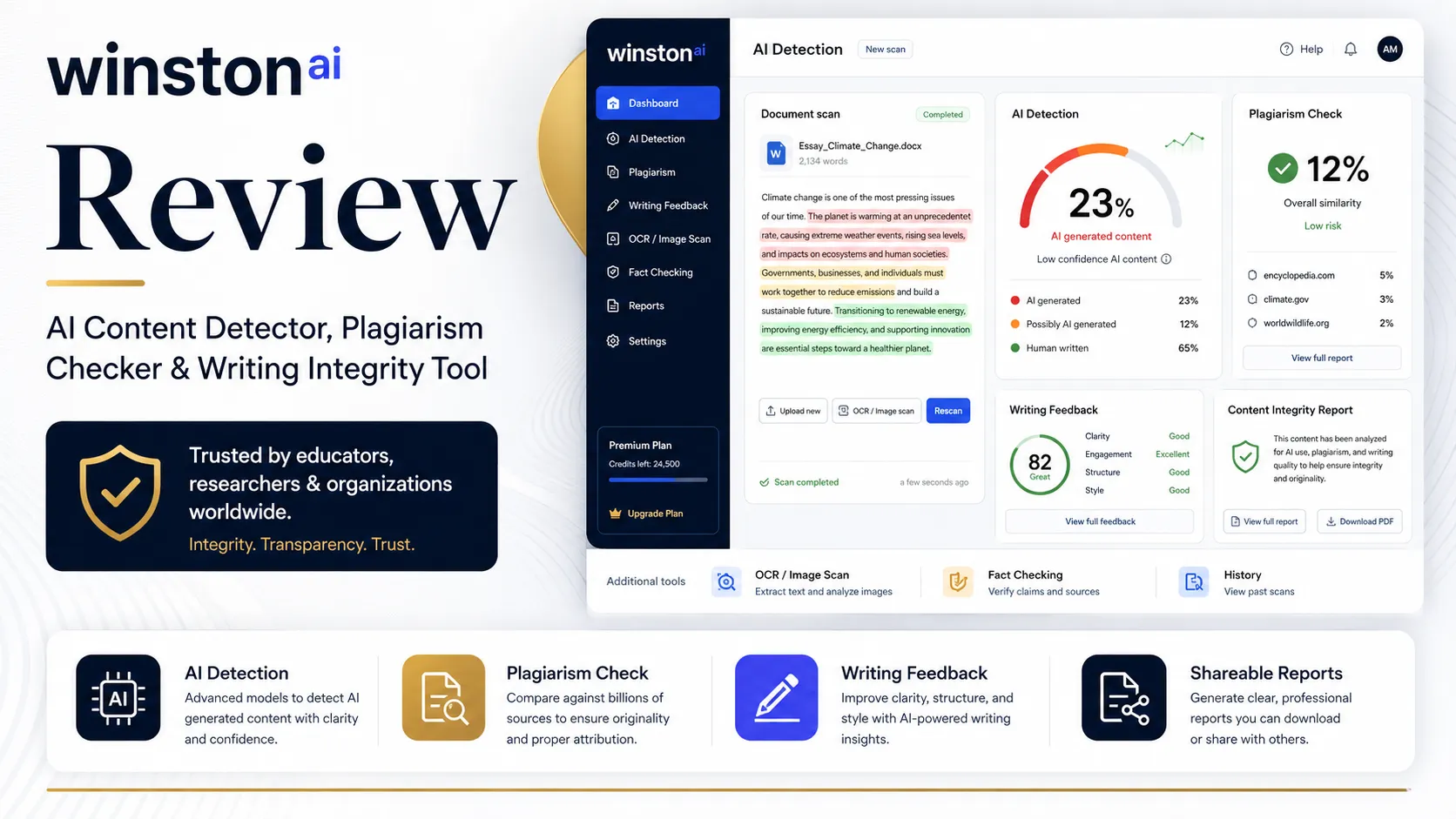
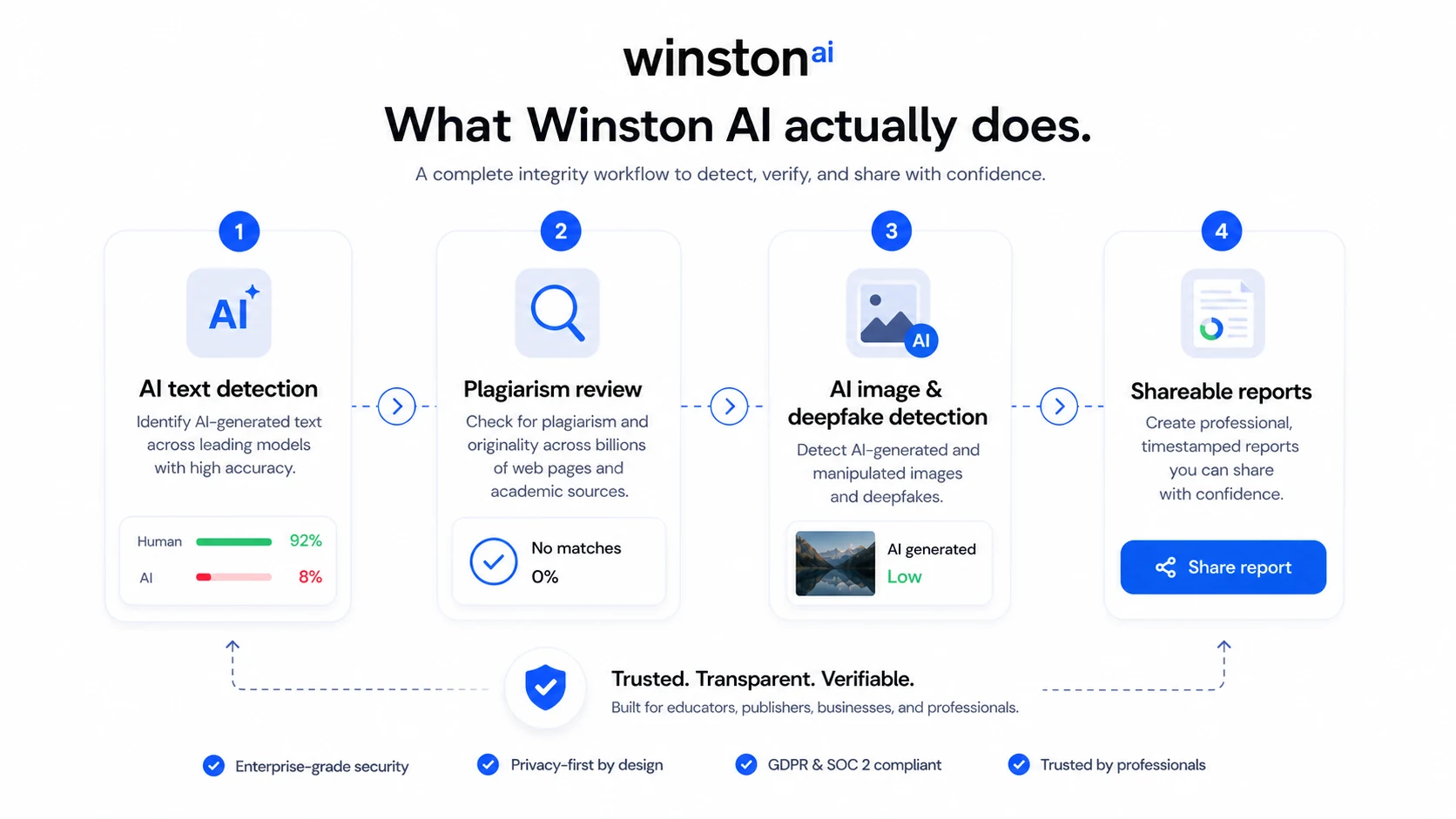
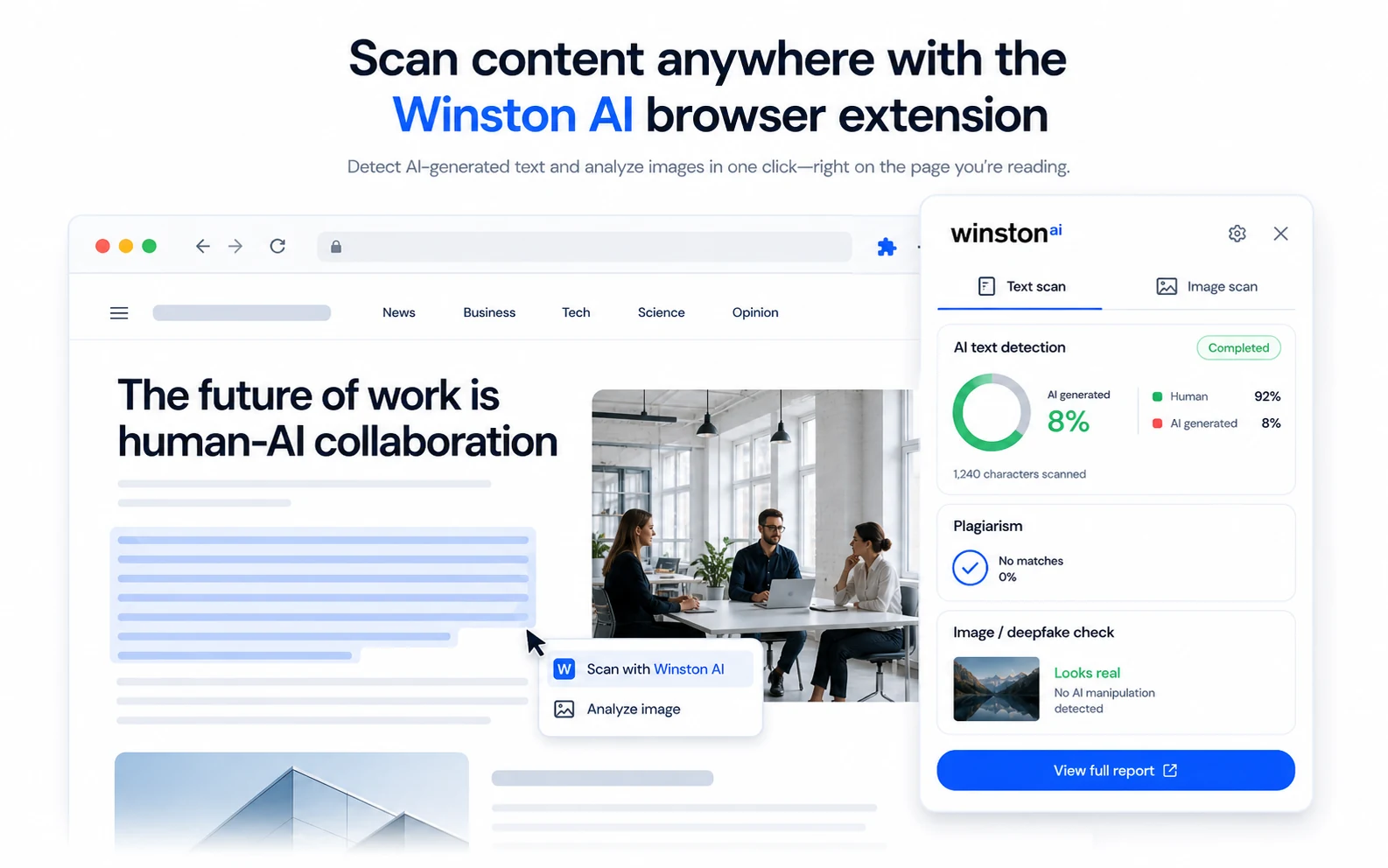
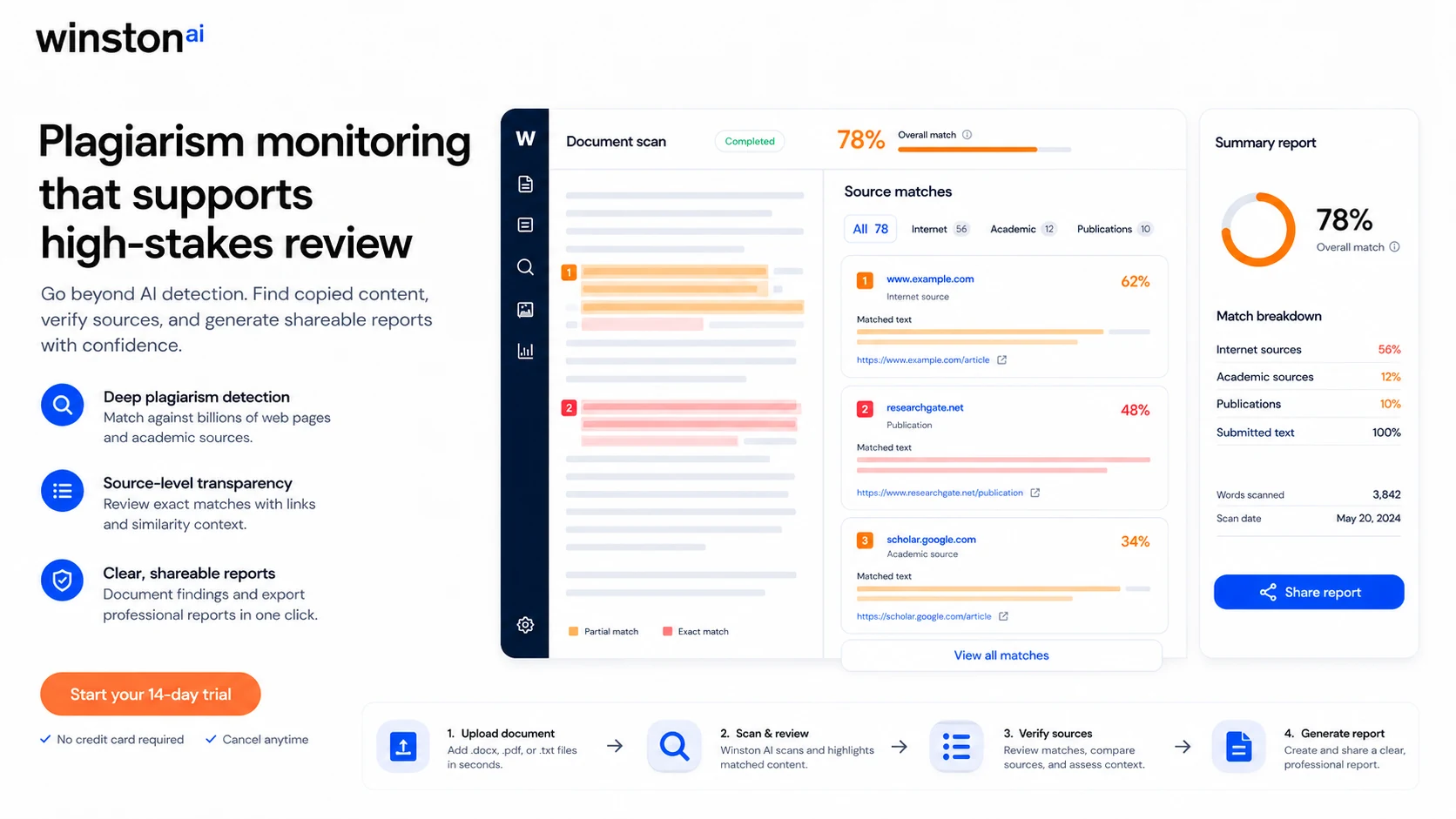
That distinction matters. Winston AI is usually framed as an AI detector, but the stronger buying case is broader: AI text detection, plagiarism checking, image and deepfake detection, OCR, shareable reports, team features, browser scanning, classroom-style use, and API paths. If those pieces fit your work, Winston AI can feel more complete than a basic free checker.
I would still be careful before paying.
The easy mistake is to see a confident AI score, a clean pricing table, and a free trial, then assume the product decision is simple. It is not. AI detection should be treated as a risk signal, not as final proof that a student, writer, freelancer, or editor did something wrong. The plan decision also depends on credits. Text detection, plagiarism checks, image scans, OCR, and API usage do not create the same cost profile.
For my money, Winston AI makes the most sense for educators, SEO publishers, content teams, and agencies that review content repeatedly and need reports they can act on. It is not the first tool I would choose for a one-off casual scan.
The safest next step is to test the 14-day trial with real documents, watch credit usage closely, and only then compare monthly versus annual billing.
Next step: If Winston AI still fits your review workflow, test the trial first and verify the current pricing route before choosing a paid plan.
Review snapshot
| Review point | Practical take |
|---|---|
| Best for | Educators, publishers, SEO teams, agencies, and teams that need repeated originality checks |
| Not ideal for | One-off users, buyers who hate credit math, or anyone treating detector scores as final proof |
| Main use case | AI text detection, plagiarism review, image checks, OCR, reports, and team review workflows |
| Trial path | 14-day trial with 2,000 credits and no credit card required |
| Paid path | Essential, Advanced, and Elite plans with monthly credits and different billing intervals |
| Main strength | Wider integrity workflow than a simple AI detector |
| Main concern | Credit consumption, annual commitment, and non-refundable purchase terms |
| Best alternatives to compare | Originality.ai, Copyleaks, GPTZero |
| Best next step | Run realistic trial scans before choosing monthly or annual billing |
What is Winston AI?
Winston AI is best understood as a content-integrity platform for people who need to review originality, authorship risk, and AI-generated signals across text and images.
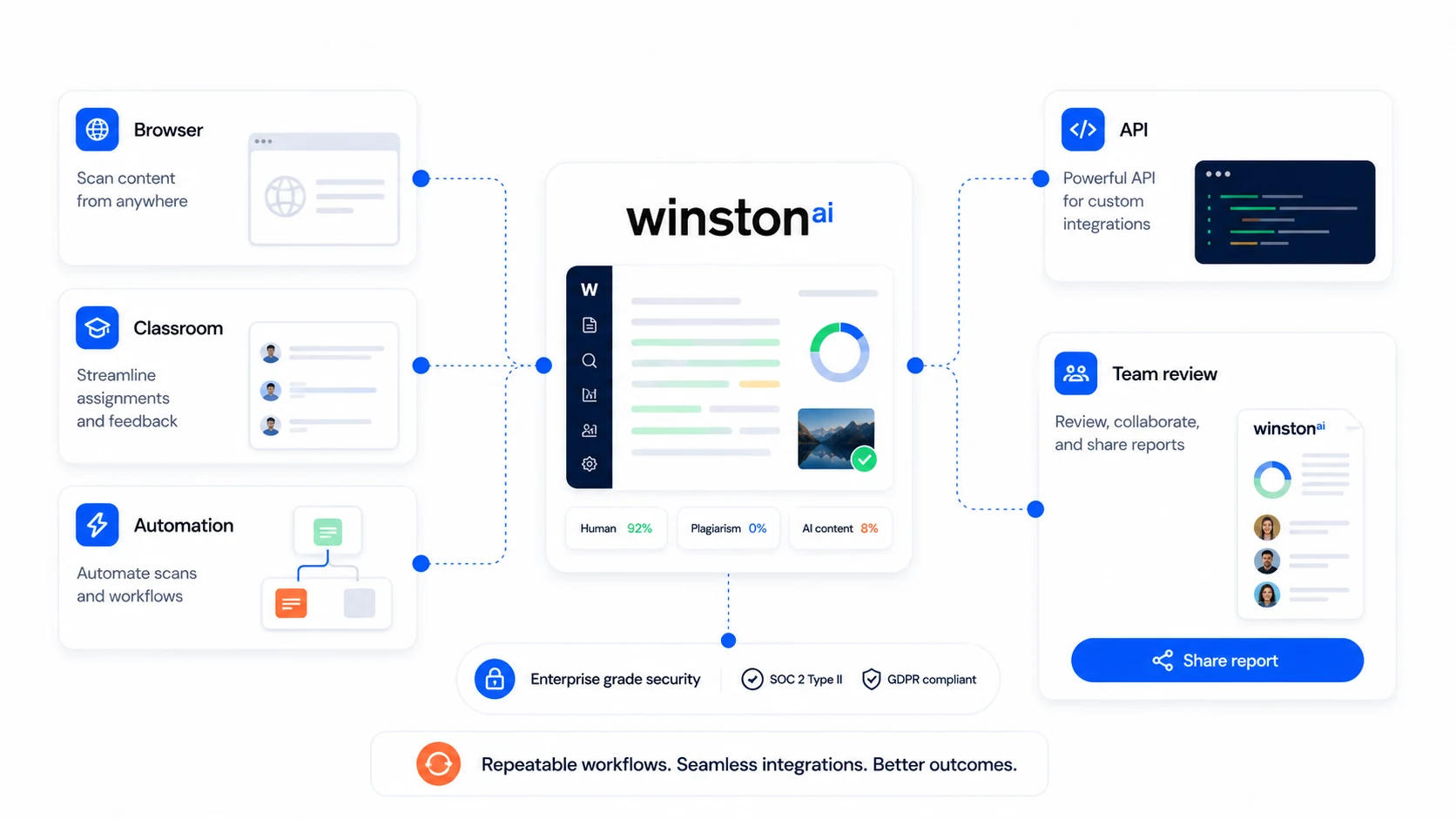
It is not only a paste-and-score AI detector. Its current public positioning includes AI content detection, plagiarism checking, AI image and deepfake detection, OCR for pictures and handwriting, writing feedback, shareable PDF reports, browser tools, Google Classroom and Zapier-style workflow routes, and API options.
That makes Winston AI more interesting than a tiny free checker. It also makes the buying decision more complicated.
A solo writer checking one paragraph does not have the same needs as a teacher reviewing essays, an SEO editor checking dozens of drafts, or a platform team considering an API. Winston AI can serve those different routes, but the right plan depends on document length, scan type, team size, and how often the buyer needs evidence beyond a simple AI probability.
Our review approach: we compare public product pages, pricing details, help documentation, terms, buyer workflow fit, and nearby alternatives. We do not treat a coupon, a free trial, or a strong detector claim as proof that the product fits every buyer.
The common wrong expectation is thinking Winston AI can answer a human question with machine certainty: “Was this written by AI?” A better use is narrower and safer: “Does this document contain enough risk signals that I should review it more carefully?”
That is where Winston AI belongs.
Who should use Winston AI?
Winston AI fits buyers who need a repeated review process.
Educators and academic reviewers are one of the clearer use cases. A teacher, tutor, or academic support team may need to review submissions for AI signals, plagiarism overlap, and originality concerns. Winston AI can support that process with reports and classroom-style workflows. The condition is important: the tool should inform a review, not become the only evidence used against a student.
SEO publishers and content editors may also find Winston AI useful. If a site uses freelancers, AI-assisted drafts, outsourced content, or multiple editors, a repeatable checkpoint can help catch synthetic-sounding sections, originality concerns, and documents that need a stronger human edit before publishing.
Small agencies and client-service teams can use Winston AI when they need a consistent pre-delivery check. This is where shareable reports matter. A report may help an editor explain why a draft needs revision. It should not be used as a lazy replacement for reading the draft.
Teams that handle visual authenticity may care about AI image and deepfake detection. This does not apply to every buyer, but it matters for publishers, educators, and organizations that review image submissions, website assets, or suspicious visuals.
Developers and operations teams may consider Winston AI when API access matters. The API route is only worth evaluating if detection or plagiarism checking needs to live inside another product, dashboard, or workflow. Casual users should ignore this until they have a real integration reason.
Who should avoid Winston AI?
Winston AI is not the cleanest fit for someone who only needs one quick AI check.
The trial may be enough for that. A paid credit-based plan is harder to justify if detection is not part of your normal work.
I would also be careful if you want a detector to produce final proof. AI detection tools can be useful, but they can also create false confidence. A score can point you toward sections to review. It should not be treated as a courtroom decision.
Buyers who dislike credit math should slow down too. Winston AI is not just “pay once and scan whatever you want.” Credits matter. AI text detection, plagiarism checking, image detection, OCR, API endpoints, and larger team workflows can use allowances differently. If you do not want to think about usage, a simpler tool may feel better.
Annual-billing buyers should also pause. Annual pricing may look cheaper on a monthly-equivalent basis, but the terms and cancellation language make it important to test the workflow first. I would not move to annual billing until the trial proves that Winston AI saves real time or reduces real risk.
Finally, Winston AI may not be the best first comparison for institutions that need mature procurement, compliance workflows, LMS depth, or organization-wide plagiarism governance. In that case, Copyleaks may be a more natural institutional comparison.
How Winston AI fits into a real workflow
A sensible Winston AI workflow starts before the scan.
The buyer should first decide what kind of risk they are trying to review. Is it AI-written text? Plagiarism overlap? Image authenticity? OCR from screenshots or handwritten work? Client-delivery risk? Classroom integrity? Those are different jobs.
A practical workflow looks like this:
- Choose a real document, not a tiny artificial test paragraph.
- Decide whether you need AI detection only, plagiarism checking, image detection, or a mixed review.
- Run the scan and look beyond the headline score.
- Review highlighted areas, report language, and any source-overlap or image-authenticity signals.
- Compare the result with your own editorial or academic judgment.
- Decide whether the document needs a human revision, a second review, or a different evidence layer.
- Track how many credits the process used.
That last step is not minor. Winston AI’s value depends on whether the credit cost matches your actual workload.
For a teacher, the decision point may be whether the report is clear enough to support a fair conversation with a student. For an editor, it may be whether the scan points to sections that need revision. For a publisher, it may be whether Winston AI reduces risk before content goes live.
The weakest workflow is emotional: paste content, see a scary score, and overreact. The stronger workflow is disciplined: scan, inspect, verify, revise, and document the decision.
Workflow check: Winston AI is easier to judge after one real trial scan than after reading a feature list. Use a document that matches your actual workload.
Real-world buyer scenarios
A teacher reviewing student submissions
A teacher may use Winston AI to review student essays for AI signals and possible plagiarism. The useful part is not only the detector score. It is the combination of report output, scan history, and originality signals.
Where it can fail is fairness. If the teacher treats the score as final proof, the tool becomes risky. The better workflow is to use Winston AI as one signal, then apply human review, assignment context, student history, and school policy.
A publisher checking AI-assisted drafts
A publisher or SEO editor may use Winston AI before publishing outsourced or AI-assisted content. This is a stronger fit when drafts move through a repeated process: writer, editor, originality check, revision, final approval.
The buyer should verify credit usage with real article lengths. A few short trial checks will not tell a publisher whether the plan can handle monthly content volume.
An agency delivering client content
A small agency may need a repeatable QA checkpoint before sending work to clients. Winston AI can help if reports are clear enough to support editing decisions.
The risk is overpromising. No agency should tell clients that an AI detector guarantees human authorship. A safer promise is that the agency uses originality and review tools as part of a broader editorial QA process.
A platform or workflow team considering API use
A developer or operations team may evaluate Winston AI’s API for AI text detection, plagiarism checking, fact checking, text comparison, or image detection. This is a different buyer path from a normal subscription.
The key checks are endpoint cost, authentication, token handling, data handling, and whether the workflow has enough volume to justify technical setup. If API use is only a vague idea, stay with the normal trial first.
Key features that actually matter
AI text detection
Winston AI’s core feature is AI text detection for content generated by major language models. The homepage makes strong accuracy claims, but I would still treat the result as a signal rather than final truth.
Buyer note: judge the usefulness of the result by whether it helps you review the document better. If the score only creates anxiety, the workflow is not mature enough yet.
Plagiarism checking
The plagiarism checker matters because originality risk is not the same as AI risk. A document can be human-written and still problematic if it overlaps heavily with existing sources. A document can be AI-assisted and still need source review.
Buyer note: plagiarism checking consumes credits differently from basic AI detection, so buyers who need both should test them together during the trial.
AI image and deepfake detection
AI image detection is a useful addition for buyers who review visual content. It is less important for a writer who only checks blog drafts, but more relevant for educators, publishers, journalists, and teams handling image submissions.
Buyer note: image scans can use far more credits per item than simple text checks. Do not assume a plan that fits short essays will also fit visual-authenticity workflows.
OCR and document scanning
OCR and document scanning help when content does not arrive as clean pasted text. This can matter for educators, institutions, and teams reviewing PDFs, images, screenshots, or handwritten materials.
Buyer note: this is a workflow feature, not just a convenience. If your review work often starts with files instead of plain text, OCR can reduce friction.
Shareable reports
Reports are one of the more practical reasons to consider Winston AI over a barebones checker. In education, publishing, or client review, a report can help explain why a document needs more attention.
Buyer note: a report is only useful if your audience understands its limits. Do not present it as absolute proof.
Integrations, team features, and API access
Winston AI’s wider appeal comes from browser extensions, classroom-style workflows, Zapier references, team members, credit pooling, and API documentation. These are the features that turn a detector into an operational tool.
Buyer note: verify the exact plan tier. API access and team capacity are useful only when they match a real rollout plan.
Pricing and plan value
Winston AI pricing is less about the plan name and more about credit usage.
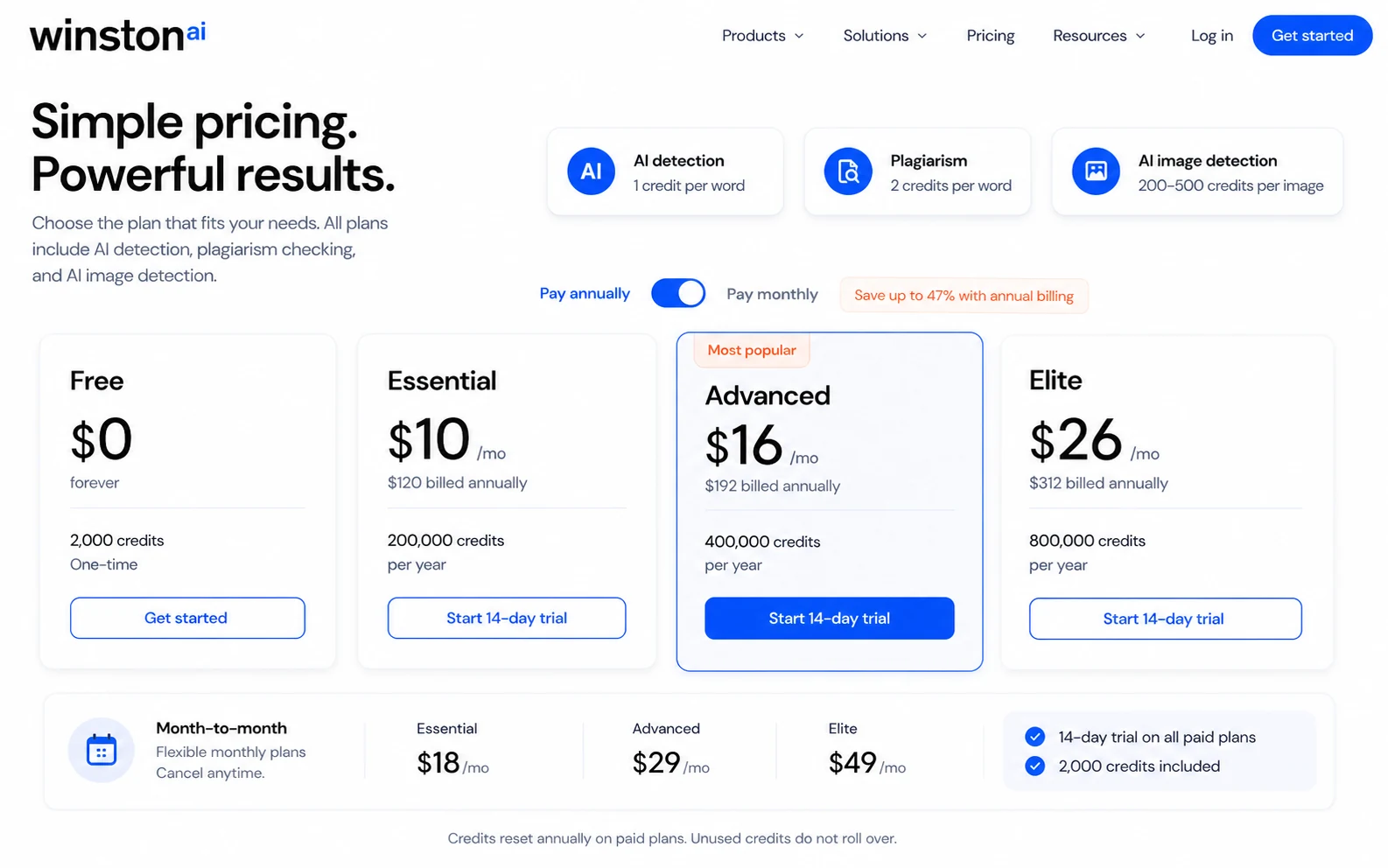
The current public pricing page shows a 14-day trial with 2,000 credits and no credit card required. Paid plans are presented as Essential, Advanced, and Elite. The pricing page shows lower monthly-equivalent pricing when billed annually and higher prices when billed month to month. At the time of this review, the public pricing display shows Essential from $10/month on annual billing or $18/month month to month, Advanced from $16/month annual or $29/month month to month, and Elite from $26/month annual or $49/month month to month.
Those numbers are only the beginning.
The bigger question is what your credits need to do. AI text detection is not the same as plagiarism checking. Image detection is not the same as scanning a short paragraph. API usage may create a different pattern from manual dashboard use. A buyer who checks five short essays per week has a different cost profile from a publisher scanning long articles, plagiarism reports, and images across a team.
The Essential plan may be enough for a smaller repeat workflow. Advanced becomes more relevant when plagiarism, team capacity, and higher monthly volume matter. Elite is the more serious route for larger teams, higher usage, or broader review operations.
I would not jump to annual billing just because the monthly-equivalent number looks better. Annual savings can be real, but only after the trial proves that Winston AI belongs in your workflow.
My pricing take is simple: start with the trial, use realistic samples, track credits, then choose the smallest paid plan that supports your actual review process. Upgrade only when usage proves the need.
Pricing check: If Winston AI fits your use case, verify the live pricing toggle and credit rules before choosing monthly or annual billing.
Check Winston AI pricing Check current offers Read store guide
Free plan, trial, coupon, and checkout notes
Winston AI’s safest entry point is the 14-day trial.
The trial is useful because it gives buyers enough room to test the interface, scan real content, inspect reports, and understand how credits move. It is not the same as a permanent free plan. It is a decision tool.
Use the trial to answer practical questions:
- Does the AI detection output match your review instincts?
- Are plagiarism results useful for your workflow?
- Do image checks matter for your real use case?
- Are reports clear enough to share with students, writers, clients, or editors?
- How quickly do credits move with realistic document lengths?
- Would monthly billing cover your volume, or would annual billing only create pressure?
The coupon path should come later. If DealBestDaily has active Winston AI offers, the Winston AI coupon page can help you check the current route. But I would not buy Winston AI because of a coupon first. The product either fits your review process or it does not.
The terms matter here. Winston AI describes paid purchases as non-refundable, subject to mandatory consumer protection rights in the buyer’s jurisdiction. Cancellation can stop renewal, but it does not necessarily turn the current paid term into a refundable purchase.
That makes the trial more important than the discount.
Checkout order: Test the trial first, compare credit usage second, and only then check whether a current offer improves the paid route.
What I would check before buying Winston AI
If I were buying Winston AI for a real workflow, I would not start with the cheapest plan. I would start with the monthly workload.
Check these before paying:
- Your main scan type. Are you mostly checking AI text, plagiarism, images, OCR documents, or API requests?
- Your real monthly volume. Use real essays, articles, client drafts, reports, or images during the trial.
- Credit consumption. Track how fast credits move when you use the features you actually need.
- Report usefulness. Decide whether the output is clear enough for teachers, editors, clients, or internal reviewers.
- Team requirements. Confirm member limits, shared billing, and credit pooling on the exact plan tier.
- API needs. Only evaluate the API path if you have a real integration plan, not a vague future idea.
- Refund and cancellation terms. Read the non-refundable purchase language before switching from trial to paid billing.
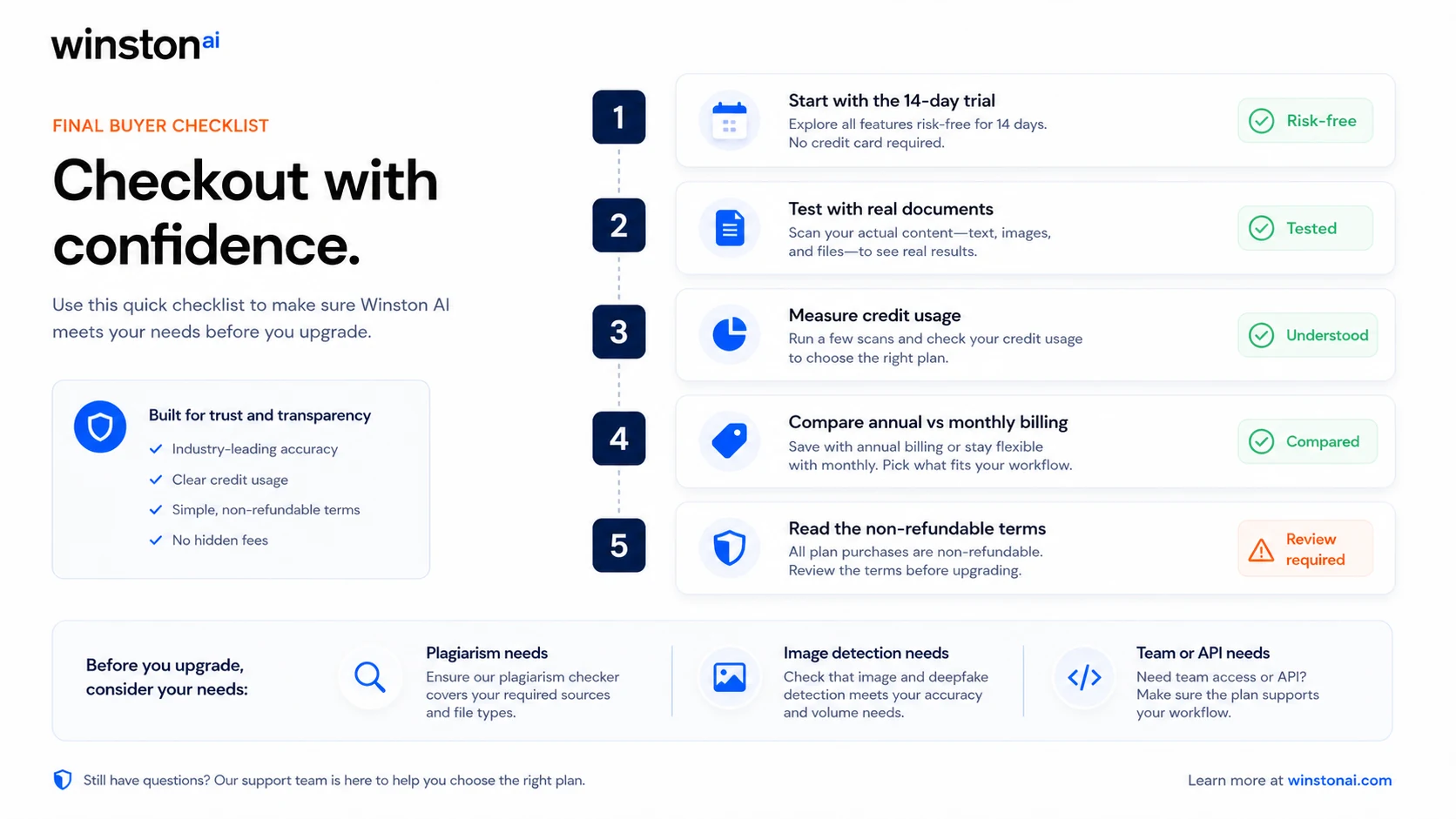
The easiest buyer mistake is overfocusing on the score. The better way to judge Winston AI is to ask whether the output changes your next editorial, academic, or operational decision.
A simple test before paying
Before paying, I would run a small test like this:
- Pick three real documents: one human-written draft, one AI-assisted draft, and one document with known source overlap.
- Scan each document using the trial.
- Check whether Winston AI gives useful detail beyond a headline score.
- Run a plagiarism check where source overlap matters.
- Test one image or OCR case only if that is part of your actual workflow.
- Export or review a report and decide whether it would be useful to share.
- Record the credits used and estimate monthly volume.
This test will tell you more than a homepage claim.
If the results help you make better decisions and the credits look manageable, Winston AI may be worth paying for. If the scan only creates uncertainty, or if the report does not improve your workflow, a paid plan may add cost without adding much clarity.
Pros explained
Winston AI covers more than basic AI detection
The biggest strength is breadth. AI text detection, plagiarism checking, image detection, OCR, reports, writing feedback, browser workflows, and API routes make Winston AI more useful for repeat review work than a simple one-box checker.
This matters most when the buyer needs a process. A teacher may need reports. A publisher may need originality checks. A team may need integrations. A developer may need API endpoints.
It stops being enough when the buyer only needs one casual scan.
The trial is useful for cautious buyers
A 14-day trial with credits gives buyers a real way to test the product without jumping straight into a paid plan. That is important because Winston AI’s value depends on the buyer’s actual content length and scan mix.
The trial is not a full production proof. But it is enough to test whether the interface, reports, and credit model make sense.
Reports and integrations can reduce workflow friction
Shareable reports, browser tools, classroom-style use, Zapier references, and API documentation make Winston AI feel more operational than many basic detector tools.
This matters when review work is repeated across students, writers, clients, or documents. It matters less for someone who checks one article once a month.
It has a clearer role for teams than many lightweight checkers
Team members, credit pooling, and higher-volume plans make Winston AI more plausible for organizations. The exact fit still depends on plan tier, but the product direction is more serious than a casual free detector.
That said, larger institutions should still compare it with Copyleaks and other enterprise-style platforms before committing.
Cons explained
AI scores can be misused
This is the biggest category risk, not only a Winston AI issue.
AI detection can help identify risk. It should not be treated as a final accusation. False positives, mixed-authorship drafts, editing patterns, and legitimate formulaic writing can all complicate interpretation.
Educators and managers should be especially careful here. A detector can support a process. It should not replace due process.
Credits add real buying complexity
Credit pricing is logical for a product with multiple scan types, but it creates more homework for buyers. AI detection, plagiarism checking, image detection, OCR, and API work can use credits differently.
If you do not test real workload during the trial, you may choose the wrong plan.
Refund safety is weak after purchase
Winston AI’s terms describe paid purchases as non-refundable, subject to mandatory consumer protection rights. That does not mean every buyer has no rights, but it does mean you should not treat checkout casually.
The safer path is trial first, monthly before annual when unsure, and annual only after repeated value is clear.
Annual pricing can create overcommitment
Annual prices can look attractive. But if you only need occasional scans, annual billing may turn a useful tool into unnecessary overhead.
The cheapest monthly-equivalent number is not automatically the best deal. The best plan is the one that matches the documents you actually review.
Green flags and red flags
Green flags
- You review content repeatedly, not casually.
- You need plagiarism checks as well as AI detection.
- You need reports that can be shared or saved.
- Your workflow includes images, OCR, browser scanning, classroom tools, or team members.
- You can estimate monthly credit usage from real trial tests.
Red flags
- You want a score to act as final proof.
- You only need one or two scans.
- You dislike credit-based plan math.
- You are considering annual billing before testing real documents.
- You need a refundable checkout path after paying.
- You need institution-wide procurement or compliance features that are better handled by a more enterprise-focused platform.
Winston AI vs alternatives
Winston AI sits in a competitive category, and the right alternative depends on the buyer’s job.
Originality.ai vs Winston AI
Originality.ai is usually the stronger comparison for publishers, SEO teams, and content operations that care about editorial originality workflows. It is especially relevant when the buyer thinks in terms of content QA, scanning volume, and publishing risk.
Winston AI may make more sense when image detection, classroom use, shareable reports, and a more education-friendly review path are part of the buyer’s decision.
The tradeoff is focus. Originality.ai often feels more publisher-centered. Winston AI feels broader across education, plagiarism, images, reports, and integrations.
Copyleaks vs Winston AI
Copyleaks is the more natural comparison for institutional plagiarism, LMS, compliance, and enterprise-style review workflows. If a school, university, or larger organization needs mature plagiarism infrastructure, Copyleaks deserves a close look.
Winston AI may feel more approachable for smaller teams that want AI detection, plagiarism, image checks, and browser workflows in one visible product path.
The tradeoff is depth versus simplicity. Copyleaks may be stronger for institutional coverage. Winston AI may be easier for buyers who want a more direct originality-review tool.
GPTZero vs Winston AI
GPTZero is a strong education-first AI detection comparison. It is often the tool buyers consider when they mainly want to review AI-written student-style or writing-submission content.
Winston AI becomes more attractive when the buyer also wants plagiarism checking, AI image detection, OCR, and broader reports.
The tradeoff is narrowness. GPTZero may feel simpler for detection-first education use. Winston AI may be better when the review process needs multiple evidence layers.
A basic free AI checker vs Winston AI
A free checker can be enough for curiosity. It may even be enough for a buyer who only scans a paragraph occasionally.
Winston AI is the better comparison when the buyer needs repeatability, reports, plagiarism review, image detection, team workflows, and credit-supported volume.
Do not pay for Winston AI if the free checker already covers your real need. Pay only when the workflow becomes serious enough to justify the plan.
Trust, refund, and buyer-risk notes
My confidence is strongest around Winston AI’s category fit: it is clearly built for AI detection, plagiarism checking, image authenticity review, reports, and repeat workflows. I am more cautious around long-term value because that depends on credit usage, plan tier, team needs, API usage, and billing interval.
The biggest trust issue is not whether Winston AI has useful features. It does.
The issue is interpretation.
AI detection can create strong-looking results, but buyers still need process discipline. In education, a detector score should not be the only basis for action. In publishing, a score should not replace editing. In client work, a report should not become a promise that content is perfectly human or perfectly safe.
Refund language is another serious buyer check. Winston AI’s terms describe paid purchases as non-refundable, with cancellation taking effect at the end of the current paid term. That makes trial testing and billing choice important.
Privacy and data handling also deserve a normal buyer review. If your content includes sensitive student work, client documents, legal material, unpublished manuscripts, or internal business content, read the current privacy and terms pages before uploading.
API buyers should be more careful than dashboard users. Once a detector becomes part of a product or workflow, mistakes scale. Check endpoint costs, credit usage, rate behavior, authentication, and result interpretation before building anything serious around it.
Final verdict
I would consider Winston AI if you need more than a casual AI detector.
It makes sense for educators, publishers, agencies, editors, and content teams that need repeated originality checks, plagiarism review, image detection, reports, and workflow support. It is especially interesting when a simple AI score is not enough and the buyer needs a broader integrity process.
I would skip Winston AI if you only need one quick scan, dislike credit-based usage, or want a detector to act as final proof. That is not a safe way to use this category.
I would compare Winston AI with Originality.ai if publishing-side content QA is your priority, Copyleaks if institutional plagiarism and compliance workflows matter more, and GPTZero if education-style AI detection is the main job.
The safest next step is trial-first, credit-aware, and slow. Use real documents. Check report quality. Measure credit usage. Read the non-refundable terms. Then decide whether monthly or annual billing actually fits the way you work.
A discount can improve the purchase, but it should not be the reason you buy. Winston AI is only worth paying for when it becomes part of a repeatable review process you trust enough to use carefully.