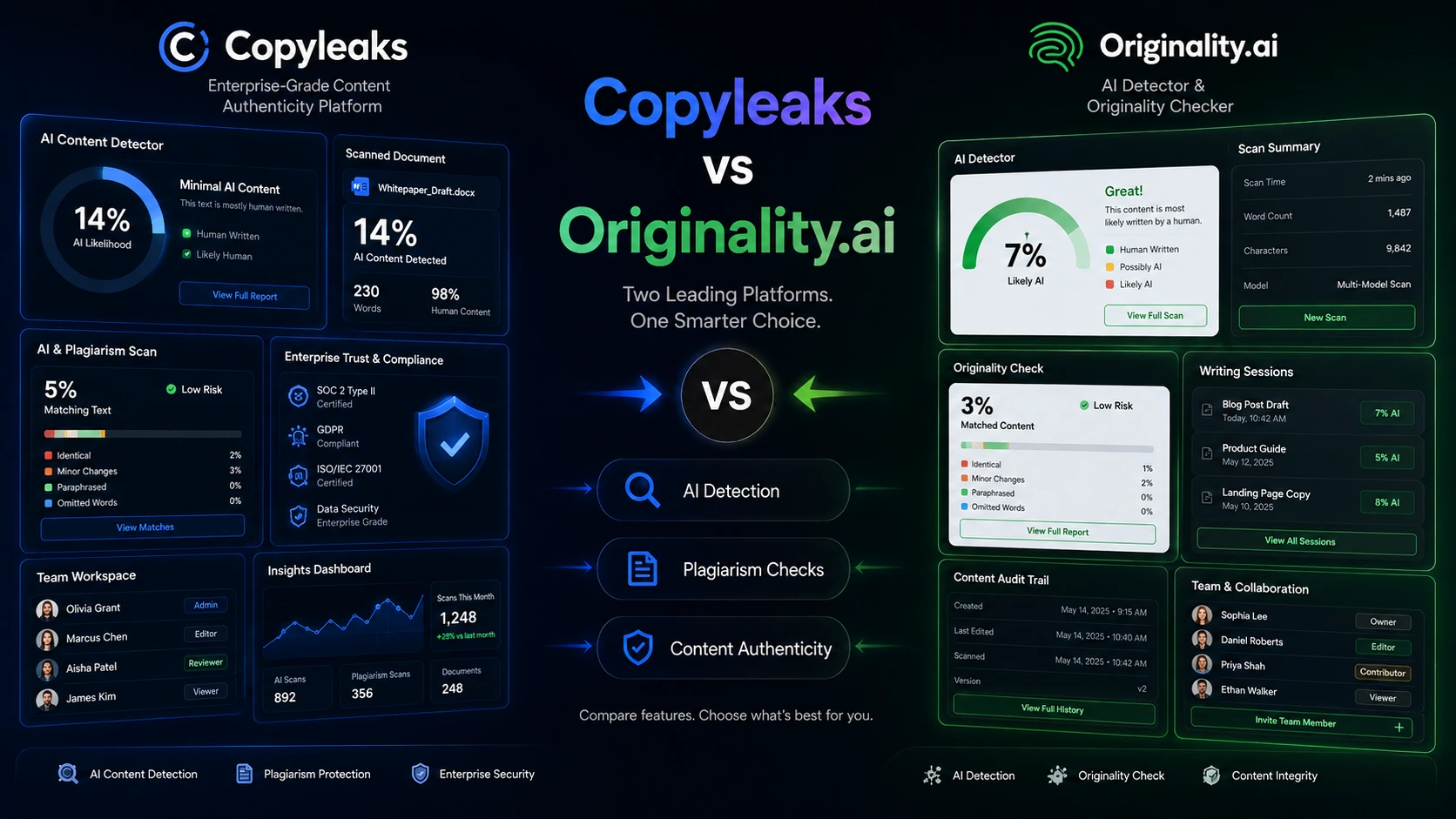
Copyleaks vs Originality.ai is a close comparison only if you describe both as AI detectors. Once you look at the actual buying decision, the split is sharper: Copyleaks leans toward academic integrity, LMS/API use, and broader content-governance workflows, while Originality.ai leans toward publisher QA, WordPress content review, and recurring editorial checks. That difference matters because the wrong choice can leave you paying for a detector that looks capable but does not fit where your content is actually reviewed.
Ask where the review happens, who needs the result, how often you check content, and whether your team needs a dashboard, API, LMS path, WordPress workflow, or simple one-off check.
Quick verdict
Choose Copyleaks if you need AI detection and plagiarism checking inside a more structured review environment — especially if LMS, API, education, Google Docs, Chrome, or organization-level governance matters.
Choose Originality.ai if you run a publisher, agency, SEO, or editorial workflow where recurring content QA, WordPress review, shareable reports, credit planning, and team scanning matter more than classroom-style integrity infrastructure.
The biggest buyer mistake is choosing only by a visible monthly price or a single detector result. Before paying, check whether you need Copyleaks’ LMS/API direction or Originality.ai’s publisher QA direction, then verify the current plan limits, credit rules, refund language, and route to checkout.
At-a-glance comparison
| Decision point | Copyleaks | Originality.ai |
|---|
| Best for | LMS/API governance, academic integrity, and AI + plagiarism workflows | Publisher QA, WordPress review, agency checks, and recurring editorial scans |
| Pricing style | Personal and Pro self-serve plans, with custom Education and Enterprise paths | Pay as you go, Pro, and Enterprise paths with credit-based usage |
| Free plan or trial | Free public AI detector path exists, but paid plan fit should be checked | No permanent free plan for the main paid workflow; free Chrome path may be useful for testing |
| Workflow strength | Better when detection must connect to LMS, API, Docs, Chrome, or governance | Better when checks sit near publishing, WordPress, reports, and team content QA |
| Team fit | Stronger when education, API, or compliance workflows are part of the requirement | Stronger when publishers need repeat scans, tags, reports, and team roles |
| Main risk | Conditional refund rules and plan/credit changes need careful review | Monthly subscription credits expire, and refund approval is discretionary |
| Best next step | Review Copyleaks plan and integration fit before checkout | Estimate monthly words/credits and choose pay-as-you-go vs subscription carefully |
Choose Copyleaks if…
Copyleaks makes more sense if your review process is not just “paste text into a detector and read a result.” It is the better fit when AI detection, plagiarism detection, and workflow integration need to sit inside a repeatable policy process. That is why it is usually easier to justify for educators, institutions, teams, and businesses that need more than a lightweight dashboard.
The official Copyleaks pricing page currently lists Personal at $16.99/month or $13.99/month when billed annually, and Pro at $99.99/month or $74.99/month when billed annually. It also says Education and Enterprise solutions, including API access and LMS integration, use custom pricing, so buyers should confirm the billing toggle and plan route before checkout.
Copyleaks also has a stronger case when LMS or API workflow is real, not theoretical. Its official API page describes platform-agnostic API use and mentions LMS integrations such as Canvas, Moodle, Blackboard, Brightspace, Schoology, Sakai, and Edsby, plus Google Docs and browser extension routes. That makes it a better candidate when the buyer needs detection to connect to existing systems rather than live only as a separate tool.
You may not love Copyleaks if you mainly publish content in WordPress and want a more publisher-centered QA lane. You should also slow down if you are relying on cancellation flexibility. Copyleaks’ pricing page says refunds are not guaranteed and are only issued when the request is submitted within the first 10 days of the billing cycle and no pages or credits have been used, so buyers should read the current refund and plan-change language before paying.
For deeper evaluation before checkout, use the Copyleaks review if you need more product context, or the Copyleaks store guide if you mainly need plan, pricing, and workflow fit.
Choose Originality.ai if…
Originality.ai makes more sense if your review process is closer to publisher QA than classroom integrity. It is better suited to agencies, content teams, SEO teams, and site owners who need recurring checks before content goes live. The product direction is not only AI detection. It also brings plagiarism checking, readability, grammar, fact-checking, SEO content tools, shareable reports, scan history, team features, Chrome and Google Docs workflows, WordPress, Moodle, and API routes into the decision.
The official Originality.ai pricing page currently shows Pay as you go at $30 for 3,000 one-time credits, Pro at $14.95/month or $12.95/month when billed yearly, and Enterprise at $179/month or $136.58/month when billed yearly. It also states that 1 credit equals 100 words, Pay as you go credits expire after 2 years if unused, and Pro or Enterprise credits expire monthly, so buyers should confirm billing interval and credit rules at checkout.
Originality.ai is especially worth checking if WordPress content QA matters. Its WordPress page positions the plugin around checking content from a single post to an entire site. Its Chrome and Google Docs page also highlights AI and plagiarism checks inside Google Docs and Chrome, plus writer replay, contributor visibility, web page scanning, and shareable reports. These features matter less for a one-off detector check, but they matter a lot when an editor needs repeatable proof, review history, or a handoff to a client or manager.
The main caution is usage planning. Subscription credits expire monthly, so a small publisher that checks content only occasionally may waste value if it chooses a recurring plan too quickly. Originality.ai’s refund policy says refunds are provided on request and at the company’s discretion, with remaining credits expiring if a refund is processed, so buyers should read the live refund page before assuming flexibility.
For deeper context before paying, use the Originality.ai review if you need a fuller product evaluation, or the Originality.ai store guide if you mainly need pricing, plan fit, and next-step routing.
Avoid both if…
Avoid both tools if you need a legally final authorship judgment. AI detection can support review, escalation, and policy decisions, but it should not be treated as absolute proof by itself.
Also avoid both if you have not defined the workflow yet. If you do not know whether your real need is classroom review, publisher QA, WordPress workflow, API integration, or a one-off check, you are likely to overpay or choose the wrong product.
A simpler free checker may be enough if you only need occasional low-stakes screening. On the other hand, a formal enterprise procurement path may be safer if you need legal review, strict data handling, custom onboarding, or organization-wide controls. In those cases, do not force a self-serve plan to do an enterprise job.
Pricing and plan fit
Copyleaks is easier to understand if you first separate casual checking from operational use. The free detector path can help with basic testing, but paid value depends on whether you need AI and plagiarism together, how much content you check, whether multiple users are involved, and whether integrations matter. The public pricing page currently shows Personal and Pro self-serve plans, while Education and Enterprise paths are custom, so buyers with LMS or API needs should verify the right sales or plan route before assuming a simple checkout will cover the workflow.
Originality.ai requires more credit planning. Pay as you go can be safer for buyers who need occasional checks and want one-time credits. Pro or Enterprise can make more sense when content QA happens every month, but subscription credits expire monthly. That makes expected word volume more important than the headline monthly price. If you scan unpredictable volumes, compare Pay as you go, Pro, Enterprise, and top-up behavior before choosing annual billing.
Buyer checklist before checkout
- For Copyleaks, confirm whether your real path is Personal, Pro, Education, or Enterprise before paying.
- For Copyleaks, verify current credit rules, refund terms, plan-change behavior, and whether API or LMS access belongs in the plan or sales route you are considering.
- For Originality.ai, estimate monthly word volume before choosing Pay as you go, Pro, or Enterprise.
- For Originality.ai, verify credit expiry, scan history, team seats, WordPress access, API access, and refund language on the current pages before annual billing.
- For both tools, decide whether the main workflow is academic/institutional governance or publisher/editorial QA before checking any coupon route.
Workflow fit
The workflow difference is the real comparison.
Copyleaks fits better when review needs to connect to policy, governance, or learning infrastructure. A teacher, academic-integrity lead, platform owner, or compliance-minded business may care less about a pretty editor dashboard and more about whether content checks can happen inside an LMS, API, Google Docs, Chrome, or a structured content-authenticity system. In that environment, the detection result is only one part of the workflow. The surrounding process — who submits, who reviews, where the result lives, and how the organization applies policy — matters just as much.
Originality.ai fits better when the review process is editorial. A publisher may need to check drafts from writers, review outsourced content, produce shareable reports, inspect plagiarism, improve readability, and keep scans tied to production workflow. WordPress and Chrome/Google Docs access matter more here because the content is usually being reviewed before publishing, not submitted through a classroom or institutional system.
If the review happens inside LMS, API, education, or governance workflows, Copyleaks has the cleaner path. If it happens inside WordPress, agency review, SEO publishing, or recurring editorial QA, Originality.ai is usually the more natural next click.
Feature depth and practical limitations
Both tools cover AI detection and plagiarism-related workflows, but the useful feature depth depends on the buyer.
Copyleaks’ advantage is breadth across structured environments: AI and plagiarism detection, Google Docs, Chrome, API integration, and LMS routes. Originality.ai’s advantage is editorial tooling around the detection job: plagiarism, readability, grammar, fact-checking, SEO content optimization, WordPress, reports, scan history, and team review. In both cases, the feature depth only matters if it fits your repeat workflow.
Neither product should be bought because of a single accuracy sentence. For policy-sensitive, academic, or client-facing decisions, keep a human review step and define what happens after a flagged result.
Team, business, or advanced use
Copyleaks is the stronger candidate when advanced use means governance, LMS, API, or institutional workflow. Its official API material says the API is platform-agnostic and also points to LMS, Google Docs, and browser extension integrations. That does not mean every buyer gets every integration on every plan. It means buyers with advanced requirements should verify API, LMS, privacy, storage, and support needs with the current Copyleaks plan or sales path.
Originality.ai is the stronger candidate when advanced use means editorial operations. Team management, shareable reports, scan history, WordPress, Chrome, Google Docs, and API access are all relevant to publishers and agencies. The buyer still needs to verify which plan includes the exact workflow they need, especially if team seats, API, scan history, or WordPress usage is central to the purchase.
For teams, the better choice depends on whether the pain is policy enforcement or content production QA.
Coupon, deal, and next-step path
Do not start with the coupon page if you are still unsure which workflow fits. First decide whether your buyer problem is closer to Copyleaks’ LMS/API and governance direction or Originality.ai’s publisher QA direction.
After that, use the store or coupon route only as a verification step. For Copyleaks, check the Copyleaks coupon route only after you know Copyleaks is the better workflow fit. For Originality.ai, check the Originality.ai coupon route only after you know Originality.ai is the better product fit. Deal availability can change, and no comparison decision should be based only on a reported discount.
If product fit is still unclear, go back to the store and review paths first: Copyleaks store, Originality.ai store, Copyleaks review, and Originality.ai review.
Final verdict
Choose Copyleaks if you need a broader content-integrity workflow built around AI detection, plagiarism checking, LMS or API needs, Google Docs or Chrome access, and governance-oriented review.
Choose Originality.ai if you need recurring publisher QA around AI detection, plagiarism, WordPress content checks, shareable reports, team review, credit planning, and editorial workflow.
If you are still unsure, do not start with the discount. Start with workflow fit: Copyleaks for LMS/API and governance, Originality.ai for publisher and editorial QA. Then check the store or coupon route only after the better match is clear.
FAQ
Is Copyleaks better than Originality.ai?
Copyleaks is better if your workflow depends on LMS, API, academic integrity, or broader content governance. Originality.ai is better if your workflow is closer to publisher QA, WordPress review, shareable reports, and recurring editorial checks.
Originality.ai is usually the more natural publisher choice because it is built around recurring content checks, WordPress access, reports, credits, and editorial QA. Publishers should still verify current credit rules, team needs, and refund language before choosing a subscription.
Copyleaks is usually the stronger first check for education and LMS workflows because its official API page mentions LMS integrations and education-oriented use. Schools should still verify the current Education or Enterprise route, data handling, support, and LMS requirements before buying.
Should I choose based on coupon availability?
No. Use coupon routes only after product fit is clear. A discount does not fix the wrong workflow, and deal availability can change before checkout.