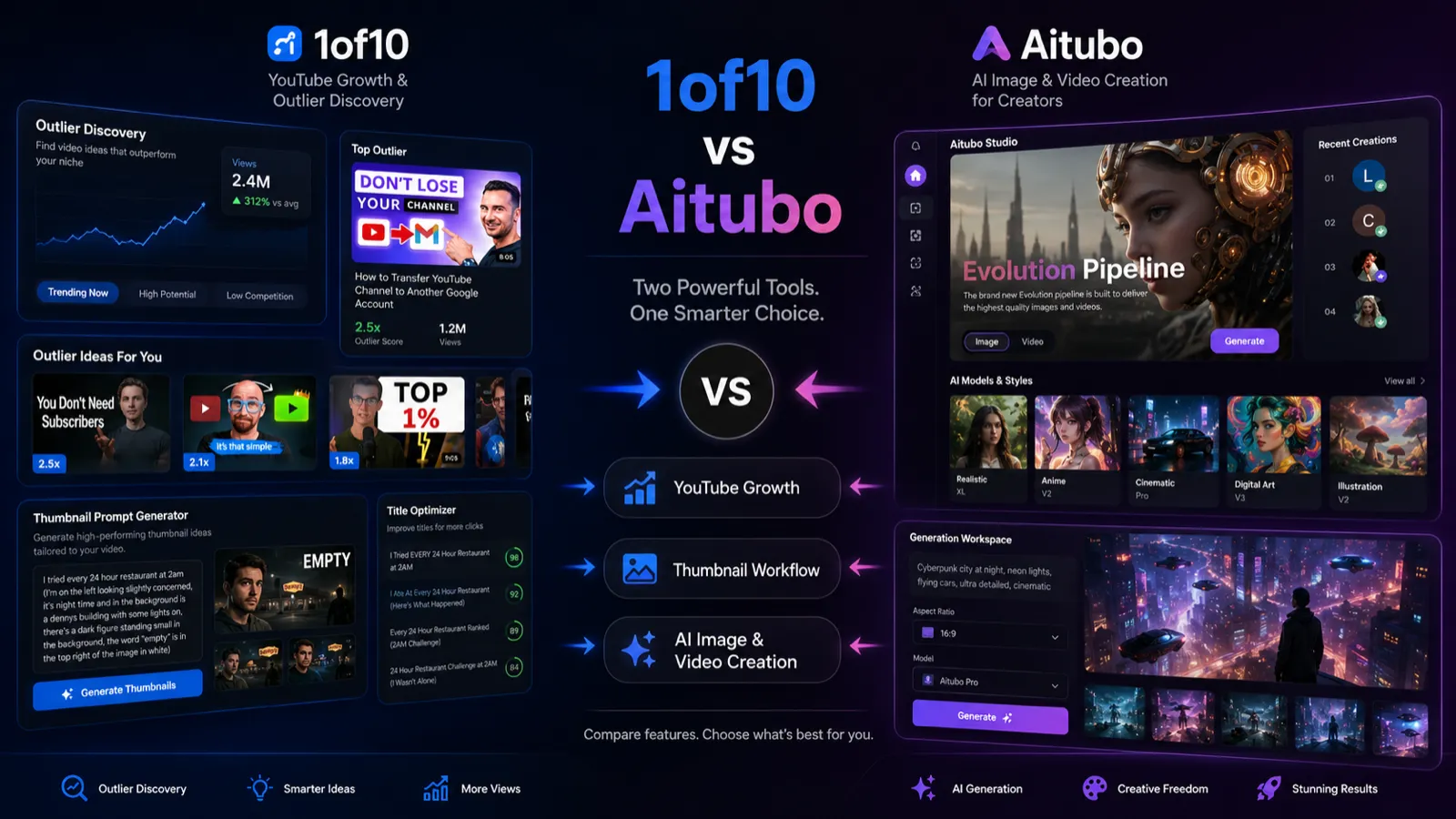
1of10 vs Aitubo is a comparison between two creator tools that can touch thumbnails, visuals, and AI-assisted content, but they do not solve the same job. 1of10 starts from the YouTube question: what topic, title, thumbnail, or outlier pattern should a creator study before publishing? Aitubo starts from the creative production question: what image, video, effect, music clip, or visual asset should the creator make?
That difference matters. A YouTuber with weak ideas may waste time inside a visual generator. A marketer who simply needs fast creative assets may find a YouTube research tool too narrow.
Quick verdict
Choose 1of10 if your main bottleneck is YouTube packaging: researching outlier videos, comparing thumbnails, shaping titles, tracking channels, and deciding which idea deserves the next upload.
Choose Aitubo if your main bottleneck is broad visual creation: AI images, short videos, effects, face swaps, music, editing tools, or programmatic creative workflows.
The buyer mistake is treating both as “AI design tools.” 1of10 is stronger when packaging strategy comes before asset creation. Aitubo is stronger when the asset itself is the work.
At-a-glance comparison
| Decision point | 1of10 | Aitubo |
|---|
| Best for | YouTube idea, title, thumbnail, and outlier research | AI image, video, music, editing, and visual effect creation |
| Pricing style | Free plan plus paid creator plans | Free plan plus token-based paid tiers |
| Free plan or trial | Free plan for research and limited AI tools | Free plan with limited monthly tokens |
| Workflow strength | Better before choosing a YouTube topic or packaging angle | Better when producing visual assets or creative variations |
| Team fit | Higher paths may suit creator teams; seat details should be checked | Less clearly a team governance tool; API path may matter more |
| Main risk | Paying for research you will not use often enough | Burning tokens on experiments before understanding output quality |
| Best next step | Try the free workflow, then read the 1of10 review or store guide | Test the free path, then read the Aitubo review or store guide |
Choose 1of10 if…
Choose 1of10 if your YouTube workflow starts before the visual asset exists. You want to know what is breaking out in your niche, which channels are outperforming expectations, what titles are working, and what thumbnail patterns deserve study before you open a design tool.
This is the safer choice for creators who publish regularly enough that research compounds. If you upload once every few months, the dashboard may feel interesting but not essential. If you upload weekly, study competitors, keep folders of ideas, and test multiple packaging directions before recording, 1of10 becomes easier to justify.
The official positioning is very focused: 1of10 says it helps creators find data-backed ideas, generate viral thumbnails, and craft winning titles. Its feature page also lists outlier discovery, thumbnail generation, niche exploration, title generation, thumbnail search, Shorts outliers, similar thumbnails, similar titles, advanced filters, tracked channels, and bookmarks.
The practical caution is that 1of10 is not a general-purpose visual creation suite. It can help with thumbnails and YouTube packaging, but it is not trying to replace every image, video, music, or visual effect tool. If you only want a creative generator, the 1of10 workflow may feel like an extra research layer.
If 1of10 sounds close but the plan split is unclear, start with the 1of10 store page and use the 1of10 review for deeper product context before checking any savings route.
Choose Aitubo if…
Choose Aitubo if you already know the creative asset you need and want to make or edit it quickly. Aitubo is not mainly about deciding which YouTube idea to chase. It is closer to a broad AI creative workspace for images, videos, music, image editing, talking avatars, image-to-video, text-to-video, face swap, background removal, upscaling, and other visual tools.
That makes Aitubo more useful for marketers, creators, and experimenters who need output variety. A YouTube creator might still use it for thumbnails or B-roll concepts, but the tool is not limited to YouTube packaging. It can also fit social visuals, concept art, short video experiments, image edits, effects, and creative testing.
Aitubo’s homepage currently positions it as a professional-level AI image and video generation platform, while its pricing page points buyers toward a token model, plan tiers, pending-job limits, model access, storage, and private generation.
The buyer caution is token planning. Aitubo can look flexible because there is a free path and many creative tools, but visual generation can become trial-and-error quickly. If you run lots of image and video experiments without watching token use, the paid plan may feel less predictable than expected.
If Aitubo is the better match, read the Aitubo store page or Aitubo review before going straight to checkout. The review path is useful when you need to understand whether the token model and creative scope fit your workflow.
Avoid both if…
Avoid both tools if you have not defined the job.
If your problem is “I need more YouTube views,” 1of10 may help only if you are ready to study packaging and change your planning process. It will not fix weak retention, unclear audience fit, or inconsistent publishing by itself.
If your problem is “I need better visuals,” Aitubo may help only if you are willing to test output quality, edit results, and manage tokens. It will not remove the need for taste, brand judgment, or final review.
Also avoid both if you need a formal creative operations platform with approvals, brand governance, and client review. 1of10 is too YouTube-specific, while Aitubo is better understood as a creative generation workspace.
Pricing and plan fit
1of10 currently shows a free plan, a Basic plan, a Pro plan, and an Enterprise path on its public pricing page. At this check, the page lists Free at $0, Basic at $29 per month when billed yearly, and Pro at $69 per month when billed yearly; buyers should still verify the current billing toggle and checkout state before treating those as final prices. The key difference is not only price. Basic is closer to research and discovery, while Pro adds AI thumbnail, title, idea, and repackaging tools, plus monthly AI credits.
Aitubo currently shows a Free plan and paid Basic, Standard, and Pro tiers with yearly-billed discount displays. At this check, the public pricing page shows Free with 50 tokens per month, Basic at a lower yearly-billed monthly equivalent, Standard and Pro above it, and plan differences around tokens, model access, queue priority, storage, private mode, and pending jobs. Buyers should verify the current billing interval, token rules, and plan limits before choosing a paid tier.
The pricing logic is very different. With 1of10, you are mostly asking, “Will YouTube research and packaging tools change enough of my publishing decisions to justify the plan?” With Aitubo, you are asking, “How many images, videos, effects, or music outputs will I create each month, and how quickly will tokens disappear?”
Refund language also deserves care. 1of10’s pricing page mentions a 7-day money-back guarantee, while its terms say refund requests are handled case by case and payments are generally non-refundable unless required by law. Aitubo’s refund policy says subscription refunds depend on timing and whether membership benefits or points have been used, with stricter handling after 7 days or after point use. Buyers should check the live policy wording before paying, especially for annual billing or larger token-heavy workflows.
Buyer checklist before checkout
- For 1of10, verify whether you need Basic research tools or Pro generation tools.
- Confirm whether 1of10 is showing monthly or yearly billing before paying.
- Check whether your YouTube workflow includes enough repeat research to justify a paid plan.
- For Aitubo, verify the live billing interval, token allowance, pending-job limits, and model access.
- Test Aitubo’s free path before using paid tokens heavily.
- Check refund language before using credits, tokens, points, or membership benefits.
- Use coupon routes only after the better workflow match is clear.
Workflow fit
The 1of10 workflow starts with research. You look at what is already working, study outlier videos, compare thumbnails, generate or refine titles, and organize ideas before committing to the next upload. It is strongest when the creator is still deciding what to make and how to package it.
The Aitubo workflow starts with creation. You enter a creative direction, choose the tool or model path, make an image or video, edit or upscale the output, and repeat until you have something usable. It is strongest when the buyer already knows the asset they need and wants a faster way to produce variations.
That is why a YouTube creator could use both, but not for the same decision. 1of10 may help decide the video angle and thumbnail direction. Aitubo may help create a supporting visual or experiment with a style. If budget only allows one, choose based on where the bottleneck actually sits.
If planning is the problem, start with 1of10. If asset creation is the problem, start with Aitubo.
Feature depth and practical limitations
1of10’s depth is in YouTube specificity. Outlier discovery, thumbnail search, tracked channels, similar titles, advanced filters, bookmarks, and title or thumbnail tools all point toward one creator problem: getting better at choosing and packaging videos.
That focus is useful, but it also creates a boundary. If your work spans product graphics, campaign visuals, music snippets, image edits, short video effects, and general creative experiments, 1of10 may be too narrow.
Aitubo’s depth is in breadth: image generation, video generation, music, image editing, talking avatars, image-to-video, text-to-video, background removal, face swap, upscaling, and API documentation for programmatic creative jobs.
That breadth is useful, but it creates a different risk. A tool with many creative paths can tempt buyers to test everything. The safer approach is to test only the asset type you actually need, then decide whether the paid token allowance matches real monthly usage.
Team, business, or advanced use
1of10 can make sense for small creator teams when the workflow involves editors, thumbnail designers, strategists, or channel operators who all care about the same packaging decisions. The public pricing page references team-member access on Pro and a higher-touch Enterprise path, but buyers should verify seat pricing, team access, onboarding, and support expectations before treating it as a team system.
Aitubo may fit business use when the buyer needs repeat creative output or API-driven visual jobs. Its API documentation shows examples around job creation and model-based workflows, but buyers should verify current API access, authentication, rate expectations, and commercial requirements before building production work around it.
For agencies, choose 1of10 if the deliverable is YouTube research and packaging strategy; choose Aitubo if the deliverable is visual asset experimentation. Neither replaces creative judgment.
Coupon, deal, and next-step path
Do not start with the coupon page if you are still unsure which workflow fits. The discount path should come after the buyer decision, not before it.
For 1of10, the safest sequence is: try the free plan, decide whether Basic research or Pro generation tools match your YouTube workflow, read the 1of10 review if you need more context, then check the 1of10 coupon page only as a final savings verification step.
For Aitubo, the safer sequence is: test the free token path, check the Aitubo store page for plan-fit context, read the Aitubo review if token usage or creative scope is still unclear, then use the Aitubo coupon page only to verify any current checkout path.
A coupon should not decide this pair. First decide whether you are buying YouTube packaging or broad visual creation.
Final verdict
Choose 1of10 if your creator workflow depends on better YouTube ideas, titles, thumbnails, outlier research, tracked channels, and packaging decisions before upload.
Choose Aitubo if your workflow depends on making AI images, videos, music, edits, effects, or creative assets, and you are comfortable checking token usage before paying.
If you are still unsure, do not start with the discount. Start with the workflow: YouTube packaging research points to 1of10; broad visual creation points to Aitubo. Then check the relevant store, review, or coupon route only after the better match is clear.
FAQ
Is 1of10 better than Aitubo for YouTube creators?
1of10 is usually the better fit if the creator needs YouTube research, title ideas, thumbnail direction, outlier discovery, and competitor tracking. Aitubo may still help create visual assets, but it does not replace a YouTube-specific planning workflow.
Is Aitubo better than 1of10 for AI image generation?
Aitubo is the better fit for broad AI image and video creation because that is its main product direction. 1of10 can help with thumbnail workflows, but buyers should not treat it as a full creative generation suite.
1of10 may be easier for beginners who already know they want to grow a YouTube channel. Aitubo may be easier for beginners who simply want to test visual creation. In both cases, the safer path is to use the free entry point before paying.
Which has better pricing for solo creators?
It depends on the creator’s repeat workflow. 1of10 pricing makes more sense when YouTube research and packaging are regular needs. Aitubo pricing makes more sense when the buyer expects to use enough visual output to justify tokens and plan limits. Current checkout details should be verified before annual billing.
Should I choose based on coupon availability?
No. Coupon availability should be a final verification step, not the reason to choose. First decide whether you need 1of10’s YouTube packaging workflow or Aitubo’s visual creation workflow.
What should I check before paying?
For 1of10, check the difference between Basic and Pro, yearly billing, team needs, and refund wording. For Aitubo, check token allowance, model access, pending-job limits, API needs, refund rules, and whether free testing proves the output quality you need.