Quick verdict
Scrumball is worth considering if influencer marketing is already a real workflow in your business, not just an idea you are curious about.
That is the first filter I would use.
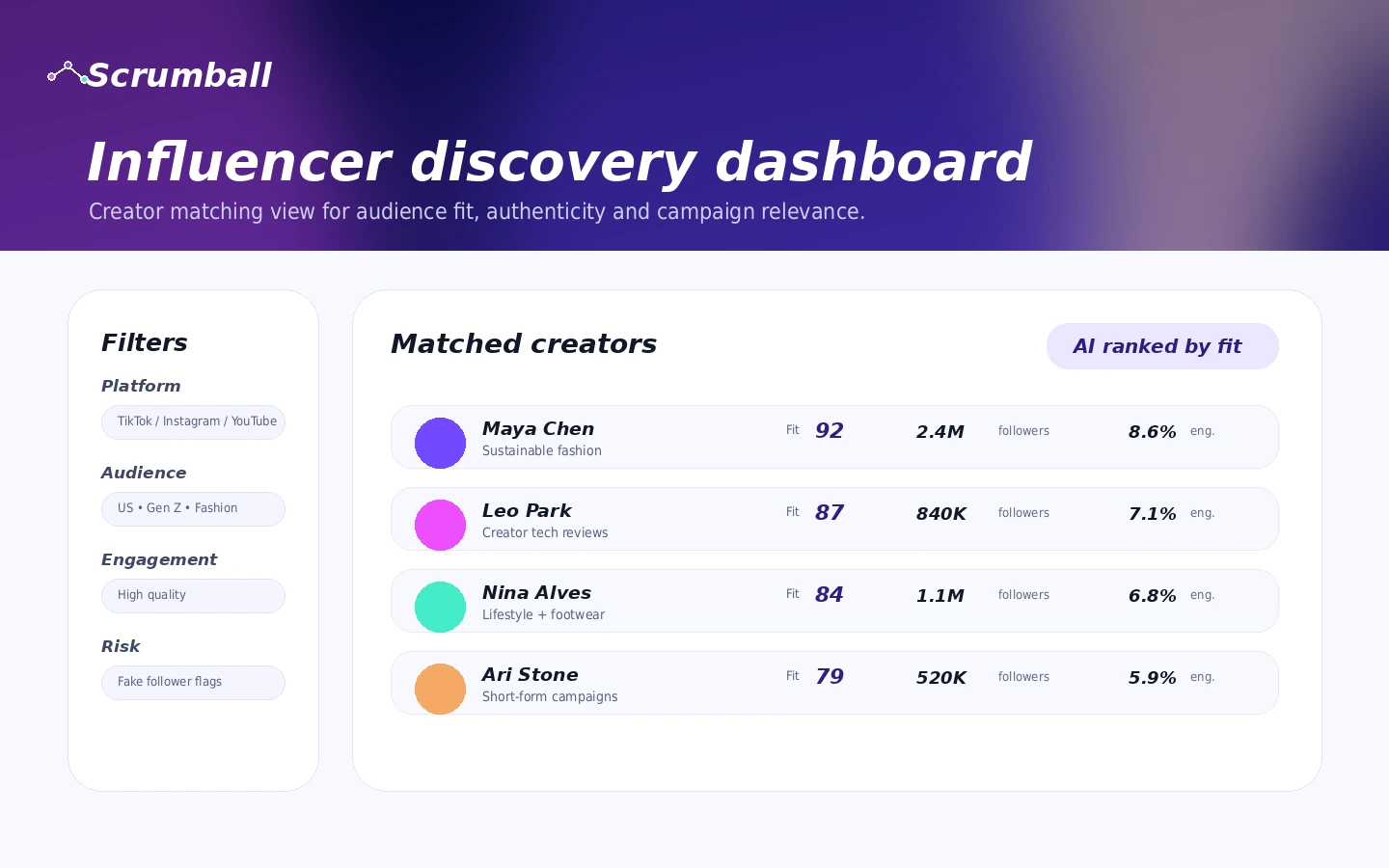
The product looks strongest when a brand needs to move from campaign brief to creator discovery, outreach, influencer management, performance tracking, and Shopify-style partnership growth without living in spreadsheets. Scrumball is not just a creator search box. Its current public positioning is much closer to an AI-assisted influencer marketing operations platform, with multiple agents and workflow areas designed around discovery, outreach, campaign tracking, team collaboration, and reporting.
The part I would be careful with is the buying path. Scrumball has a free entry route, a public pricing page, and a separate Shopify App Store listing with its own pricing structure. That can be useful, but it also means buyers need to slow down and ask which route they actually need: the broader influencer campaign platform, the Shopify affiliate and referral app, or a simpler affiliate/UGC tool instead.
For my money, Scrumball makes the most sense for ecommerce brands, agencies, and marketing teams that already have a campaign calendar, creator budget, target platforms, and reporting expectations. I would skip it, or at least stay free longer, if you only need a few creator names for a one-off campaign.
The safest next step is to test one real campaign brief before choosing a paid tier. If the creator matches, outreach workflow, and reporting logic feel useful, then pricing becomes worth checking. If the workflow fit is weak, a lower price or coupon path will not fix that mismatch.
Next step: If Scrumball still fits your influencer campaign workflow, verify the current buyer route before treating any plan or offer as final.
Review snapshot
| Review point | Practical take |
|---|---|
| Best for | Ecommerce brands, agencies, and marketing teams running repeated influencer or creator partnership campaigns |
| Not ideal for | One-off creator research, casual influencer browsing, or buyers who only need simple affiliate tracking |
| Main use case | Turning a campaign brief into creator discovery, outreach, campaign CRM, tracking, and reporting |
| Pricing note | Free entry is visible, but paid value depends on credits, reports, emails, Shopify limits, and team depth |
| Free path | Useful for testing whether creator matching and campaign workflow quality are good enough before paying |
| Main strength | Connects influencer discovery, AI outreach, management, performance tracking, and ecommerce partnership workflows |
| Main concern | Core platform pricing, Shopify app pricing, refund language, and plan limits need live verification |
| Direct alternatives | The Influencer AI for creator-assistant workflow, Rewardful or Tapfiliate for affiliate tracking, MakeUGC for UGC creative generation |
| Best next step | Use one real campaign brief to test creator quality, workflow fit, and plan pressure before checkout |
What is Scrumball?
Scrumball is best understood as an AI-powered influencer marketing platform for brands that want help with creator discovery, outreach, influencer management, campaign tracking, team collaboration, and ecommerce partnership workflows.
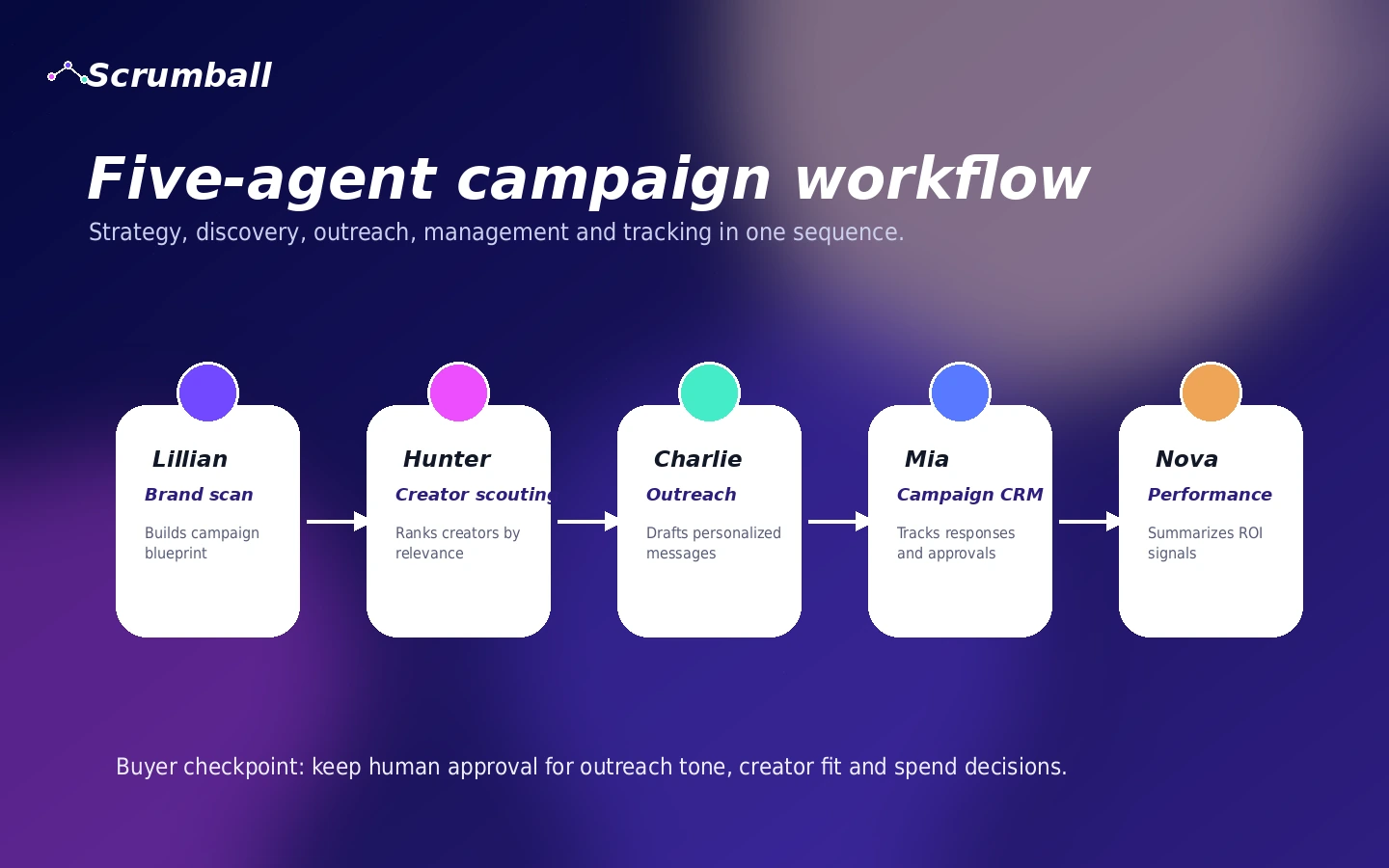
The product is not positioned like a generic business dashboard. It is built around the messy middle of influencer marketing: finding relevant creators, understanding whether they fit a brand, contacting them, tracking the relationship, watching campaign performance, and keeping the team aligned. The official site also presents Scrumball through a five-agent model, with agents supporting campaign strategy, influencer scouting, outreach, ranking, and ROI reporting.
That positioning matters because the wrong buyer can overestimate the value quickly. A marketer who only wants a handful of creator ideas may not need this much workflow. A Shopify merchant who only wants affiliate links may be better served by an affiliate platform. A brand that wants full campaign execution, however, may find Scrumball more interesting because the product tries to connect discovery, outreach, CRM, tracking, and ecommerce partnership logic.
Our review approach compares public product pages, pricing details, help documentation, buyer workflow fit, refund and checkout terms, Shopify app context, and nearby alternatives. A free plan, app listing, or promotional path is useful only if the product actually fits the work the buyer needs to repeat.
The common wrong expectation is thinking Scrumball is simply a database. The database matters, but the bigger buyer question is operational: can this help you run creator campaigns with less manual research, fewer scattered spreadsheets, better outreach discipline, and clearer reporting?
Who should use Scrumball?
Scrumball is most convincing for ecommerce brands that already know influencer marketing is part of their acquisition plan. If you sell through Shopify, run product seeding, recruit creators, track referrals, or want a more structured way to coordinate affiliate-style partnerships, Scrumball has a clearer role. The condition is simple: you need enough campaign activity for the workflow to matter.
It also fits marketing teams that are tired of manual creator research. If the current process is a mix of TikTok searches, Instagram tabs, YouTube notes, spreadsheet columns, email templates, and half-tracked follow-ups, Scrumball’s staged workflow may reduce friction. I would still verify whether the creator recommendations are relevant for your market before assuming the paid plan will save time.
Agencies can also consider it when they manage repeated creator campaigns for multiple clients. The team, CRM, reporting, and workflow structure become more valuable when there are approvals, deliverables, budgets, and creator communication threads to track. The risk is plan pressure. Agencies should check user roles, reports, email unlocks, Shopify store limits, API or data access, and collaboration depth before committing.
Scrumball may also interest brands that want AI-assisted outreach without handing over all judgment to automation. The official positioning suggests outreach can be generated and reviewed, which is the right buyer model. AI can draft and structure the process, but brand tone, creator fit, compensation, and partnership terms still need human approval.
Finally, Scrumball fits buyers who want a campaign operations layer rather than a single-point tool. If you only need discovery, outreach, affiliate tracking, or UGC production, there may be a narrower alternative. If you need several of those steps connected, Scrumball becomes more relevant.
Who should avoid Scrumball?
I would avoid paying for Scrumball too quickly if you do not yet have a real campaign brief. Without a target audience, platform priority, creator budget, region, product angle, and success metric, even a capable influencer platform can feel vague. The tool cannot fix a strategy that has not been defined.
Small buyers should also be careful if they only need a few manually researched creators. In that case, a free search, manual spreadsheet, or lightweight creator research process may be enough. Scrumball’s paid value is easier to justify when the buyer repeats the workflow, not when the buyer is doing one exploratory campaign.
Scrumball is not the cleanest first choice if your main job is affiliate tracking. For SaaS or ecommerce affiliate program management, tools like Rewardful or Tapfiliate may be a more direct comparison. Scrumball is relevant when influencer sourcing, creator outreach, and campaign operations matter alongside affiliate or referral mechanics.
I would also slow down if refund flexibility matters to you. The public pricing and terms language is strict about activated digital plans. That does not make the product bad, but it changes the risk profile. Free testing and careful plan selection matter more when checkout is not a reversible experiment.
Finally, buyers who are shopping mainly for a coupon should step back. A discount can improve a purchase, but it should not decide the purchase. With Scrumball, the real decision is campaign fit, plan limits, and workflow value. The offer path comes after that.
How Scrumball fits into a real workflow
A realistic Scrumball workflow should start before the user opens the product.
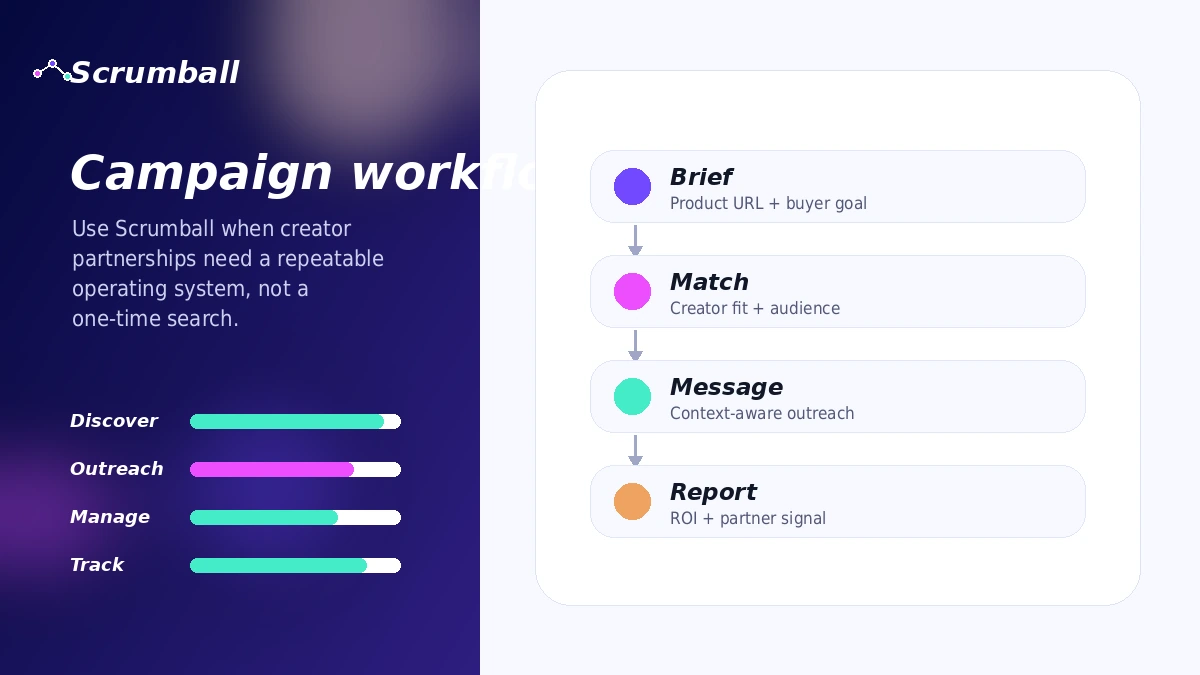
The buyer should prepare a campaign brief: product URL, target customer, ideal creator type, platform priority, region, budget range, commission or compensation model, and the outcome they want to measure. Without that input, an AI-powered creator tool can return ideas that look interesting but are hard to act on.
From there, Scrumball can fit into a campaign sequence:
- Define the campaign goal and audience.
- Use creator discovery to build an initial shortlist.
- Review audience fit, creator quality, authenticity signals, and past performance.
- Use AI-assisted outreach to draft communication.
- Approve tone, compensation language, and partnership terms manually.
- Move accepted creators into a CRM or campaign management flow.
- Track posting, engagement, affiliate or referral activity, and performance.
- Use reporting to decide whether to repeat, expand, or stop the campaign.
That is where Scrumball makes more sense than a standalone search tool. It is trying to reduce friction across the whole creator campaign loop, not just help you find names.
The weak workflow is the opposite: open the tool, browse creators, feel impressed by the database, pay for a tier, and then realize you have no outreach plan, no budget logic, and no way to judge ROI. That is the buyer mistake I would avoid.
Workflow test: Before choosing a paid tier, use Scrumball with one real campaign brief and judge whether the recommendations are useful enough for repeated work.
Real-world buyer scenarios
Ecommerce brand launching a creator campaign
A Shopify brand selling a visual product may use Scrumball to find creators, compare audience fit, create affiliate-style links, and track partnership activity. This is one of the more believable use cases because influencer discovery and ecommerce performance are connected.
The buyer still needs to verify whether the Shopify app route is enough or whether the broader Scrumball platform is the better fit. If the goal is mainly affiliate short-links and commission tracking, an affiliate tool may be simpler. If the goal is creator discovery plus outreach plus campaign reporting, Scrumball becomes more relevant.
Agency managing repeated influencer campaigns
An agency may find Scrumball useful if it handles influencer campaigns across clients, platforms, and markets. The CRM, collaboration, approval, reporting, and AI-assisted outreach pieces matter more when the work is repeated.
The risk is operational fit. Agencies should verify sub-account support, team roles, campaign history, reporting exports, API or data access, and plan limits before building a client workflow around it.
Solo marketer testing influencer marketing for the first time
A solo marketer may be attracted to Scrumball because it makes influencer marketing look structured. That can help, but it can also lead to overbuying.
If this is the first campaign, I would start with free access, one narrow product brief, and a small creator target. If the tool helps you find better creators and write better outreach, then a paid tier is easier to evaluate. If you are still unsure whether influencer marketing is worth doing, stay cautious.
Brand that mainly needs affiliate tracking
Some buyers will arrive through the Shopify affiliate angle and think Scrumball is primarily an affiliate program tool. It can be relevant there, but the comparison set changes.
If the main job is partner tracking, commissions, payouts, and affiliate links, compare Scrumball with Rewardful, Tapfiliate, and Shopify-native affiliate tools. If the main job is finding creators and running influencer campaigns, Scrumball is a more natural fit.
Key features that actually matter
Influencer discovery and creator matching
The discovery layer is the first feature buyers will notice, but it should not be judged by database size alone. Scrumball’s public pages mention large creator coverage across major platforms, but the buyer’s real question is narrower: does it surface creators who match your product, audience, budget, and campaign style?
Buyer note: test with a real product and a specific target audience. A large database is useful only if the shortlist is relevant enough to save research time.
AI agents for campaign flow
Scrumball’s agent framing is useful because influencer marketing is not one task. It involves strategy, research, evaluation, outreach, follow-up, tracking, and reporting. Specialized AI agents can make the workflow feel more guided than a blank search interface.
The caution is that “AI agent” language can sound stronger than the buyer should assume. I would treat the agents as workflow assistants, not as a replacement for campaign judgment.
Buyer note: check whether the agents produce decisions you can trust, edit, and explain to your team.
Outreach automation
AI-assisted outreach can save time when the team contacts many creators. Scrumball’s official pages describe personalized outreach and email setup paths, including SMTP-enabled providers and Gmail Workspace integration.
That is useful, but outreach quality still matters. A bad outreach message sent faster is still a bad outreach message. The buyer should review tone, creator relevance, compensation language, and brand safety before sending.
Buyer note: test outreach drafts manually before letting automation influence a live creator relationship.
Influencer CRM and campaign management
The CRM layer is where Scrumball becomes more interesting for repeated campaigns. Creator profiles, lists, collaboration status, notes, tags, posting trackers, and campaign management features can reduce the scattered spreadsheet problem.
This is more valuable for teams than one-off users. If your campaign has approvals, outreach stages, deliverables, content tracking, and reporting needs, a structured CRM can matter.
Buyer note: compare the CRM depth against your current workflow. If your campaign is simple, this may be more platform than you need.
Shopify affiliate and referral workflow
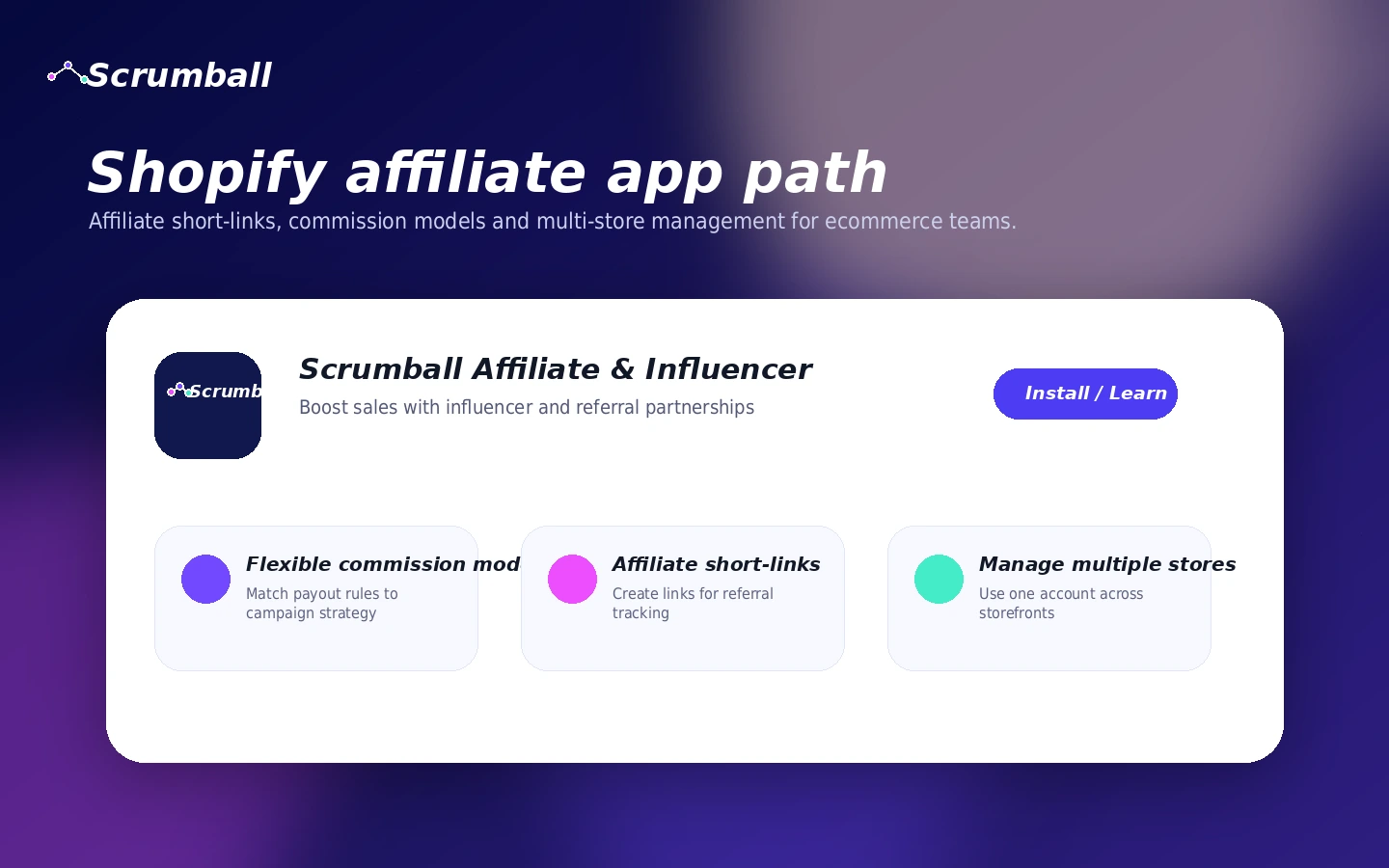
The Shopify App Store listing gives Scrumball a separate ecommerce path. It highlights flexible commission models, affiliate short-links, multiple store management, and influencer or referral partnership workflows.
This is useful, but it can also confuse the buying decision. The Shopify app pricing route is not automatically the same as the full Scrumball platform route.
Buyer note: decide whether you are buying influencer discovery and outreach, Shopify affiliate management, or both.
API and data integration path
Scrumball also presents API services around influencer metadata, fan data, competitor cooperation tracking, data frequency, and data dimensions. This matters for more technical buyers or teams that want influencer data integrated into internal systems.
I would not assume API use is casually included in every plan. API or custom data integration should be verified directly before a team depends on it.
Buyer note: technical buyers should check plan access, cost, data scope, usage limits, and support coverage before treating API integration as part of the purchase.
Pricing and plan value
Scrumball’s pricing should be evaluated carefully because there are at least two buyer routes to keep separate.
The first is the main Scrumball platform route. Public information shows a free entry path, and third-party pricing references commonly show paid monthly tiers such as Starter, Professional, Enterprise, and Premium. The internal store data lists Starter around $32/month, Professional around $299/month, and higher business tiers above that. Because pricing can change and some plan tables are rendered dynamically, I would verify the current pricing page and live checkout before treating any number as final.
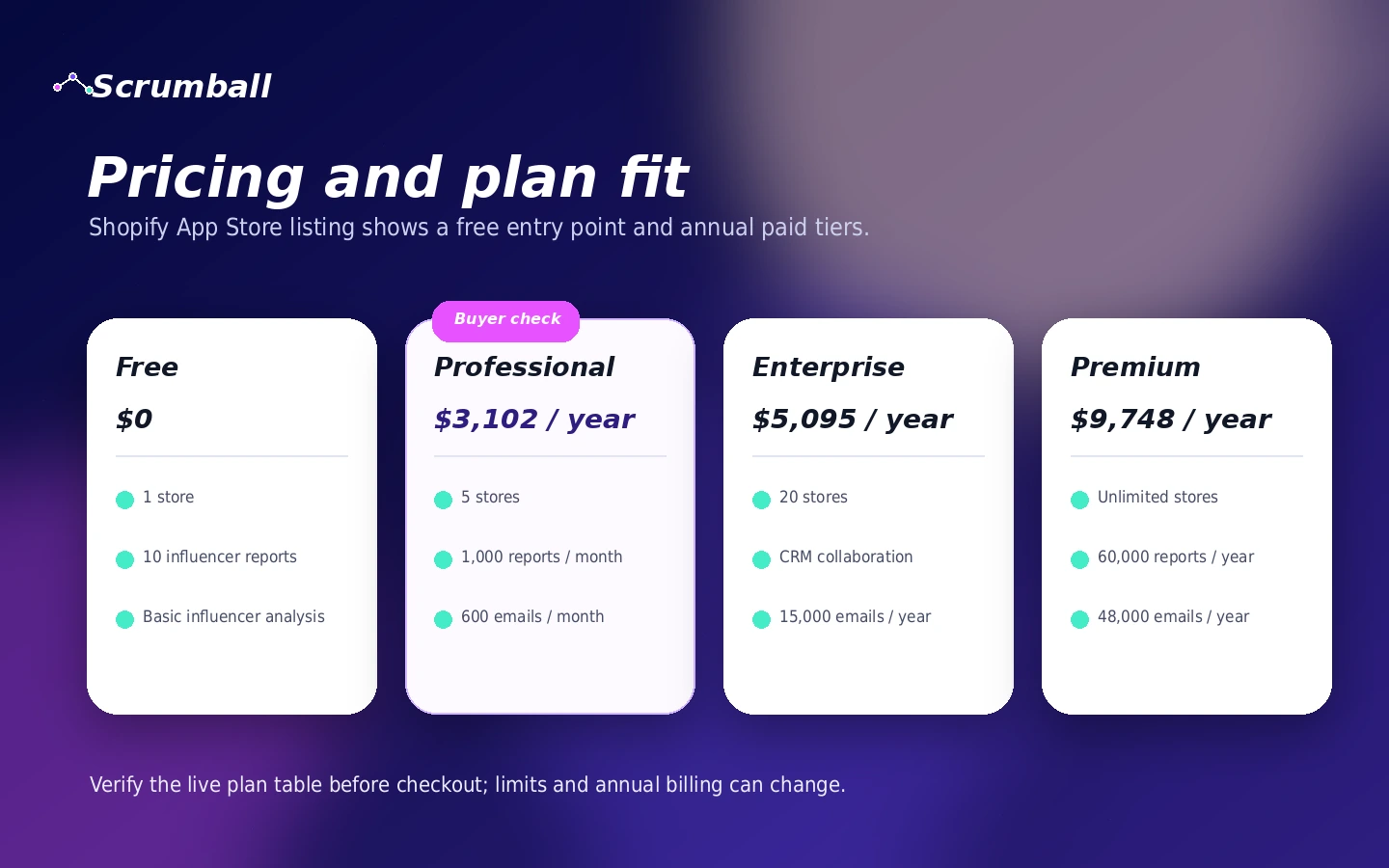
The second route is the Shopify app listing. That page shows a Free plan and yearly paid tiers for Shopify affiliate and influencer partnership workflows, with limits around stores, email volume, influencer reports, CRM collaboration, and higher-tier usage. This route may be more relevant for ecommerce buyers who care about affiliate short-links and multiple store management.
The important point is not just price. It is plan pressure.
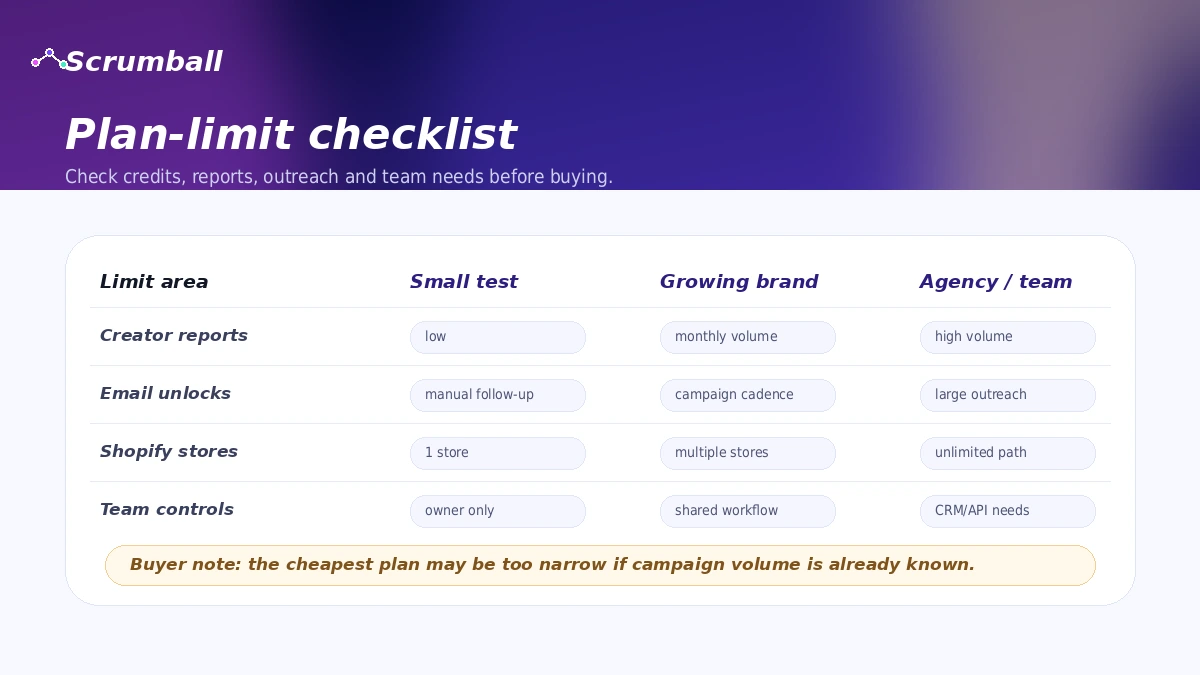
Scrumball’s value can change based on credits, creator reports, email unlocks, posting trackers, Shopify store limits, team features, CRM access, social listening, API access, and support expectations. A buyer who only compares monthly sticker price may miss the real limit that affects campaign execution.
I would start free if you are still validating creator quality. I would consider a paid monthly route only after a real campaign test shows that the recommendations, outreach workflow, and reporting save enough time. I would move toward higher tiers only when campaign volume, team collaboration, Shopify store needs, or API/data requirements make the extra workflow depth necessary.
Annual billing should come later, not first. With Scrumball’s strict refund posture, proving repeated value matters more than chasing the lowest effective monthly price.
Pricing check: Review Scrumball's current plan table and compare it against your campaign volume before choosing monthly, annual, or Shopify app pricing.
Check Scrumball pricing Check current offers Read store guide
Free plan, trial, coupon, and checkout notes
Scrumball’s free entry path is the right place for most cautious buyers to start.
Free access should be used to answer practical questions, not just to browse. Bring one campaign brief and test whether the platform returns creator matches that look useful, whether outreach drafts sound appropriate, whether reporting expectations make sense, and whether the workflow feels better than your current spreadsheet or manual research process.
The coupon path should be secondary. A current deal can make a good purchase cheaper, but it should not be the reason you choose the product. With Scrumball, the bigger risk is buying the wrong route: core platform when you only needed Shopify affiliate support, Shopify app when you needed broader influencer campaign operations, or any paid plan when you only needed a small creator list.
If you want to check active offers, use the Scrumball coupon page after workflow fit is clear. Do not treat a reported coupon path as proof that the platform fits your campaign.
Refund terms deserve special attention. The public pricing and terms language describes activated plans as digital products and warns that refunds may not be available. That makes free testing, plan-limit review, and monthly-before-annual caution more important.
What I would check before buying Scrumball
If I were buying Scrumball for a real campaign workflow, I would check these seven things first:
- Campaign clarity: Do we have a real product, target audience, platform priority, creator budget, and success metric?
- Creator quality: Do Scrumball’s recommendations match our niche, region, audience, and price expectations?
- Plan limits: Which tier controls credits, influencer reports, email unlocks, posting trackers, Shopify stores, CRM access, and team features?
- Core vs Shopify route: Are we buying the full influencer platform, the Shopify affiliate app, or both?
- Refund and renewal terms: Are we comfortable with strict digital subscription terms before paying?
- Outreach control: Can the team review and approve messaging before creators receive it?
- Alternative fit: Would an affiliate platform, UGC creative tool, or simpler creator assistant solve the real job with less cost?
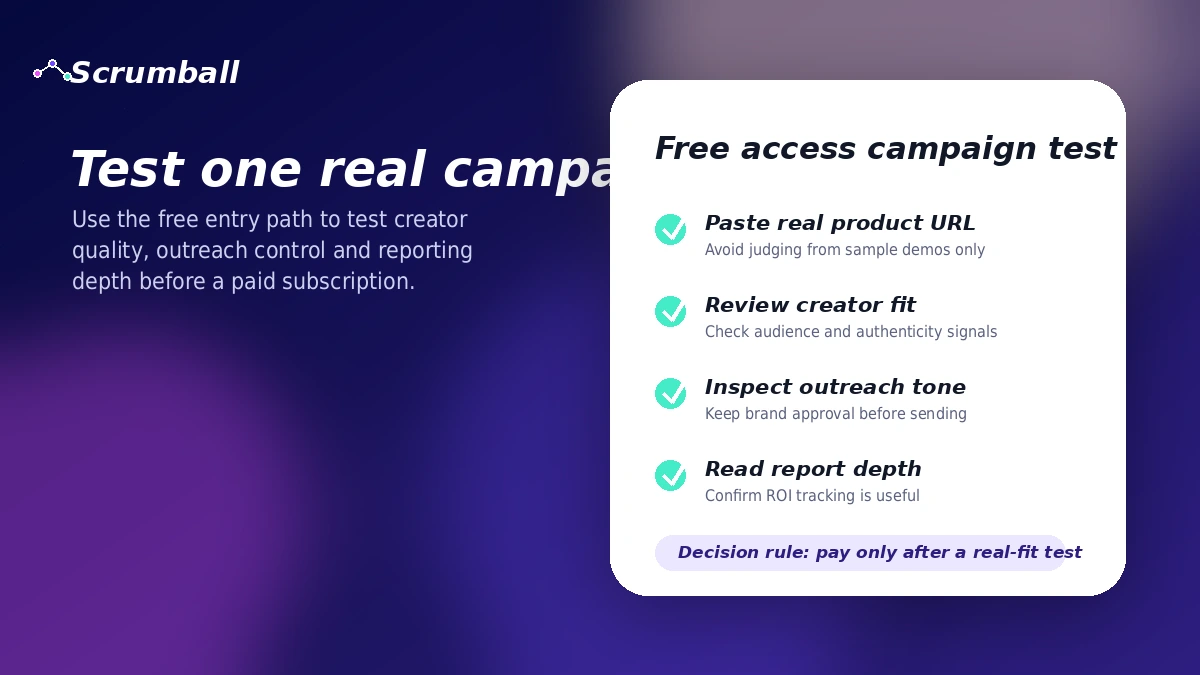
The first check matters most. If the campaign is vague, the product evaluation will be vague. A strong campaign brief makes Scrumball easier to judge.
A simple test before paying
Before paying, I would run a small test like this:
- Choose one real product or campaign, not a generic brand idea.
- Define the target customer, platform priority, region, budget range, and creator type.
- Use Scrumball to generate or discover an initial creator shortlist.
- Review creator relevance manually: audience fit, authenticity, content quality, partnership history, and expected cost.
- Generate or inspect outreach messaging, then check whether it sounds like your brand.
- Look at campaign tracking or reporting options and ask whether they would replace your current spreadsheet.
- Compare the plan limits against the campaign you just tested.
If this test produces useful creator candidates and a clearer workflow, a paid plan becomes easier to evaluate. If the test produces generic matches or still requires the same manual work, I would not expect a higher plan to automatically fix the fit.
The test should be practical. Do not test with a fantasy campaign. Use the product, market, and budget you would actually run.
Pros explained
Scrumball connects more than one campaign step
The main advantage is that Scrumball is not limited to a single piece of influencer marketing. Discovery, AI-assisted outreach, campaign management, tracking, and Shopify partnership workflows all sit near the same buyer problem.
That matters when the current process is fragmented. It matters less if you only need one part of the workflow.
The AI agent model gives structure to messy work
Influencer marketing can be scattered: research creators, compare fit, write messages, follow up, track posts, measure results. Scrumball’s agent model gives buyers a clearer path through those steps.
The benefit stops being enough if the buyer treats the agents as final decision-makers. Creator partnerships still need human judgment.
Free entry lowers the testing risk
A free path is helpful because Scrumball should not be bought blindly. The buyer needs to see whether creator matching and outreach output are useful for a real campaign.
The free path is not the same as paid value. It is a testing lane, not proof that a paid tier will fit.
Shopify app support gives ecommerce buyers another angle
For Shopify merchants, affiliate short-links, store-based partnership workflows, and flexible commission models can be relevant. This makes Scrumball more interesting than a pure creator database.
The tradeoff is route confusion. Buyers need to compare the Shopify app path with the core platform path before choosing.
Cons explained
Pricing value depends on plan limits
Scrumball can look straightforward until you examine the details that affect campaign volume. Credits, reports, emails, posting trackers, Shopify store limits, CRM access, team collaboration, and API access may determine real value more than the headline price.
This matters most for agencies, ecommerce teams, and brands planning repeated campaigns.
Refund flexibility is limited
Strict refund language changes the buying decision. If activated digital plans are not refundable, the free path and plan review become more important.
This does not mean buyers should avoid Scrumball. It means they should not treat paid checkout as a casual experiment.
Core platform and Shopify app paths can be confusing
Scrumball’s broader platform and Shopify app listing overlap in the buyer’s mind but may not be the same purchasing route. One buyer may need influencer discovery and outreach. Another may need affiliate links and store-based referral workflows.
Choosing the wrong path can make a good tool feel poorly matched.
Not every marketer needs this much workflow
A small brand running one lightweight creator test may not need AI agents, CRM, reporting, and team collaboration. Manual research or a simpler tool may be enough.
The more repeatable the campaign workflow, the stronger Scrumball becomes. The more casual the campaign, the weaker the case for paying.
Green flags and red flags
Green flags
Scrumball is a stronger fit when you already run influencer campaigns repeatedly and want less manual work across research, outreach, tracking, and reporting.
It is also a good signal if your team needs structure: approvals, creator status tracking, collaboration, multiple campaigns, and performance review. Those are the situations where a connected workflow can save time.
The Shopify route is another green flag for ecommerce buyers, especially if affiliate or referral partnerships are already part of the growth strategy.
Red flags
The first red flag is buying before defining the campaign. If you do not know your target creator, audience, budget, platform, and outcome, no influencer platform can make the decision clean.
The second red flag is plan-limit uncertainty. If you cannot tell which tier gives you enough reports, email unlocks, Shopify stores, team access, or API options, slow down.
The third red flag is coupon-first thinking. A cheaper checkout can still be a bad purchase if the tool does not fit the campaign.
Scrumball vs alternatives
The Influencer AI vs Scrumball
The Influencer AI is the closer comparison if the buyer mainly wants influencer assistance or creator-focused AI support without committing to a broader campaign operations stack.
Scrumball may still make more sense if discovery, outreach, campaign CRM, tracking, and ecommerce workflow all matter together. The tradeoff is depth versus simplicity.
MakeUGC vs Scrumball
MakeUGC is an adjacent route, not a direct one-to-one replacement. It is more relevant when the buyer wants UGC-style ad creatives or creator-like content outputs rather than a platform for finding and managing real influencer partnerships.
Choose MakeUGC-style tools when creative production is the main job. Consider Scrumball when the main job is creator discovery, outreach, relationship management, and campaign reporting.
Rewardful vs Scrumball
Rewardful is a stronger comparison when the buyer needs SaaS affiliate tracking, referral links, and partner attribution. It is not trying to solve influencer discovery in the same way.
Scrumball may be stronger when the buyer needs to find creators and manage influencer campaigns, especially around ecommerce growth. Rewardful may be cleaner if the main workflow is a software affiliate program.
Tapfiliate vs Scrumball
Tapfiliate is another stronger fit for affiliate program management and partner tracking. Buyers who already have partners and mainly need tracking, commission logic, and program infrastructure should compare it carefully.
Scrumball is more relevant when the buyer still needs influencer discovery, outreach, creator analysis, and campaign operations before tracking becomes the main issue.
Trust, refund, and buyer-risk notes
Scrumball has enough public infrastructure to evaluate: homepage, solution pages, pricing page, user terms, privacy policy, API services page, help center, Product Hunt listing, and Shopify App Store listing. That is a positive trust signal compared with tools that only have a thin landing page.
Still, there are several buyer-risk notes I would not ignore.
First, pricing needs live verification. Public references and app listings can show different routes, and plan details may change. Check the current pricing page and the Shopify App Store listing before assuming any number, limit, or billing interval.
Second, refund terms are strict. If you activate a paid digital plan, do not assume you can reverse the purchase easily. Test before paying, and be especially careful with annual billing.
Third, privacy and data responsibilities matter. Scrumball deals with influencer data, brand data, campaign information, and outreach workflows. Teams should read the privacy policy and terms, especially if they operate in regions where data controller responsibilities apply.
Fourth, AI outreach needs oversight. The product can help structure communication, but creators are real business partners. Review messages, compensation language, product claims, and expectations before sending.
Fifth, do not confuse database size with campaign success. A large creator pool is helpful only when it leads to relevant, reachable, brand-safe creators who can produce the outcome you need.
Final verdict
I would consider Scrumball if influencer marketing is already a real part of your growth workflow and you need help connecting discovery, outreach, creator CRM, performance tracking, Shopify partnerships, and team collaboration.
I would be more cautious if you are still experimenting with influencer marketing for the first time. In that case, use the free path, run one narrow campaign test, and avoid annual billing until the workflow proves itself.
I would skip Scrumball, or at least compare alternatives first, if your main need is only affiliate tracking, UGC creative generation, or a one-time creator list. Rewardful or Tapfiliate may be cleaner for affiliate infrastructure. MakeUGC-style tools may be better for creative production. A simpler creator assistant may be enough if full campaign operations are not needed.
The real buying question is not whether Scrumball has enough features. It does. The better question is whether your team has enough repeated influencer work for those features to matter.
If the answer is yes, Scrumball deserves a serious look. If the answer is no, start smaller and keep your money flexible.
