Quick verdict
Ryne AI is worth a closer look if you specifically want an AI humanizer wrapped inside a broader student-facing writing suite. It is not the kind of tool I would buy just because the homepage promises cleaner, more natural, detector-aware writing.
That distinction matters here.
The product sits in a sensitive category: humanizing AI-assisted drafts, checking AI signals, helping with essays, supporting citations, and offering a Chrome extension for quick rewriting across the web. Used carefully, that can save time. Used carelessly, it can create a false sense of safety around academic, client, or publishing rules.
For my money, Ryne AI makes the most sense for buyers who already know they need a repeated rewrite-and-check workflow. A student might use it to improve rough AI-assisted study notes before rewriting them properly. A creator might use it to make a working paragraph sound less stiff before doing a final human edit. A web-based writer might like the extension because it reduces the copy-paste loop.
The main caution is commercial and ethical at the same time. Ryne has a free plan, but the paid decision depends on coin limits, per-run word limits, AI Report access, yearly billing, and narrow refund terms. The detector-bypass positioning also needs buyer discipline. Passing a detector is not the same as producing accurate, ethical, acceptable work.
The safer path is simple: start free, test a realistic draft, read the refund rules, and only then decide whether a paid tier fits the way you actually write.
Next step: If Ryne AI still fits your writing workflow, verify the current plan path before checkout instead of buying on the humanizer claim alone.
Review snapshot
| Review point | Practical take |
|---|---|
| Best for | Buyers who want a humanizer, AI report workflow, study tools, and Chrome-based rewriting in one account |
| Not ideal for | Buyers who need a risk-free paid trial, flexible refunds, mature team controls, or a standard SEO writing suite |
| Main use case | Reworking AI-assisted drafts, checking detector signals, and improving draft tone before a human edit |
| Free path | Amethyst plan with limited coins and English-only use for basic testing |
| Paid path | Sapphire starts the paid route; higher tiers matter when longer humanization, more reports, or heavier use is needed |
| Main strength | Ryne combines humanization, AI checks, study features, and browser workflow instead of offering only one rewrite box |
| Main concern | Refund terms, renewals, detector-bypass expectations, and policy-sensitive use require careful checking |
| Direct alternatives | Undetectable AI and Phrasly for humanizer-style workflows |
| Detection-first routes | GPTZero and Originality.ai when the real job is review, scoring, or originality checking |
| Best next step | Test one realistic workflow free before choosing monthly or yearly billing |
What is Ryne AI?
Ryne AI is best understood as an AI humanizer and study-writing workspace, not a normal long-form copywriting platform.
The main promise is text humanization: taking AI-assisted draft text and making it sound more natural. Around that core use case, Ryne also presents a wider set of tools, including Ryne Chat, Essay Composer, AI Report, Lecture Lab, Citation Kitchen, and a Chrome extension that can act on selected text inside web pages.
That makes Ryne broader than a one-button humanizer. It also makes the buying decision less clean.
Someone who only needs a simple blog draft editor may find Ryne too focused on detector-aware rewriting and study workflows. Someone who wants a full SEO content suite may be better served by a tool built for keyword research, outlines, content briefs, and publishing workflows. Ryne becomes more interesting when the buyer wants a humanizer, quick AI checks, and study-style writing support in the same account.
The common wrong expectation is that Ryne can make a document “safe” by changing the score. I would not think about it that way. The better way to judge Ryne is whether it helps you revise draft text more thoughtfully, preserve meaning, improve readability, and avoid submitting or publishing work that still needs human review.
Our review approach compares public product pages, pricing details, help and policy information, buyer workflow fit, and nearby alternatives. A free plan, discount route, or low monthly equivalent is not proof that the product belongs in your workflow.
Who should use Ryne AI?
Ryne AI fits buyers who have a real reason to combine rewriting, detector-aware checking, and study or web-writing support.
Students working with rough AI-assisted notes may find Ryne useful if they treat it as a revision aid, not a shortcut around academic rules. The fit is strongest when the student is improving clarity, exploring phrasing, organizing notes, checking citations, or learning how a draft sounds after revision. The condition is important: school and course policies come first.
Creators who use AI for early drafts may also find Ryne useful. A YouTuber, newsletter writer, or solo publisher may paste a stiff working paragraph into a humanizer, compare the result, and then edit manually for voice, accuracy, and reader usefulness. In this case, Ryne is not the writer. It is a cleanup checkpoint.
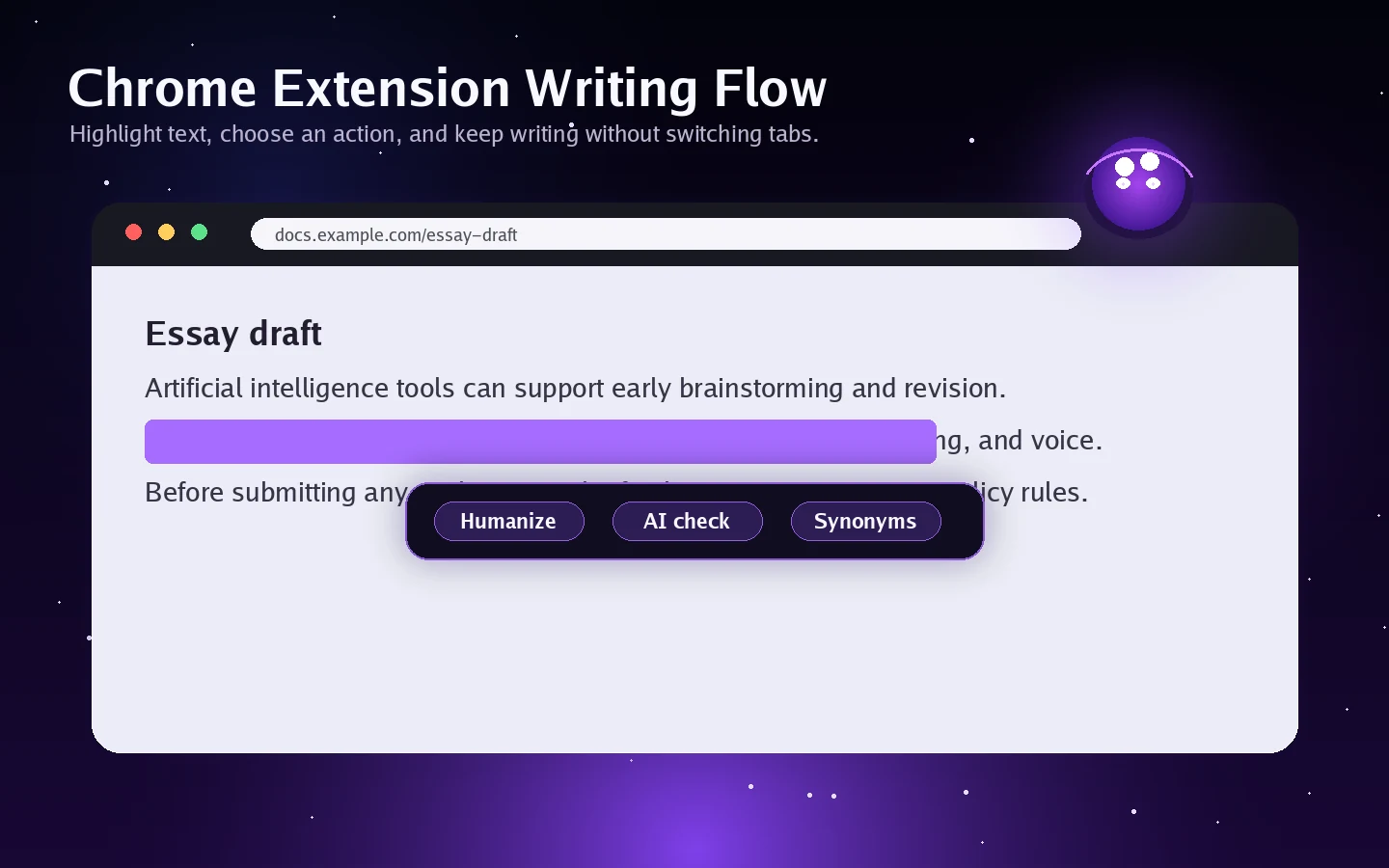
Web-based writers may like the Chrome extension angle. If most of the writing happens in Gmail, Google Docs, Notion, Overleaf, social fields, or browser editors, highlighting text and acting in place can reduce friction. That only matters if the extension workflow actually saves time and the privacy tradeoff is acceptable.
Buyers who want detector-aware editing can also consider Ryne. The AI Report and detector-facing language may help people understand how draft text is being interpreted. I would still treat those reports as signals, not final proof.
Heavier users may consider paid tiers only after the free plan proves useful. The real paid-plan question is not whether Ryne can humanize text. The question is whether the coins, word limits, report limits, and billing terms match your monthly volume.
Who should avoid Ryne AI?
I would be careful with Ryne AI if your main goal is to hide improper use of AI-assisted writing. The product’s detector-facing positioning may be tempting, but school, employer, client, platform, and publishing rules still matter. A lower AI score does not make a weak, inaccurate, or policy-violating draft acceptable.
I would also avoid paying too quickly if you only need a one-off rewrite. The free plan exists for a reason. Use that first. A paid plan is harder to justify if you will only humanize a few short passages.
Teams should be cautious as well. Ryne feels more like a student and individual writer workspace than a mature business writing platform with procurement, roles, permissions, governance, and collaboration controls. If you are buying for an agency or institution, compare it carefully with tools built for review workflows or content operations.
Buyers who dislike restrictive refund terms should slow down. Ryne’s refund path is narrow enough that a careless paid test can become expensive quickly. If a buyer needs a generous trial, this may not feel comfortable.
I would also skip Ryne if you mainly need SEO content planning, long-form article optimization, plagiarism review, or editorial team management. Those are different jobs. Ryne can sit near those workflows, but it is not the strongest default choice for them.
How Ryne AI fits into a real workflow
A careful Ryne AI workflow should not start with “bypass the detector.” It should start with the draft.
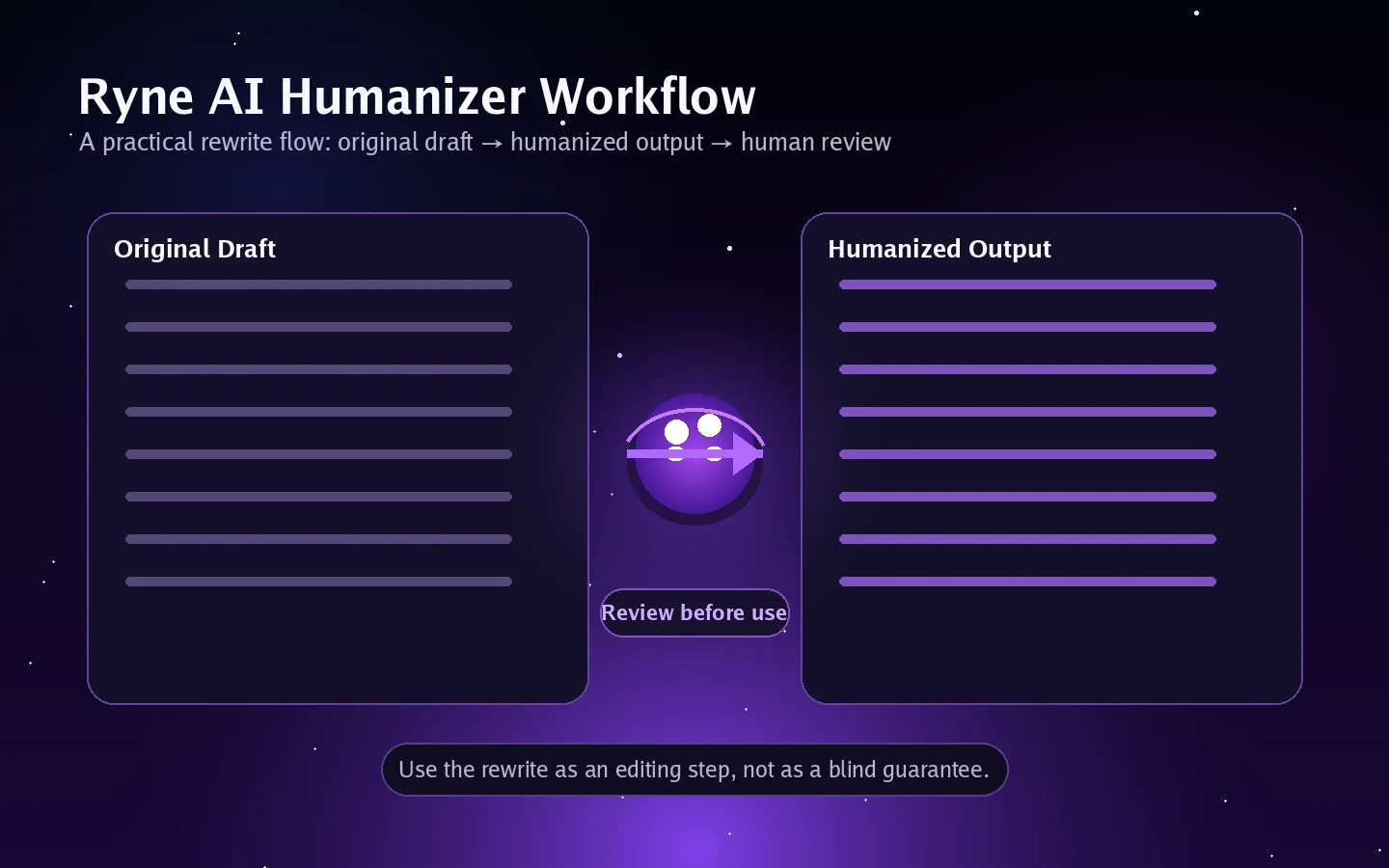
Here is the safer process I would use to evaluate it:
- Choose a realistic AI-assisted draft, not a tiny throwaway sentence.
- Read the draft yourself and mark the parts that sound stiff, vague, repetitive, or over-polished.
- Run a small section through Ryne’s humanizer.
- Compare the meaning before and after rewriting.
- Check whether the output sounds clearer or merely different.
- Use any AI report or detector signal as a review cue, not as final truth.
- Edit manually for accuracy, ethics, reader value, and policy fit.
- Decide whether Ryne saved enough time to justify a paid plan.
That workflow matters because humanizer tools can easily create the wrong incentive. If the only goal is to lower a detector score, the buyer may accept worse writing. If the goal is to improve a working draft and then review it like a human editor, the tool has a more defensible role.
For a student, the workflow may involve lecture notes, rough outlines, citations, or draft paragraphs. For a creator, it may involve polishing an AI-assisted intro before recording or publishing. For a browser-based writer, it may involve highlighting a paragraph inside a web editor and using the extension to test a lighter rewrite.
Ryne is strongest when it creates a repeatable review checkpoint. It is weakest when the buyer treats the output as automatically ready.
Real-world buyer scenarios
A student cleaning up study notes
A student may use Ryne to turn rough AI-assisted notes into clearer study material. That can be reasonable when the goal is comprehension, summary, or revision. The risk appears when the same workflow is used to mask authorship for graded submissions.
Before paying, this buyer should check school policy, citation expectations, and whether the output still reflects their own understanding.
A creator polishing AI-assisted draft text
A creator may use Ryne to make a draft paragraph sound less robotic before turning it into a newsletter, script, or social post. This is a better fit than using Ryne as a one-click publishing tool.
The buyer should test whether Ryne preserves meaning. If the rewrite introduces vague wording, loses the original point, or makes the voice generic, manual editing is still doing the real work.
A web writer using the Chrome extension
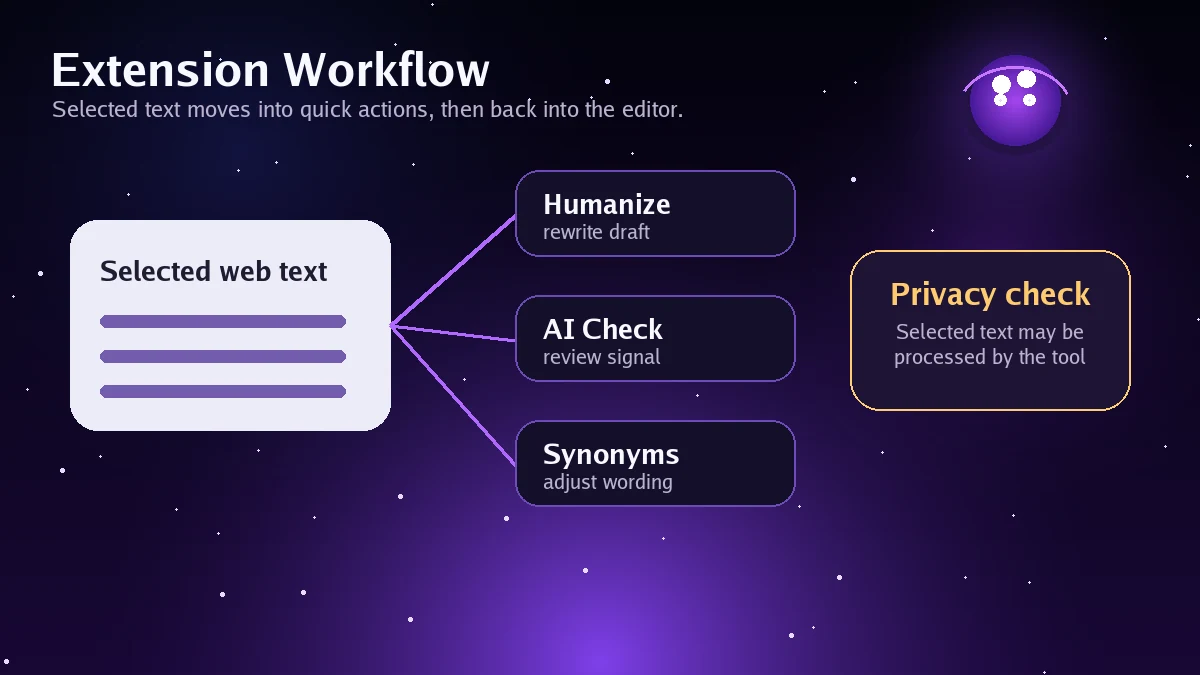
The Chrome extension is one of Ryne’s more practical workflow angles. Highlight-based rewriting can be useful when the buyer writes across multiple browser tools and does not want to move every paragraph into a separate dashboard.
The risk is privacy and context. Selected text is processed by the service, so sensitive client, school, or business material should be handled carefully.
A buyer comparing humanizers and detectors
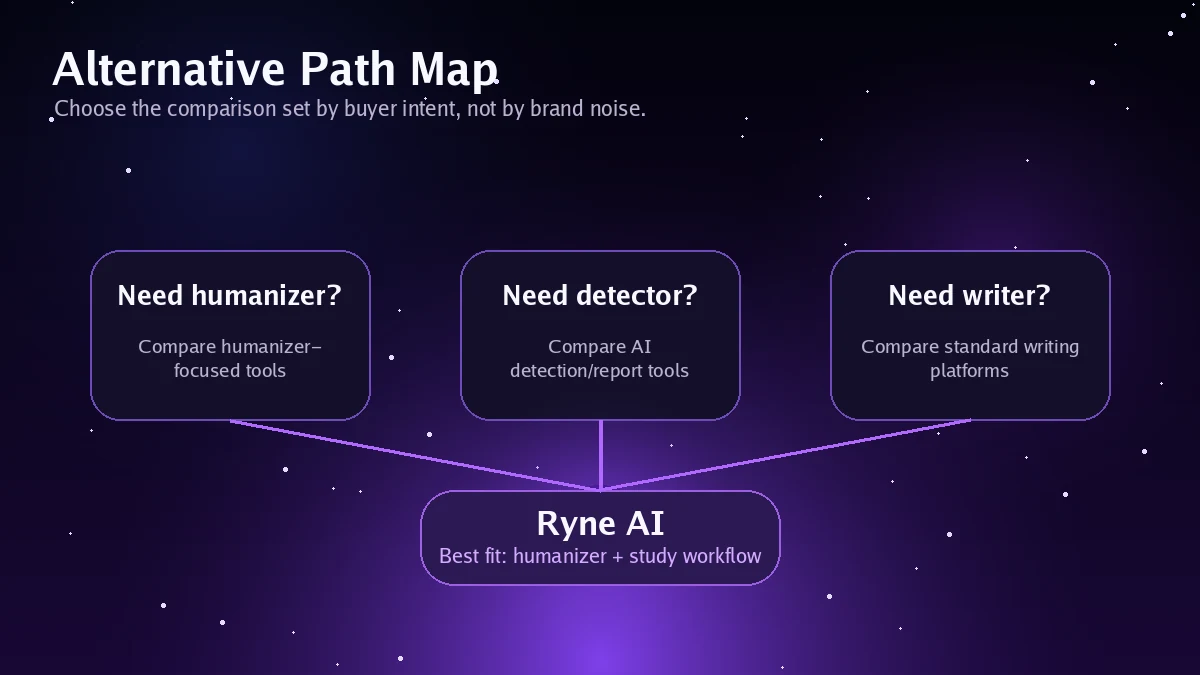
Some buyers are not sure whether they need a humanizer or a detector. Ryne sits between those worlds. It can be useful if the job is rewrite-and-check. But if the real need is detection-first reporting, GPTZero or Originality.ai may be more relevant. If the real need is humanizer-only comparison, Undetectable AI or Phrasly may be closer.
Key features that actually matter
AI humanizer
The humanizer is the core feature. It rewrites AI-assisted draft text to sound more natural and less machine-like.
The value depends on output quality, not marketing claims. A good humanizer should preserve meaning, avoid strange phrasing, and make the text easier to edit. A weak humanizer simply swaps words, changes rhythm, and leaves the buyer with a different kind of awkwardness.
Buyer note: test with a real sample from your workflow. Do not judge the tool from a single short sentence.
AI Report and detector-aware checks
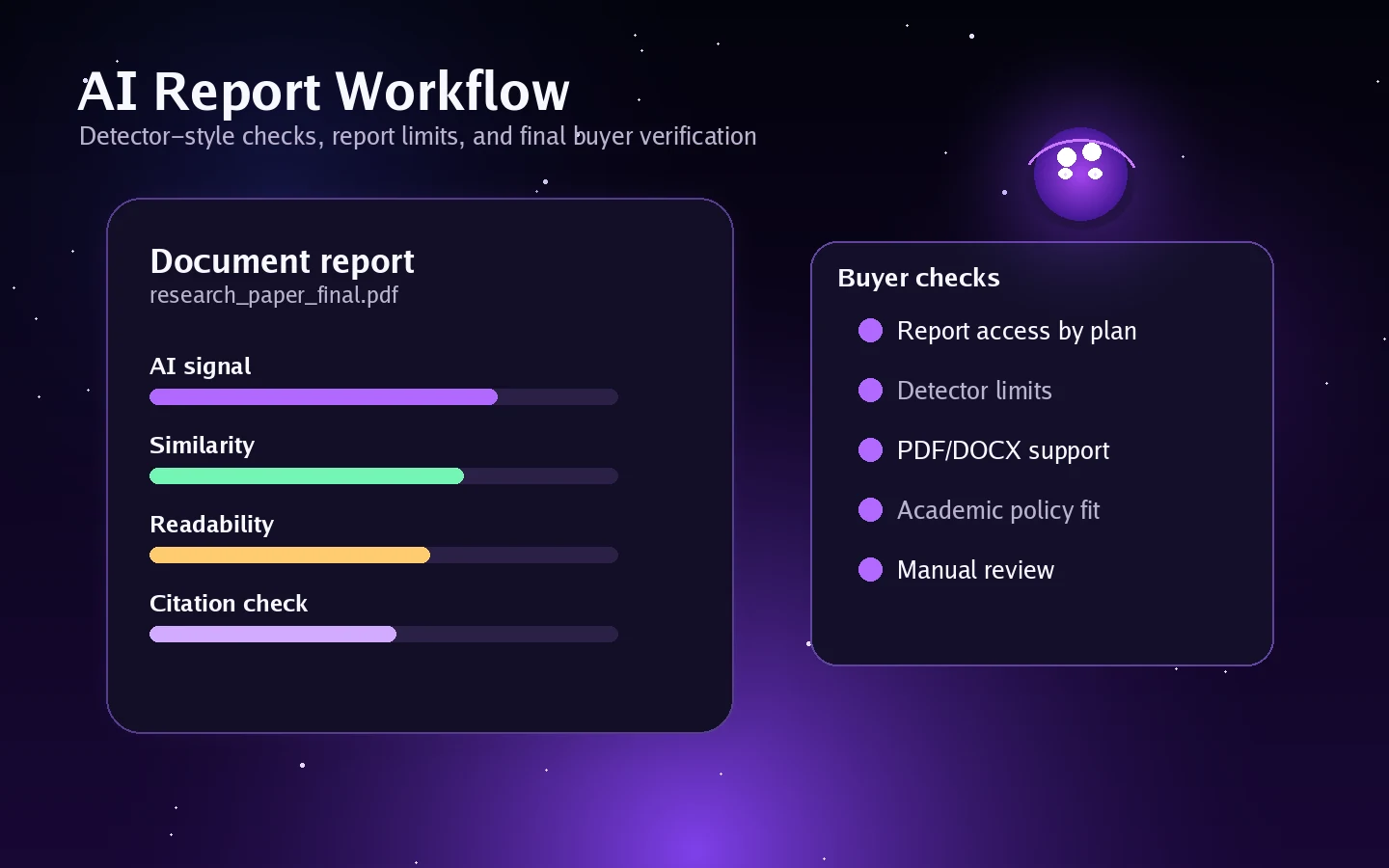
Ryne’s AI Report angle matters because buyers in this category often care about how text is interpreted by detectors. This can be useful as a review checkpoint, especially when the buyer wants to understand which drafts may need more editing.
The disappointment risk is expectation. Detector signals are not final truth. They can vary by tool, model, content type, and update cycle. A report can help you decide where to look. It should not decide whether a person is honest, whether a draft is acceptable, or whether the writing is ready.
Buyer note: use reports to guide revision, not to replace policy judgment.
Study-writing tools
Ryne includes study-facing surfaces such as essay support, lecture tools, citation help, and chat. This makes the product more than a simple rewrite tool.
That breadth is useful if the buyer wants one account for multiple study-related tasks. It becomes less useful if the buyer only needs one narrow job. More features can create more perceived value, but only if you actually use them.
Buyer note: list the tools you will use weekly before paying. If the answer is only “humanizer,” compare dedicated humanizer alternatives first.
Chrome extension
The Chrome extension can be a real workflow advantage. Highlighting selected text and acting without switching tabs is a practical improvement for daily writing.
The limitation is that browser convenience does not remove the need for privacy checks. If selected text contains client material, private academic work, internal business notes, or sensitive information, the buyer should understand how the extension processes that text.
Buyer note: test the extension with low-risk text before using it in sensitive workflows.
Coins, word limits, and report access
The pricing model is not only about monthly price. Coins, per-run word limits, AI Reports, and billing interval shape the real value.
This is where buyers can easily overestimate the plan. A plan can look affordable until repeated rewrites, longer drafts, or report checks use more of the allocation than expected.
Buyer note: estimate your monthly draft volume before choosing a paid tier.
Pricing and plan value
Ryne’s public pricing is clear enough to evaluate, but not simple enough to ignore the details.
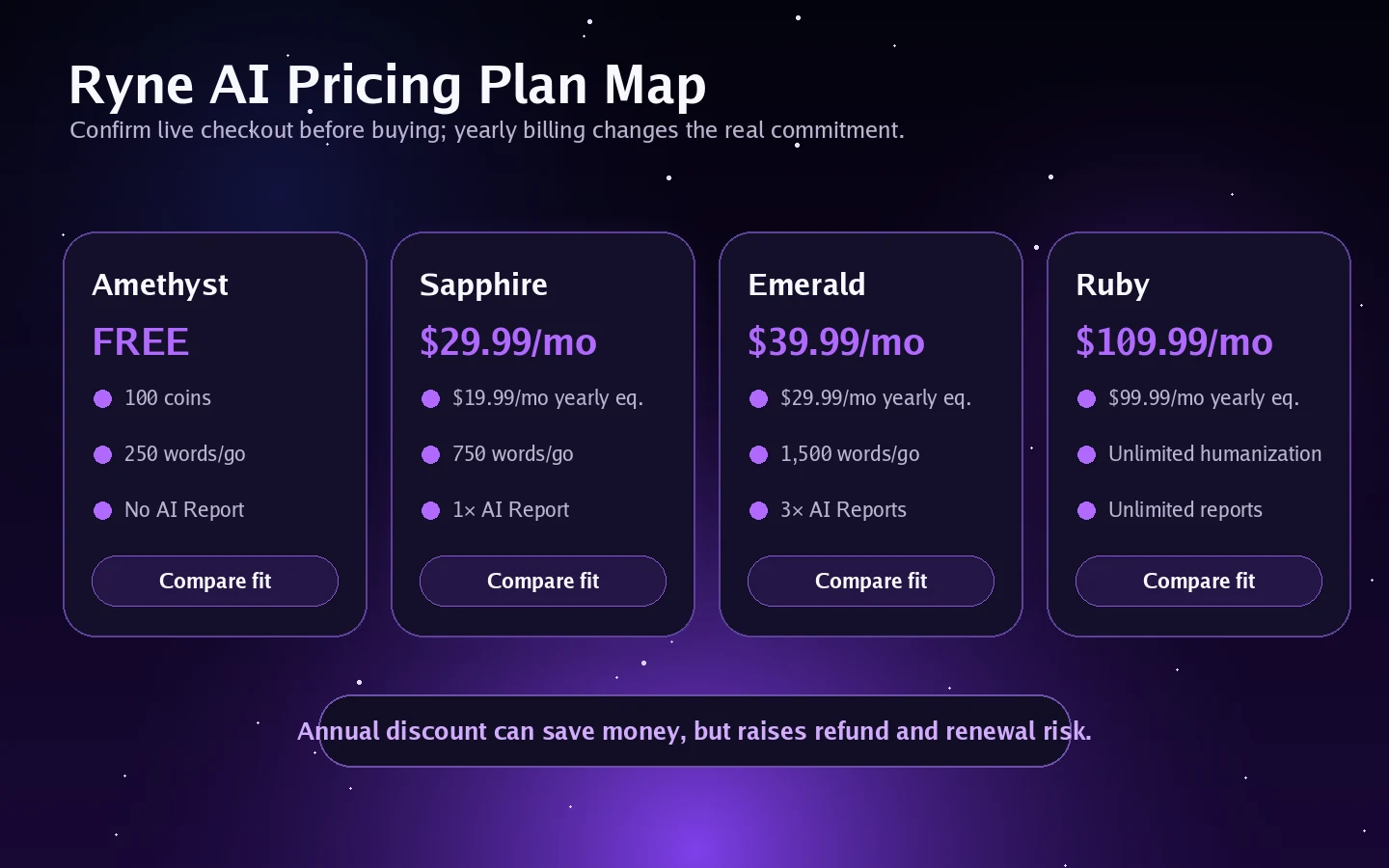
The free Amethyst plan is the right starting point for most buyers. It provides limited coins, English-only use, and a small per-run humanization limit. That is enough to test the basic feel of the product. It is not enough to prove paid-plan value for heavy writing.
The paid path starts with Sapphire. At the time of review, the public pricing page shows Sapphire at $29.99 per month, with a lower monthly equivalent shown for yearly billing. Emerald raises the humanization limit and AI Report access, while Ruby is positioned for much heavier use with unlimited humanization and reports. The pricing page also presents yearly billing as a discounted route.
The mistake is judging the product from the lowest-looking number. A yearly equivalent is not the same decision as paying month to month. It creates a larger upfront commitment, and Ryne’s refund and renewal terms make that commitment more important.
A paid plan makes sense when you know three things: how many drafts you will process, how often you need AI Reports, and whether Ryne’s output actually saves editing time. If those are unclear, start free or monthly before considering a larger commitment.
I would also check whether any API access, advanced use, or heavier workflow need is genuinely included in the plan being considered. Do not build a process around an access path unless the current plan page or support route confirms it.
Pricing check: Ryne AI's paid value depends on coins, report limits, and billing interval, so compare the current plan page before choosing monthly or yearly.
Free plan, trial, coupon, and checkout notes
The free plan is the safest way to start with Ryne AI.
Use it as a workflow test, not as a toy demo. Run a realistic paragraph, compare the rewrite, inspect whether meaning is preserved, and decide whether the result is something you would actually edit from.
Ryne does not need to be judged first by coupon availability. A discount can improve the purchase, but it should not be the reason you buy. The better order is:
- Test the free plan.
- Decide whether the output helps.
- Compare paid plan limits.
- Read the refund and renewal rules.
- Check the current deal path only after workflow fit is clear.
The coupon route may still matter for buyers ready to pay, but I would treat it as secondary. Coupon pages and checkout paths can change. The tool either fits your workflow or it does not.
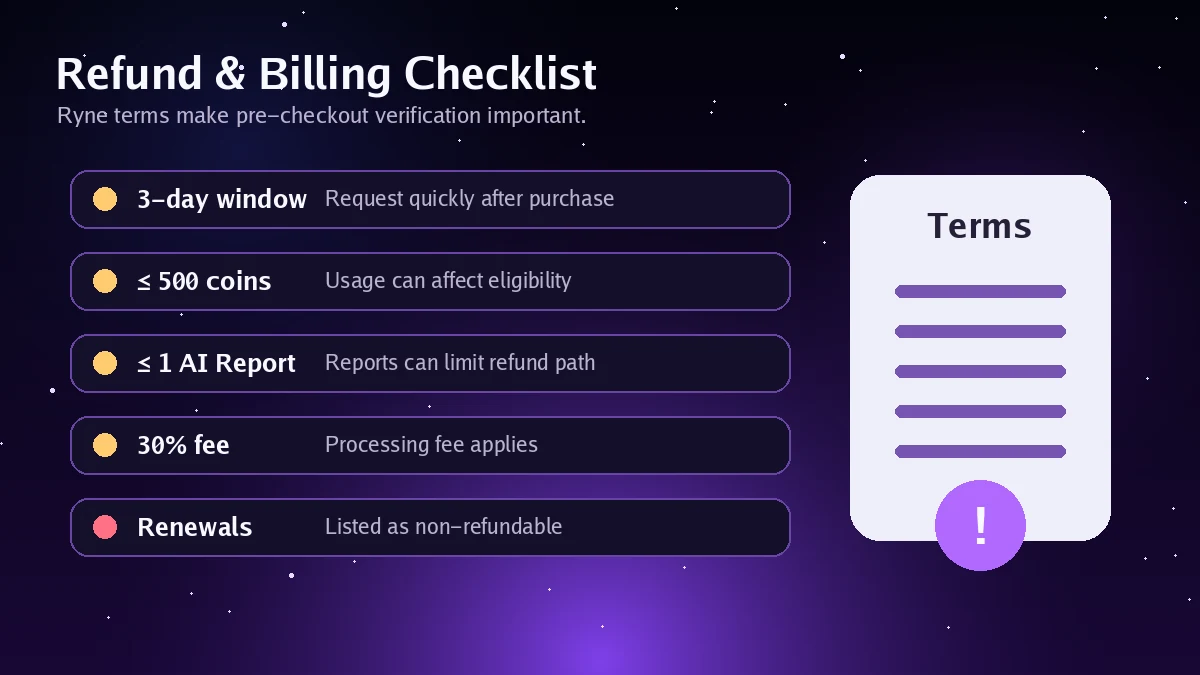
Refund rules deserve special attention. Ryne’s terms describe a short refund window, usage conditions, a processing fee, and non-refundable renewals. That does not make the product bad. It makes careless paid testing risky.
Offer check: Use the coupon route only after Ryne AI passes your free workflow test and you understand the refund limits.
What I would check before buying Ryne AI
If I were buying Ryne AI for a real writing workflow, I would check these points first:
- Whether the free Amethyst plan is enough to test the exact type of writing I care about.
- Whether the per-run word limit is practical for my normal draft length.
- Whether coins run down faster than expected during revisions.
- Whether AI Report access is included in the tier I am considering.
- Whether monthly billing is safer than yearly billing for my first paid month.
- Whether the refund terms still match the current terms page before checkout.
- Whether my school, client, employer, or platform rules allow the way I intend to use the tool.
The policy check is not a side issue. It is central to this product category. Humanizing text can be legitimate when it supports editing and clarity. It becomes risky when the buyer uses it to hide work that violates a rule.
A simple test before paying
Before paying, I would run a small Ryne AI test like this:
- Choose a 300- to 600-word draft that represents your real work.
- Mark the parts that sound stiff, generic, or AI-assisted before using the tool.
- Run only part of the draft through Ryne.
- Compare the before and after versions for meaning, accuracy, flow, and voice.
- Check whether the tool made the text better or merely less detectable-looking.
- Repeat the test inside the Chrome extension if browser workflow matters.
- Decide whether the result saves enough editing time to justify a paid plan.
The goal is not to prove Ryne can make every detector happy. The goal is to decide whether the rewritten output is useful enough for your actual writing process.
If the tool fails this test, do not assume a higher paid tier will fix the mismatch. Higher limits help only when the core workflow already works.
Pros explained
Ryne combines several related workflows
The strongest advantage is that Ryne brings humanization, AI checks, study tools, chat, citations, and extension workflow into one product surface. For students or browser-based writers, that can be more convenient than stitching together several separate tools.
This matters when the buyer actually uses multiple pieces. It matters less when the buyer only needs a basic rewriter.
The free plan lowers the first test risk
A free entry path is important in this category because output quality is personal. One buyer may like the rewrite style. Another may find it too generic. You need to see it on your own draft.
The free plan is not enough for heavy use, but it is enough to answer the first buyer question: does this tool improve the kind of text I actually work with?
The Chrome extension can reduce workflow friction
For people who write across web apps, the extension is not a minor detail. Copying text into a dashboard, waiting, copying it back, and reformatting can become annoying quickly. A selected-text workflow is more natural.
This advantage stops being enough if the buyer works with sensitive text or if the extension output still needs heavy cleanup.
Public pricing makes plan comparison possible
Ryne shows its main plan structure publicly. That is helpful because buyers can compare free, monthly, and yearly paths before creating a paid commitment.
The visibility does not remove risk. It simply gives buyers enough information to ask better questions.
Cons explained
Detector-bypass positioning creates policy risk
Ryne’s strongest marketing angle is also its biggest buyer-risk area. If a buyer treats detector bypass as permission to ignore rules, the tool can create more trouble than value.
This matters most for students, freelancers, and professionals working under clear authorship, disclosure, or originality expectations.
Refund terms are narrow
The refund path is not the kind of generous safety net that lets a buyer test heavily after paying. The short window, usage limits, processing fee, and renewal rule all make pre-purchase testing more important.
The way to avoid this issue is simple: use the free tier first, then keep the first paid decision modest.
Plan value depends on actual usage
Coins, report limits, and word limits can change how valuable a plan feels. A buyer who processes short occasional snippets may be fine. A buyer rewriting longer assignments, scripts, or content drafts may hit limits faster.
This is why I would not choose a paid plan from price alone.
External sentiment is not one-sided
Ryne has positive public feedback, but there are also critical buyer complaints around billing, support, and output expectations. I would not treat either side as the whole truth. The practical takeaway is to test before committing and keep billing risk under control.
Green flags and red flags
Green flags:
- You know you need a repeated humanizer and draft-review workflow.
- The free plan produces output you can actually edit from.
- The Chrome extension saves time in your normal writing environment.
- You understand the difference between detector signals and acceptable work.
- Monthly usage is clear enough to choose a plan confidently.
Red flags:
- You are buying mainly because of detector-bypass language.
- You expect a tool to make academic or client policy concerns disappear.
- You need a flexible refund window before paying.
- You are tempted by yearly billing before testing real usage.
- You need team procurement, admin controls, or an enterprise review workflow.
The easy mistake here is buying the promise rather than the process. The better way to judge Ryne is to test whether it improves a real draft without creating new accuracy, policy, or billing problems.
Ryne AI vs alternatives
Ryne AI should be compared by buyer job. Do not compare it only by feature count.
Undetectable AI vs Ryne AI
Undetectable AI is the more direct comparison if the buyer wants a dedicated humanizer-style product. It may be the cleaner option for someone who does not need Ryne’s study tools, citation support, or lecture features.
Ryne may still make more sense if the buyer wants the humanizer plus AI Report, chat, and browser workflow in one account.
Phrasly vs Ryne AI
Phrasly is worth opening when the buyer wants a simpler draft-polishing or humanizer workflow. A simpler product can be easier to evaluate because there are fewer moving parts.
Ryne is more attractive when the buyer wants a wider study-writing toolkit and is willing to manage plan limits.
GPTZero vs Ryne AI
GPTZero is not a direct humanizer alternative. It is a detection-first route. Buyers should compare it when the real need is identifying or reviewing AI-assisted writing rather than rewriting text.
Ryne may be more useful when the buyer wants to revise a draft after seeing detector-aware signals.
Originality.ai vs Ryne AI
Originality.ai is usually the stronger comparison for publishers, agencies, and site owners who need originality and AI detection checks as part of content quality control.
Ryne is a more natural fit for individual writing, study workflows, and humanizer-first use.
Winston AI vs Ryne AI
Winston AI is another detection-first comparison route. It makes more sense when the buyer cares about review, reporting, and AI detection confidence rather than rewriting output.
Ryne is closer to the buyer who wants to change the draft, not only check it.
Trust, refund, and buyer-risk notes
Ryne AI gives buyers enough public information to evaluate the purchase, but several risks need attention.
First, pricing should be checked live before checkout. Plan names, discounts, yearly equivalents, and usage limits can change. Do not rely on an old screenshot, review, or coupon listing.
Second, refund rules are stricter than many buyers may expect. A short request window, usage limits, processing fee, and non-refundable renewals mean the free test path matters more.
Third, privacy and data expectations should be checked before using Ryne with sensitive material. The privacy page says user data is not used to train AI models, and the Chrome extension listing says selected text is sent for processing. For ordinary drafting, that may be acceptable. For private client, school, legal, medical, or business material, the buyer should be more careful.
Fourth, AI reliability matters. Humanized text can still be inaccurate, awkward, over-smoothed, or unacceptable under a specific policy. Detector scores can also vary. The tool can support review. It cannot replace judgment.
Fifth, the academic angle should be handled honestly. Ryne’s study tools may help with learning, summarizing, citations, and draft improvement. They should not be treated as permission to submit work that violates rules.
The safest buyer posture is cautious and practical: test small, keep billing flexible, respect policies, and compare alternatives before committing to annual billing.
Final verdict
Ryne AI is worth considering if you want a humanizer and study-writing workspace with AI report checks, Chrome-based rewriting, and enough free access to test before paying.
I would consider it if your workflow already involves AI-assisted drafts that need cleanup, revision, and detector-aware review. I would also consider it if you write mostly in browser-based tools and the extension reduces friction.
I would skip it if your main goal is to hide improper AI use, if you need flexible refunds, or if you only need a normal content editor. I would also slow down if you are thinking about annual billing before testing the tool on real writing.
The strongest reason to try Ryne is convenience: humanization, study tools, AI-aware checks, and browser workflow in one account. The strongest reason to be cautious is risk: detector claims, refund limits, billing commitment, and policy-sensitive use.
For most buyers, the best decision is not “buy or skip” immediately. It is “test free, compare output, read the terms, then decide.” If Ryne still saves time after that test, a paid plan can make sense. If it only changes words without improving the draft, the safer move is to compare a simpler humanizer or a detection-first tool before paying.
