Quick verdict
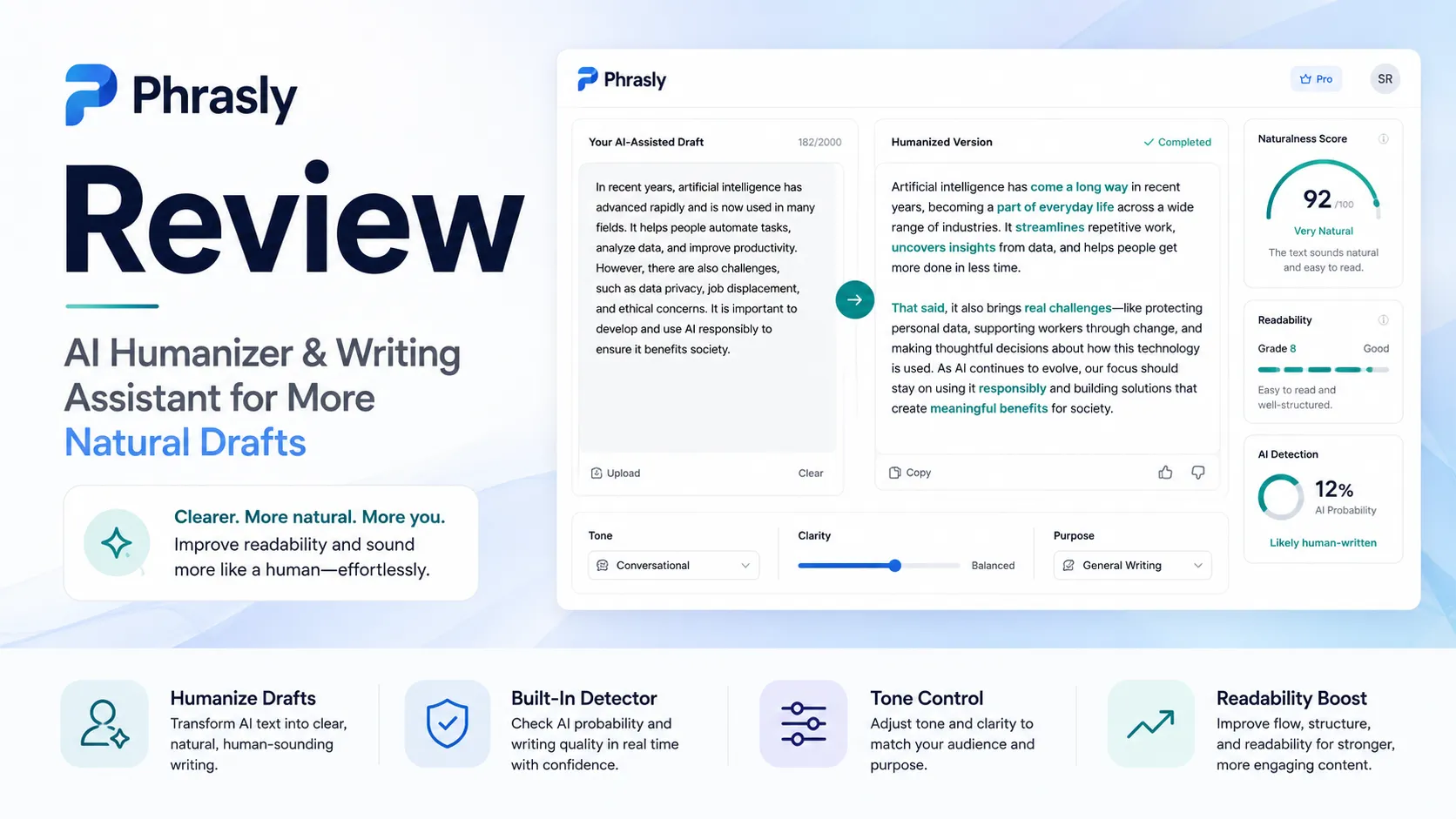
Phrasly is useful if you treat it as a writing refinement workspace, not as a magic switch that makes a rough AI-assisted draft safe, original, or acceptable everywhere.
That distinction is the whole review.
The product sits in a category where buyers can easily ask the wrong question. They ask, “Can this make text sound human?” The better question is narrower: “Does this help me revise a draft responsibly before I submit, publish, or send it to someone who will judge the writing?”
For that job, Phrasly has a reasonable fit. It combines an AI humanizer, AI detector checks, Phrasly Pages, an AI writer, translation, thesis generation, word counting, plagiarism-checking support, and a separate Business API route. That makes it more than a single rewrite box. It can become a small writing workflow if you repeatedly work with AI-assisted drafts and still do the final editorial pass yourself.
I would be careful, though.
This is not the kind of tool I would buy only because the homepage looks confident or because an annual savings message appears at checkout. Phrasly’s refund policy is strict once the account has any usage. The 3 Day Access path can convert into a paid subscription if it is not canceled on time. Detector-facing rewrite tools also sit in a sensitive category, so buyers should use them for clarity, readability, and policy-compliant editing rather than trying to hide poor work.
My practical take: Phrasly makes sense for writers, students, creators, and small teams who already have a repeat writing process and want one place to refine, check, and polish working drafts. It is weaker for buyers who only want one quick rewrite, need formal detection reporting, or expect any AI detector result to settle an authorship question.
Next step: If Phrasly still fits your writing workflow, verify the live plan, trial, and refund terms before processing any real document.
Review snapshot
| Review point | Practical take |
|---|---|
| Best for | Writers, students, freelancers, creators, and small content teams refining AI-assisted drafts |
| Not ideal for | Buyers who want a flexible refund after testing, formal detection proof, or enterprise audit workflows |
| Main use case | Humanize draft text, check AI-like patterns, revise manually, and prepare cleaner writing for review |
| Pricing path | 3 Day Access, Unlimited monthly or annual billing, and a separate Business API route |
| Refund caution | Personal refund eligibility can be lost once the account has usage |
| API path | Separate Business API with a monthly credit pool and per-word humanization/detection rates |
| Main strength | Humanizer-led writing workflow with detector checks and Pages-style editing support |
| Main risk | Buyers may overtrust detector outcomes or miss trial/refund/annual-billing details |
| Alternatives to compare | Originality.ai, Copyleaks, GPTZero for detection-first or compliance-heavy needs |
| Safest next step | Read pricing and refund terms first, then test a non-sensitive sample before choosing annual billing |
What is Phrasly?
Phrasly is an AI writing assistant built around making AI-assisted drafts read more naturally, then checking the result with AI detection and related writing tools.
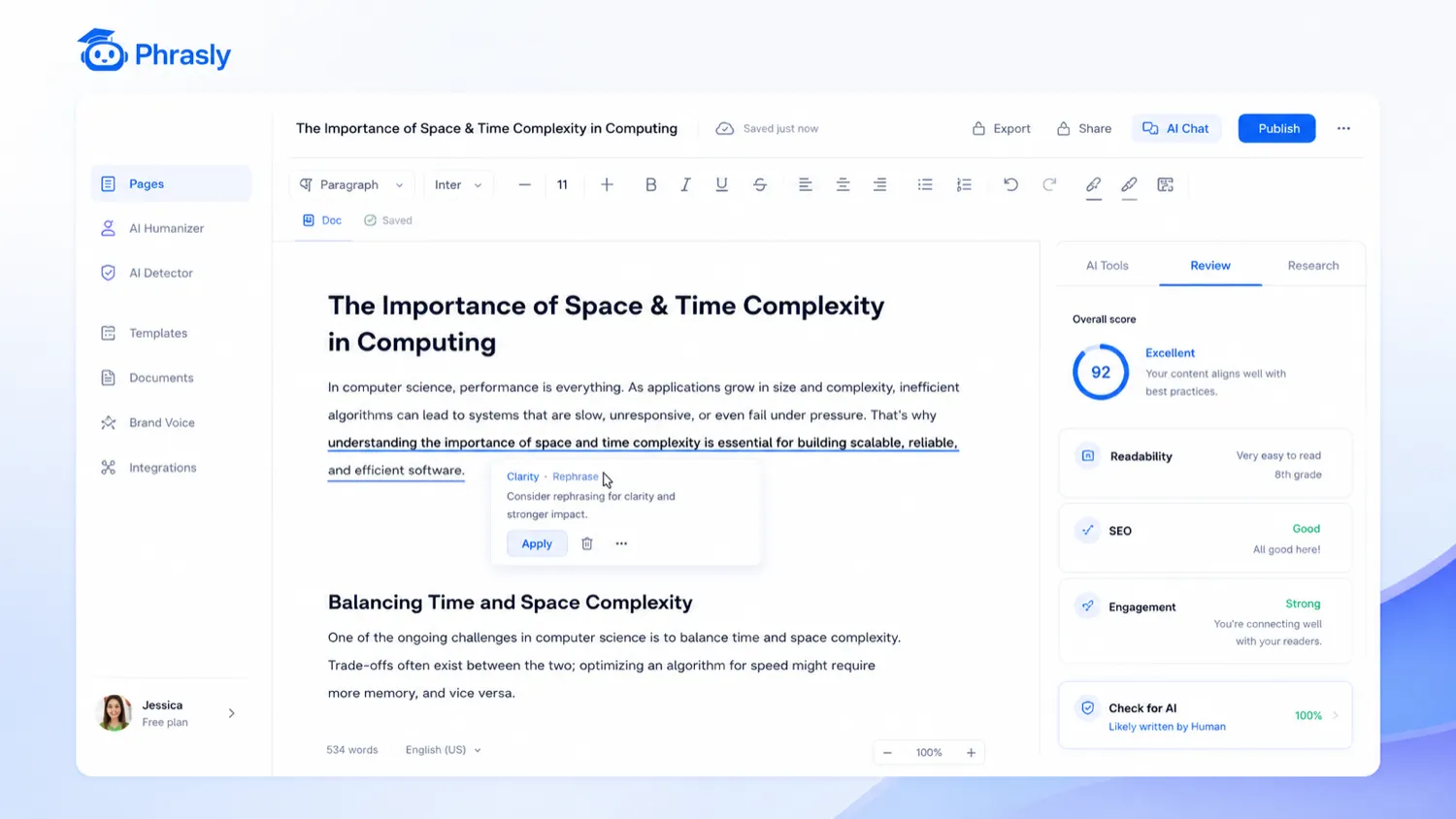
The official product experience is not only a humanizer box. Phrasly presents a wider platform: AI Humanizer, AI Detector, Pages, Content Generator, Translator, Thesis Generator, Word Counter, and Plagiarism Checker. In plain English, that means the product is trying to sit between raw AI draft generation and the final version a person actually feels comfortable submitting or publishing.
That can be useful.
A lot of AI-generated writing has the same problem: it is technically readable, but it carries a flat rhythm, predictable transitions, and generic phrasing. Phrasly is trying to solve that middle step. You bring a working draft, improve the texture, check whether it still feels machine-like, and then make your own edits before delivery.
The important phrase is “working draft.”
I would not frame Phrasly as a tool for rewriting copied material, hiding academic misconduct, or skipping original thinking. The safer and more durable use case is polishing AI-assisted text that you are allowed to use, improving readability, and checking for signals that might make the writing feel too automated.
That also explains who should compare alternatives first. If your main need is publisher-grade AI detection, plagiarism review, classroom reporting, or institution-style compliance, Phrasly may not be the first tool I would open. It is more humanizer-led. For detection-first work, Originality.ai, Copyleaks, or GPTZero may be stronger comparison routes.
Who should use Phrasly?
Phrasly makes the most sense for people who touch AI-assisted writing often enough that a repeat workflow matters.
A student might use it to improve clarity and flow in a permitted AI-assisted draft, then still check the final text against school rules and personal understanding. A freelance writer might use it before sending a client draft that started from an AI outline but needs a more natural editorial pass. A content creator might use it to polish newsletters, captions, scripts, or article drafts that feel too stiff after the first generation step.
A small content team may also find a fit. One person drafts, another reviews, Phrasly helps flag machine-like phrasing, and the final editor still checks meaning, sources, claims, and brand voice. In that kind of workflow, the tool is not doing the thinking. It is making the revision step faster.
The Pages workspace is the feature I would pay attention to here. A simple humanizer can be useful for a paragraph. A Pages-style workspace can be more useful when the work is longer and you do not want to keep moving text between separate tabs.
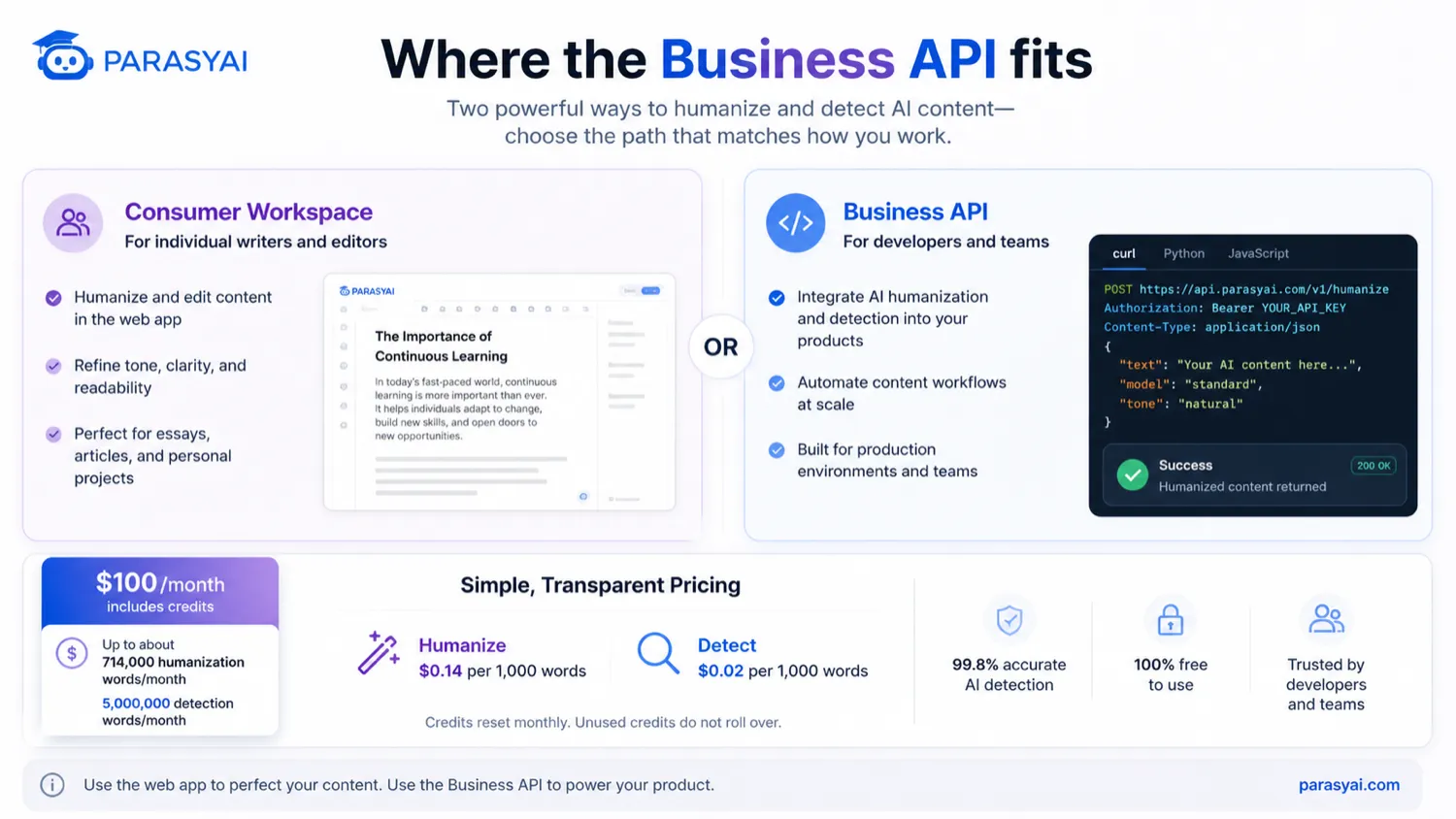
Phrasly’s Business API is a different buyer path. That is for teams, developers, or products that need humanization or AI detection inside another system. If you are only editing your own documents, the API is probably not your buying problem. If you are processing text at scale, the API pricing, credit pool, rate behavior, compliance rules, and refund policy matter much more than the consumer workspace.
Who should avoid Phrasly?
I would avoid Phrasly if your main goal is to get a guaranteed “human” outcome across every detector, teacher, client, or platform.
No tool can honestly remove that risk from the buyer. Detector results vary. Review standards vary. Some institutions and clients care less about a score and more about whether the work reflects your own thinking. A polished paragraph can still be weak if the argument, sources, or logic are not yours.
I would also be careful if you want to test heavily and then decide later whether to keep the purchase. The refund terms are not relaxed. The personal refund path is described as available only when there has been no account usage. That means buyers should read the terms before using a real document, not after.
Phrasly is also not the cleanest first choice for buyers whose real problem is detection governance. If you need plagiarism checks, formal reports, API governance, LMS-style workflows, or institutional review, Phrasly may be adjacent rather than central. Compare Copyleaks if plagiarism and compliance matter more. Compare GPTZero if education-style AI detection is the main job. Compare Originality.ai if publishing-side originality checks are closer to your workflow.
Finally, I would not choose annual billing on day one unless the workflow has already proved itself. A cheaper annual path is still expensive if the tool only solves a one-time curiosity.
How Phrasly fits into a real writing workflow
The best Phrasly workflow does not start with “make this pass.” It starts with a draft that you are responsible for improving.
Here is the cleaner process I would use:
- Start with a draft you are allowed to revise with AI assistance.
- Read it yourself first and mark weak sections.
- Use Phrasly to improve natural flow and reduce robotic phrasing.
- Check the revised text with the included detector signal.
- Compare the output against your own meaning, source material, and assignment or client rules.
- Edit manually until the final version sounds like something you can defend.
- Avoid treating a detector result as final proof of quality or authorship.
That process is slower than the fantasy version. But it is safer.
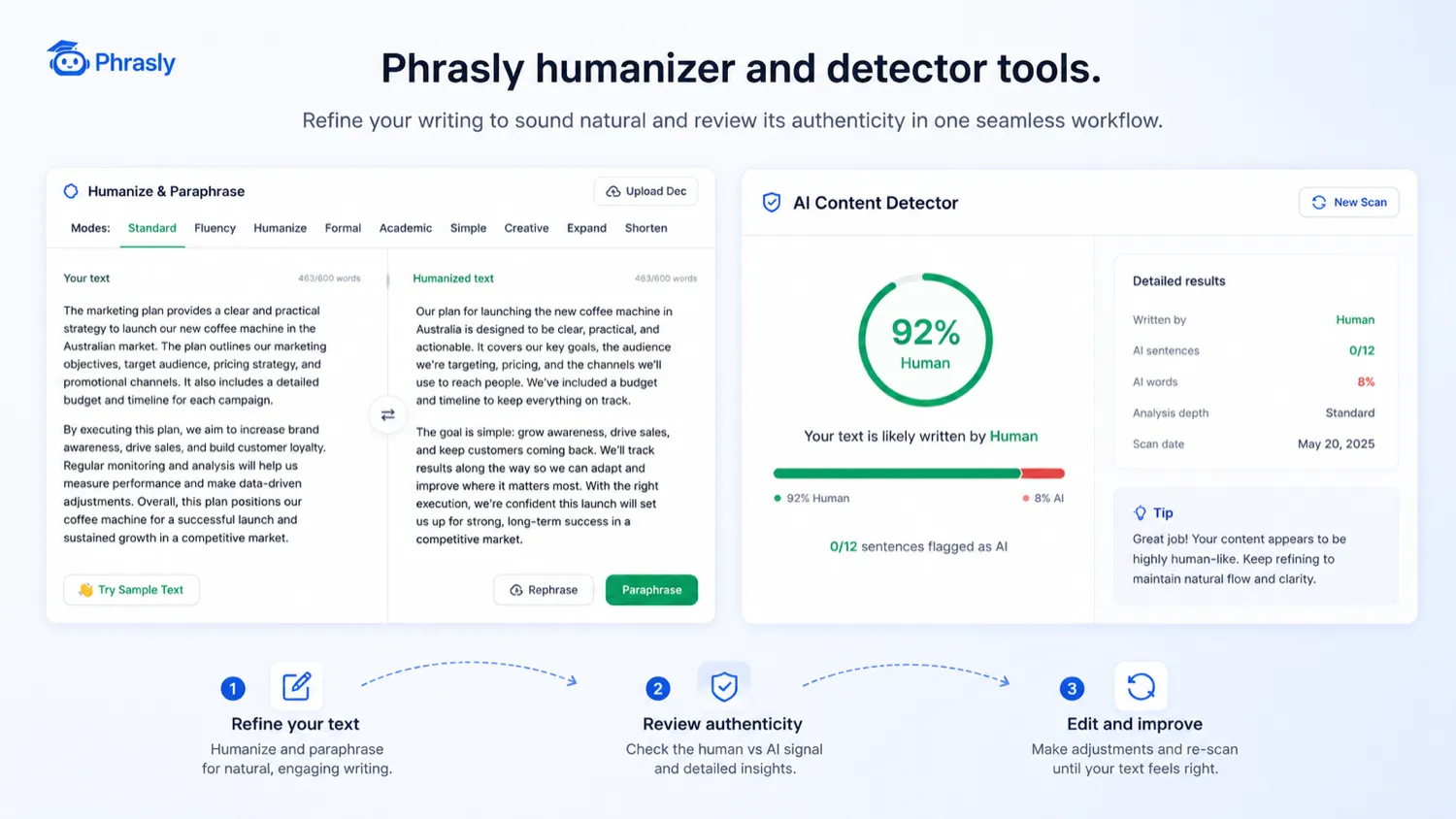
The humanizer can help when the draft sounds too uniform. The detector can help when you want a quick signal before submission or publishing. Pages can help when the document is longer than a small paste-and-check task.
But the human check is still the gate.
This is especially important for students and client writers. A tool can smooth language. It cannot guarantee that the writing meets an assignment, citation policy, originality requirement, or editorial standard. If that risk matters, Phrasly should be one checkpoint, not the final authority.
Workflow check: Before choosing a paid plan, open Phrasly with one non-sensitive sample and see whether the output actually improves your editing process.
Key features that matter
Phrasly’s feature list looks broad, but only a few parts should drive the buying decision.
AI Humanizer
This is the core. Phrasly is most naturally judged as a humanizer-led tool. If the humanizer does not improve the text in a way you can actually use, the rest of the platform becomes less important.
The right test is not whether the output looks impressive for one paragraph. The right test is whether it preserves meaning, improves rhythm, avoids awkward substitutions, and leaves you with a draft that needs less editing than before.
AI Detector
The detector is useful as a signal, not a verdict.
If it shows that a section still reads as machine-like, that can guide revision. But buyers should not treat detector feedback as a legal, academic, or client-proof conclusion. This is one of the easiest ways to misuse tools in this category.
Phrasly Pages
Pages matters if you write or revise longer documents. It can reduce the copy-paste friction of moving between a generator, editor, humanizer, and detector.
For one-off users, Pages may not matter much. For repeat writers, it may be the difference between a small utility and a real workspace.
AI Writer and content generator
The content generator can be useful for producing starting material, but I would not judge Phrasly mainly as a full SEO writing platform. If you are building long-form SEO workflows, tools like Frase, Surfer, NeuronWriter, or dedicated content optimization platforms may belong in a different comparison set.
Translator, thesis generator, word counter, and plagiarism checker
These are useful supporting tools. They make the platform feel more complete, especially for students and general writers. Still, they should not distract from the main question: does the humanizer plus detector flow help you improve real drafts responsibly?
Business API
The Business API is the clearest separate path. It is not just a toggle on the consumer plan. The API route uses a credit pool and per-word pricing for humanization and detection, so the buyer should estimate word volume before treating it as affordable.
Pricing and plan value
Phrasly’s buying decision needs more care than the average writing tool because pricing, trial behavior, annual billing, refund rules, and API credits all matter.
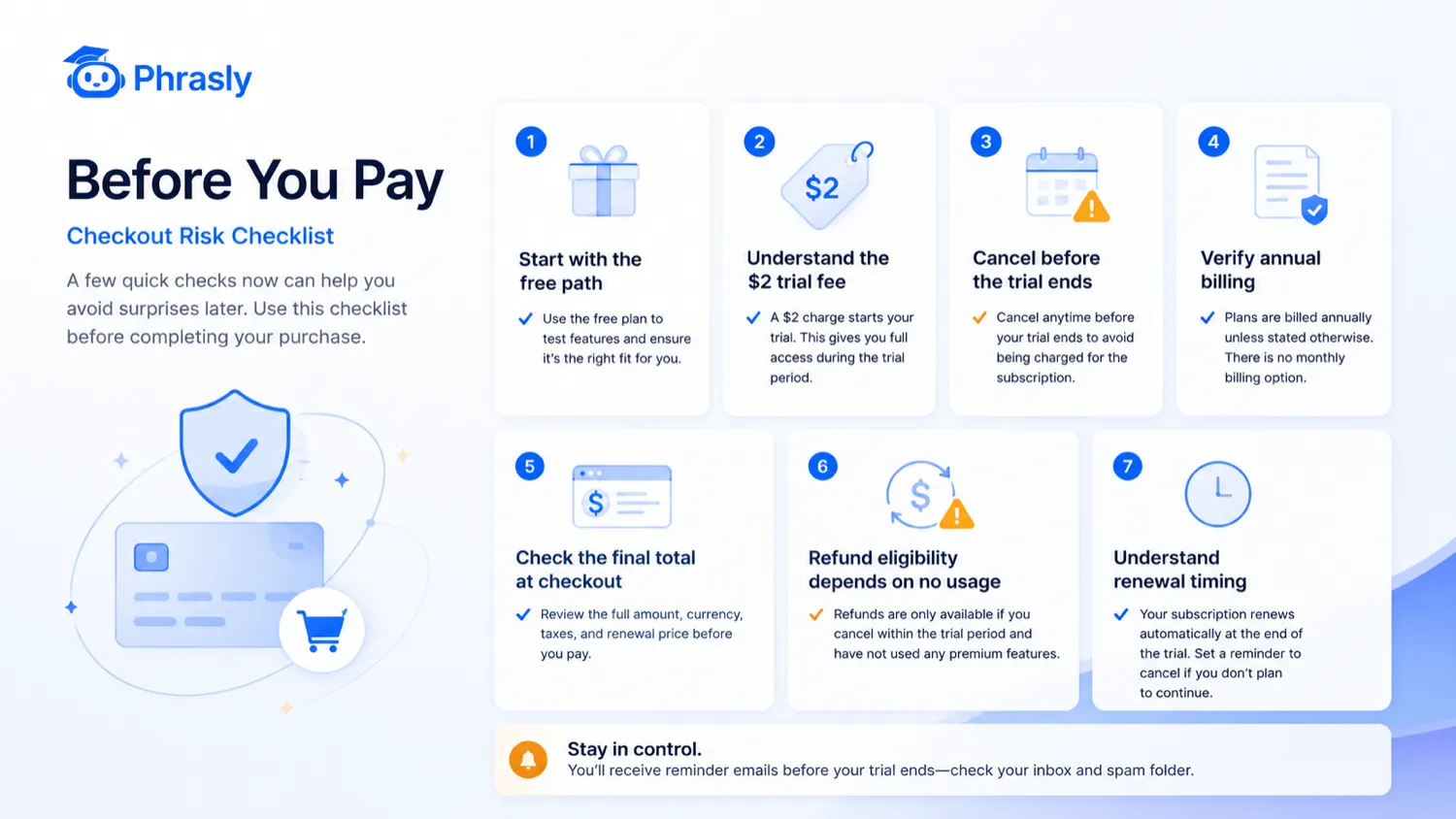
The public personal pricing path currently presents a 3 Day Access route and an Unlimited plan route, with annual savings messaging. The terms explain that new users may start a 3-day trial by paying a non-refundable fee, and that the trial can convert into the full subscription if it is not canceled before the trial ends.
That is not automatically bad. Many SaaS products use trial conversion.
But it does mean the buyer should slow down.
If you are evaluating Phrasly, do not process important documents before you understand the refund rule. The terms state that the personal refund path is available within 14 days only when there has been no usage across the account. That includes no documents processed, no API calls, and no feature use.
In practical terms, that creates a strange buyer tension: the best way to know if the tool works is to use it, but using it can remove refund eligibility. So the safer approach is to treat the trial and checkout flow as a commitment-sensitive step. Read the terms first. Test a non-sensitive sample. Avoid annual billing until you know the tool will be part of a repeated workflow.
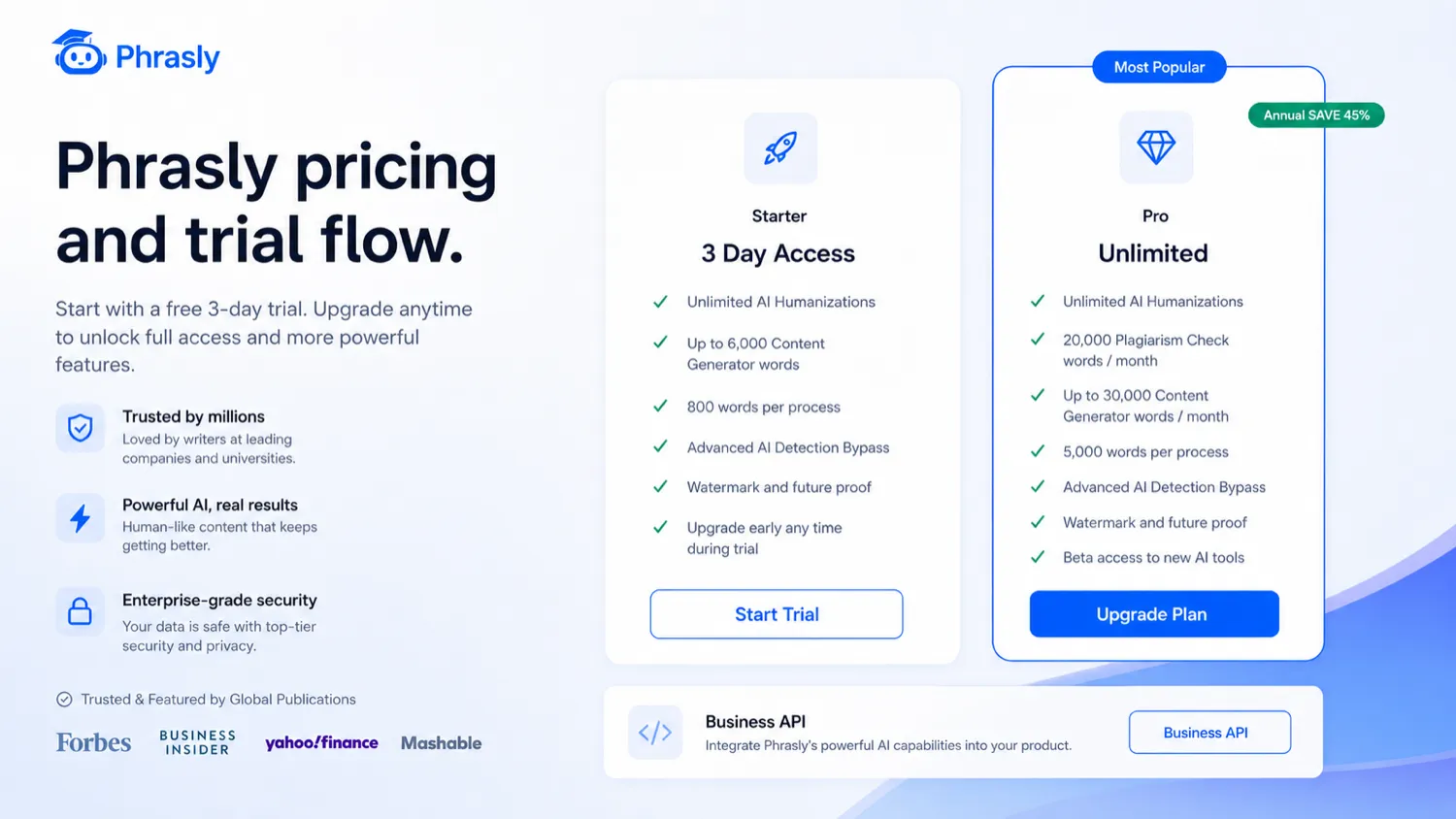
For the Business API, the decision is more mathematical. The API route uses a monthly credit pool and bills humanization and detection by word volume. That can be attractive for teams processing text inside another product or internal workflow, but it is a poor fit for casual personal use.
Pricing check: If Phrasly still fits, compare the live monthly, annual, and API routes before choosing the cheapest-looking option.
Free plan, trial, coupon, and checkout notes
Phrasly is not a coupon-first decision.
A discount may improve the purchase, but it should not be the reason you buy. With this product, the more important checkout questions are:
- Is the 3 Day Access route free, paid, or tied to a later subscription in your checkout flow?
- What exact monthly or annual amount will be charged after trial access ends?
- Does the Unlimited plan match your real writing volume?
- Are you comfortable with the refund rule before using the account?
- Do you need the personal workspace or the Business API?
- Are you buying for one person, or does your team need separate seats or an enterprise arrangement?
The coupon page can still be useful after the fit is clear. It can help route you to current offers, plan notes, or checkout reminders. But I would not start there.
The sequence should be: workflow fit first, terms second, price third, coupon route last.
Checkout note: Use the coupon route only after you understand the plan, trial, and refund terms. A lower price does not fix a poor workflow match.
What I would check before buying Phrasly
Before paying for Phrasly, I would check five things.
First, I would confirm the live checkout total. Public pricing copy can change, annual savings language can vary, and third-party pricing pages may lag behind the current product.
Second, I would read the trial terms carefully. The 3 Day Access path is useful only if the buyer understands the fee, the daily limits, cancellation timing, and the subscription conversion behavior.
Third, I would read the refund policy before using the account. This is the biggest practical caution. If usage voids refund eligibility, the buyer should not treat the purchase like a relaxed test drive.
Fourth, I would test the tool with a non-sensitive sample. Do not upload private client documents, internal business text, or sensitive academic work until you are comfortable with the privacy and data handling terms.
Fifth, I would compare at least one detection-first alternative. If your real concern is a detection report, Phrasly may not be the strongest category fit.
Simple test before paying
A good Phrasly test should be small and realistic.
Use a draft that is yours, non-sensitive, and representative of the kind of writing you actually do. Do not test with a perfect paragraph. Test with a draft that has the normal problems: repeated transitions, stiff phrasing, weak flow, and uneven voice.
Then ask four questions:
- Did Phrasly preserve the meaning?
- Did it improve the rhythm without making the writing vague?
- Did the detector feedback give you something actionable?
- Did the final version still need your own edit?
The fourth answer should be yes.
If the final version needs no human edit, I would be suspicious. Good writing tools should reduce friction, not remove responsibility. The buyer still needs to check facts, sources, citations, claims, tone, and compliance with the rules of the place where the writing will be used.
Pros and cons explained
Phrasly’s main strength is focus. It is not trying to be a giant marketing suite. It knows the buyer problem: AI-assisted writing often sounds too machine-like, and people want a faster way to revise it before review.
The second strength is workflow breadth. Humanizer, detector, Pages, content generation, translation, thesis support, word counting, and plagiarism-checking support give the product more room than a one-box rewriter.
The API path is also a plus for the right buyer. Separating Business API pricing from personal writing plans makes the developer decision cleaner. You can ask, “Do I need programmatic processing?” instead of assuming the personal plan solves everything.
The biggest weakness is refund flexibility. A 14-day policy sounds buyer-friendly at first glance, but the no-usage condition changes the practical meaning. Buyers who like to test deeply before deciding should be careful.
The second weakness is category risk. Humanizer and detector tools are easy to misuse or overtrust. A better score does not automatically mean better writing, acceptable academic use, or client-ready work.
The third weakness is that detection-first buyers may be looking in the wrong place. If you need formal reporting, plagiarism workflows, education-oriented review, or enterprise controls, Phrasly may be less direct than alternatives built around those jobs.
Green flags and red flags
| Green flag | Why it matters |
|---|---|
| Phrasly is clear about being a writing assistant, not just a score tool | The product has a plausible place in a real draft-refinement workflow |
| Pages gives longer-form writers a workspace | This can reduce copy-paste friction for repeat users |
| API pricing is separated from personal plans | Technical buyers can evaluate cost and volume more directly |
| Ethics language exists on the site | This is important in a category where buyer misuse is a real concern |
| Red flag | Why it matters |
|---|---|
| Refund eligibility can disappear after usage | Buyers should read terms before processing any document |
| Trial conversion needs attention | The 3-day access path can become a paid subscription if not canceled on time |
| Annual savings can encourage overbuying | Annual billing only makes sense after repeated workflow value is proven |
| Detector results can be overtrusted | A tool signal should not replace human judgment or policy compliance |
Phrasly vs alternatives
Phrasly’s alternatives depend on what the buyer is actually trying to solve.
If the buyer wants writing refinement, Phrasly can make sense. If the buyer wants formal detection confidence, the comparison shifts.
Phrasly vs Originality.ai
Originality.ai is usually the stronger comparison for publishers, SEO teams, and editorial workflows where AI detection, plagiarism checking, fact-checking, and team review matter more than rewriting the text itself.
Phrasly is more attractive if the buyer needs to improve draft texture and run a detector signal in the same writing flow. Originality.ai is more attractive if the buyer is reviewing content at a publishing or editorial operations level.
Phrasly vs Copyleaks
Copyleaks is the more natural comparison when plagiarism detection, LMS integration, enterprise controls, API usage, and institutional workflows matter.
Phrasly may feel simpler for individual writers and creators. Copyleaks may be safer for organizations that need broader governance and formal review paths.
Phrasly vs GPTZero
GPTZero is a cleaner comparison for buyers focused on AI detection itself, especially in education-style workflows or situations where a free entry point and document checking matter more than humanizing the draft.
Phrasly has a stronger writing-refinement angle. GPTZero has a stronger detector-first identity.
When Phrasly is the better fit
Phrasly is the better fit when your main problem is: “This AI-assisted draft is allowed, but it sounds too generic and needs a more natural editorial pass.”
When an alternative is the better fit
An alternative is the better fit when your main problem is: “I need to evaluate originality, plagiarism, authorship risk, or institutional policy compliance with more formal confidence.”
Those are not the same buyer problem.
Trust, privacy, and policy notes
Phrasly operates in a sensitive category. That does not make it bad, but it raises the standard for buyer judgment.
The homepage frames the product as an ethical AI writing assistant and encourages users to follow institutional policies. That matters. It gives buyers a better frame than “paste text, make it pass, move on.”
The privacy policy should still be read by anyone handling sensitive text. Phrasly’s privacy language describes processing personal information for service delivery, legal bases, usage trends, fraud prevention, marketing, and related business needs. That is common SaaS language, but it is still relevant when the text being processed is private, client-owned, academic, or business-sensitive.
For most individual buyers, the practical rule is simple: do not test sensitive documents first. Use a sample. Understand the data and refund terms. Then decide whether the tool belongs in your workflow.
For API buyers, the rule is stricter. Review API usage terms, prohibited uses, content ownership language, audit rights, pricing, overage behavior, and support expectations before putting Phrasly into production.
Final verdict
Phrasly is worth considering if you need a humanizer-led writing refinement workflow and you understand the limits.
It is strongest when the buyer already works with AI-assisted drafts and wants a faster way to improve readability, check machine-like phrasing, and keep longer document work inside a more complete writing environment. It can be especially useful for writers, students, freelancers, creators, and small teams that are willing to keep human editing at the center of the process.
I would skip it if you only need one casual rewrite, if you expect a detector score to prove authorship, or if you want to use the product heavily and still keep an easy refund option. The refund terms alone are enough reason to slow down before processing real text.
I would compare alternatives first if your real need is detection-first. Originality.ai is a better route for publisher-style checks. Copyleaks is stronger for plagiarism and institutional workflows. GPTZero is cleaner for education-style AI detection.
For my money, Phrasly is not a tool to buy on impulse. It is a tool to test carefully, with terms open in another tab, using a draft you are comfortable evaluating honestly.
If it saves time inside a workflow you repeat, it can make sense. If it only gives you confidence for a moment, the safer path is to compare before paying.
