Quick verdict
Outranking is worth a serious look if your content workflow starts with SEO research, not with a blank document.
That is the useful way to judge it.
Outranking is not just another AI blog writer that asks for a topic and gives you a draft. Its public positioning is built around SEO briefs, first drafts, content optimization, keyword strategy, content planning, and internal linking. That makes it more interesting for SEO teams and agencies, but also less casual than a lightweight AI writing tool.
For my money, the real question is not whether Outranking can help create content. The real question is whether your team publishes enough search-focused content to make its structured workflow and monthly SEO document limits worthwhile.
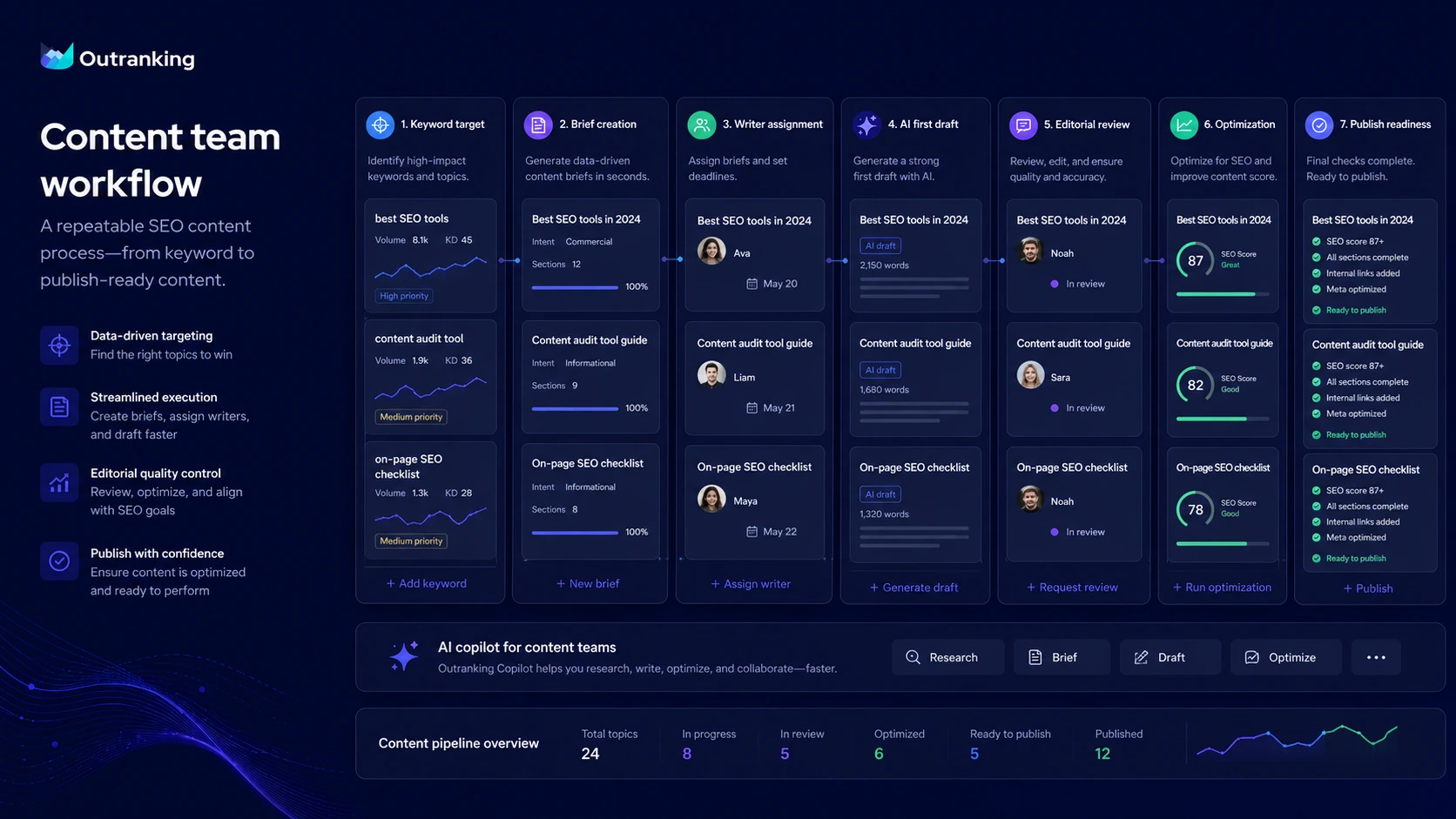
If you write one article every now and then, Outranking may feel like too much process. If you manage a repeatable publishing workflow, the product starts to make more sense: choose a keyword, analyze search intent, build a brief, create a draft, optimize it, add internal linking context, and send the article through human editorial review.
I would not judge Outranking by the lowest monthly price alone. The pricing page shows plan differences around SEO documents, users, AI drafts, automatic optimization, and internal linking. Those are not tiny details. They decide whether the plan fits your real output volume.
The safer path is simple: treat Outranking as a workflow tool first, a writing tool second, and a discount target last.
Next step: If Outranking already sounds like a fit for your SEO publishing process, check the live pricing route before choosing a plan.
Review snapshot
| Review point | Practical take |
|---|---|
| Best for | SEO teams, agencies, bloggers, and content marketers creating repeatable search-focused content |
| Not ideal for | Buyers who only need quick AI copy, backlink research, technical audits, or rank tracking |
| Main use case | Turning target keywords into briefs, outlines, AI-assisted drafts, and optimized articles |
| Pricing pressure | The practical cost depends on SEO document limits, users, AI drafts, and billing interval |
| Learning curve | More structured than a basic AI writer, so expect a workflow adjustment period |
| Main strength | Connected SEO content workflow from planning to optimization |
| Main caution | Do not buy a higher tier until you know your real monthly document volume |
| Alternatives to compare | Frase, AISEO, Balzac AI, Surfer SEO, Clearscope |
| Best next step | Run one real keyword through the workflow before committing to a bigger plan |
What is Outranking?
Outranking is an AI-assisted SEO content platform for planning, briefing, writing, and optimizing search-focused content.
The homepage frames the product around data-backed SEO writing: briefs, first drafts, optimization, strategy clustering, planning, and automatic interlinking. That positioning matters because Outranking is not trying to be only a fast copy generator. It is trying to sit inside the content production process before and after the draft.
The clearest buyer fit is this: you have a target keyword, you need to understand the search intent, you want a content brief or outline, you want AI help with the first draft, and you still need optimization guidance before publishing.
That can be useful.
It can also be too much if your workflow is simple. A solo blogger who wants a quick draft may not want document limits, optimization steps, tutorials, and a more guided editor. A content team that publishes every week may appreciate the same structure because it makes the process more repeatable.
This is where buyers can easily overestimate the value. Outranking does not remove the need for human editing, source checking, content strategy, or brand judgment. It gives you a more structured way to move from keyword to draft to optimization.
That is the difference.
Who should use Outranking?
Outranking makes the most sense for buyers who already have a content operation, even a small one.
An SEO team can use it to standardize briefs and reduce the amount of blank-page thinking before writers begin. That is probably the cleanest use case. If different writers are working across multiple topics, a shared brief and optimization process can keep the work more consistent.
An agency can use it when every client article needs a repeatable process: keyword, SERP review, outline, draft, optimization, internal linking, and final editorial pass. The agency angle is important because Outranking’s higher plans and custom route make more sense when multiple people and multiple websites are involved.
A niche-site builder or blogger can use it if SEO articles are part of a regular publishing calendar. The product is less compelling for casual writing, but more useful when the same workflow happens every week.
A content marketer may use Outranking to connect planning and writing. If the current process is scattered across keyword tools, spreadsheets, Google Docs, AI chats, and manual on-page checks, Outranking’s appeal is consolidation.
I would still be careful with the word “automation” here. Outranking can speed up parts of the process, but the final article still needs an editor who understands the topic, checks claims, removes weak AI phrasing, and decides whether the piece deserves to be published.
Who should avoid Outranking?
I would avoid Outranking if your main need is a lightweight AI writer.
The product is built around SEO content structure. That is useful when you care about SERP context, outlines, optimization, and internal linking. It is less useful when you only need short email copy, social captions, ads, or quick brainstorming.
I would also avoid treating Outranking as a full SEO suite. It can help with SEO content creation and optimization, but it is not the tool I would choose first for deep backlink intelligence, full technical crawling, daily rank tracking, or competitor domain research. You may still need separate SEO tools for those jobs.
Very low-volume users should be cautious too. If you only create a few SEO documents per month, the Starter plan may be enough for testing, but upgrading too quickly can turn Outranking into another subscription you underuse.
Writers who dislike guided workflows may also feel friction. Some user-review patterns point to a learning curve, and that makes sense. A tool that combines research, brief creation, drafting, and optimization will naturally require more setup than a plain AI chat box.
The product is strongest for people who want process. If you hate process, that strength may feel like a burden.
How Outranking fits into a real SEO workflow
A practical Outranking workflow should not begin with the AI draft.
It should begin with a keyword and a reason to publish.
The workflow I would use to evaluate Outranking looks like this:
- Choose a real target keyword from your content plan.
- Use Outranking to inspect the SERP and build a content brief.
- Review the suggested outline before generating a draft.
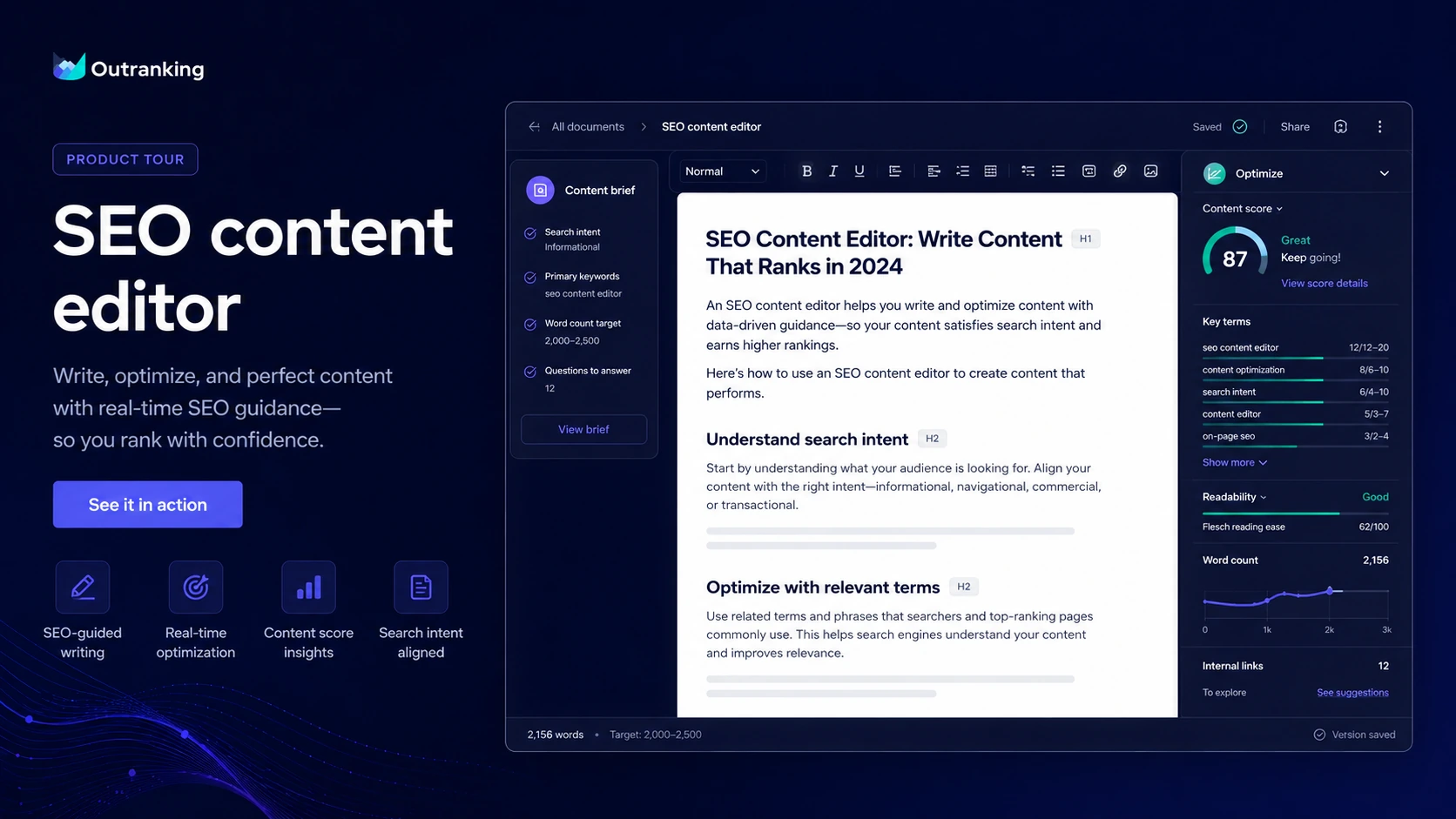
- Create or assist the first draft.
- Edit the article manually for accuracy, examples, tone, and buyer usefulness.
- Run optimization checks after the draft has substance.
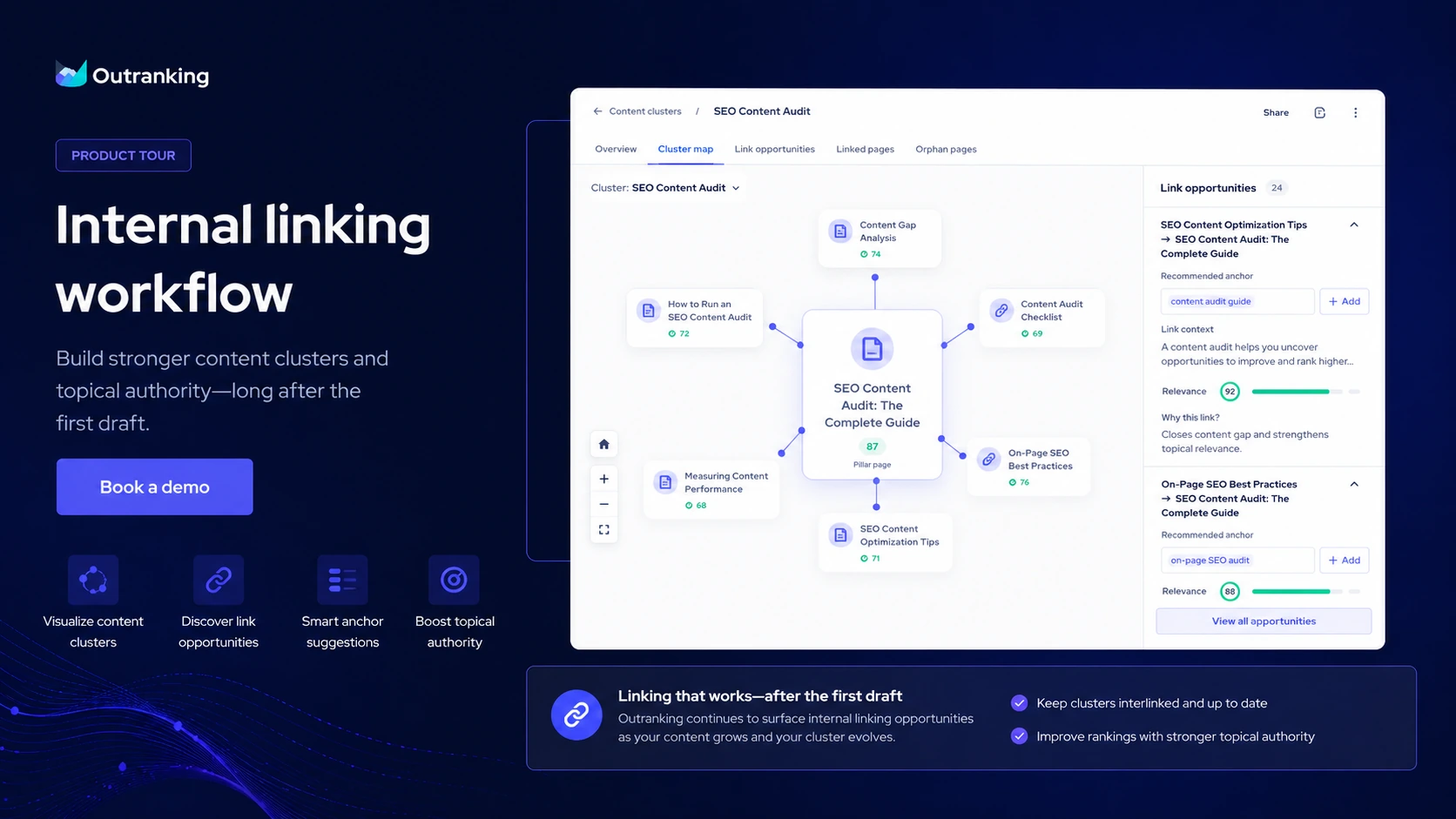
- Review internal linking opportunities.
- Publish only after a human editor has checked the final article.
That last step matters. SEO content tools can make content production faster, but they can also make mediocre content easier to scale. If nobody checks facts, examples, intent, or real usefulness, the workflow can produce polished-looking pages that do not deserve trust.
Outranking is most useful when it saves time inside a process you already repeat. It is weaker when it becomes the process.
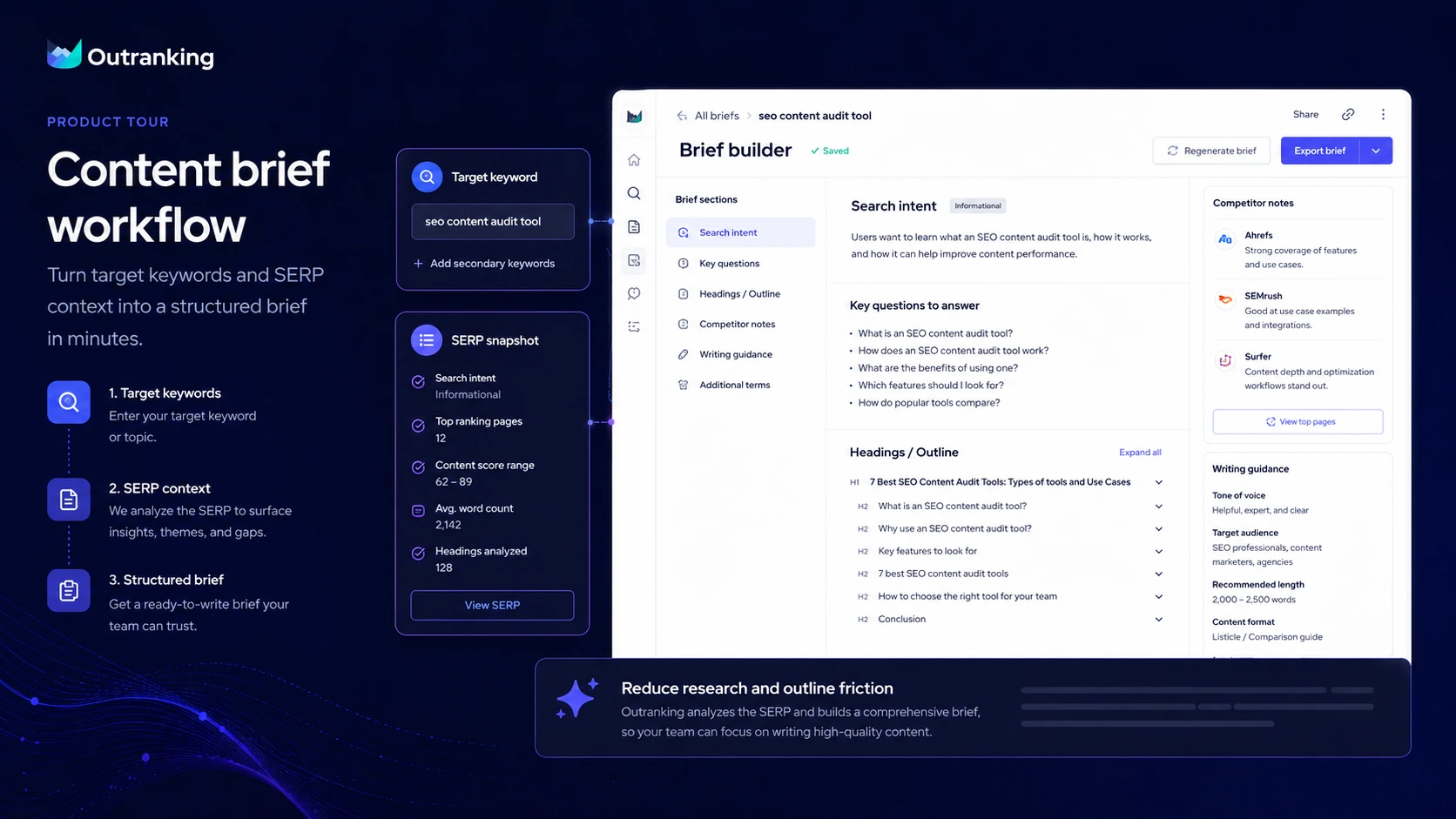
Workflow check: If this brief-to-optimization process matches how your team publishes content, Outranking deserves a closer look.
Features that actually matter
The feature list only matters if it changes the buying decision.
For Outranking, the most important feature is not one button. It is the connected workflow.
SEO briefs and outlines matter because they reduce the early research burden. Instead of asking a writer to guess the structure, Outranking helps turn SERP context into a brief and article plan. That is valuable when several people need to produce consistent SEO content.
AI-assisted first drafts matter because they can speed up the blank-page stage. I would not treat the first draft as publish-ready. I would treat it as a starting point that still needs editorial cleanup, source checks, examples, and brand voice.
Content optimization matters because it gives teams a way to check coverage after the draft exists. This is where Outranking competes more directly with content optimization tools. The value is not just writing faster; it is spotting gaps before the article goes live.
Internal linking support matters for publishers building topical clusters. If your site has many related articles, internal linking becomes part of the SEO workflow, not an afterthought.
Training and tutorials matter more than usual here. Outranking has official tutorial and webinar resources, and that is useful because the platform is not a one-screen writing toy. Buyers should watch enough of the workflow to know whether the interface feels helpful or heavy.
The feature I would be most careful with is AI generation. AI drafts can save time, but they can also create content that looks complete before it is actually trustworthy. If your team is not willing to edit, Outranking will not solve the deeper quality problem.
Pricing and plan value
Outranking pricing should be judged by content volume, not by the cheapest number on the page.
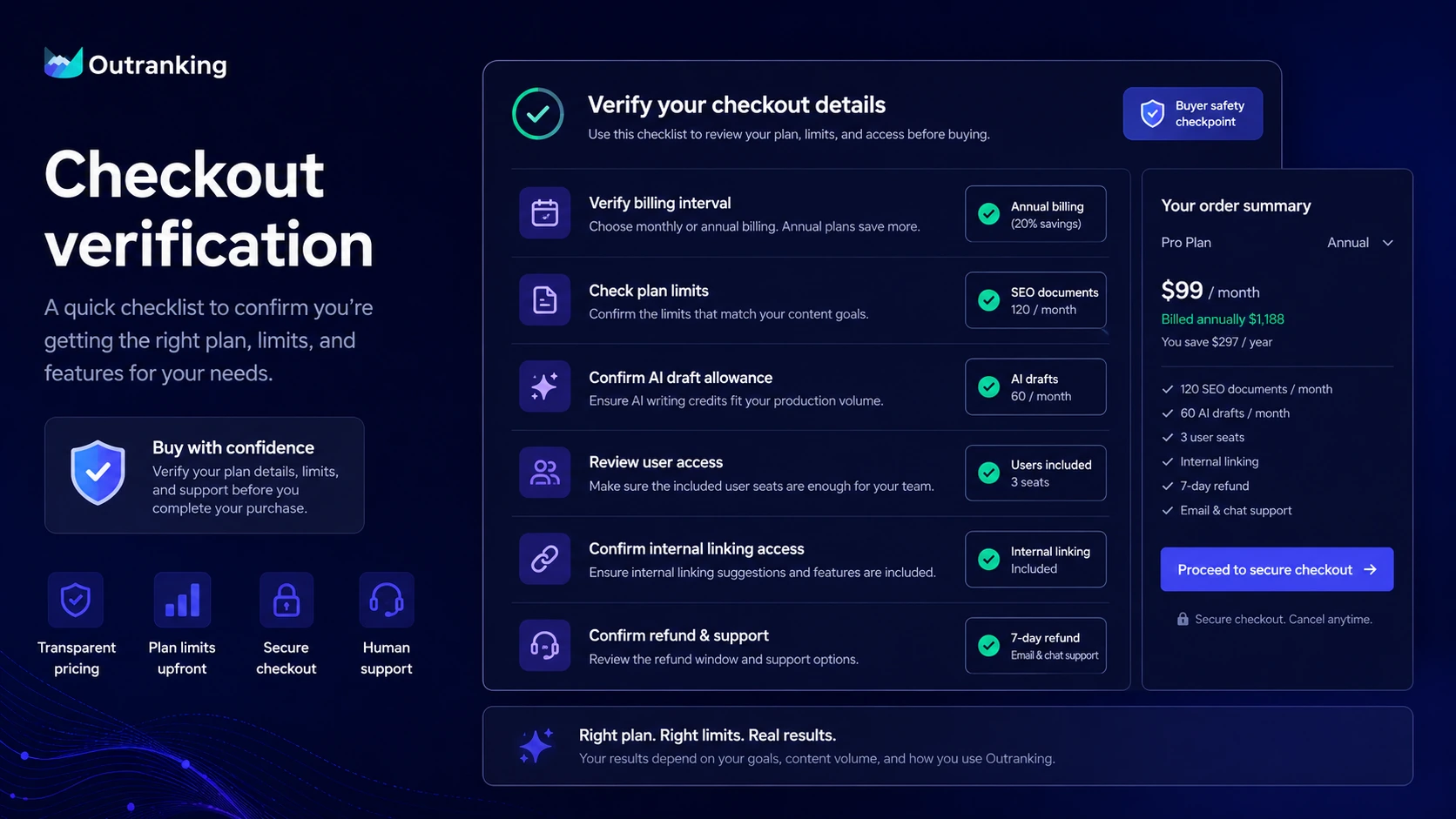
The current official pricing page presents several plan blocks. The visible structure includes a Starter route around low monthly SEO document volume, SEO Writer for a more serious recurring content workflow, SEO Wizard for higher document and draft capacity, and a custom plan for agency or enterprise needs.
The important buyer detail is that plans are tied to SEO documents, user counts, AI draft capacity, automatic optimization, and internal linking access. That means a plan can look affordable and still be too limited if your team publishes frequently.
| Plan route | Buyer interpretation |
|---|---|
| Starter | Best treated as a low-volume test path for checking whether the workflow fits |
| SEO Writer | More realistic for recurring SEO content production with multiple workflow features |
| SEO Wizard | Better for higher document volume and teams that need more draft capacity and users |
| Custom plan | More relevant for agencies and larger teams that need training, invoicing, account support, or packaged work |
The cheapest plan is not automatically the best deal.
If you publish four to five articles per month, a Starter-style path might be enough for evaluation. If you publish 15 to 30 SEO pieces per month, you need to compare the higher plans carefully. If you manage client work, the custom route may be safer than trying to force an agency workflow into a smaller subscription.
I would also pay attention to billing tabs and offer blocks. The pricing page can show different monthly, yearly, or limited-offer states. That is not unusual for SaaS pricing pages, but it means the live checkout screen is the final source of truth.
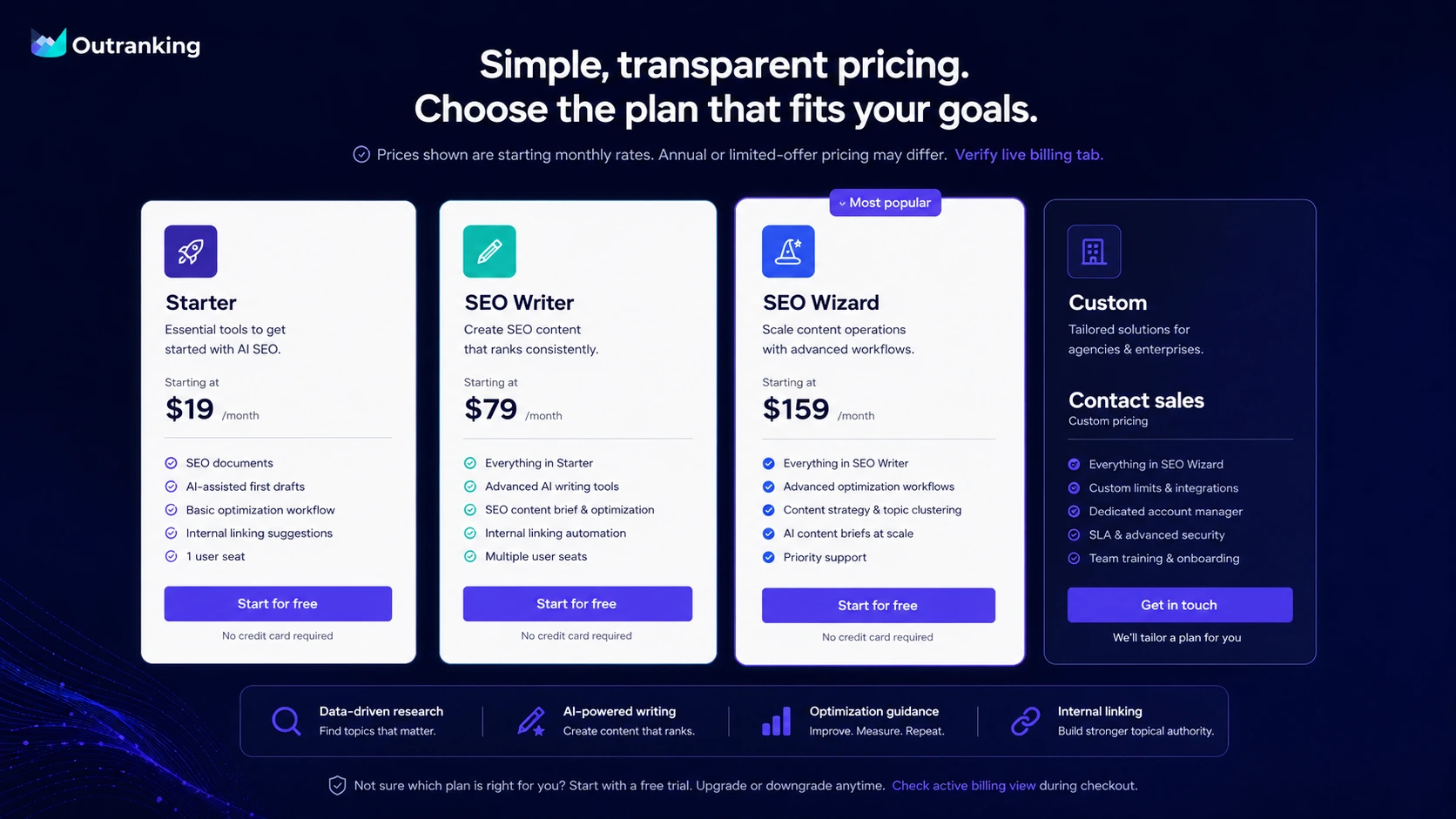
Pricing check: Before upgrading, compare your expected monthly SEO documents against the live plan limits and checkout total.
Free trial, coupon, and checkout notes
I would not assume a public coupon code is the main savings path for Outranking.
The safer buyer route is to check the official pricing page, compare monthly and annual billing, review any live checkout offer, and then use the DealBestDaily coupon route only after the workflow fit is clear.
There may be a trial-style path or get-started route available from the pricing page, but buyers should verify the live signup flow before assuming a free plan or free trial condition. The official pricing presentation can change, and old screenshots or third-party articles may lag behind the current checkout experience.
Refund handling also deserves a closer look. Outranking’s FAQ says refund requests can be made by email or chat, but I would not treat that as the same thing as a clearly advertised fixed refund window. If refund timing matters to you, ask before paying.
This is especially important if you are considering annual billing or a higher plan. A discount can improve a purchase, but it should not be the reason you buy. The reason to buy is that Outranking fits your real SEO publishing process.
Checkout note: Use the offer path only after you know which plan matches your document volume, user needs, and publishing workflow.
What I would check before buying Outranking
Before paying for Outranking, I would check six things.
First, I would count expected SEO documents. Not ideal output. Real output. How many briefs, drafts, and optimizations will your team actually run each month?
Second, I would check user count. If you have writers, editors, and managers involved, a plan that looks fine for one person may become awkward for a team.
Third, I would check whether internal linking matters. If your site is building topical clusters, this feature may be part of the reason to choose Outranking. If not, it may not justify a higher tier.
Fourth, I would test the learning curve. Watch the tutorials, run one real keyword, and see whether the workflow saves time or adds friction.
Fifth, I would verify refund and cancellation details. Do not rely on vague assumptions when a paid subscription is involved.
Sixth, I would compare alternatives before annual billing. If Frase, AISEO, Balzac AI, Surfer SEO, or Clearscope fits your workflow better, the lowest Outranking offer may still be the wrong purchase.
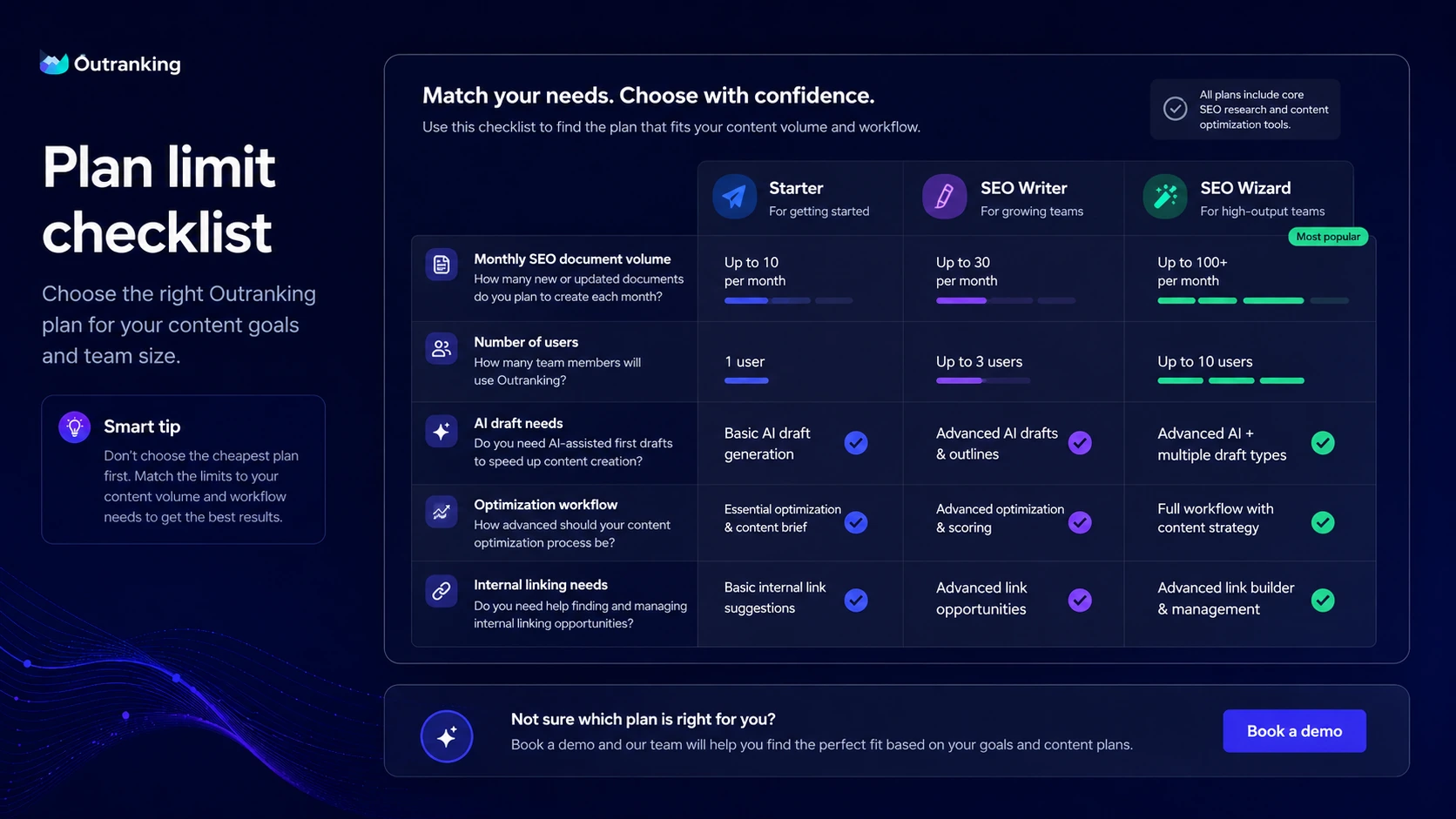
Pros and cons explained
Outranking’s biggest strength is that it understands SEO content as a workflow.
That sounds obvious, but many AI writing tools still treat content like a prompt-and-output problem. Outranking is more useful when the buyer wants structure: research, brief, outline, draft, optimization, and internal links. That structure is why it can make sense for content teams and agencies.
The second strength is plan clarity around SEO documents. I do not love all usage limits, but document-based pricing at least forces the buyer to think about real production volume. That is healthier than pretending every team needs unlimited AI output.
The third strength is the training layer. A structured tool needs education. Outranking’s official videos, webinars, and resources give buyers a way to inspect the workflow before committing.
The downsides are just as real.
Outranking can feel heavy if you only want simple writing help. A tool built around SEO documents, optimization, and workflow steps will not feel as frictionless as a basic AI chat interface.
The pricing can also require more attention than the homepage suggests. Buyers need to compare plan limits, billing interval, offer state, and actual checkout terms. If you pick the wrong plan, the tool can become either too limited or more expensive than expected.
The other caution is AI quality. Public user feedback around AI SEO tools often praises the speed and structure, but the old problem remains: AI-generated drafts still need human review. A workflow tool can support quality, but it cannot care about accuracy for you.
Green flags and red flags
Here are the green flags I see.
Outranking has a clear category fit. It is not trying to be everything for everyone. It is an SEO content workflow platform, and the official pages consistently describe briefs, drafts, optimization, strategy, and internal linking.
The pricing page lists concrete plan dimensions such as SEO documents, users, drafts, and optimization access. That gives buyers something real to compare.
The tutorial and webinar footprint is helpful. A buyer can inspect how the workflow actually works instead of relying only on sales copy.
The strongest red flag is not a scandal. It is fit risk.
If you buy Outranking without knowing your monthly content volume, you are guessing. If you buy it as a replacement for a full SEO suite, you are likely to be disappointed. If you buy it expecting AI drafts to remove editing work, you are misunderstanding the category.
I would also treat review-platform data carefully. Capterra shows a small review base with generally positive signals, while Trustpilot has very limited volume and mixed sentiment. That does not make the product bad. It just means the public evidence base should be treated as useful but not overwhelming.
Outranking vs alternatives
Outranking should be compared with SEO content workflow tools, not with every AI writer on the market.
| Alternative | When it may be a better fit |
|---|---|
| Frase | Better comparison if your main job is brief creation, content optimization, and SERP-informed content planning |
| AISEO | Better next tab if you want a lighter AI writing and optimization workflow without as much process weight |
| Balzac AI | Better comparison if your content needs are broader than SEO briefs and optimization |
| Surfer SEO | Stronger comparison if content scoring, optimization standards, and a mature SEO writing workflow are the priority |
| Clearscope | Stronger comparison for teams that want a more premium content optimization environment and have the budget for it |
If you want an internal next step, compare Outranking with the AISEO store guide and the Balzac AI store guide. If brief and optimization logic matter most, the Frase store guide is also worth reviewing before you commit.
The important point is not that one tool is universally better. The important point is matching the workflow.
Outranking is a stronger fit when you want a connected SEO production process. AISEO may feel better when writing speed matters more than process depth. Balzac AI may fit broader content use cases. Frase, Surfer SEO, and Clearscope are more obvious comparisons when content optimization is the center of the buying decision.
Review methodology and evidence confidence
This Outranking review is based on the public product pages, current pricing-page structure, official FAQ and tutorial resources, internal DealBestDaily store data, and third-party review patterns from software review and editorial sources.
My confidence is highest on the broad positioning: Outranking is clearly presented as an AI-assisted SEO content workflow platform for briefs, drafts, optimization, planning, and internal linking.
My confidence is moderate on pricing interpretation because the pricing page can display multiple billing views, limited-offer blocks, and plan variations. Buyers should treat the live checkout screen as the final source of truth.
My confidence is mixed on public user sentiment because available review data is not huge. Some reviews praise the depth, SEO workflow, and research support. Some complaints point toward learning curve, UI friction, credit or usage confusion, and the need for tutorials.
That combination leads to a practical judgment: Outranking is a serious tool for the right workflow, but not a casual impulse purchase.
Final verdict
Outranking is worth considering if you publish SEO content often enough to need a repeatable workflow.
It is not the tool I would buy just because I wanted an AI writer. It is also not the tool I would buy as a replacement for a full SEO stack. The better fit is narrower and more useful: SEO teams, agencies, bloggers, and content marketers who need to move from target keyword to brief to draft to optimization with less scattered process.
I would consider Outranking if your team already knows what it wants to publish each month, needs better briefs, wants AI-assisted drafting, and values optimization guidance before publishing.
I would skip it if you only need occasional blog drafts, dislike structured editors, or expect the software to handle strategy, fact-checking, and final editorial quality on its own.
I would compare it first if you are choosing between several SEO content platforms. Frase, AISEO, Balzac AI, Surfer SEO, and Clearscope can all make sense depending on whether your priority is writing speed, brief quality, content scoring, team workflow, or premium optimization.
The safest next step is to test Outranking with one real keyword and one real article workflow. If the process saves time and improves the article before publishing, the pricing conversation becomes easier. If the workflow feels heavy or the document limits feel tight, a cheaper checkout path will not fix the mismatch.