Quick verdict
FunnelAIQ is worth a closer look if your business needs something more intentional than a contact form, but less heavy than a full CRM or marketing automation stack.
That is the key distinction.
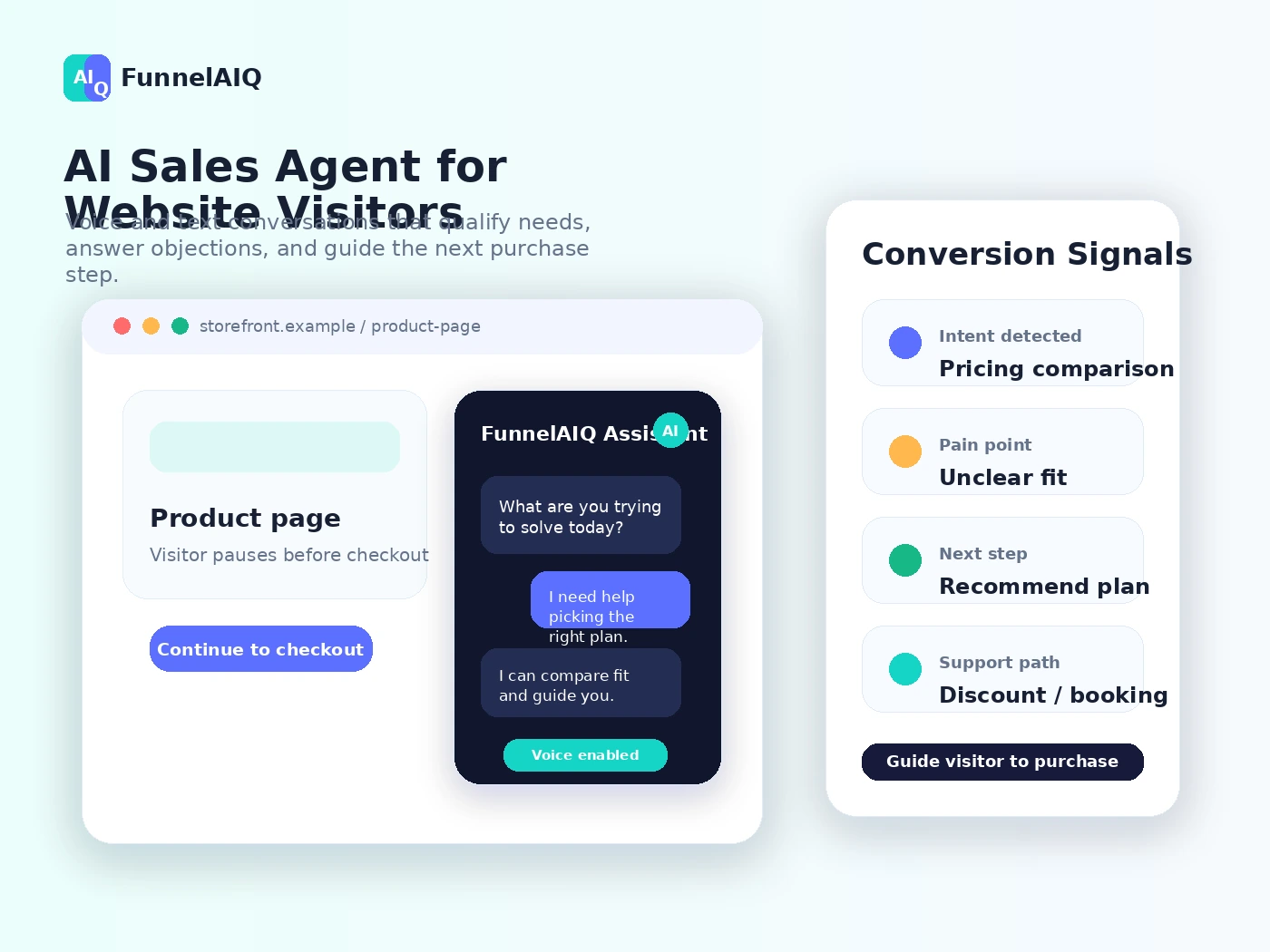
The product is not just selling a prettier survey. FunnelAIQ is trying to turn visitor answers into a guided sales path: ask adaptive questions, read hesitation signals, score the lead, and move the person toward a more relevant next step. The newer AI Sales Agent angle pushes the same idea further with voice and text conversations for website visitors.
I would consider FunnelAIQ if you already have a real offer, a clear follow-up path, and enough visitor activity to learn from the responses. It can make sense for e-commerce stores, service businesses, consultants, and small teams that want to qualify prospects before showing pricing, discounts, booking links, or sales follow-up.
I would be careful if you only need a simple survey, a normal lead form, or a chatbot that answers FAQs. FunnelAIQ becomes useful when the answers actually change what happens next. If every visitor gets the same thank-you page, the adaptive layer may be wasted.
The safest path is to test one narrow funnel first. Use the free plan or trial route, build a real qualification flow, and check whether lead scoring or hesitation detection changes your sales process before choosing a paid tier.
Next step: If FunnelAIQ fits your sales workflow, verify the current buyer route and plan limits before checkout.
Review snapshot
| Review point | Practical take |
|---|---|
| Best for | Businesses that want adaptive survey funnels, lead scoring, and visitor qualification |
| Not ideal for | Basic contact forms, simple quizzes, low-traffic sites, or teams needing mature CRM workflows today |
| Main use case | Asking better questions before routing visitors toward offers, discounts, booking, or follow-up |
| Free path | Public Free plan with basic limits and FunnelAIQ branding |
| Paid starting point | Starter is publicly listed at $19/month, with higher tiers for more responses and advanced logic |
| Trial note | The AI Sales Agent page states that plans include a 14-day free trial with no credit card required |
| Main strength | Focused conversion flow: adaptive questions, scoring, hesitation detection, and sales-agent positioning |
| Main concern | Refund rules, integration maturity, and conversion claims need careful buyer verification |
| Direct alternatives | ClickFunnels, Systeme.io, GoHighLevel, ChatBot depending on the buyer job |
| Best next step | Build one real funnel and compare results against your current form or chat path |
What is FunnelAIQ?
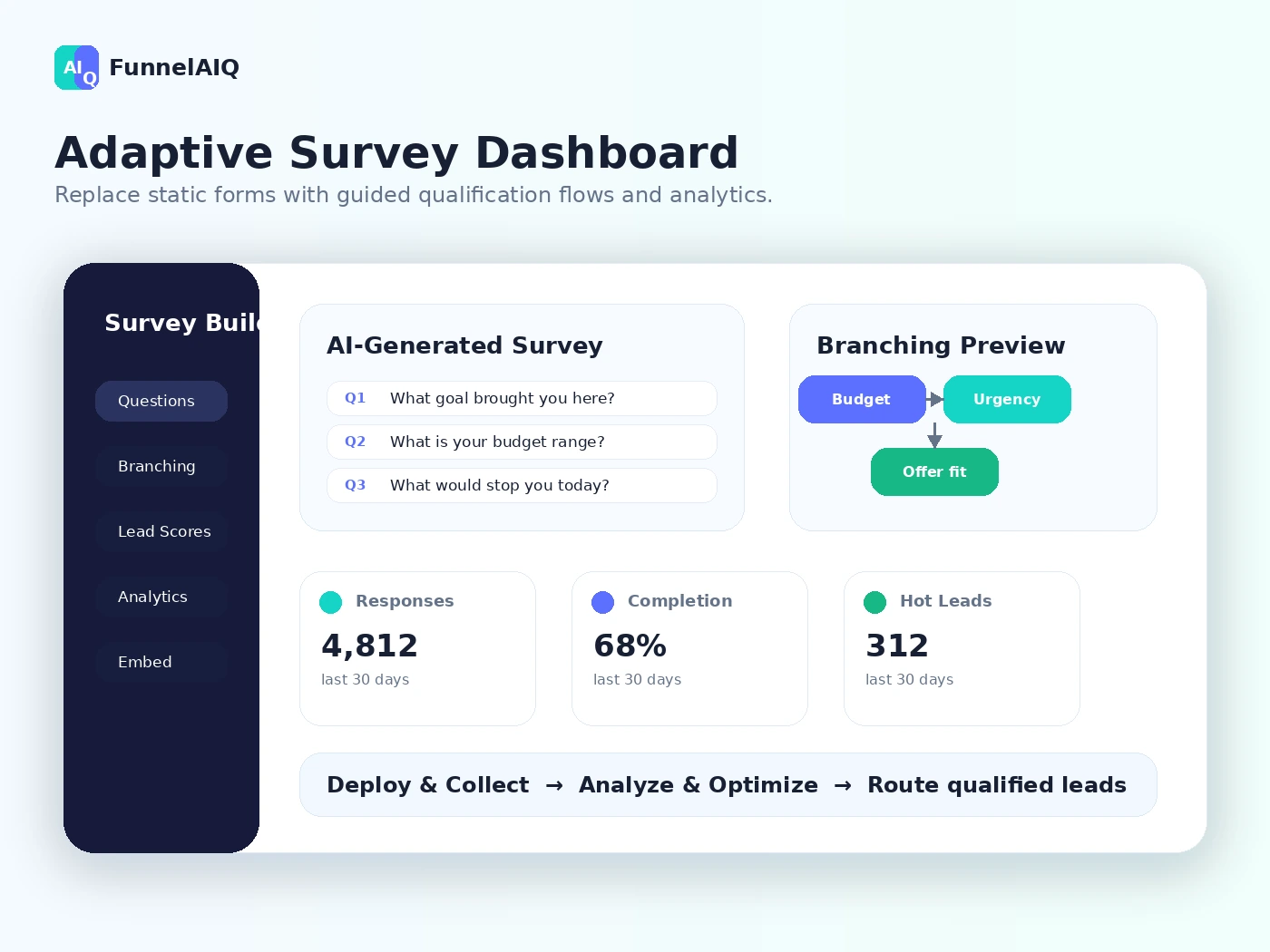
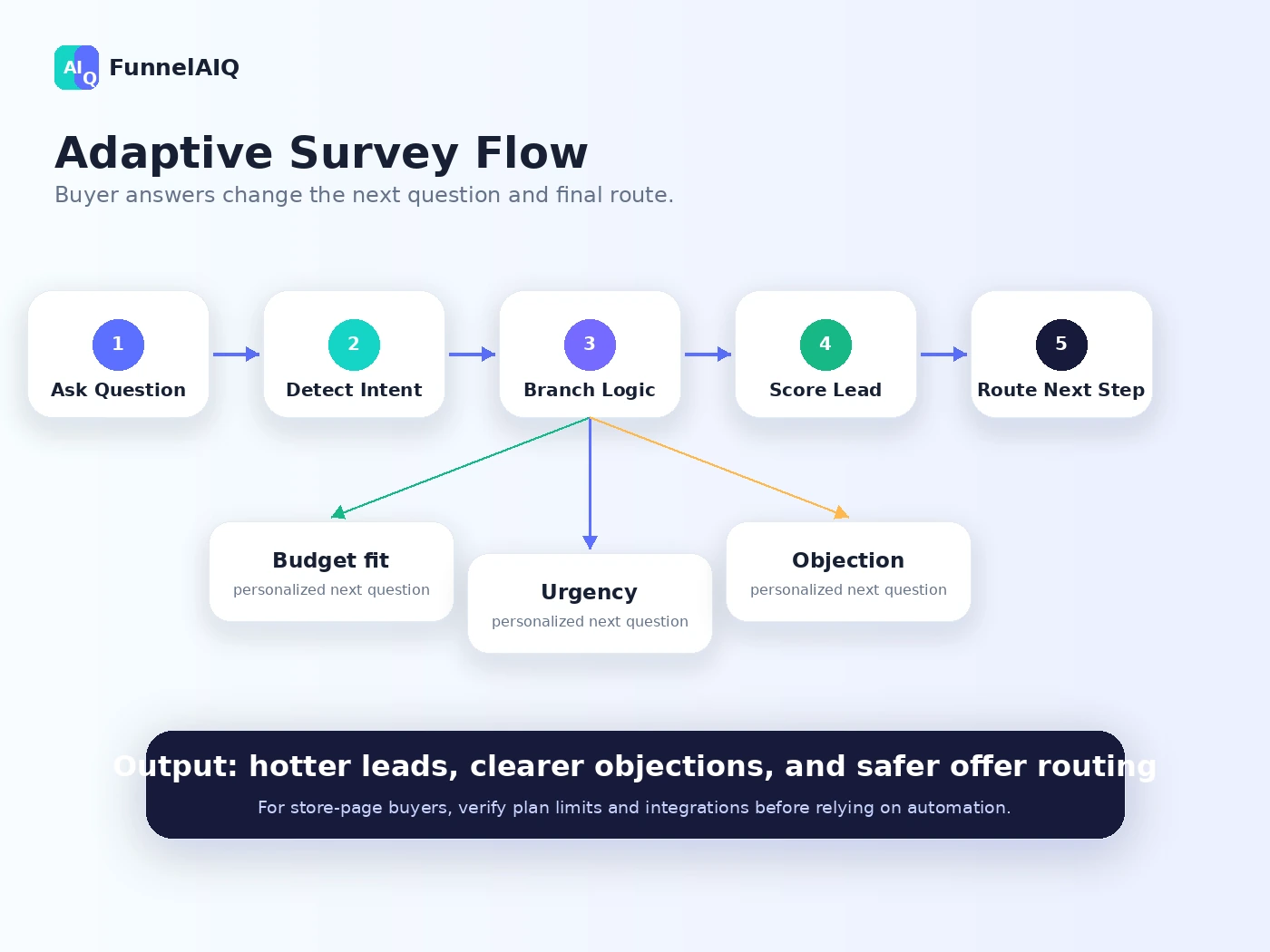
FunnelAIQ is an AI-powered survey funnel and sales conversion platform. In plain language, it helps businesses ask visitors better questions, adapt the next question based on the response, score lead readiness, detect hesitation, and route people toward a more relevant next step.
The main product sits closer to survey funnels and lead qualification than a normal form builder. Instead of collecting static answers, FunnelAIQ is built around the idea that visitor behavior should change the sales journey.
The AI Sales Agent layer adds a more conversational path. Its public positioning focuses on voice and text engagement, animated-avatar interaction, lead qualification, recommendations, discounting, and order-tracking style support. That makes the product feel like a hybrid of survey funnel, guided selling tool, and sales assistant.
I would not judge FunnelAIQ only by the word “AI.” The better question is whether your current sales process has a qualification problem. If your team already knows which questions separate serious buyers from casual visitors, FunnelAIQ gives you a tool to test that logic. If you do not yet know the customer journey, the software can make the funnel look smarter than it really is.
Our review approach compares public product pages, pricing details, help and policy pages, buyer workflow fit, and nearby alternatives. We do not treat a conversion claim, free plan, trial, or coupon path as proof that the product fits the buyer.
The common misunderstanding is thinking FunnelAIQ automatically creates better sales. It does not. It gives you a structure for asking questions and guiding visitors. The quality of the offer, traffic, scoring logic, and follow-up process still matters.
Who should use FunnelAIQ?
FunnelAIQ makes the most sense for businesses where visitor answers should change the next step.
An e-commerce store may use it as a guided product finder. If shoppers often hesitate because they do not know which product, package, or offer fits them, an adaptive survey or sales agent can help narrow the choice. This works best when the store has enough traffic and clear product-fit rules.
A service business may use FunnelAIQ for pre-call qualification. Instead of sending every lead to the same booking page, the business can ask budget, timing, need, and urgency questions first. That can help separate serious prospects from people who are not ready yet.
A founder or consultant may use it before showing pricing. If the offer requires education, qualification, or objection handling, FunnelAIQ can help collect context before the pitch. The condition is simple: the answers must change what the visitor sees or receives next.
A small sales team may use it to prioritize follow-up. Lead scoring and hesitation signals can be useful when the team needs to decide who gets human attention first. I would still verify how scoring rules work in practice before making it central to pipeline management.
A Shopify-style seller may consider the AI Sales Agent path if the goal is conversational guidance, product recommendation, dynamic discounting, or support-adjacent buying help. The buyer should confirm the current install path, data access, support model, and plan limits before using it on a live storefront.
Who should avoid FunnelAIQ?
I would avoid FunnelAIQ if you only need a basic contact form. A normal form builder is simpler, cheaper, and less likely to create unnecessary setup work.
I would also be careful if your site has very low traffic. Adaptive surveys and lead scoring need enough responses to produce useful patterns. If only a few people complete the funnel each month, the paid tiers may not teach you much.
Teams that need mature CRM, automation, and agency operations should compare broader platforms first. FunnelAIQ’s pricing page presents CRM integrations, conversion tracking, and AI-driven purchase prediction as coming-soon items. If those functions are required today, verify them directly before paying.
Buyers who expect an AI agent to fix a weak offer should slow down. FunnelAIQ can ask questions and guide visitors, but it cannot repair unclear messaging, poor product-market fit, weak checkout flow, or a discount strategy that does not make sense.
I would also avoid buying only because a deal route exists. A lower price may help, but the refund rules are narrow once the service has been accessed or used. That makes workflow testing more important than coupon hunting.
How FunnelAIQ fits into a real workflow
A practical FunnelAIQ workflow starts before the software.
First, map the buyer journey. What problem does the visitor have? What question would separate a ready buyer from a casual browser? What answer should send someone to a product page, booking page, discount, sales call, or nurture sequence?
Then build a small adaptive funnel. Start with a few questions, not twenty. Use the first version to test whether visitors finish the flow and whether the answers are actually useful.
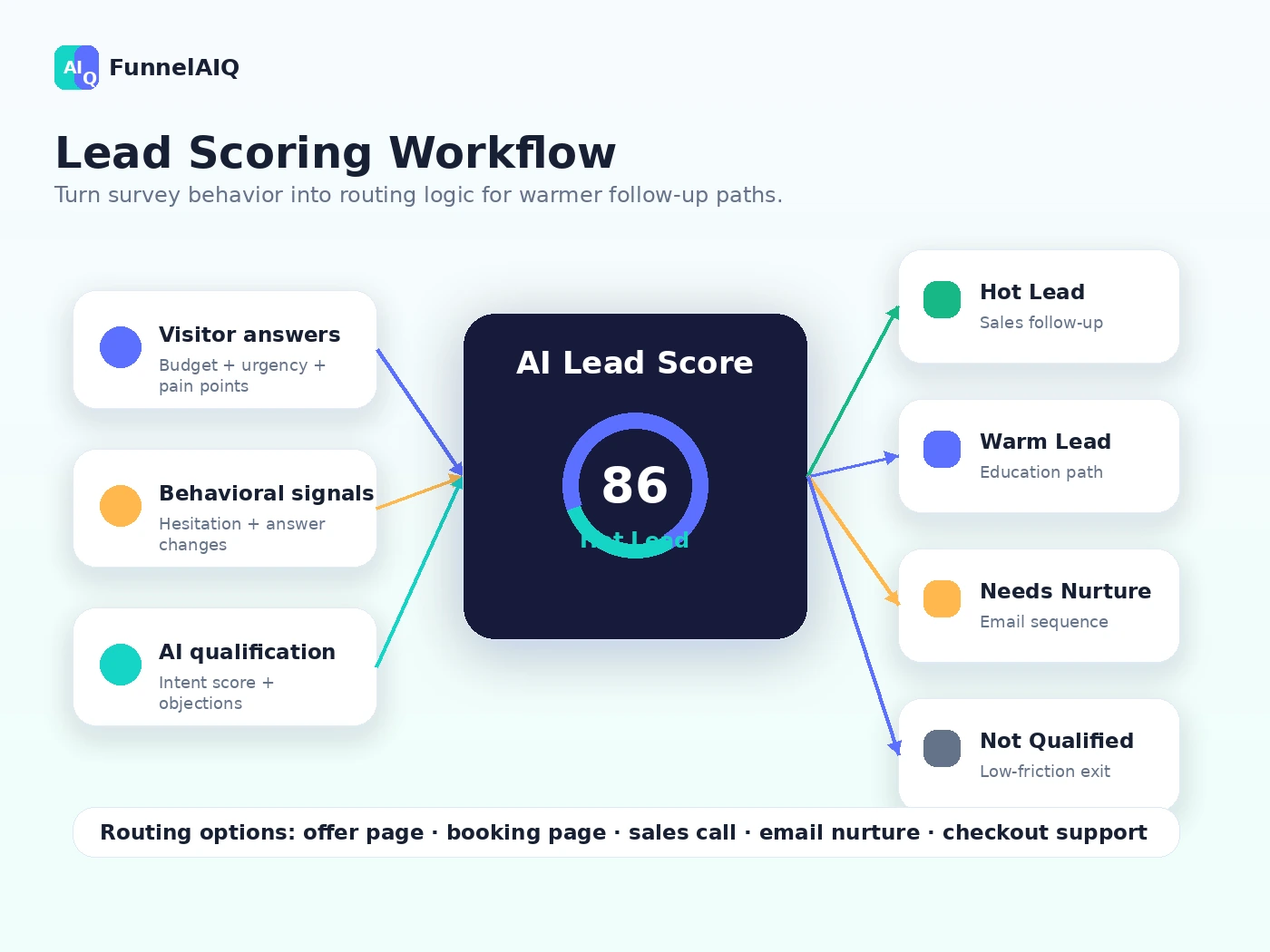
Next, add scoring. A lead score is valuable only if the business knows what to do with it. A hot lead should trigger a different next step from a cold lead. If the score does not change follow-up, the scoring layer becomes decoration.
After that, test hesitation and objection handling. This is where FunnelAIQ becomes more interesting than a normal form. If the tool can help surface uncertainty, timing concerns, or objections, the business can adjust the message or follow-up.
Finally, compare results against the old path. Did the funnel produce better leads? Did visitors complete it? Did sales follow-up improve? Did the team understand the data? These questions matter more than the headline feature list.
Workflow check: If you can define one real qualification flow, test FunnelAIQ with that funnel before rolling it across your site.
Real-world buyer scenarios
A small agency selling strategy calls may use FunnelAIQ to qualify leads before booking. The survey can ask about budget, business stage, current problem, and timeline. FunnelAIQ may fit if the answers help the agency prioritize who gets a call. It may fail if the agency sends everyone to the same calendar anyway.
An e-commerce brand may use it as a product finder. The sales-agent angle is especially relevant when shoppers need help choosing between products. FunnelAIQ may fit if recommendations and discounts are tied to actual buyer needs. It may be overkill if the catalog is tiny or the product choice is obvious.
A SaaS founder may use it to segment website visitors before showing a demo path. The funnel might identify company size, use case, urgency, and current stack. This is useful only if the founder has different next steps for different segments.
A course creator or consultant may use it to route people into the right offer. A visitor who is early-stage may get education content, while a high-intent buyer may see a call-to-action. FunnelAIQ can support that journey, but the creator still needs strong offer logic.
Key features that actually matter
Adaptive survey generation
FunnelAIQ can generate survey questions and adapt the flow based on responses. This matters because a static form often asks everyone the same questions even when the buyer context changes.
Buyer note: use AI-generated questions as a starting point, not as final strategy. The questions still need to match your offer and follow-up process.
Lead scoring
Lead scoring is one of the clearer reasons to consider FunnelAIQ. If the answers and behavior indicate purchase readiness, the business can prioritize warmer leads.
Buyer note: scoring is only useful if someone acts on it. Before paying, decide what a high, medium, or low score will trigger.
Hesitation detection and objection handling
FunnelAIQ’s public feature set includes hesitation detection and AI objection handling. This is the more conversion-focused part of the product. It suggests the tool is looking not only at answers, but at friction.
Buyer note: do not assume hesitation detection will automatically reveal the truth. Treat it as a signal to improve copy, follow-up, and buyer education.
Branching logic
Branching logic lets different visitors take different paths. This is where FunnelAIQ can become more useful than a simple survey.
Buyer note: start with a few meaningful branches. Overbuilding the funnel can make the experience confusing and harder to analyze.
AI Sales Agent layer
The AI Sales Agent side adds voice and text engagement, animated-avatar interaction, qualification, recommendations, discounting, and support-style actions. This may be useful for businesses that want proactive website selling.
Buyer note: verify the current plan, session limits, integration route, and storefront fit before placing an AI sales agent in front of real customers.
Pricing and plan value
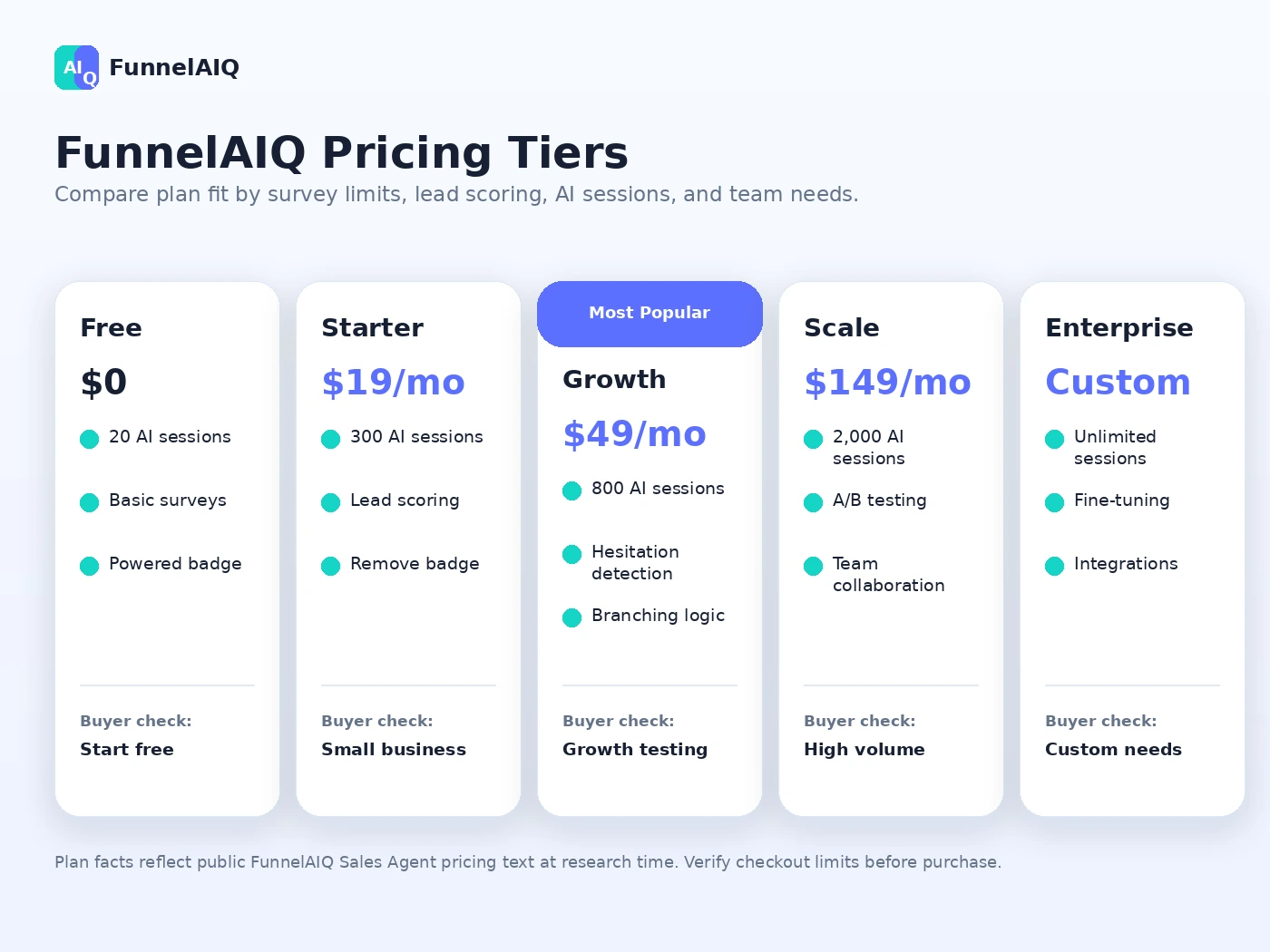
At the time of review, FunnelAIQ’s public pricing page shows a Free plan, Starter at $19/month, Growth at $49/month, Scale at $149/month, and Enterprise as custom pricing.
The Free plan is useful for early validation. It includes basic AI-generated surveys, limited response volume, embedded surveys, basic analytics, and FunnelAIQ branding. I would treat it as a proof-of-fit tier, not a serious rollout plan.
Starter is the first paid step. It raises response limits, removes the FunnelAIQ badge, adds AI-driven lead scoring, allows more embedded surveys, and includes CSV export. This is the tier I would look at if the business wants to test a cleaner version of the funnel without paying for the heavier feature set.
Growth is more interesting if hesitation detection, objection handling, and branching logic are the reason you are considering the product. If those features are not central to your decision, Growth may be more than you need.
Scale is for higher volume, A/B testing support, custom branding, and team collaboration. I would not jump here until one smaller funnel has already proved that the qualification path improves lead quality or conversion quality.
Enterprise is custom and should be treated as a sales-led path. Buyers should confirm unlimited responses, custom integrations, priority support, and dedicated AI tuning before relying on those claims operationally.
The AI Sales Agent page also lists AI session limits across plans and states that plans include a 14-day free trial with no credit card required. That means pricing is not only about monthly subscription cost. It is also about response volume, AI session volume, embedded survey count, team needs, and whether the buyer is using the survey product, the sales-agent layer, or both.
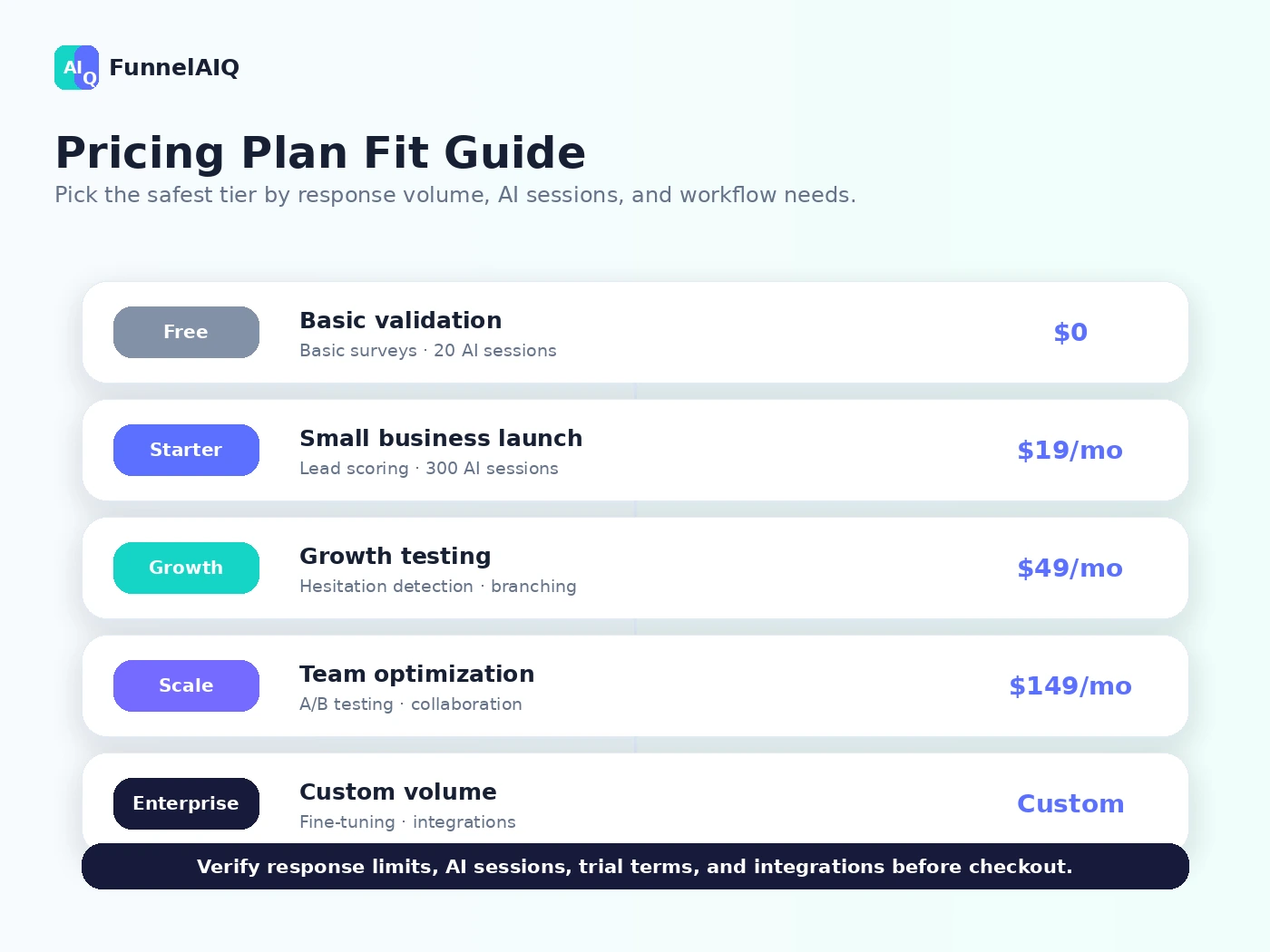
Pricing check: Before choosing Starter, Growth, or Scale, compare response limits and AI session limits against one real funnel.
Free plan, trial, coupon, and checkout notes
The free plan is the safest starting point if you want to test the survey funnel concept. It should be enough to validate whether the product shape makes sense, though the limits and branding may not fit a serious campaign.
The AI Sales Agent page states that plans include a 14-day free trial with no credit card required. I would verify the exact checkout path before assuming the same trial conditions apply to every product route, because FunnelAIQ’s survey funnel and sales-agent pages emphasize overlapping but not identical use cases.
I would not make a coupon the main reason to buy FunnelAIQ. The practical savings path is simpler: start free or trial, build one real funnel, then choose the lowest plan that matches your response volume, AI sessions, branding, and team needs.
The refund policy deserves extra attention. FunnelAIQ says refunds are available only if the service has not been accessed or used, and that a request must be submitted within 14 days if the buyer cancels before using the service. It also says promotional or discounted plans are not eligible for refunds.
That makes the first paid click important.
Use the free or trial route before relying on refund flexibility. Once you log in, access features, or use the service, the refund path may narrow quickly.
Checkout note: Treat the offer route as a live verification step after workflow fit is clear, not as the reason to buy.
What I would check before buying FunnelAIQ
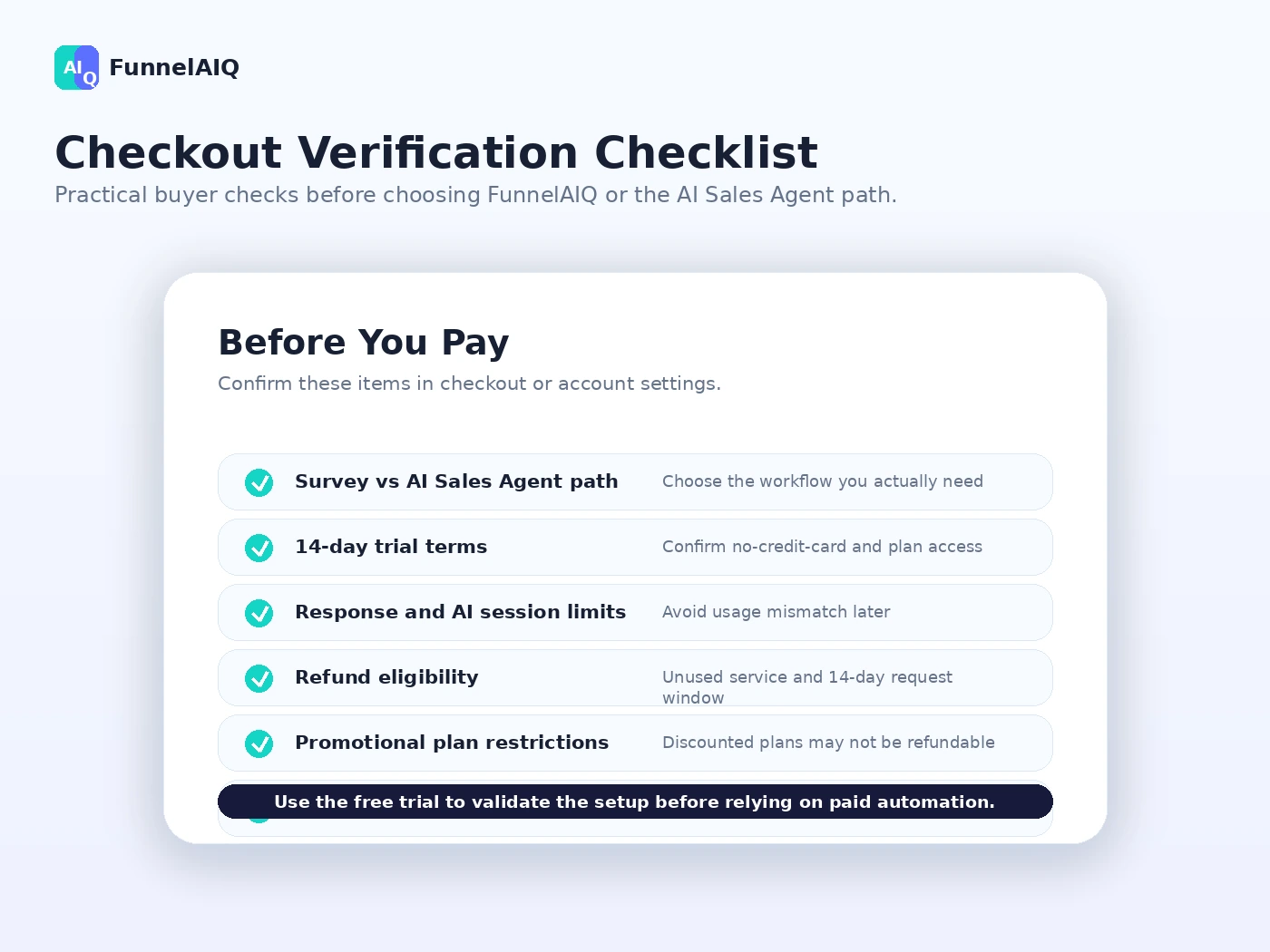
If I were buying FunnelAIQ for a real conversion workflow, I would check these points before paying:
- Whether the business needs the survey funnel product, the AI Sales Agent layer, or both.
- Whether the Free plan or trial route is enough to test one practical funnel before paid usage.
- Whether monthly response limits match expected traffic and completion rate.
- Whether AI session limits match the sales-agent use case.
- Whether branding removal, CSV export, team collaboration, A/B testing, or custom branding is actually needed.
- Whether CRM integrations, webhooks, conversion tracking, and purchase prediction are live or still listed as coming soon.
- Whether refund eligibility still applies after logging in, accessing features, or using the service.
A simple test before paying
Before paying for FunnelAIQ, I would run a small test like this:
- Pick one product, offer, or service page where visitor qualification actually matters.
- Write the three to five questions that would change the visitor’s next step.
- Decide what a hot, warm, and cold lead should receive after the survey.
- Build the simplest version of the flow in FunnelAIQ.
- Compare the output against your current form, chat widget, or landing page.
- Check whether lead scoring or hesitation signals create better follow-up decisions.
- Only upgrade if the plan limits match the number of responses or AI sessions you realistically expect.
This test keeps the decision grounded. FunnelAIQ should earn its place by improving qualification, not by sounding advanced.
Pros explained
The first real advantage is focus. FunnelAIQ is not trying to be every marketing tool at once. It is focused on adaptive surveys, lead scoring, hesitation signals, and guided conversion. That makes the product easier to judge.
The second advantage is the entry path. A Free plan and low-cost Starter tier make it easier to test the concept before moving into heavier plans. That matters because conversion tools often look better in theory than they perform in a specific funnel.
The third advantage is the combination of survey logic and sales-agent positioning. A normal form collects answers. FunnelAIQ is trying to use answers, hesitation, and intent signals to guide the visitor forward.
The fourth advantage is pricing transparency. Public plan tiers and response limits make the first-pass evaluation easier. You still need to verify checkout details, but the pricing page gives buyers a clear starting point.
Cons explained
The biggest drawback is refund flexibility. FunnelAIQ’s policy is narrow after access or usage. That does not make the product bad, but it does mean buyers should test carefully before activating a paid workflow.
The second drawback is that conversion claims need proof in your own funnel. A tool can promise better engagement, but your traffic quality, offer clarity, product fit, and follow-up discipline will decide the real outcome.
The third drawback is integration maturity. The pricing page presents conversion tracking, purchase prediction, and CRM integrations as coming soon. If your buying decision depends on those features, verify them before paying.
The fourth drawback is category fit. FunnelAIQ may be too much if you only need a simple form or customer support chatbot. It is best when adaptive qualification is part of the sales process.
Green flags and red flags
Green flags:
- You already know which questions separate ready buyers from weak leads.
- Your current form or chatbot collects information but does not guide the sales journey.
- Your sales team needs better qualification before follow-up.
- You have enough traffic to test response patterns.
- You can define what should happen after each score or answer path.
Red flags:
- You do not yet have a clear offer or conversion path.
- You only need a basic survey or lead capture form.
- You expect AI to fix poor traffic quality or weak messaging.
- You need CRM integrations or webhooks today and have not confirmed availability.
- You are buying because of a promo before testing the free or trial path.
FunnelAIQ vs alternatives
FunnelAIQ’s alternatives depend on the buyer job. It should not be compared only with chatbot tools or only with funnel builders. It sits between survey funnels, guided selling, lead qualification, and AI sales assistance.
ClickFunnels vs FunnelAIQ
ClickFunnels is the broader route when landing pages, funnel assets, offers, checkout flows, and page-building matter more than adaptive qualification. FunnelAIQ may still make sense if the main bottleneck is asking better pre-sale questions before sending visitors into the funnel.
If you are building the whole sales system from scratch, compare the ClickFunnels route before deciding. If your pages already exist and the missing piece is qualification, FunnelAIQ is the cleaner comparison.
Systeme.io vs FunnelAIQ
Systeme.io is usually a simpler all-in-one choice for creators and small businesses that want funnels, email, courses, and sales tools in one account. FunnelAIQ is narrower and more qualification-focused.
I would compare Systeme.io if budget simplicity and all-in-one operations matter more than adaptive survey logic. I would stay closer to FunnelAIQ if the business already has marketing tools and only needs better guided lead qualification.
GoHighLevel vs FunnelAIQ
GoHighLevel is stronger for agencies that need CRM, automation, pipelines, client accounts, and broader marketing operations. It is not a one-to-one replacement for a survey funnel tool, but it may be the better system if the buyer needs full sales operations.
FunnelAIQ may still fit inside or beside a broader stack if the qualification flow is the specific missing piece. The buyer should verify integrations before assuming the handoff will be seamless.
ChatBot vs FunnelAIQ
ChatBot is the cleaner comparison when the buyer mainly wants support automation, FAQ handling, or a general conversational widget. FunnelAIQ is more interesting when the conversation needs to qualify intent and route visitors toward sales outcomes.
If the job is answering questions, compare chatbot tools. If the job is guiding a visitor through a buyer-readiness flow, FunnelAIQ deserves the closer look.
Trust, refund, and buyer-risk notes
The biggest buyer-risk note is the refund policy. FunnelAIQ states that refunds are only available if the service has not been accessed or used, with a 14-day request window in eligible cases. It also excludes promotional or discounted plans. That is not a casual money-back path.
The second risk is feature timing. If CRM integrations, webhooks, conversion tracking, or purchase prediction are essential, verify whether they are live before subscribing. A coming-soon feature should not be the reason you pay today.
The third risk is data and privacy. FunnelAIQ’s privacy policy says it collects personal data, usage data, cookies, and may use trusted third-party providers for analytics and payment processing. That is common for SaaS tools, but sales and lead data can be sensitive. Businesses should check privacy requirements before collecting customer answers through any tool.
The fourth risk is overestimating AI. AI-generated questions, scoring, and sales-agent conversation can help, but they still depend on the business’s offer and follow-up quality. I would not treat the AI layer as a replacement for sales strategy.
The fifth risk is plan mismatch. A funnel that works at low volume may require a higher response or AI session limit later. Check expected traffic before moving from Free or Starter to higher tiers.
Final verdict
FunnelAIQ is a good fit if your business already understands its sales journey and needs a better way to qualify visitors before the next step.
I would consider it for adaptive product finders, pre-call qualification, guided selling, Shopify-style visitor assistance, and lead scoring workflows where answers actually change what happens next.
I would skip it if you only need a basic form, a simple quiz, or a chatbot that answers support questions. I would also slow down if your purchase depends on coming-soon integrations, broad refund flexibility, or conversion lift that has not been tested on your own traffic.
I would compare FunnelAIQ with ClickFunnels if you need full funnel building, Systeme.io if you need low-cost all-in-one marketing, GoHighLevel if you need agency CRM depth, and ChatBot if support automation is the real job.
For my money, FunnelAIQ is not a tool to buy because the AI language sounds persuasive. It is a tool to test because your current visitor path may be asking the wrong questions, scoring leads too weakly, or sending everyone to the same next step.
If one focused funnel proves that guided qualification improves the buyer journey, FunnelAIQ can make sense. If the funnel logic is still unclear, the safer move is to fix the offer and follow-up path first.