Quick verdict
Frase is worth testing if your content workflow has become too large for a simple AI writer, but not yet clean enough to justify stitching together five different SEO and AI visibility tools.
That is the real decision.
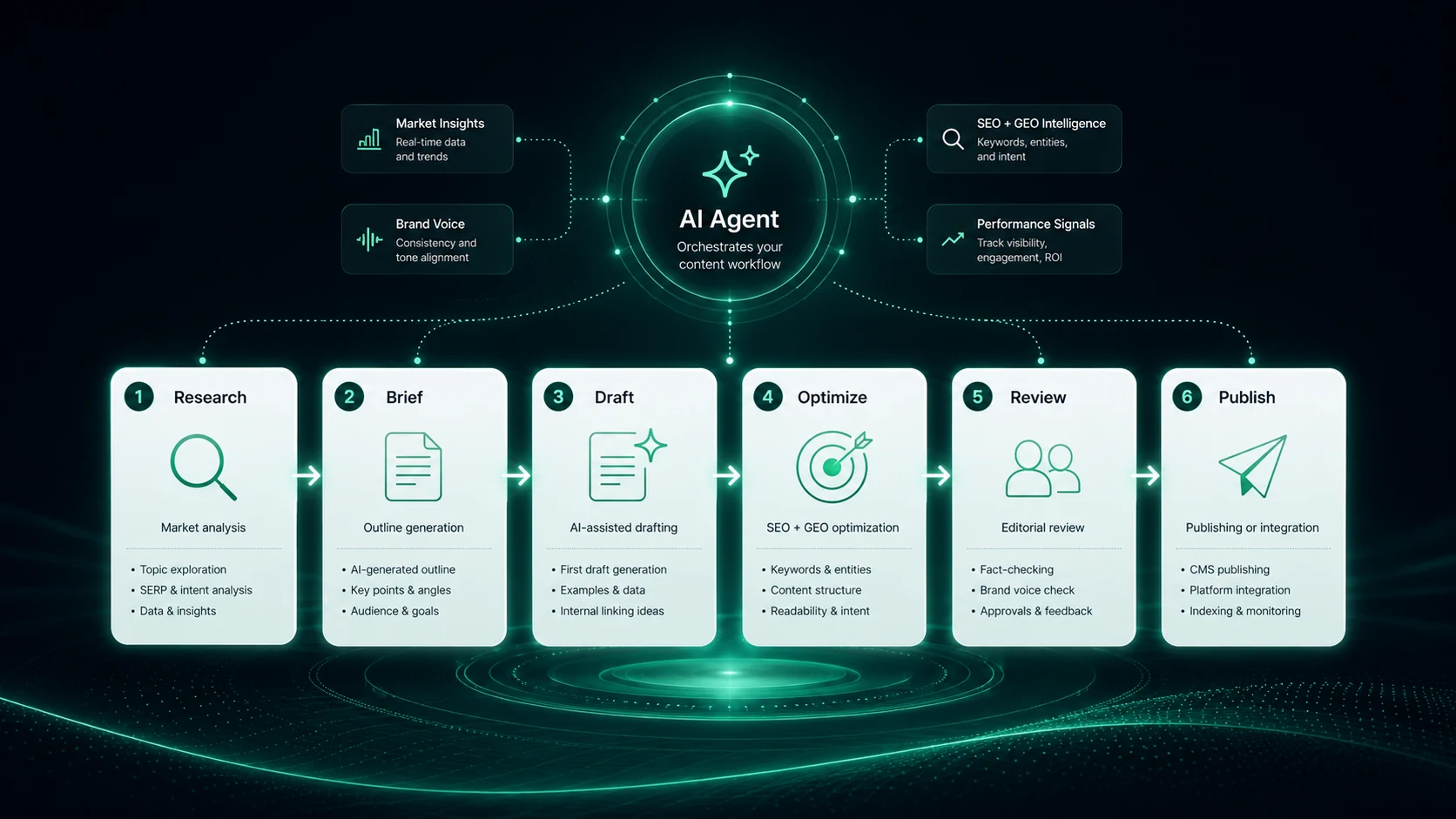
Frase is no longer just a classic content optimization editor. Its current positioning is broader: research the market, create optimized content, track visibility across Google and AI answer engines, run audits, and use an AI Agent to move more of the content workflow forward. That makes it more interesting for SEO teams, agencies, and publishers than for someone who only wants a quick blog-post generator.
I would not judge Frase by the homepage alone. The homepage makes the platform sound like a single answer for SEO and GEO content operations. The safer question is narrower: do you have enough repeatable content work to make that kind of workflow useful?
If you publish regularly, refresh existing articles, manage briefs for writers, or need to understand whether your brand appears in AI-generated answers, Frase deserves a serious trial. If you only write the occasional blog post, the platform may feel like more machine than you need.
The good part is that Frase currently offers a 7-day free trial with no credit card required. That gives buyers a real chance to test the workflow before paying. The caution is refund flexibility. Frase’s public refund guidance is strict, so I would treat the trial as the decision window, not as a casual preview before asking for money back later.
Next step: If Frase still fits your SEO workflow, test it with a real keyword and an existing article before choosing a paid plan.
Review snapshot
| Review point | Practical take |
|---|---|
| Best for | SEO teams, content marketers, agencies, and publishers with repeatable content workflows |
| Not ideal for | Solo users who only need a cheap AI writer or occasional content scoring |
| Core use case | Research, brief, draft, optimize, audit, and track content visibility across search and AI answers |
| Trial path | 7-day free trial with no credit card required |
| Paid entry | Starter plan is positioned as the entry plan; buyers should verify live monthly and annual pricing before checkout |
| Main strength | SEO and GEO workflow in one platform instead of a single-purpose content editor |
| Main caution | Refund terms are strict, so buyers should test during the trial and verify limits before paying |
| Best alternatives to compare | Dashword, AISEO.ai, Surfer SEO, Clearscope, MarketMuse, NeuronWriter |
| Best next step | Run one new article and one existing article through Frase before upgrading |
What is Frase?
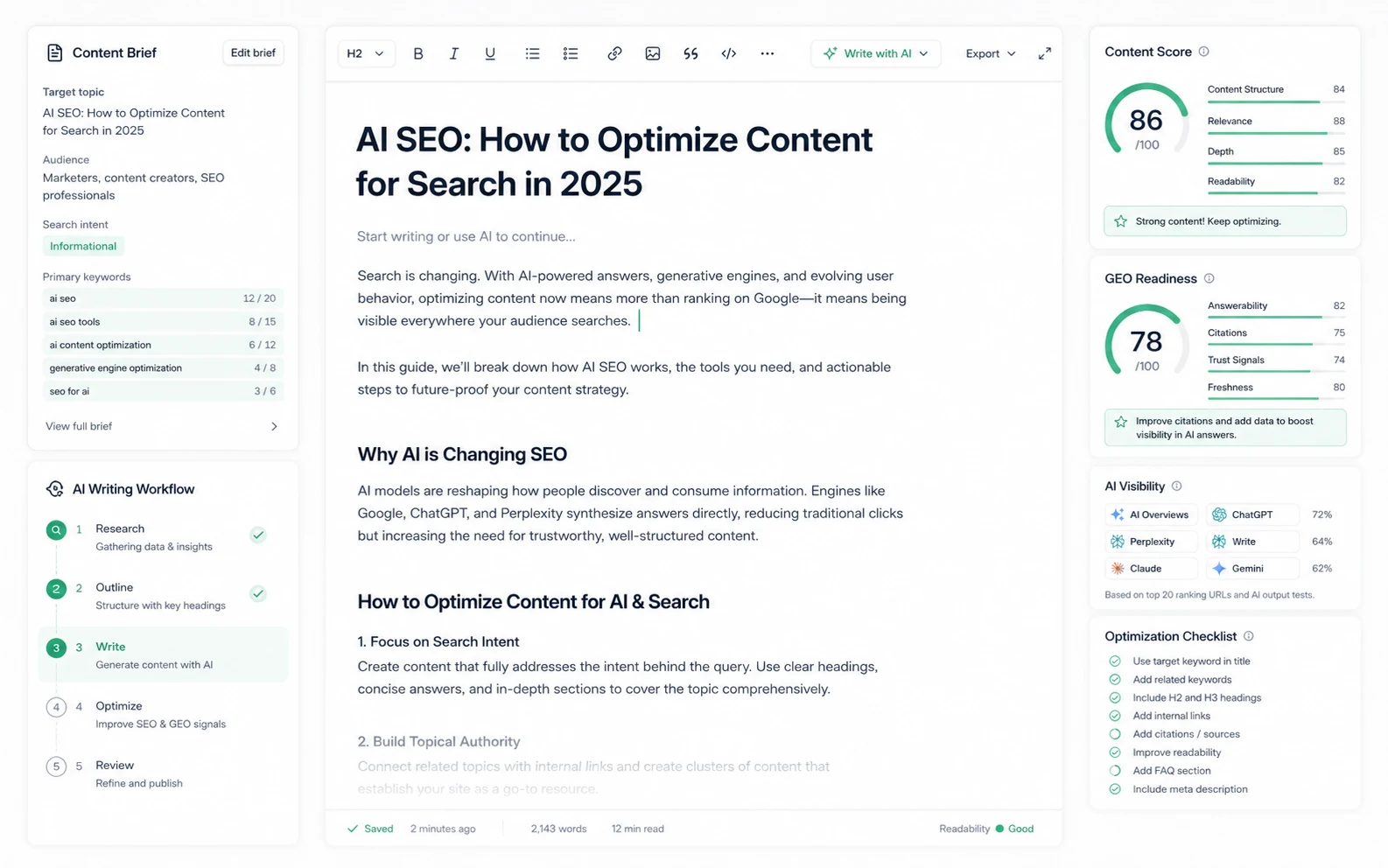
Frase is an AI-powered SEO and GEO content platform for teams that want to research topics, create briefs, draft content, optimize pages, audit content opportunities, and track visibility across search engines and AI answer engines.
The GEO part matters.
A few years ago, most content optimization tools were judged by a familiar question: can they help an article rank in Google? That question still matters, but buyers now have a second concern. They want to know whether their content is structured clearly enough to appear, get cited, or stay visible inside AI-generated answers from tools like ChatGPT, Perplexity, Claude, Gemini, and AI Overviews.
Frase is trying to sit in that new middle ground. It still covers the classic SEO workflow: SERP research, content briefs, outlines, drafts, topic coverage, competitor analysis, and optimization guidance. But its current positioning also includes AI visibility tracking, site audits, content opportunities, API and MCP access, and an AI Agent with many workflow skills.
That makes Frase more like a content operations system than a simple writing assistant.
I would treat that as both the upside and the risk. If you have a real publishing process, Frase can reduce friction. If you only need a few paragraphs written, the platform can feel heavier than the problem.
Who should use Frase?
Frase makes the most sense for buyers who already publish enough content to feel the pain of research, briefing, optimization, and updating.
An SEO content team can use Frase to turn SERP research into a more structured brief, then move the draft into an editor that checks coverage and search intent. That can reduce the messy handoff between strategist, writer, editor, and content manager.
An agency can use Frase when client content production needs repeatability. The value is not just that Frase can help draft content. The value is that briefs, outlines, topic gaps, and optimization notes can become part of a consistent process.
A publisher with an existing library may get value from the audit and content opportunity angle. Brand-new sites often need help producing good initial content. Mature sites need to know what to update, consolidate, expand, or refresh. Frase is more believable when it helps with both new and existing content.
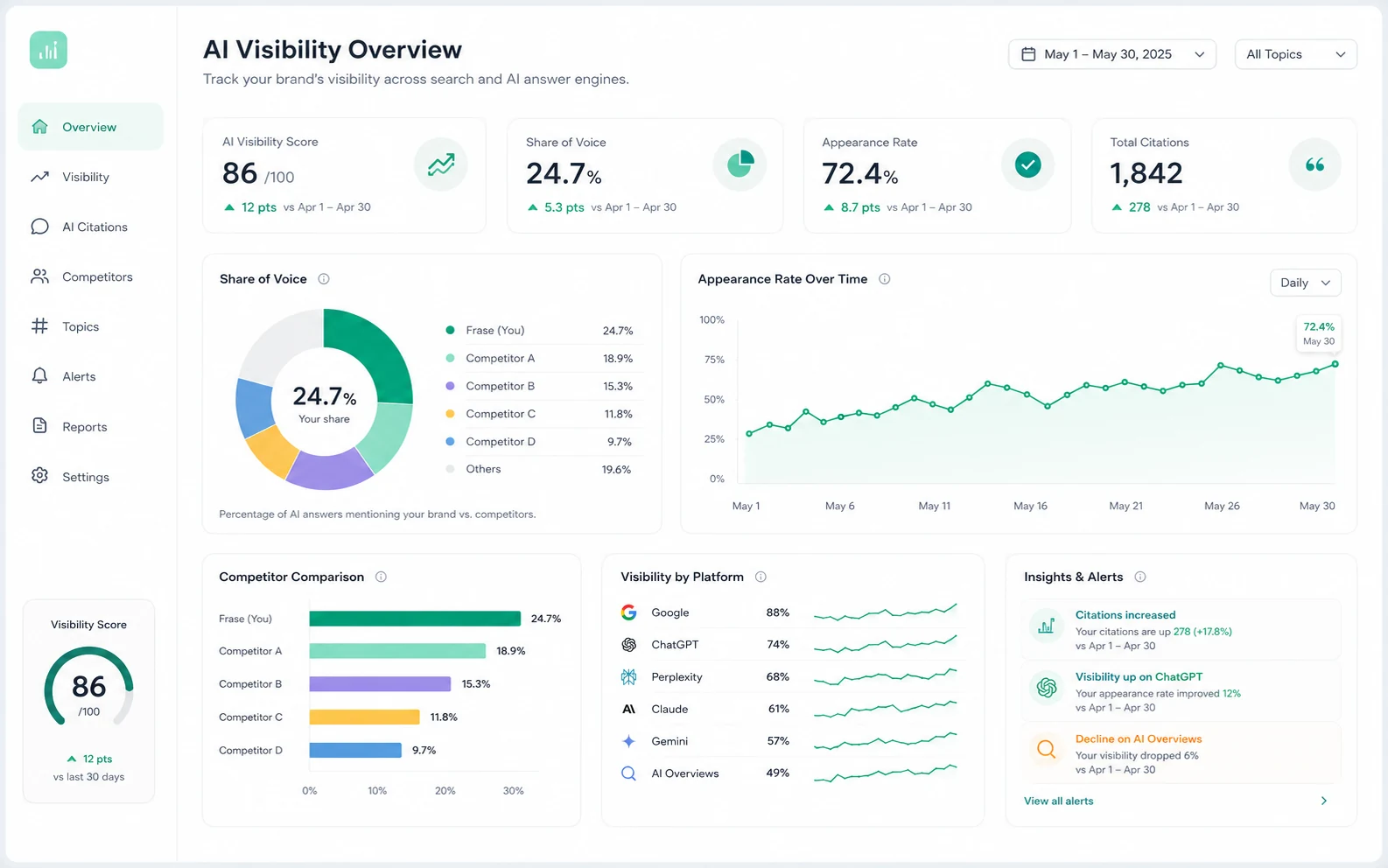
A team paying attention to AI search can also use Frase as a monitoring and optimization layer. This is still a developing category, so I would avoid treating any AI visibility score as a guarantee. But as a directional signal, it can be useful for teams that want to see where content and brands appear across AI answer environments.
Frase is less interesting if your workflow is tiny.
If you publish once a month, do not manage writers, do not refresh old content, and do not care about AI visibility yet, the platform may be more than you need. In that case, a simpler writing tool or brief generator may be enough.
Who should avoid Frase?
I would be careful with Frase if you are mainly shopping for the cheapest AI writing tool.
Frase can help with AI-assisted drafting, but that is not the strongest reason to pay for it. The stronger reason is the workflow around the draft: research, brief, optimize, audit, track, and improve. If you remove that workflow, Frase becomes much easier to compare against cheaper writing tools.
I would also avoid Frase if you expect it to replace a full SEO stack. It is not a backlink database. It is not a deep technical crawler. It is not a complete rank tracking suite. It is not a replacement for analytics, Search Console, Ahrefs, Semrush, Screaming Frog, or a serious technical SEO process.
That does not make Frase weak. It just makes the buying decision clearer.
Frase is strongest around content operations. If your main bottleneck is link building, technical crawling, keyword database depth, or enterprise SEO reporting, Frase should be one part of the stack, not the whole stack.
I would also be cautious if you are refund-sensitive. Frase offers a no-credit-card trial, which is good. But the public refund policy says refunds generally are not offered. That means you should not pay first and evaluate later. Use the trial like it matters.
How Frase fits into a real workflow
A good Frase test should not start with “write me an article.”
That is too shallow.
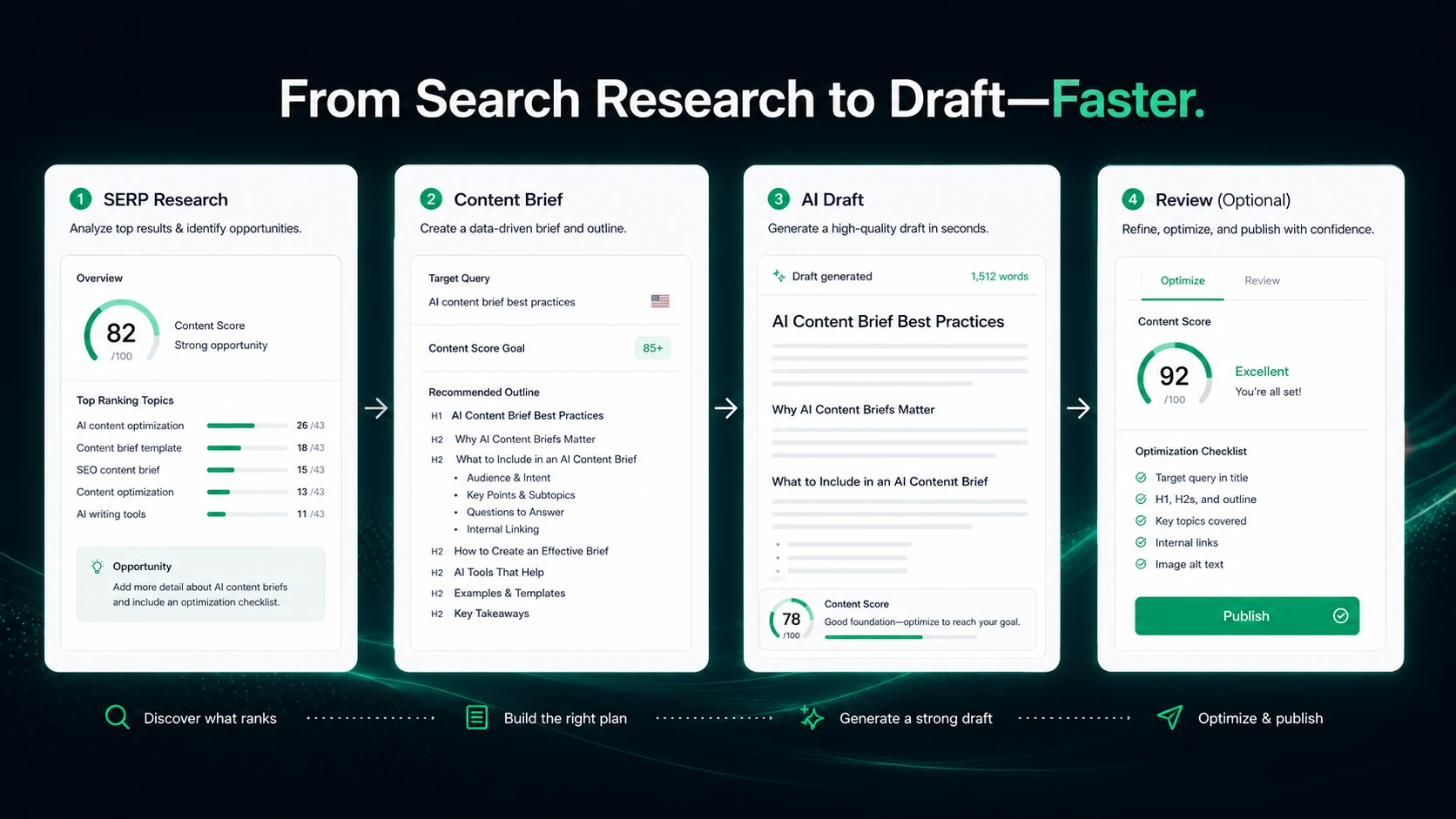
The better test is to run Frase through the whole process you would actually repeat after buying:
- Choose one keyword you genuinely want to target.
- Research the SERP and competing content.
- Build a brief or outline.
- Draft or import working content.
- Optimize for coverage, structure, and reader intent.
- Check whether the GEO guidance makes the page clearer for AI answer environments.
- Review the draft manually for facts, examples, tone, internal links, and usefulness.
- Test one existing URL or content opportunity if your site already has published pages.
- Compare the result with your normal workflow.
- Decide whether Frase saved enough time or improved enough quality to justify the plan.
This is where many buyers make the wrong call. They judge the product by the speed of the first AI draft. But AI drafts are cheap now. The harder part is whether the content becomes easier to plan, edit, optimize, update, and defend.
Frase is useful only if it improves the repeated process.
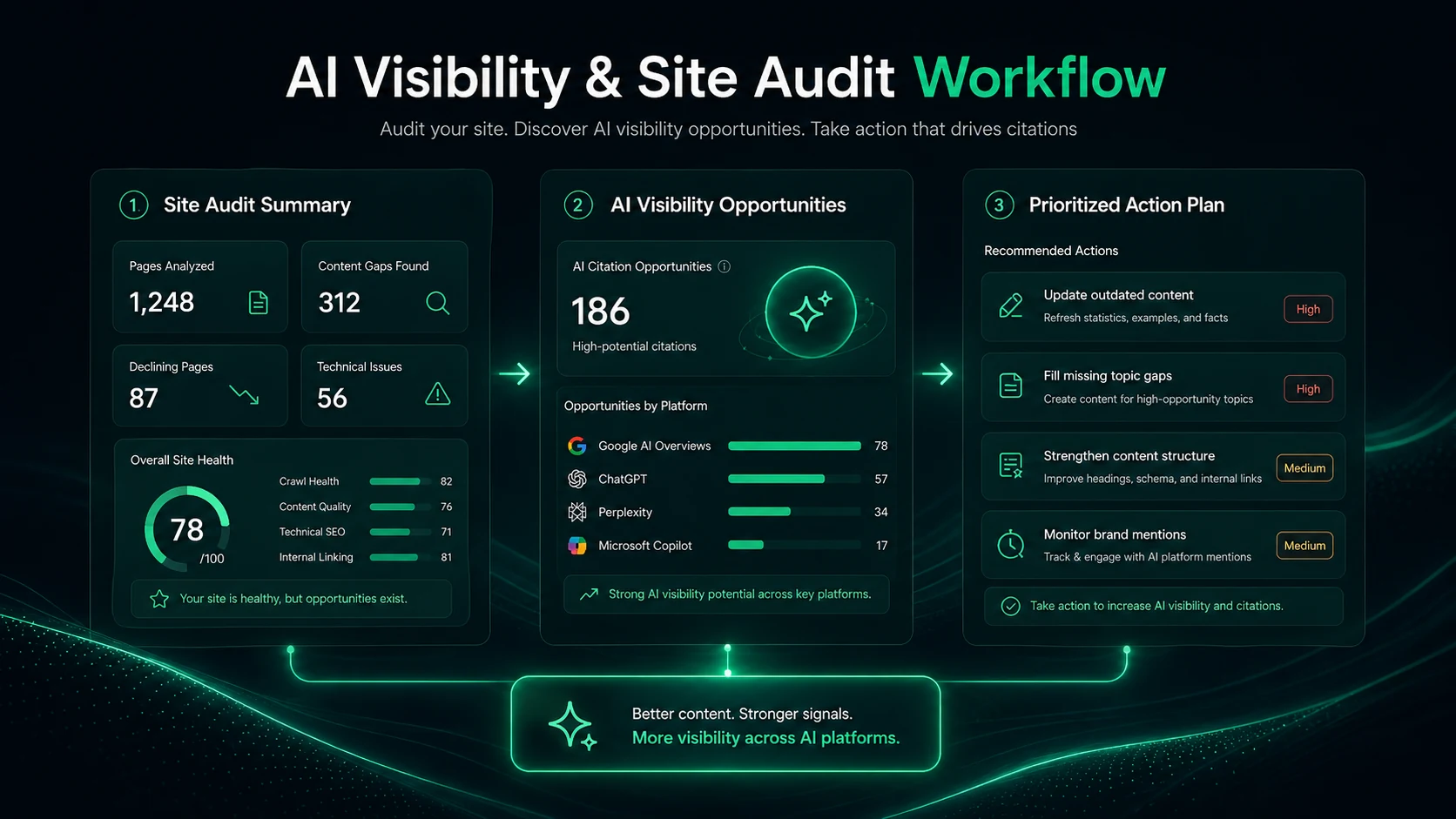
Workflow check: Frase is easiest to evaluate when you bring a real keyword, a working draft, and an existing article into the trial.
Key features that matter
Frase has a lot of feature language around AI, SEO, GEO, agents, audits, and visibility. I would not give every feature equal weight.
The features that matter most are the ones that affect your actual content decisions.
SERP research and content briefs
This is still one of Frase’s most practical use cases. A content brief turns a messy research process into a clearer writing plan. For agencies and teams, that can be more valuable than the AI writer itself because it reduces editorial confusion before writing begins.
A good brief should help answer:
- What does the searcher actually want?
- What topics do competing pages cover?
- Which questions should the article answer?
- Where are the gaps in existing content?
- What should the writer include, avoid, or clarify?
If Frase helps you build better briefs faster, the platform already has a real role.
SEO and GEO content optimization
Frase’s current direction combines traditional SEO optimization with GEO-style thinking. That means the editor is not only trying to help a page rank in search; it is also trying to improve clarity and coverage for AI-generated answers.
This can be useful, but I would not chase the score blindly.
A high optimization score can still produce generic content if the editor follows suggestions mechanically. The better use is to treat Frase as a second brain: it points out gaps, questions, terms, and coverage patterns, while the human editor decides what actually belongs in the article.
AI Agent and automation
The AI Agent angle is interesting because it moves Frase away from a single editor screen and toward a more guided workflow. In theory, that helps teams research, write, optimize, and track through a more natural process.
The part I would test is not whether the agent sounds impressive. I would test whether it reduces real handoff friction. Does it help you move faster from keyword to brief? From brief to draft? From draft to optimization? From published content to refresh decisions?
If yes, it can matter. If not, it becomes another feature label.
AI visibility tracking
AI visibility tracking is one of the more timely reasons to look at Frase in 2026. Search behavior is changing, and content teams increasingly want to know whether their pages and brands appear inside AI answer engines.
I would use this as a directional signal, not a final truth machine.
AI answers change. Prompts vary. Citation behavior is not as clean as a keyword ranking report. But if you are a team already investing in content, AI visibility tracking can give you another layer of feedback about where your brand appears, where competitors appear, and which topics may deserve updates.
Site audits and content opportunities
Site audits are more valuable when you already have a content library. If your site has 100 articles, the question is not only “what should we publish next?” It is also “which existing pages are declining, incomplete, outdated, or poorly structured for search and AI answers?”
This is where Frase can become more than a drafting tool. It can help prioritize updates.
That said, Frase should not replace a technical SEO audit. Use it for content opportunities, not for every technical diagnosis.
Pricing and plan value
Frase pricing is easiest to judge after you know your publishing volume.
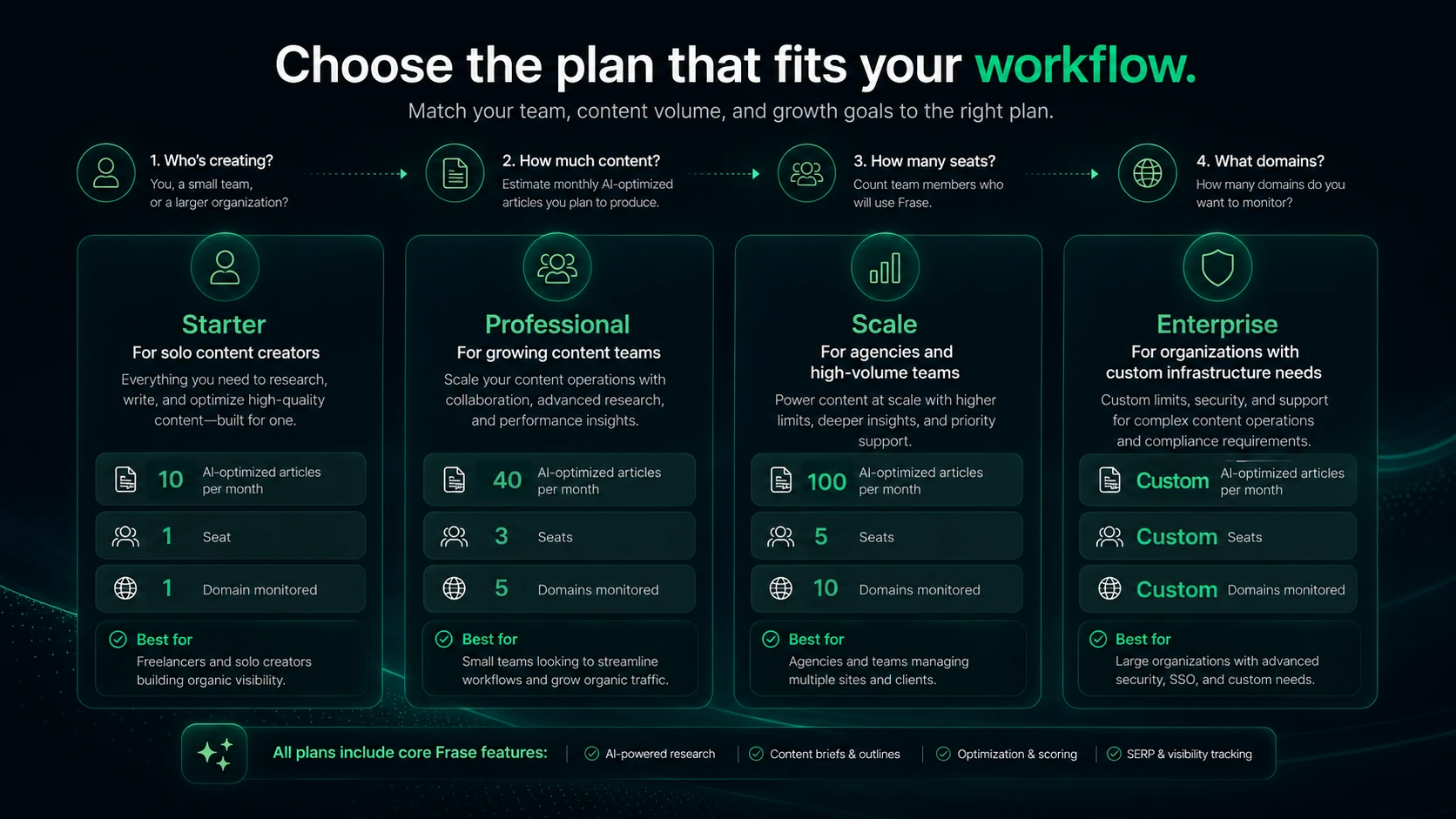
The current official positioning starts with a Starter path and moves through Professional, Scale, and Enterprise. The live pricing page and feature page should be checked before checkout because plan limits, article volume, seats, audit pages, AI visibility prompts, add-ons, and annual savings matter more than the headline monthly price.
As of the current public pricing data reviewed for this article, Starter is positioned at $39/month on annual billing or $49/month on monthly billing. Higher tiers such as Professional, Scale, and Enterprise are built for more seats, more articles, more tracked AI platforms, higher audit capacity, and more operational needs.
The cheapest plan is not automatically the best deal.
If Starter gives you enough article volume and one-seat usage, it may be the cleanest entry point. But if your team has multiple writers, editors, clients, domains, or AI visibility needs, the real cost may sit higher. On the other hand, upgrading too early can be wasteful if you have not proven the workflow.
I would look at Frase pricing through four questions:
| Pricing question | Why it matters |
|---|---|
| How many articles do you create or optimize each month? | Article volume is one of the clearest plan-fit signals. |
| How many people need access? | Seats matter for teams, agencies, and editorial workflows. |
| Do you need audits or AI visibility tracking? | These features matter more for established sites and serious content operations. |
| Are add-ons cheaper than upgrading? | Temporary overages may not justify moving to a larger plan. |
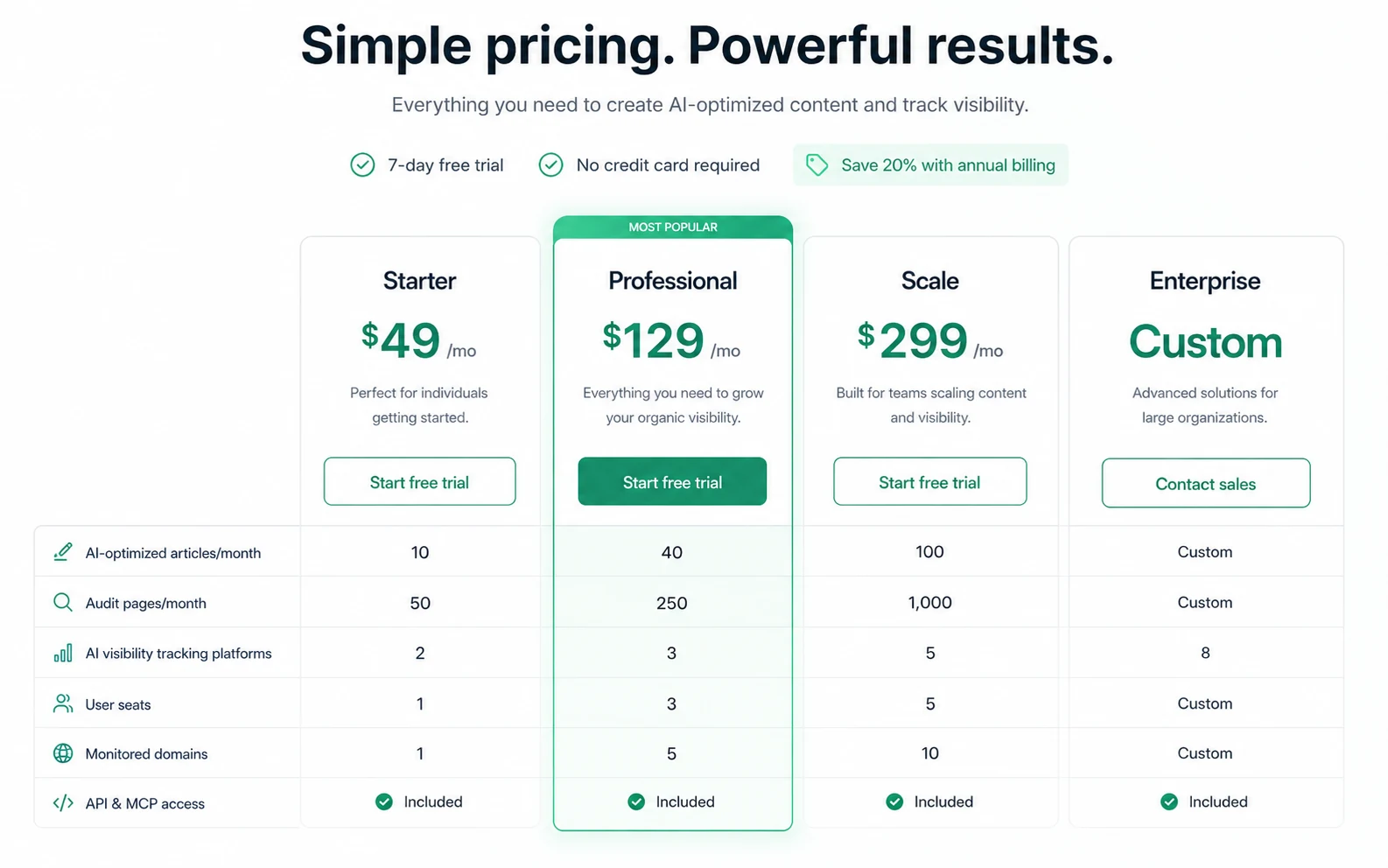
Pricing check: Before paying, compare your monthly article volume, seats, audit needs, and AI visibility prompts against the current Frase plan limits.
Free trial, coupon, and checkout notes
The 7-day free trial is the most important savings path for Frase.
That may sound less exciting than a coupon code, but it is more useful for the buyer. A discount can improve the purchase. It cannot prove workflow fit.
Frase’s current public pricing route says every plan includes a 7-day free trial with no credit card required. That lowers the first-test risk because you can prepare a real workflow before signing up, then use the trial to answer practical questions:
- Does Frase produce better briefs than your current process?
- Does the optimization guidance improve your draft or just add noise?
- Does the GEO layer help you structure content more clearly?
- Does the AI Agent reduce work or create more review overhead?
- Does the audit workflow reveal useful update opportunities?
- Do you need Starter, Professional, Scale, Enterprise, or no paid plan at all?
Public coupon codes should not be assumed. If an offer exists, check the current DealBestDaily coupon route or official checkout route before paying. But I would still use this order: workflow fit first, pricing math second, coupon path last.
Refunds are the bigger caution. Frase’s public refund guidance says refunds generally are not offered because the product has a free trial and manual sign-up. That does not mean support will never help in edge cases, but it does mean buyers should not rely on refunds as the backup plan.
The safer path is simple: prepare your test before starting the trial.
What I would check before buying Frase
I would not start the Frase trial casually.
Seven days can disappear quickly if you open the account without a plan. Before starting, I would prepare three assets:
- A keyword you actually want to target.
- A working draft that needs optimization.
- An existing article or URL that may need a refresh.
Then I would check the product against this buyer checklist:
- Can Frase create a useful brief faster than your current process?
- Does the editor improve coverage without making the article generic?
- Does the GEO guidance help make the content clearer for answer engines?
- Does the AI Agent save time across the workflow, not just inside one prompt?
- Are audit and content opportunity suggestions useful for your existing site?
- Are the plan limits realistic for your monthly article volume?
- Do the seats match your team structure?
- Are API, MCP, integrations, or publishing workflows actually needed?
- Are add-ons cheaper than upgrading for occasional overages?
- Are you comfortable with the refund and cancellation terms?
Pros and cons explained
Pros
Frase covers more of the content workflow than a basic AI writer.
The strongest reason to consider Frase is not one-click drafting. It is the combination of research, brief creation, optimization, audits, AI visibility, and workflow support.
The trial is buyer-friendly.
A 7-day trial with no credit card required is useful because it lets cautious buyers test before payment. That matters more because the refund policy is strict after purchase.
SEO and GEO are handled together.
This is the main modern angle. Frase is trying to help content teams think about traditional search and AI answer environments in the same workflow.
It can fit agencies and repeat publishers.
Teams that repeatedly create briefs, drafts, updates, and client content may get more value than casual users.
Cons
It is not a complete SEO suite.
Frase does not replace backlink research, technical SEO crawling, analytics, enterprise rank tracking, or large-scale keyword databases.
The platform can be too much for light users.
If you only need occasional AI writing, Frase may feel broad and expensive compared with simpler tools.
AI writing still needs editing.
Even if Frase improves drafting speed, buyers still need human review, fact checking, examples, source judgment, and brand voice control.
Refund flexibility is limited.
The trial is the safe evaluation window. I would not upgrade unless the workflow improvement is already clear.
Evidence confidence
My confidence is highest around Frase’s current official positioning, pricing structure, trial availability, refund guidance, and product direction because those are supported by official Frase pages and the internal store YAML.
My confidence is moderate around third-party user sentiment. Public review sources broadly praise Frase for saving time, simplifying research, and supporting SEO content workflows, while some buyers mention pricing, subscription concerns, learning curve, or AI output limitations. That pattern is useful, but it should not be treated as a guarantee that Frase will fit every content team.
My confidence is intentionally lower around exact ROI claims, AI visibility outcomes, and future platform behavior. Those depend on your site, content quality, niche, prompts, publishing process, and how AI answer engines change over time.
That is why I would not buy Frase based on promised outcomes. I would buy only after a real trial shows workflow improvement.
Frase vs alternatives
Frase sits in a crowded category. The mistake is comparing it only against AI writing tools. The better comparison depends on the buyer job.
Frase vs Dashword
Dashword is the cleaner comparison if you want a simpler content brief and optimization workflow. It may feel lighter for teams that do not need Frase’s broader AI Agent, audits, API, AI visibility, or GEO positioning.
Frase is the stronger fit if your content operation is moving beyond briefs and into ongoing optimization, audits, and AI visibility tracking. If you want fewer moving parts, read the Dashword store guide before choosing.
Frase vs AISEO.ai
AISEO.ai is a closer comparison for buyers who care about AI writing, paraphrasing, humanization, and content creation features. It may fit users who want writing help more than a full SEO and GEO content workflow.
Frase is more compelling if the main job is research-to-optimization content operations. If your buyer job is writing-heavy rather than SEO-process-heavy, compare the AISEO.ai store guide before committing.
Frase vs Surfer SEO
Surfer SEO is one of the obvious external comparisons for content optimization. It has a longer reputation around content scoring and NLP-style optimization. Buyers who care mainly about on-page content scoring for Google may still compare Surfer closely.
Frase is more interesting when you want a broader workflow that includes GEO, AI visibility, AI Agent automation, audits, and content operations. I would compare both if your team already has a mature SEO publishing process.
Frase vs Clearscope
Clearscope is usually a stronger comparison for teams that want a polished, trusted content optimization workflow with a strong editorial feel. It may be a better fit when quality control and simplicity matter more than a broad feature set.
Frase may be the better fit if you want more workflow coverage around AI visibility, audits, and agentic content operations.
Frase vs MarketMuse
MarketMuse tends to fit larger content strategy and planning use cases. If your team cares heavily about topical authority, content inventory, and strategic planning, it may be worth comparing.
Frase is likely easier to test quickly and may be more approachable for teams that want practical briefing, optimization, and AI visibility without entering a heavier enterprise content strategy system.
Frase vs Voila
Voila is a general AI assistant route, not a direct SEO content operations replacement. It makes more sense if your daily need is browser-based writing, summarizing, and productivity help.
Frase is the better fit when the buyer job is SEO and GEO content workflow. If you mainly need general AI assistance, check the Voila store guide instead.
Frase vs Windsor.ai
Windsor.ai is not a direct content optimization alternative. It belongs more to marketing data, connectors, and BI workflows. Compare it only if your real problem is marketing reporting and data movement rather than content briefs and optimization.
For content operations, Frase is the more direct fit. For marketing data pipelines, the Windsor.ai store guide is the better route.
Green flags and red flags
Green flags
- Frase has a clear current positioning around SEO plus GEO content workflows.
- The no-credit-card trial lets buyers test before paying.
- The platform goes beyond one-off AI writing and supports briefs, optimization, audits, and visibility tracking.
- Official materials make plan differences easier to evaluate around volume, seats, prompts, audits, and enterprise needs.
- Third-party sentiment generally points to time savings, research help, and content workflow value.
Red flags
- Refund terms are not flexible enough for casual paid testing.
- The platform may feel too broad if you only need simple writing help.
- AI optimization scores can encourage mechanical writing if editors chase them blindly.
- Exact plan fit depends on limits that buyers must verify live before checkout.
- Frase does not replace specialist SEO tools for backlinks, rankings, analytics, or technical crawling.
Simple test before paying
Here is the Frase test I would run before paying:
| Trial task | What to look for |
|---|---|
| Create one content brief | Does Frase reduce research time and clarify search intent? |
| Optimize one draft | Do the suggestions improve the article or make it more generic? |
| Refresh one existing page | Does Frase identify useful gaps or only obvious surface-level changes? |
| Check GEO or AI visibility features | Do the signals help you make a practical content decision? |
| Compare plan limits | Does your expected monthly volume fit Starter, Professional, Scale, or an add-on path? |
If those tests do not show obvious value, I would pause.
A tool can be impressive and still not be the right purchase.
Trial plan: Start Frase only when you have a real keyword, draft, and existing URL ready to test during the 7-day window.
Final verdict
Frase is a strong candidate for teams that treat content as an operation.
That is the key phrase.
If your work involves regular research, briefs, drafts, optimization, content updates, audits, and growing concern about AI-search visibility, Frase is worth a serious trial. It has moved beyond the old “AI writer plus SEO score” category and now feels more like an SEO and GEO content workflow platform.
I would consider Frase if you publish consistently, manage content across a team, care about both Google and AI answer visibility, and want fewer disconnected tools in the content process.
I would skip it if you only need occasional AI writing, a cheap blog generator, backlink research, technical SEO crawling, or a permanent free plan.
For my money, the safest path is not to overthink the feature list. Prepare a real test, use the 7-day trial, compare the output against your current workflow, and only pay if Frase clearly improves the process you already repeat.
Final next step: If Frase fits your content workflow, verify the current plan limits and offer route before checkout.