Before you click
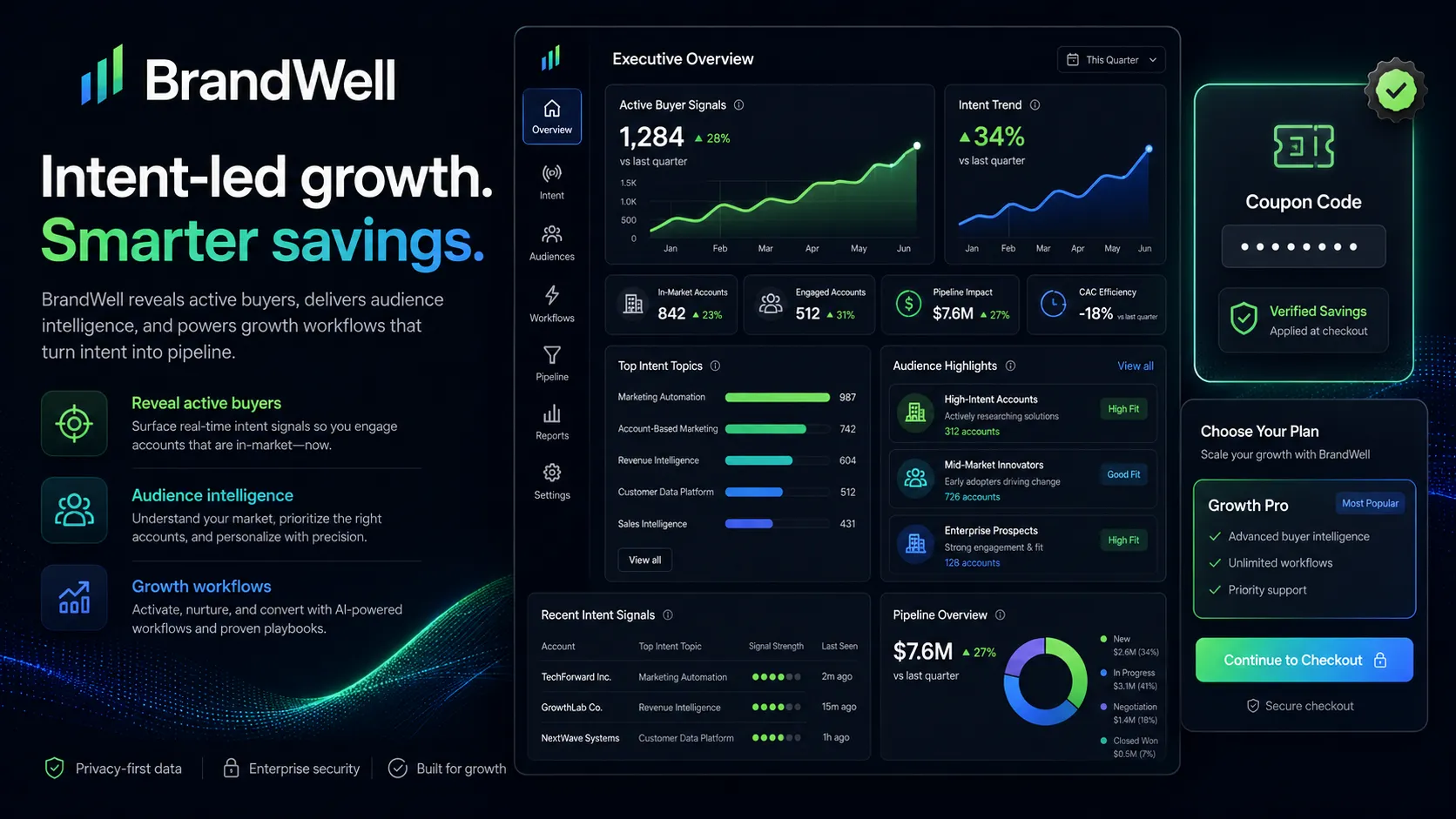
A brandwell coupon code search can be a little misleading because BrandWell is not a low-priced writing app where the only question is “does the code work?” It is currently positioned as an intent-led GTM platform for B2B teams, combining visitor identification, intent data, stakeholder audiences, AI content workflows, and reporting. That makes the buying decision heavier than a normal coupon page.
The live offer cards can still be useful. There is a show-code path to test, plus several no-code savings routes around trial access, monthly flexibility, commitment pricing, annual prepay, and add-on paths. But the final checkout screen matters more than the headline discount. A code that looks good is not helpful if the selected plan, billing term, cancellation rule, or renewal behavior is wrong for your team.
What to check first
- Confirm whether you are starting a trial, choosing a monthly plan, committing for a longer term, or using annual prepay.
- Review the trial language before entering payment details, especially when the trial converts to paid billing.
- Compare monthly flexibility against any lower effective annual or commitment path.
- Check whether content creation, intent data, stakeholder audiences, reporting, and add-ons are included in the plan you want.
- Verify refund, cancellation, rollover, and renewal terms before approving a high-ticket checkout.
Why this coupon page matters
BrandWell is the kind of tool where a discount should come after fit, not before it. If your team needs B2B visitor identification, intent topics, account-level research, stakeholder mapping, and AI-assisted content production, a valid saving can reduce friction. If you only need a lightweight blog writer, a coupon will not fix a mismatch.
The real buyer tension is commitment. BrandWell’s public pricing path presents month-to-month choices, commitment options, and annual prepay. Those routes may differ in flexibility, rollover behavior, and effective savings. A buyer who is still validating traffic quality, lead accuracy, or article output should be careful about choosing the deepest discount too early.
This is also why trial terms matter. A 7-day trial can be useful if you already know what you want to test: lead identification, form enrichment, stakeholder audiences, or the broader GTM workflow. It is much less useful if you start the trial casually and forget to check conversion or cancellation timing.
How to use the live offers
Start with the live offer cards near the top of this page. If a BrandWell show-code offer is available, use the Show code action only when you are ready to test the checkout. Do not treat a reported code path as guaranteed until the BrandWell checkout accepts it and updates the subtotal.
For no-code savings, pay attention to the label. A trial path is different from a discount. A monthly plan path is different from annual prepay. A commitment path may reduce the effective cost but usually deserves more caution because your team is taking on a longer buying decision. Add-ons and article bundles can also be useful, but they should be checked as separate purchases rather than assumed to be included everywhere.
A practical sequence is: start with plan fit, check the trial terms, test the show-code path if relevant, compare annual or commitment savings, then review the final checkout total. Do not skip straight to payment because the coupon headline sounds strong.
When to use the deal
Use the BrandWell deal path when you already know the platform matches your GTM workflow. That means your team has a clear market, a real need for buyer-intent signals, a plan for using identified leads, and a content strategy that can turn those signals into useful campaigns.
Monthly billing is usually safer when you are still testing. Annual prepay or commitment-style savings make more sense when you have already validated lead quality, output volume, internal ownership, and renewal budget. The show-code path is worth testing at checkout, but it should not be the only reason to buy.
When to read the review or store page first
Read the BrandWell store page first if you need a cleaner overview of what the platform does, who it fits, and how its pricing paths compare. Read the review first if you are unsure whether BrandWell is closer to a content platform, an intent-data tool, an ABM workflow, or a managed GTM system.
That extra step is useful because the wrong BrandWell plan can be more expensive than missing a small coupon. If your team has not confirmed use case, data fit, cancellation comfort, and ownership of the GTM workflow, slow down and compare alternatives before using any checkout path.
Common checkout issues
The most common issue is assuming every saving works on every plan. A reported coupon may apply only to selected checkout paths, and a no-code saving may depend on billing term rather than a coupon box. Another issue is trial timing: if payment details are required, mark the cancellation deadline before starting.
For higher-ticket tools, also check whether add-ons, extra projects, article bundles, or expanded intent coverage are billed separately. The cleanest deal is the one that still makes sense after you read the live checkout total, renewal language, and cancellation terms.
 annual save Verified