Quick verdict
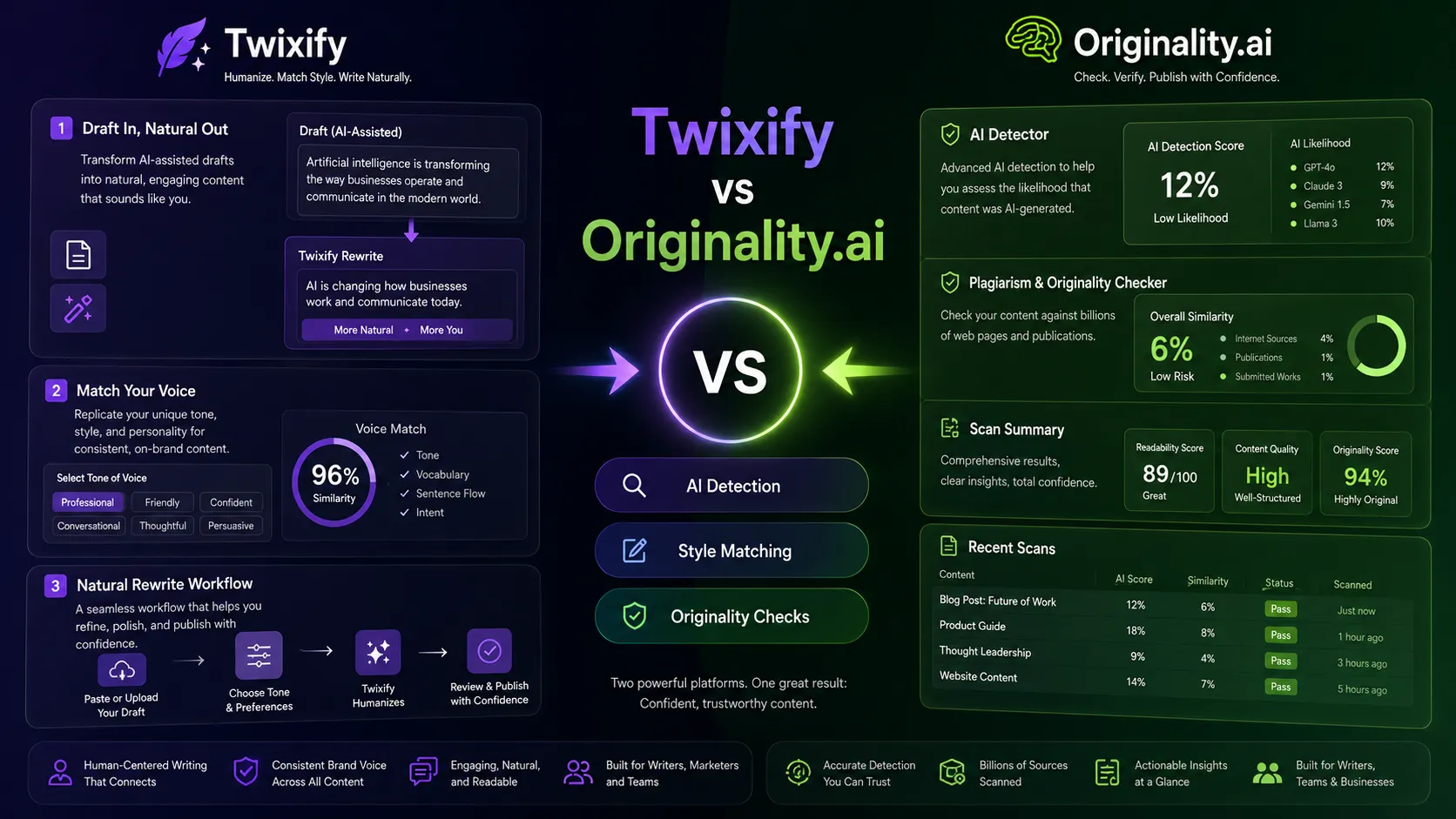
Choose Twixify if your actual problem is style cleanup. It is the better fit when you have an AI-assisted working draft that feels too flat, too generic, or too obviously machine-shaped, and you want a faster first rewrite before doing your own edit. The safer way to use it is as a draft-polishing tool, not as a promise that a piece of writing will pass every detector, every editorial review, or every disclosure policy.
Choose Originality.ai if your actual problem is content verification. It is the stronger option for publishers, agencies, SEO teams, schools, and content managers who need AI detection, plagiarism checks, readability support, scan reports, team workflows, integrations, and repeatable content QA before publishing.
My practical recommendation: Twixify is the lighter tool for rewriting rough AI-assisted drafts. Originality.ai is the safer choice for teams that need to inspect content before it goes live. Do not treat them as direct replacements. One is a humanizer. The other is a detection-first and originality-checking platform.
At-a-glance comparison
| Decision point | Twixify | Originality.ai |
|---|
| Best fit | Humanizing and rewriting AI-assisted drafts | AI detection, plagiarism, and content QA |
| Main buyer job | Make a draft sound less robotic before manual editing | Check content quality and originality before publishing |
| Starting path | Free trial and paid humanizer plans | Pay-as-you-go credits or subscription plans |
| Pricing style | Monthly, annual-equivalent, and lifetime paths | Credits, Pro subscription, Enterprise subscription |
| Team fit | Possible for writers and small content teams | Stronger for agencies, publishers, schools, and teams |
| Main risk | Over-trusting detector-bypass claims | Over-trusting detector scores as final proof |
| Best next step | Test one real draft during the trial | Estimate monthly word volume before buying credits |
What Twixify is better at
Twixify is better when the work starts with a rough draft. Its public positioning centers on turning AI-generated text into copy that sounds more like a human wrote it. The product also highlights custom style direction, writing-style influence, wording adjustments, and a simple paste-and-rewrite workflow.
That is useful for a specific kind of buyer: someone who already knows the draft is not finished. Maybe the structure is fine, but the voice is stiff. Maybe the paragraph says the right thing, but it reads like a generic AI output. Maybe the editor wants a faster first pass before checking facts, tone, citations, internal links, and brand style manually.
Used that way, Twixify can make sense. The risk starts when the buyer treats a humanizer as a guarantee. AI detectors change. Editorial policies change. Client disclosure rules differ. Schools, publishers, and agencies may have their own standards. A rewrite tool can help a working paragraph feel more natural, but it cannot replace judgment, fact-checking, originality review, or policy compliance.
That is why Twixify should be framed as a draft-polishing tool first. If your question is, “Can this help me make a rough AI-assisted draft less wooden before I edit it?” then Twixify is relevant. If your question is, “Can this prove my content is original and safe to publish?” then you are asking for the wrong kind of tool.
What Originality.ai is better at
Originality.ai is better when the work starts with review, not rewriting. It is built around AI detection, plagiarism checking, readability, grammar, fact-checking support, SEO quality checks, reports, team workflows, and integrations such as Chrome, Google Docs, WordPress, Moodle, and API access.
That makes it a stronger fit for content operations. A publisher does not only need a paragraph to sound more natural. A publisher needs to know whether a contractor submitted heavily AI-assisted content, whether a post may have plagiarism issues, whether a team can share scan reports, whether editors can review results consistently, and whether checking can fit closer to the publishing workflow.
Originality.ai is not magic proof either. AI detection should be treated as a signal, not a courtroom verdict. False positives, false negatives, rewritten AI text, mixed human-plus-AI drafts, and detector model changes can all complicate results. Still, Originality.ai is more appropriate when the buyer needs a documented QA workflow rather than a rewrite button.
That is the core difference: Twixify changes the text; Originality.ai inspects the text.
Choose Twixify if…
Choose Twixify if you are a writer, editor, freelancer, or SEO content producer who wants a quick style pass on AI-assisted drafts before doing the real editorial work yourself. It fits best when the draft is already yours to revise, the final meaning still needs review, and you want help reducing robotic phrasing.
It also fits buyers who want a simple workflow. You do not need to build a scan system, configure team reports, connect WordPress, or estimate credit usage across a department. You paste working text, choose the style direction, rewrite, and then inspect the result.
The pricing structure also gives several entry points. Twixify publicly shows annual-equivalent pricing, a free trial path, and a lifetime option. That can be attractive if you already know you will use a humanizer repeatedly. But do not buy the lifetime plan first just because it looks cheaper over time. Test the output with real drafts, check monthly request limits, confirm word-per-cycle limits, and read the current refund or unused-credit language before paying.
Twixify is the better pick if your decision is about voice cleanup. It is not the better pick if your decision is about audit trails, plagiarism risk, scan reports, or team-level publishing QA.
Choose Originality.ai if…
Choose Originality.ai if you manage content that other people write, submit, edit, or publish. That includes agencies reviewing freelance drafts, SEO teams checking outsourced posts, publishers protecting site quality, educators reviewing submissions, and platforms that need API-based detection or plagiarism workflows.
The strongest reason to choose Originality.ai is repeatability. You can build a process around it: scan content, review AI likelihood, check plagiarism, look at readability, share reports, tag scans, connect workflows, and decide what needs human review before publishing.
Originality.ai also makes more sense when the cost should be tied to usage volume. The pay-as-you-go path can work for occasional batches, while Pro and Enterprise make more sense for monthly scanning volume, team workflows, and higher operational needs. The important step is estimating words, not just reading the monthly price. One credit equals a set amount of scanning capacity, and credit expiry rules affect the real value of each plan.
Originality.ai is the better pick if your decision is about content QA and originality review. It is not the better pick if all you want is a lighter-sounding rewrite of a short working draft.
Avoid both if…
Avoid both if you are trying to make policy problems disappear. If your school, client, employer, or publisher requires disclosure around AI use, a humanizer does not remove that responsibility. If someone needs proof of misconduct or authorship, a detector score should not be treated as the only evidence.
Also avoid both if the real issue is weak writing fundamentals. A rough draft may need clearer thinking, stronger examples, cleaner structure, better sourcing, or deeper product knowledge. Twixify can smooth a paragraph, and Originality.ai can flag risks, but neither tool replaces a real editorial process.
Pricing and plan fit
Twixify is the simpler buying decision, but request limits still matter. The public pricing page shows annual-equivalent tiers, a free trial, and a lifetime plan. The buyer question is not only “What is cheapest?” It is “How many drafts will I rewrite, how long is each draft, and how many monthly requests do I need?”
Originality.ai is more of a volume decision. The current public pricing path includes pay-as-you-go credits, Pro, and Enterprise options. If you scan a few articles occasionally, pay-as-you-go may be easier. If you scan client or publisher content every month, a subscription may fit better. If you need team workflows, API, or higher operational depth, Enterprise may be the relevant path.
Refunds deserve a careful check for both. Twixify has refund-related language across its public pages, including cancellation and unused-credit references, but buyers should confirm the live rule before choosing an annual or lifetime path. Originality.ai publishes a refund policy that says refunds are handled on request and at the company’s discretion. In both cases, test first and pay only when the workflow fits.
The easiest way to decide is to ask what happens after you paste the text.
With Twixify, you expect the output to change. The workflow is: paste a draft, choose a style direction, rewrite, and then manually review whether the meaning, facts, tone, and compliance still hold. It is a pre-edit or mid-edit tool.
With Originality.ai, you expect the output to inform a decision. The workflow is: scan content, read the AI and plagiarism signals, review reports, compare against editorial standards, and decide whether the draft needs revision, disclosure, rejection, or a deeper human review. It is a QA tool.
Those workflows can exist together, but they should not be confused. If you are choosing only one, the winner depends on whether your bottleneck is writing polish or publishing confidence.
Buyer checklist before checkout
Before choosing Twixify, check:
- Have you tested the free trial on your own working draft, not a random sample?
- Does the rewritten output preserve meaning, facts, citations, and brand voice?
- Are the word-per-cycle and monthly request limits enough for your workload?
- Are you buying it for legitimate draft polishing rather than trying to hide AI use where disclosure is required?
- Have you confirmed the current refund, cancellation, annual billing, and lifetime-plan terms?
Before choosing Originality.ai, check:
- How many words do you need to scan each month?
- Do you need AI detection only, or also plagiarism, readability, grammar, fact-checking, reports, integrations, or API access?
- Will pay-as-you-go credits be enough, or does a subscription fit your recurring volume better?
- Do you understand credit expiry and monthly renewal behavior before checkout?
- Are you treating detector results as editorial signals rather than final proof?
Coupon, trial, and savings path
For Twixify, the safer savings path starts with the free trial and current pricing-page deal, not with hunting for a public coupon code. Test one real draft, compare the annual-equivalent plan against your actual request volume, and only then consider whether the lifetime option makes sense. You can also check the current Twixify store page, Twixify review, and Twixify coupon route before checkout.
For Originality.ai, the safer savings path is plan fit. Estimate your scan volume first, then compare pay-as-you-go, Pro, and Enterprise. Annual savings may matter for recurring users, but only if the monthly credit allowance and expiry rules match your real workflow. After choosing the right plan type, check the Originality.ai store page, Originality.ai review, and Originality.ai coupon route for current checkout guidance.
If a live route shows a hidden code or temporary offer, verify the final checkout total before paying. A discount should support a good product decision. It should not be the reason you pick the wrong workflow.
Final verdict
Pick Twixify if you need a simple humanizer for AI-assisted working drafts and you are willing to manually review every output for meaning, accuracy, and policy fit. It is the more natural choice for draft style cleanup.
Pick Originality.ai if you need AI detection, plagiarism checking, reports, team workflows, integrations, or content QA before publication. It is the more natural choice for agencies, publishers, educators, SEO teams, and serious content operations.
The clean decision is this: Twixify helps revise the draft. Originality.ai helps inspect the draft. If the problem is stiff writing, start with Twixify’s trial. If the problem is editorial risk, scan volume, or publishing confidence, start with Originality.ai’s pricing and credit model.
FAQ
Is Twixify better than Originality.ai?
Twixify is better if you want to rewrite and humanize an AI-assisted working draft before manual editing. Originality.ai is better if you need AI detection, plagiarism checking, reports, or a repeatable content QA workflow.
Is Originality.ai a Twixify alternative?
Not directly. Originality.ai is a detection-first and originality-checking platform. Twixify is a humanizer and rewriting tool. They overlap in the AI-content conversation, but they solve different buyer jobs.
Can Twixify guarantee that text passes AI detectors?
No buyer should treat any humanizer as a guaranteed pass across every AI detector, editorial policy, or submission context. AI detection changes often, and final responsibility still belongs to the writer or team using the tool.
Is Originality.ai enough to prove content was written by AI?
Originality.ai can be useful as part of a review process, but detector results should be treated as signals, not final proof. Mixed drafts, rewritten text, false positives, and false negatives can all affect results.
Which one is safer for SEO teams?
Originality.ai is usually safer for SEO teams that need recurring QA across outsourced or AI-assisted content. Twixify can help polish drafts, but it does not replace plagiarism checks, scan reports, editorial review, or publishing standards.
Should I check coupons before choosing?
Check coupons only after choosing the better workflow. Twixify buyers should test the trial and request limits first. Originality.ai buyers should estimate scan volume and credit needs first. Then use the store, review, or coupon route to verify the current checkout path.