Quick verdict
Amazing Selling Machine is worth a serious look only if you are evaluating Amazon FBA as a real business, not as a lightweight online course purchase.
That is the first filter.
ASM can be useful because it gives buyers a structured path through private-label Amazon selling: product research, supplier decisions, listing work, launch planning, advertising, scaling, and ongoing seller education. The official positioning is not subtle. This is a premium seller-training route backed by Amazing.com software, training, coaching, and community elements.
But the buying decision is not simply “does ASM teach Amazon FBA?” It does.
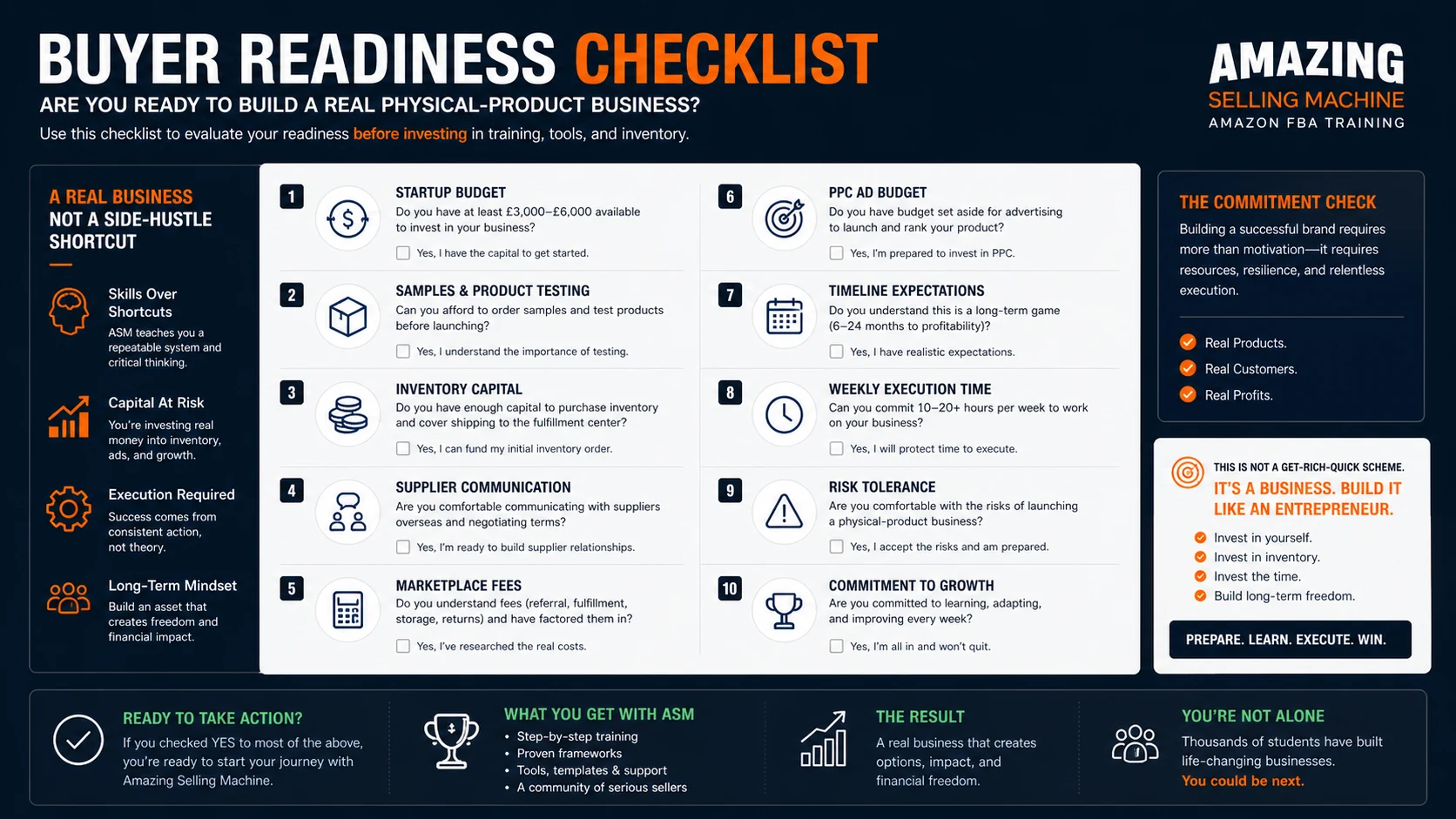
The better question is whether you are ready for the business model that sits behind the course. Amazon FBA can involve product samples, supplier mistakes, freight, marketplace fees, PPC costs, inventory risk, cash-flow pressure, and slow learning cycles. A course can reduce confusion. It cannot remove the risk of choosing the wrong product or underfunding the launch.
The pricing also deserves care. Public pages can show more than one access path: a standalone ASM course offer, Amazing Membership pricing, free or trial-style entry points for related Amazing.com products, and promotional guarantee language. I would not treat a single headline price as the whole decision. I would verify the live checkout route, the refund terms, and what access continues after the initial offer.
Next step: If Amazing Selling Machine still fits your business goal, verify the current access path and pricing before treating the course as your Amazon FBA plan.
Visit Amazing Selling Machine Check current offers Read store guide
Review snapshot
| Review point | Practical take |
|---|---|
| Best for | Serious Amazon FBA beginners who want a structured roadmap, coaching, software, and accountability |
| Not ideal for | Casual learners, low-budget side hustlers, or buyers who are not ready for inventory and ad spend |
| Main use case | Learning the private-label Amazon FBA path from product research to launch and scaling |
| Pricing note | Public pages show a standalone ASM offer and Amazing Membership-style pricing paths, so live checkout verification matters |
| Trial or entry path | Amazing.com pricing currently presents trial-style access for membership, but buyers should confirm which product path they are entering |
| Main strength | Deep seller-focused structure instead of scattered Amazon tutorials |
| Main concern | Total business cost and execution risk are much larger than the course price alone |
| Direct alternatives | Proven Amazon Course, Jungle Scout Academy, Marketplace SuperHeroes |
| Adjacent routes | Acquisition for broader business education, async.com for a lighter learning-platform path |
| Best next step | Compare the course path, membership path, refund terms, and your realistic FBA startup budget before paying |
What is Amazing Selling Machine?
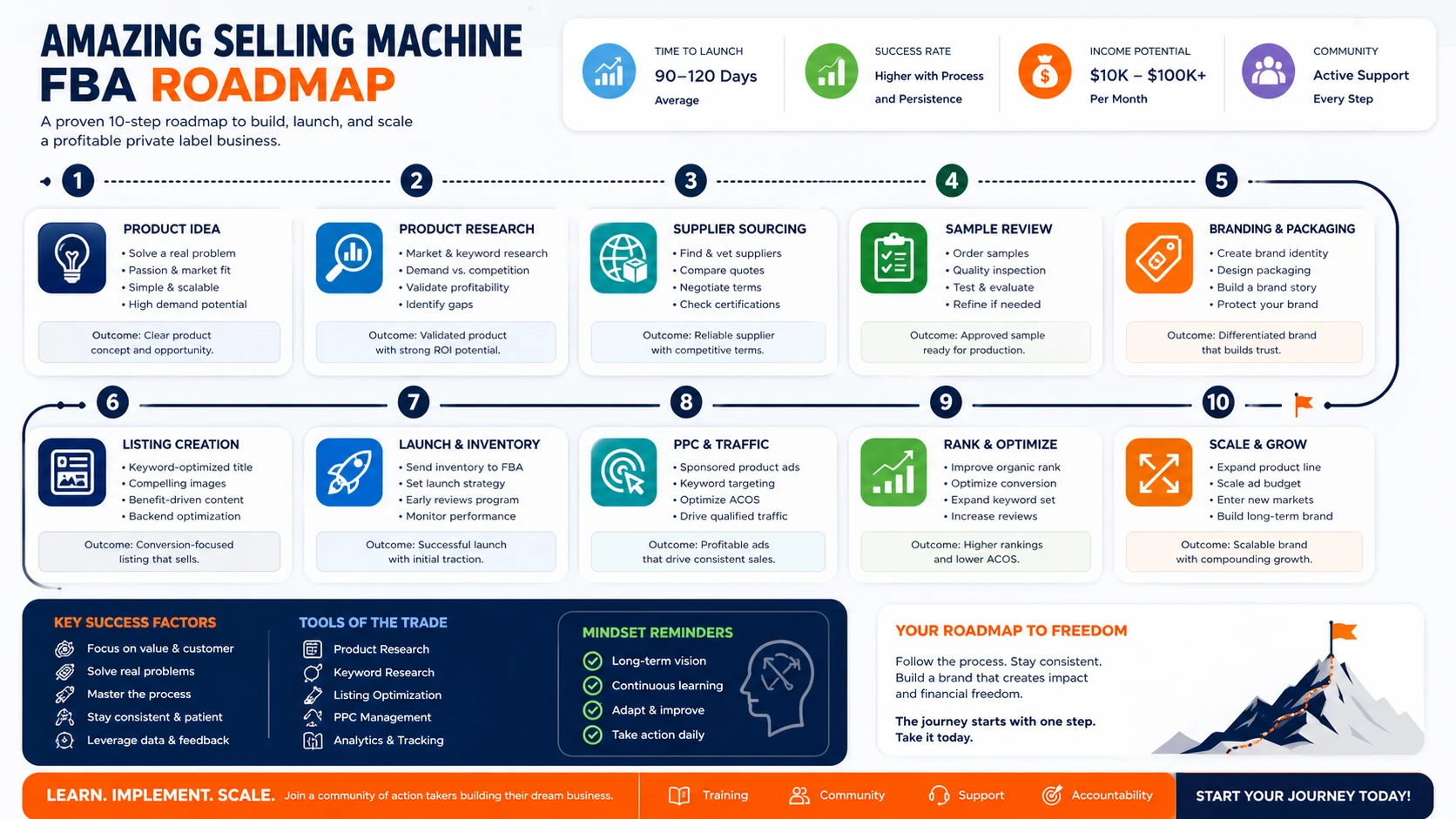
Amazing Selling Machine is a premium Amazon FBA training program from Amazing.com. It is built around the private-label seller journey: find a product, validate demand, work with suppliers, create a brand, build the listing, launch on Amazon, manage advertising, and scale the business.
It is not a small SaaS tool.
That matters because a buyer should not evaluate ASM the same way they evaluate a $19 writing app or a simple ecommerce plugin. ASM sits closer to business education, coaching, seller workflow software, and Amazon marketplace training. The official Amazing.com ecosystem also presents software, AI-assisted product research, training, live coaching, community, and seller-support elements around the broader membership path.
The common misunderstanding is assuming that a premium course lowers business risk just because it gives structure. Structure helps. It can save a beginner from random YouTube learning and scattered advice. But a structured course does not guarantee that your product will have demand, your supplier will perform well, your ads will convert, or your first launch will be profitable.
Our review approach compares public product pages, pricing details, guarantee language, buyer workflow fit, and nearby alternatives. I would not treat a discount, bonus stack, or success story as proof that ASM fits the buyer. The safer judgment is whether the training and support match a realistic Amazon FBA plan.
Who should use Amazing Selling Machine?
Amazing Selling Machine makes the most sense for buyers who want a full Amazon FBA roadmap and are willing to follow it seriously.
A first-time private-label seller may find ASM useful if they want a step-by-step path instead of piecing together free resources. Product research, supplier outreach, listing optimization, launch planning, and PPC can feel scattered when learned alone. A guided course can reduce the number of open questions.
A buyer who values coaching may also fit. If live calls, community feedback, and structured accountability help you move faster, ASM has a clearer role than a cheaper video-only course. The condition is that you actually use that support during the trial or refund window, not weeks later.
A seller who already knows Amazon is the chosen business model may benefit more than someone still exploring. If you have already decided that physical products, supplier work, inventory risk, and marketplace operations are acceptable, ASM can serve as a structured execution system.
A buyer comparing course versus membership access may also find ASM worth evaluating. The public Amazing.com ecosystem presents both a standalone course route and membership-style access. That can be useful, but it also means you should slow down and confirm what the checkout includes.
Who should avoid Amazing Selling Machine?
I would avoid ASM if you want a cheap, low-risk side hustle with almost no startup cost.
Amazon FBA is not that.
Even before a course fee, a serious product launch may involve product samples, supplier deposits, packaging, shipping, Amazon fees, product photography, PPC testing, cash tied in inventory, and mistakes that do not become obvious until later. If the course price already feels financially uncomfortable, the business model behind it may be the bigger issue.
I would also be careful if you are buying because of urgency, discount framing, or income-driven messaging. Those can make the opportunity feel closer than it really is. The better question is not “how much is the discount?” It is “can I execute the full model after I buy?”
ASM is also not ideal if you only need one narrow Amazon tactic. If you already know how to sell and only need keyword research, PPC help, or listing optimization, a specialist Amazon seller tool or focused tutorial may be a cleaner purchase.
Finally, buyers who dislike physical-product uncertainty should probably avoid it. FBA can be rewarding, but it is operational. You are dealing with products, suppliers, inventory, rules, reviews, ads, and platform changes. If that sounds exhausting before you even start, a broader digital business route may fit better.
How Amazing Selling Machine fits into a real workflow
A realistic ASM workflow starts before you enter payment details.
First, you decide whether Amazon FBA is the right business model. That means accepting that the work is not just watching lessons. You are going to research products, compare markets, speak with suppliers, evaluate samples, estimate margins, create listings, and make decisions with incomplete information.
Then ASM becomes the map.
A careful buyer would use the program to move through the business in stages: understand the product criteria, shortlist ideas, validate demand, check competition, plan a brand angle, source samples, prepare a listing, decide on initial inventory, and learn launch/PPC basics before spending heavily.
The software and AI elements can help with research and decision support, but they do not replace the buyer’s judgment. A tool can point toward a product opportunity. It cannot guarantee that a supplier will deliver quality, that reviews will build smoothly, or that Amazon ads will work at a profitable cost.
The real value of ASM appears when the training changes what you do next. If a lesson helps you reject a weak product before ordering samples, that is valuable. If coaching helps you avoid a supplier mistake, that is valuable. If the course merely becomes another folder of videos you plan to watch later, the value drops quickly.
Workflow check: If you are still testing whether Amazon FBA fits you, review the course route and offer terms before committing to a high-ticket path.
Real-world buyer scenarios
The serious beginner with startup capital
This is the cleanest ASM fit. The buyer has savings allocated for education, product testing, inventory, and ads. They do not want to spend months guessing from free content. They want a sequenced path and are willing to do the work.
ASM may fit here because the buyer needs structure more than another cheap tutorial. The risk is underestimating costs beyond the course. Before paying, this buyer should estimate the total launch budget, not only the course price.
The course collector
This buyer has bought multiple programs but has not launched anything. ASM may feel like the missing premium system, but that is not always true. The problem may be execution, not information.
If this is you, I would slow down. Before buying, write down what you failed to execute in previous programs. If the answer is time, fear, budget, or consistency, a more expensive course may not fix it.
The existing ecommerce operator
An operator with Shopify, DTC, or marketplace experience may use ASM differently. They may not need every beginner lesson, but they may want a structured Amazon-specific path, product research software, or coaching.
This buyer should compare ASM against targeted Amazon tools and specialist consulting. If the goal is one narrow gap, a full course may be heavier than needed.
The low-budget side-hustle seeker
This is the weakest fit. If the buyer is looking for a low-cost experiment, ASM may put too much money into education before product validation. A free Amazon FBA tutorial, Jungle Scout Academy-style education, or a lighter learning path may be safer until the buyer knows the model still appeals after seeing the operational work.
Key features that actually matter
Structured Amazon FBA training
The main feature is the structured path. ASM is designed to teach the private-label Amazon seller process rather than one isolated tactic.
Buyer note: This matters if you need the full map. It matters less if you already know the model and only need one tool or one advanced skill.
Amazing.com software and AI support
Amazing.com positions its platform around AI-powered product discovery, listing support, keyword research, alerts, and Amazon seller tools. These can make the program feel more practical than a course-only offer.
Buyer note: Software access should be verified at checkout. Make sure you know whether the access comes through the standalone ASM offer, Amazing Membership, or a time-limited bonus.
Live coaching and support
Coaching can be valuable in a business model where beginners often get stuck on product choice, suppliers, and launch decisions. The value is highest when you ask questions early and use the support during the trial or refund period.
Buyer note: Do not assume coaching will rescue a weak product decision. Use it to improve judgment, not to outsource responsibility.
Community and accountability
A community can help buyers stay engaged and see how others approach the same process. This can be useful when Amazon selling feels isolating.
Buyer note: Community value varies by participation. If you do not ask questions, review examples, or engage consistently, it may not matter much.
Course bonuses and resource vaults
ASM pages often present bonus stacks and resource access. Bonuses can add value, but they can also make the purchase feel more urgent than it should.
Buyer note: Evaluate the core course first. If the main Amazon FBA path does not fit, a large bonus value does not fix the mismatch.
Pricing and plan value
Pricing is the section I would read slowly.
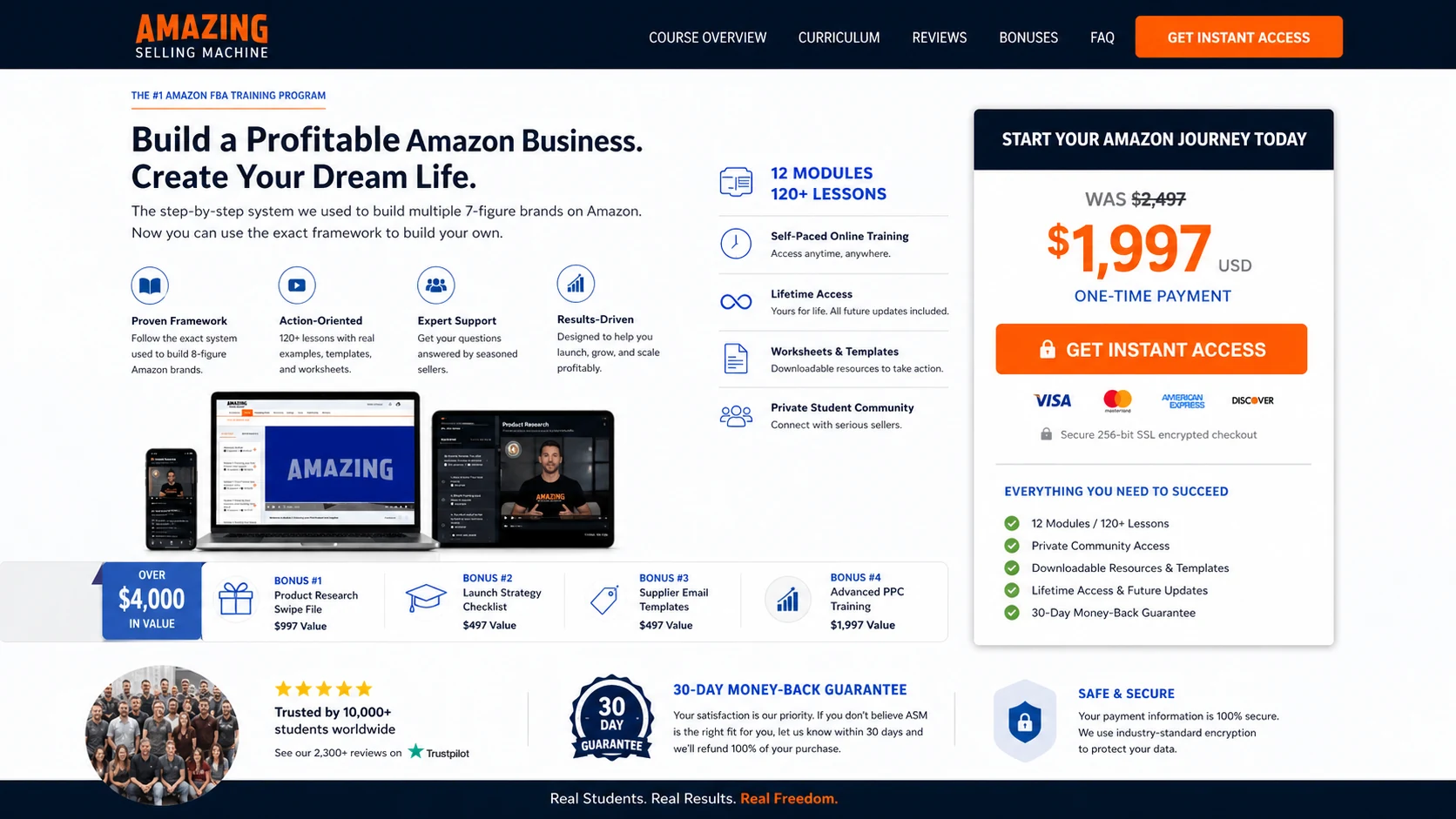
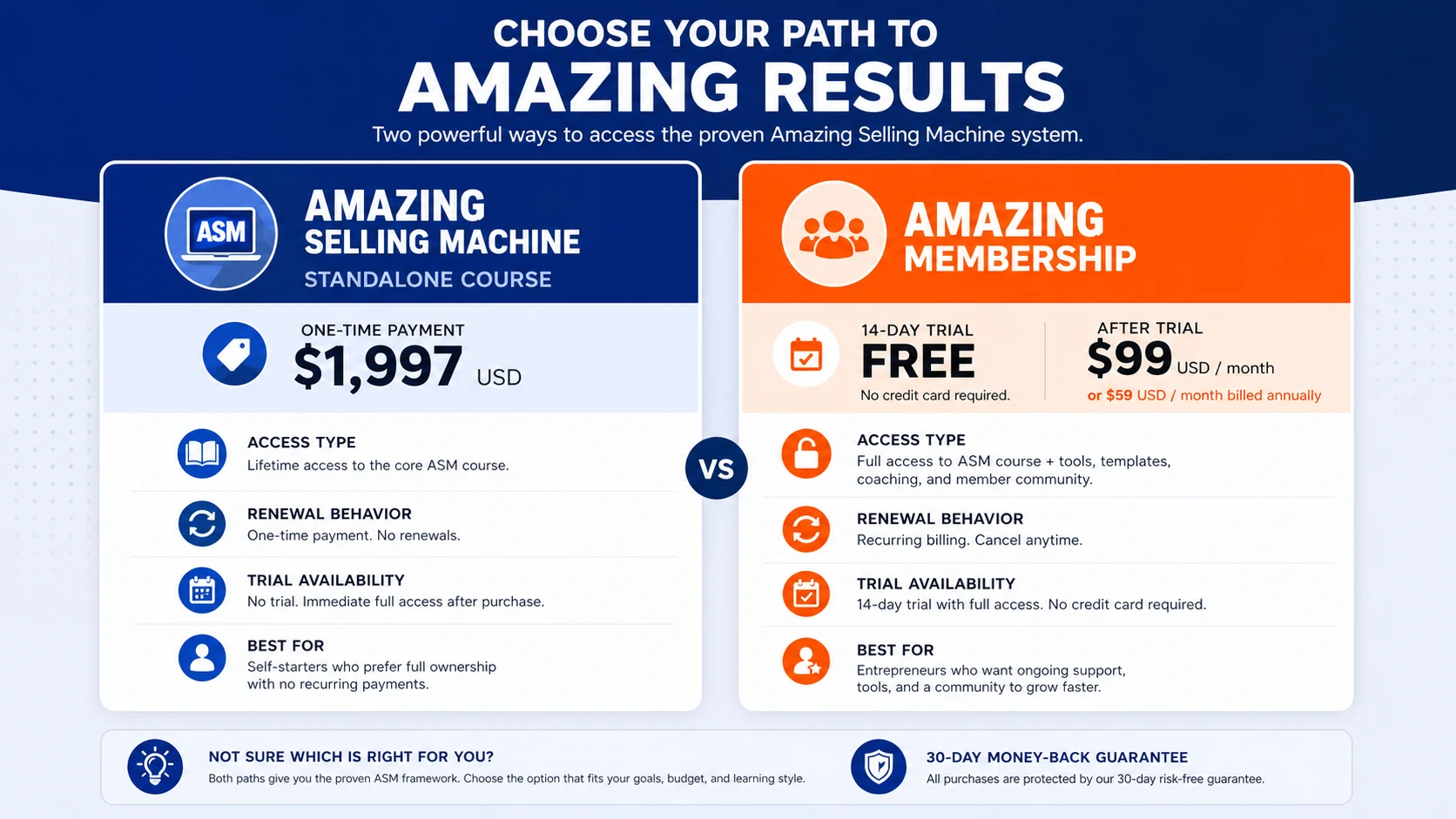
At the time of review, the public ASM landing page presents a standalone Amazing Selling Machine offer at $1,997, shown against a higher listed course value. It also presents a 30-day money-back guarantee and mentions ASM AI, 120+ training lessons, 20+ hours of ecommerce content, private resources, bonuses, and membership-related access.
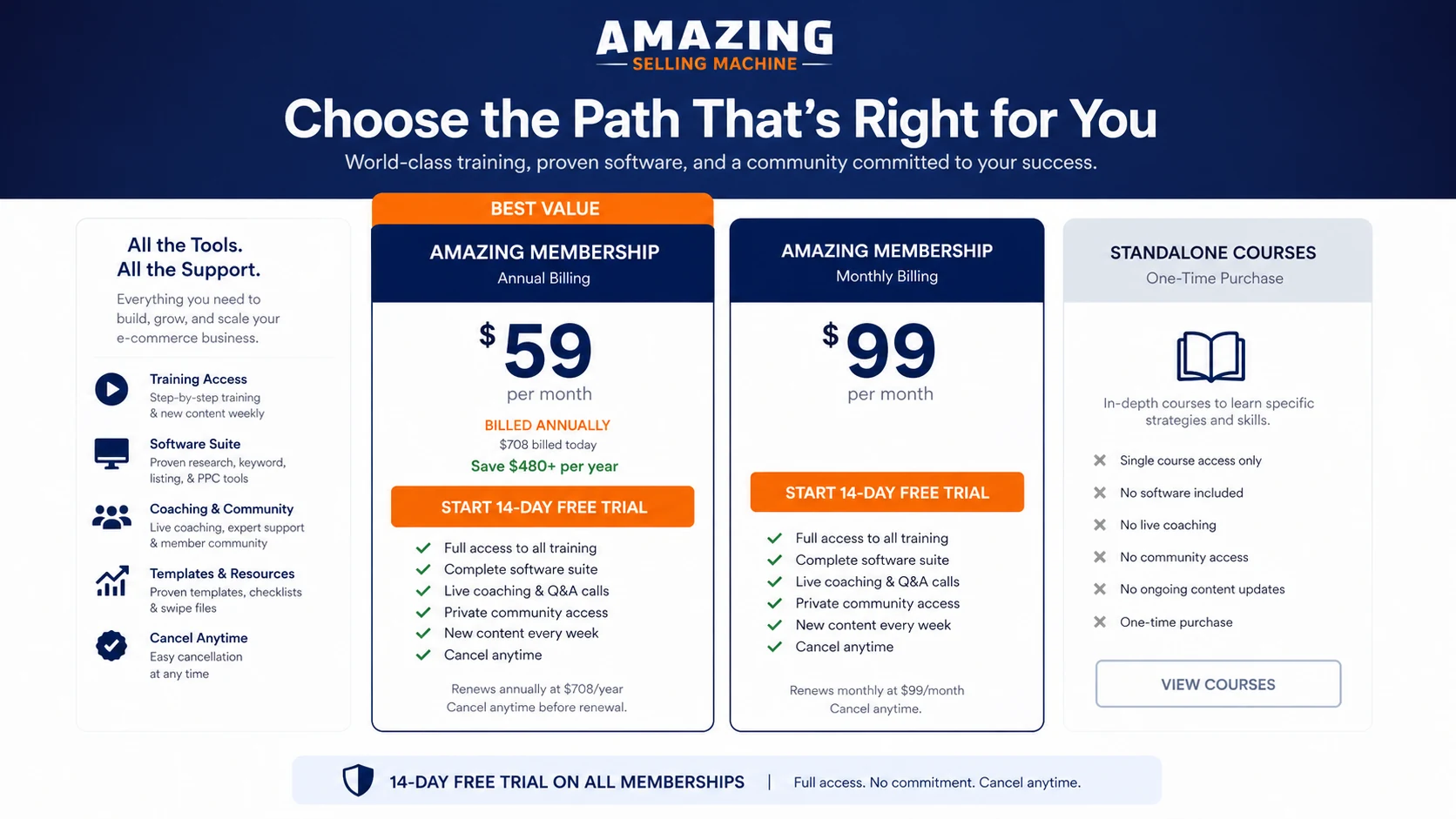
Amazing.com pricing also presents an Amazing Membership path with monthly and annual pricing, a 14-day trial, and access to software, training, live coaching, and support. The pricing page shows a monthly route and a lower annual-billing route, while some Amazing.com pages may present membership copy in slightly different ways.
That is not automatically bad, but it means buyers should not skim.
The key question is which path you are entering:
- standalone Amazing Selling Machine course
- Amazing Membership access
- promotional bundle
- trial-style membership route
- renewal-based access after an initial period
The cheapest-looking path is not automatically the safest path. A lower monthly entry may help with evaluation, but annual billing, renewal behavior, access limits, and cancellation timing still matter. A high upfront course payment may make sense for a committed buyer, but only if the buyer has the extra capital required to launch the business.
For my money, the strongest pricing test is simple: if you cannot comfortably budget for samples, inventory, advertising, and mistakes after paying for ASM, the course may be early rather than wrong.
Pricing check: Before paying, compare the current ASM course offer, Amazing Membership route, and written guarantee terms on the live checkout path.
Check current ASM pricing Check current offers Read store guide
Free plan, trial, coupon, and checkout notes
ASM is not a product where I would start by chasing random coupon codes.
The safer order is different:
- Decide whether Amazon FBA is the business model you actually want.
- Confirm whether you are buying the standalone ASM course, Amazing Membership, or another promotional path.
- Check trial eligibility, guarantee language, and renewal behavior.
- Estimate non-course costs.
- Then check the coupon page or current offer route.
Amazing.com pricing currently presents trial-style membership access, while the standalone ASM page presents a course-style purchase with a 30-day guarantee. Those are not the same buying psychology. One feels like testing a membership. The other feels like committing to a premium course path.
A coupon can improve a purchase that already makes sense. It should not be the reason you buy. If you are unsure about product research, supplier work, or inventory risk, no discount removes that uncertainty.
If you do use the Amazing Selling Machine coupon page, use it after the business-fit check. The checkout page, guarantee terms, and payment schedule matter more than old deal copy.
What I would check before buying Amazing Selling Machine
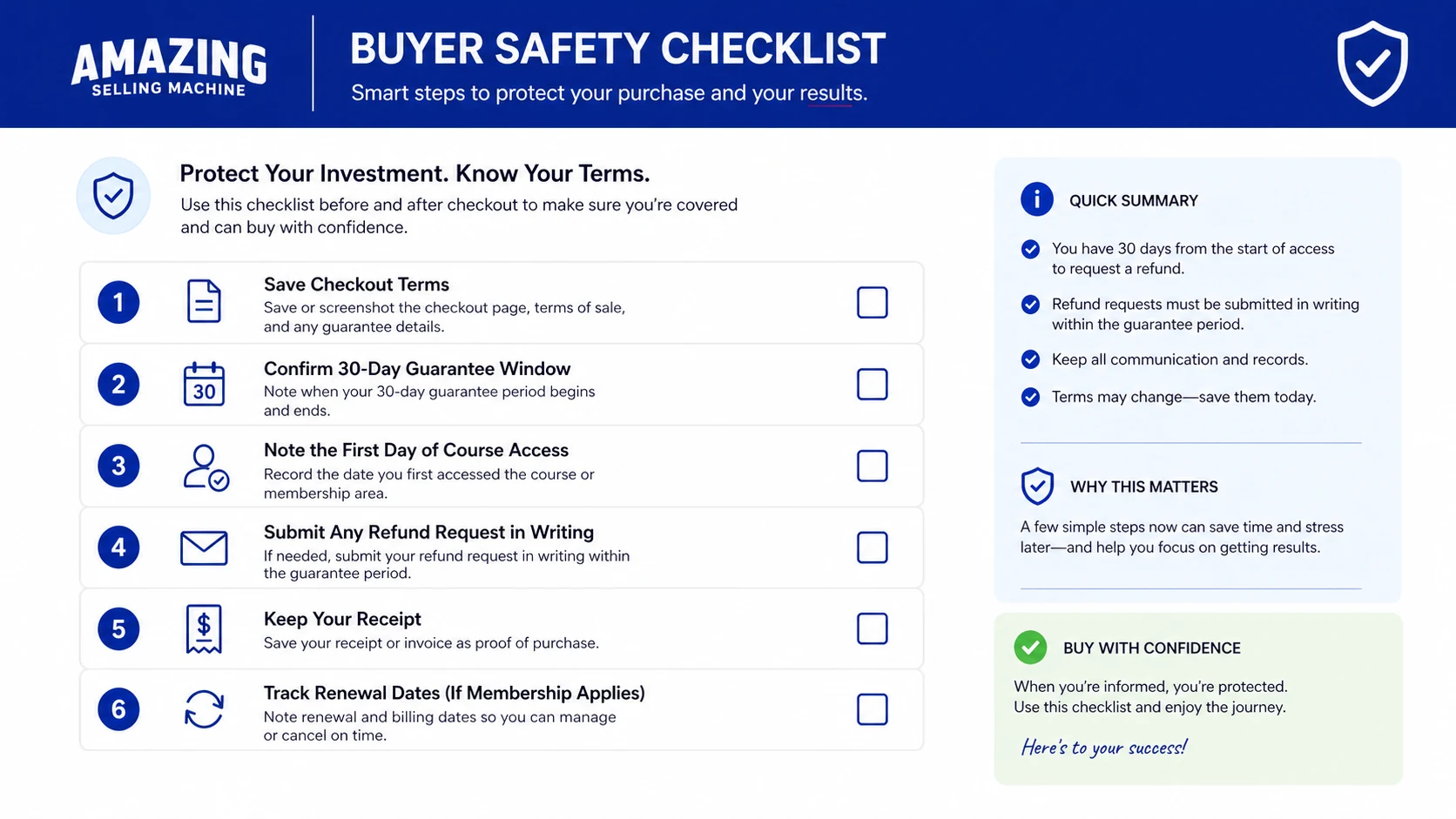
If I were buying ASM for a real Amazon FBA plan, I would check these items before entering payment details:
- Whether the current checkout is for standalone ASM, Amazing Membership, or a promotional bundle.
- The exact first payment, renewal amount, billing interval, and whether annual billing is involved.
- Whether the 14-day trial, 30-day guarantee, or other refund language applies to the exact path I choose.
- When the refund window starts: purchase date, first access to course material, or another defined trigger.
- How written cancellation or refund requests must be submitted.
- Whether software, coaching, community, and bonus access are lifetime, membership-based, or time-limited.
- Whether I have enough separate budget for samples, inventory, shipping, Amazon fees, PPC, and product mistakes.
The biggest buyer mistake is thinking the course price is the business cost.
It is not.
The course may be only the first visible expense. The real financial pressure often arrives later, when you need to act on the lessons.
A simple test before paying
Before paying for ASM, I would run a small readiness test like this:
- Watch one current free Amazon FBA tutorial from a reputable seller education source.
- Write down every operational step that sounds difficult: product research, sourcing, samples, freight, listing, PPC, reviews, inventory, or cash flow.
- Estimate a realistic launch budget beyond education.
- Review the ASM offer page and Amazing.com pricing page side by side.
- Check whether the training, coaching, and software solve your actual weak points.
- Read the refund and cancellation language before starting the trial or paid path.
- Decide whether you are ready to take action during the first two to four weeks, not “someday.”
That last step matters most.
A course can feel motivating on purchase day. The useful question is whether you will still execute when the work becomes boring: supplier follow-ups, margin spreadsheets, product samples, keyword research, listing edits, and ad testing.
Pros explained
The first real pro is structure. ASM gives the buyer a mapped route through a complicated business model. For a beginner, that can reduce decision fatigue.
The second pro is category focus. ASM is not broad entrepreneurship advice. It is centered on Amazon and ecommerce selling. That focus helps if Amazon FBA is already the chosen path.
The third pro is the ecosystem around the course. Amazing.com presents software, AI seller tools, live coaching, support, training, and community. If those pieces are included in the path you choose, they can make the learning experience more actionable than a static course library.
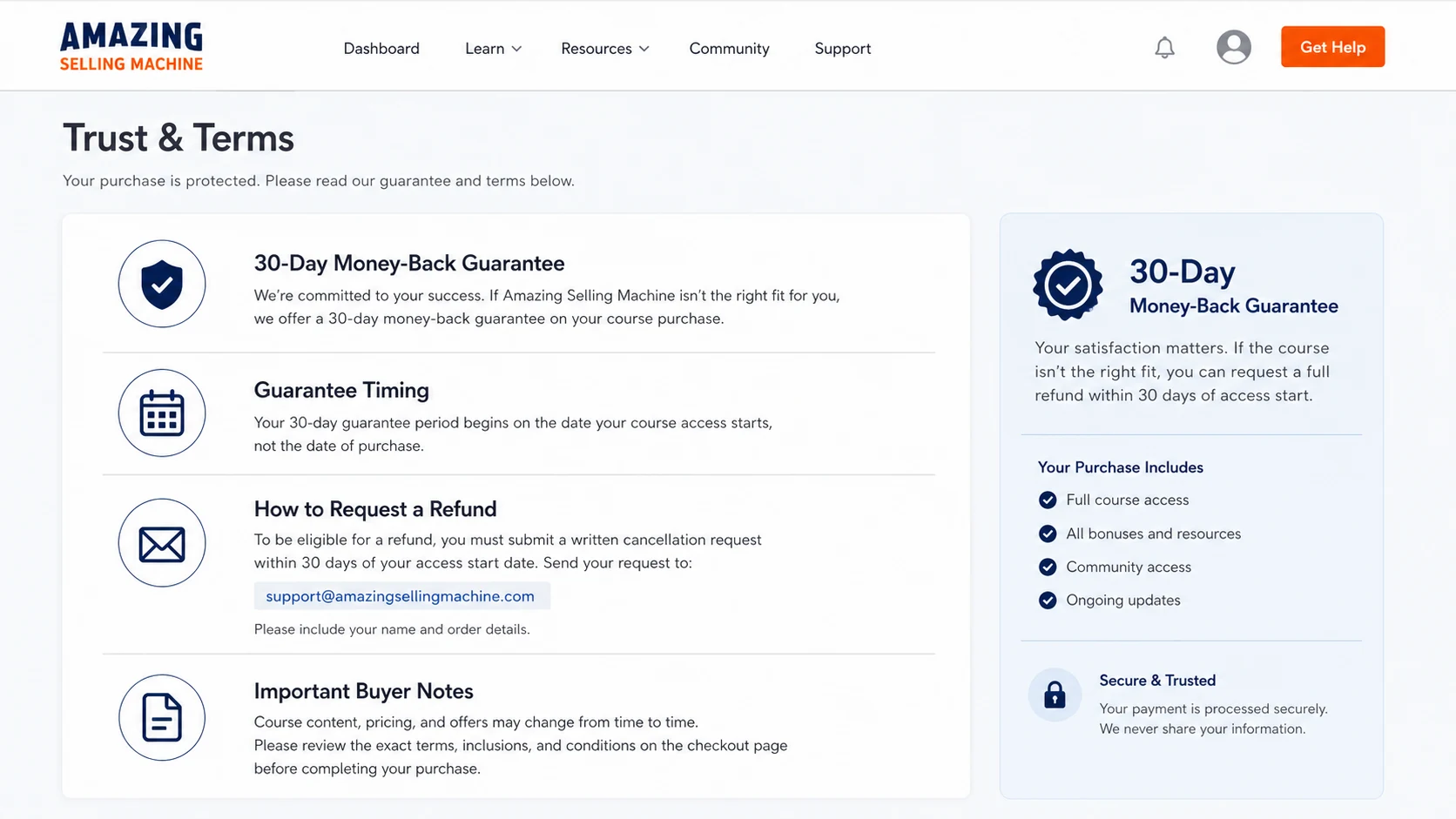
The fourth pro is visible guarantee language. Buyers still need to verify details, but the public pages do give enough refund and support direction to check risk before payment.
The fifth pro is that ASM has been around long enough to have a recognizable brand in the Amazon FBA course space. That does not guarantee results, but it does make the product easier to research than obscure new seller courses.
Cons explained
The first con is cost beyond the course. ASM may be expensive, but the more important issue is the business model. Amazon FBA can require serious cash before you know whether your first product will work.
The second con is pricing-path confusion. Public pages may present the standalone course, membership, trial, software, and promotion language in different contexts. Buyers should verify the current checkout route instead of relying on a single page or an old review.
The third con is that the sales page uses strong outcome framing. That can be motivating, but it can also make beginners underestimate the difficulty of product selection, logistics, ads, and competition.
The fourth con is that ASM may be too heavy for narrow needs. If you only need keyword research, listing help, or product validation software, a specialized Amazon seller tool may be a cleaner starting point.
The fifth con is follow-through risk. A premium program does not create discipline. If you do not complete lessons, ask questions, and make decisions quickly during the refund window, the purchase can become expensive shelfware.
Green flags and red flags
A green flag is that ASM is clearly focused on a real business workflow. It is not pretending to be a tiny hack. It teaches a multi-step seller process.
Another green flag is the mix of training, software, coaching, and support. For buyers who need structure and feedback, that combination can matter.
A third green flag is visible refund language. Buyers can review the guarantee and terms before payment, which is important for a high-consideration course.
The red flags are more about the buyer than the product.
If you are buying because you want income quickly, slow down. If you have not estimated inventory and ad costs, slow down. If you are unclear whether you want to sell physical products, slow down. If you are only looking at a discount or bonus stack, slow down.
The strongest red flag is needing the course to make the business model feel safe. A course can make a hard business model clearer. It cannot make it risk-free.
Amazing Selling Machine vs alternatives
Proven Amazon Course vs Amazing Selling Machine
Proven Amazon Course is a direct comparison if you want Amazon seller education but prefer a broader course-library style. It may appeal to buyers who want multiple Amazon business models and a large training archive rather than a premium ASM-style private-label path.
ASM may still make more sense if you want a polished, structured Amazon FBA roadmap with Amazing.com software and coaching tied into the experience.
Jungle Scout Academy vs Amazing Selling Machine
Jungle Scout Academy is a direct comparison for buyers who want Amazon training connected to seller software. It can be attractive if you are already evaluating Jungle Scout tools and want education that supports product research and seller operations.
ASM may make more sense if you want a course-first experience with broader coaching and a premium seller-training ecosystem.
Marketplace SuperHeroes vs Amazing Selling Machine
Marketplace SuperHeroes is another Amazon FBA training route, often discussed by buyers researching Amazon course alternatives. It may be more relevant if you are studying wholesale or different Amazon inventory models.
ASM remains the comparison if you want the Amazing.com private-label training ecosystem and are comfortable evaluating a higher-consideration course path.
Acquisition as an adjacent route
Acquisition is not a direct ASM replacement. It is broader business education. It may be useful if you are not sure Amazon FBA is the right model and want a wider business-building perspective first.
async.com as an adjacent route
async.com is also adjacent, not a one-to-one Amazon FBA course alternative. It is more relevant if you are exploring a lighter learning-platform or operator education path rather than a premium Amazon seller program.
Trust, refund, and buyer-risk notes
The refund language is visible, but buyers should still read it carefully.
The standalone ASM page presents a 30-day money-back guarantee. Amazing.com terms explain that refund periods or money-back guarantee periods begin on the first day of access to course material, and refund or cancellation requests must be submitted before the refund period expires. The terms also say guarantee details can vary by promotion and product.
That means the safe move is practical:
- Save the checkout page.
- Save the guarantee language.
- Save the payment schedule.
- Save the cancellation instructions.
- Use the course immediately if you enter a trial or refund window.
- Decide early, not after the guarantee period is nearly over.
From a privacy and data perspective, ASM is not only an information product. Amazing.com software and membership paths may involve account data, seller workflow information, and platform interactions. Buyers with strict business-data concerns should read the current privacy policy and understand what they are connecting before using seller tools deeply.
Support is also worth checking. Amazing.com publishes contact routes, including support email and phone information, but the real question is not whether support exists. The real question is whether support matches your purchase path, timezone, urgency, and stage of the FBA workflow.
Finally, do not treat old third-party pricing references as current. ASM has had multiple versions and promotional structures over time. The live official page and checkout route matter most.
Final verdict
I would consider Amazing Selling Machine if you are serious about Amazon FBA, want a structured private-label roadmap, value coaching, and have enough separate budget for product testing, inventory, advertising, and mistakes.
I would skip it if you are still unsure about physical products, uncomfortable with inventory risk, or mainly attracted by discount framing. A course can help you navigate the model. It cannot make the model easy, cheap, or guaranteed.
I would compare ASM with Proven Amazon Course if you want a broader Amazon learning library, Jungle Scout Academy if you want software-led seller education, and Marketplace SuperHeroes if you are comparing different Amazon FBA training styles. I would treat Acquisition and async.com as adjacent routes only if the real question is broader business education rather than Amazon FBA specifically.
The safest judgment is this: ASM can be a strong fit for the right committed buyer, but it is not a casual purchase. Verify the live pricing, guarantee, access route, and your total launch budget before treating it as your Amazon seller plan.
