Quick verdict
AI-Writer.com is worth considering if your writing problem is not simply “I need more words,” but “I need a draft that is tied to sources I can inspect.”
That difference matters.
A normal AI writer can give you a fluent paragraph in seconds. AI-Writer.com is trying to solve a narrower and more serious problem: research-backed answers, citations, source paragraphs, bibliography details, and a workflow that can move from a broad topic into a structured review-style draft. That makes it more interesting for researchers, students, technical writers, academic-adjacent content teams, and SEO writers who need traceable references before they start polishing.
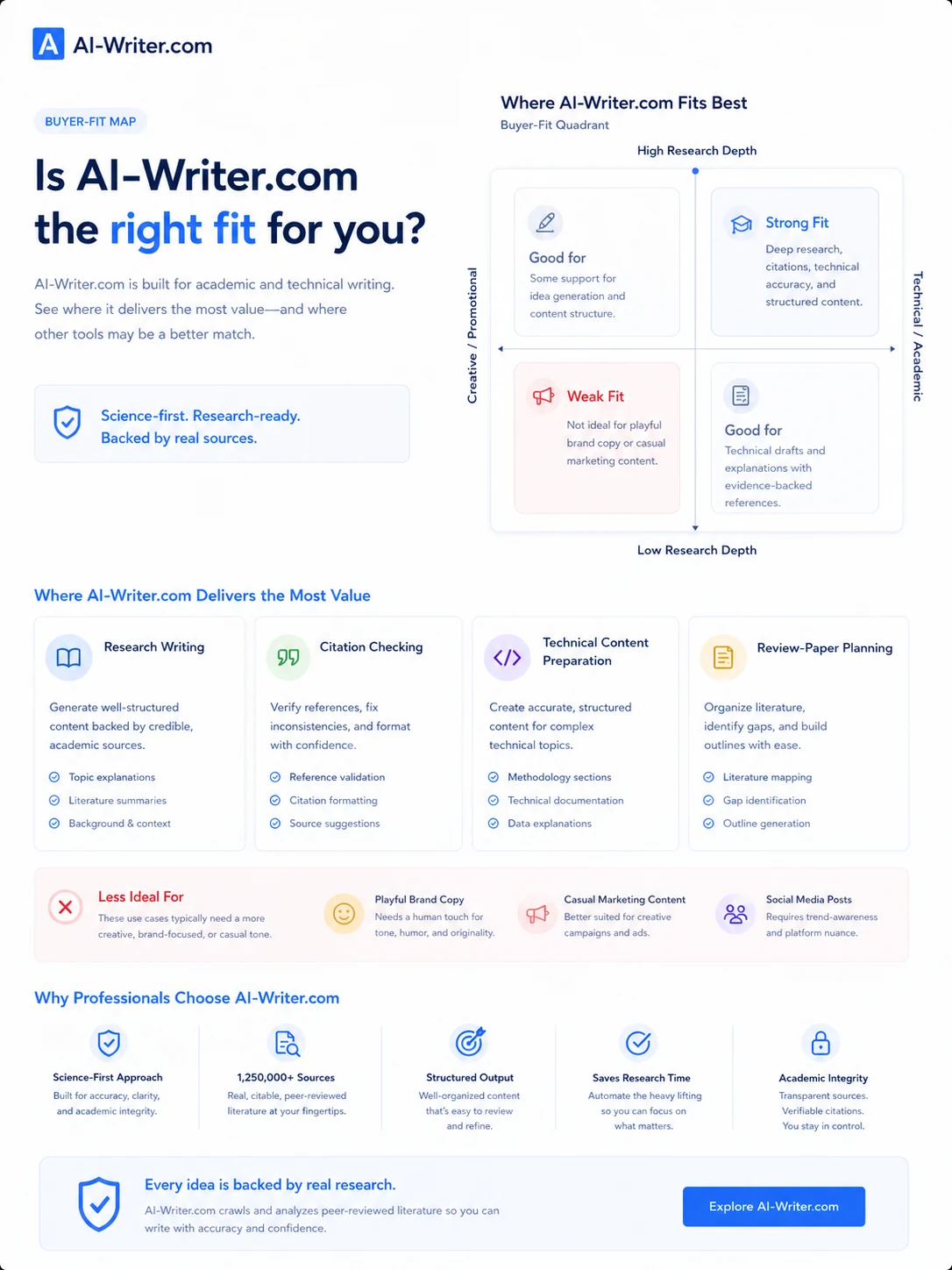
I would not judge it like a playful copywriting tool. If you need social captions, brand voice, sales emails, or quick ad variations, AI-Writer.com may feel too research-heavy. If you need citations, source checking, and a stronger starting point for factual writing, it becomes much more relevant.
The safest path is simple: use the 7-day trial with one real research task before paying. Do not upgrade because the homepage sounds trustworthy. Upgrade only if the cited output reduces your research time and the editing workload is still reasonable.
Next step: If AI-Writer.com fits your research workflow, check the live buyer route and pricing before choosing a paid plan.
Review snapshot
| Review point | Practical take |
|---|---|
| Best for | Researchers, students, technical writers, and source-focused content teams |
| Not ideal for | Buyers who mainly need creative copy, brand voice, or casual chatbot output |
| Main use case | Turning research questions into cited, source-backed answers and structured drafts |
| Pricing note | Current public pricing starts at $29/month for Basic, with annual billing shown as a lower effective monthly rate |
| Trial path | 7-day trial presented as no credit card needed and not automatically becoming a subscription |
| Main strength | Citations, source paragraphs, bibliography details, Topic Explorer, and review-paper workflow |
| Main concern | Buyers still need to verify source relevance, editing workload, plan limits, and cancellation terms |
| Direct alternatives | Jenni AI for academic drafting, SciSpace-style research assistants if available in your stack |
| Adjacent routes | NeuronWriter for SEO optimization, Rytr for cheaper marketing copy, WordAI for rewriting |
| Best next step | Run one serious research task in the trial before monthly or annual billing |
What is AI-Writer.com?
AI-Writer.com is a research-focused AI writing tool built around questions, scientific sources, citations, and structured answers.
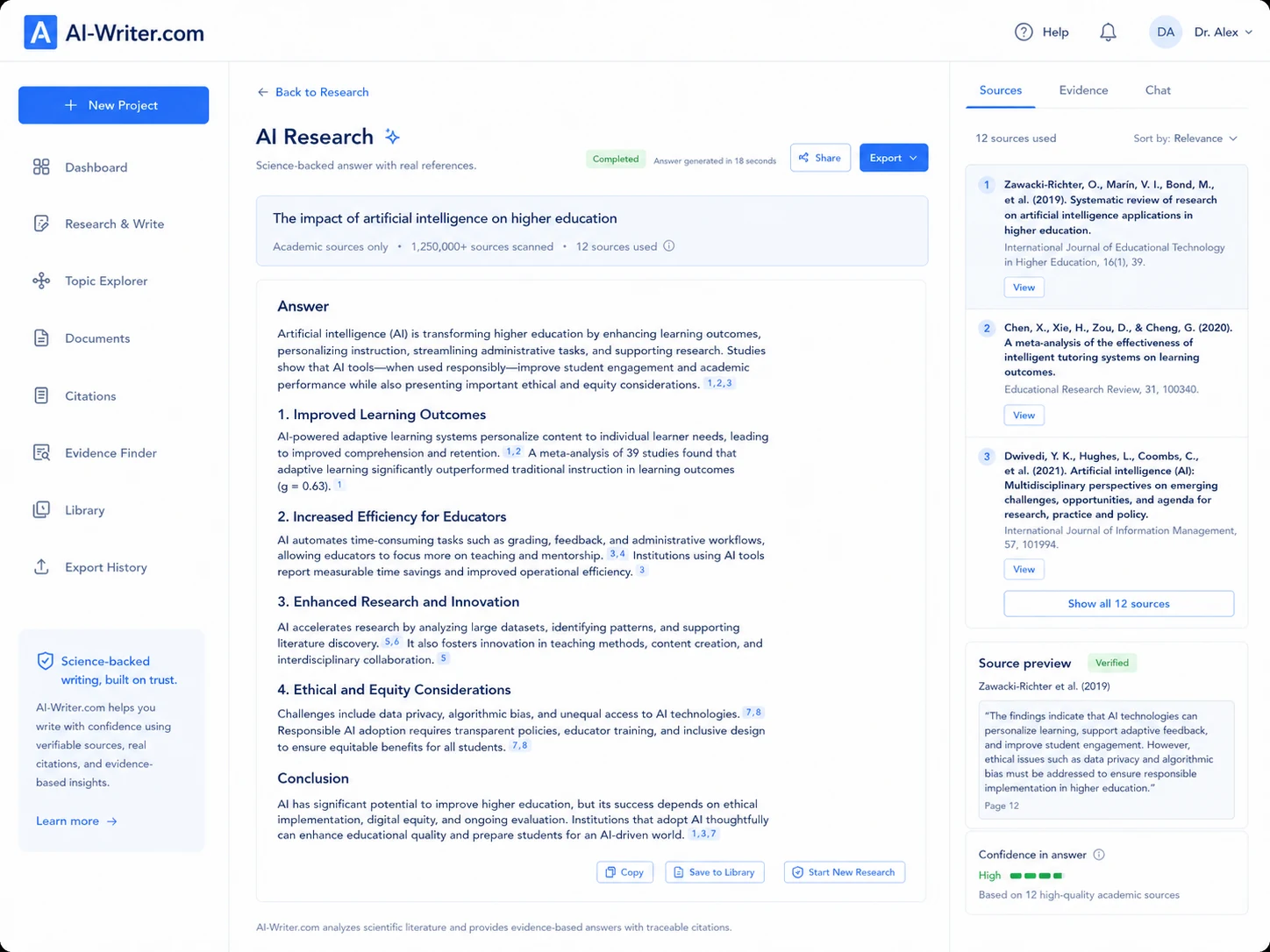
The current public positioning is not “give us any prompt and we will write anything.” The product is presented more narrowly: ask a question, get an answer backed by scientific papers, inspect the cited source paragraphs, review bibliographic details, and use the output as a research-backed starting point. The site also highlights Topic Explorer, citations, bibliography support, and the ability to move from a single question into a structured review-paper workflow.
That makes AI-Writer.com different from a general AI writing assistant.
A general AI writer usually competes on speed, templates, marketing copy, tone, and volume. AI-Writer.com competes on traceability. It wants the buyer to care about where claims came from. For academic, technical, medical-adjacent, science, B2B, or research-backed SEO writing, that can be a meaningful advantage.
It also creates a higher responsibility for the buyer.
A citation is not automatically proof that the generated answer is correct. The source can be relevant, weak, outdated, or used too broadly. The honest way to use AI-Writer.com is to treat it as a research assistant that shortens the first pass, not as a final authority that removes your need to read and edit.
Our review approach compares public product pages, pricing details, help information, buyer workflow fit, and nearby alternatives. I would not treat a trial, annual discount, or coupon route as proof that the product belongs in your workflow. The trial has to prove that on a real task.
Who should use AI-Writer.com?
AI-Writer.com makes sense for buyers who already feel the pain of sourcing.
A researcher or graduate student may use it to turn broad questions into cited starting points. The fit is strongest when you need help mapping a topic, finding relevant questions, and assembling a source-backed draft that can be checked and rewritten. The condition is important: you still need to read the cited material and follow your institution’s rules on AI assistance.
A technical writer may use it when accuracy matters more than speed. If a topic requires references, definitions, technical background, or careful explanation, AI-Writer.com can provide a stronger research layer than a blank chatbot response. The buyer should verify whether the cited paragraphs actually support the claims before moving the text into a final article.
A research-backed SEO writer may also find it useful. Some SEO articles are not just “best tips” content. They need statistics, scientific context, technical explanations, and claims that should be traceable. AI-Writer.com can help with the research layer, while SEO structure, search intent, internal linking, and editorial polish still need separate work.
Small teams may consider Standard or Power only when multiple users and heavier research demand make sense. I would be careful here. A team plan is only useful if the team has a repeated research workflow, not just a vague desire to “write faster with AI.”
Who should avoid AI-Writer.com?
AI-Writer.com is not the cleanest fit for buyers who mainly need brand voice.
If your workflow is ad copy, landing page variants, social media captions, ecommerce descriptions, or punchy sales emails, a more marketing-oriented AI writer may be easier to justify. AI-Writer.com is more comfortable around citations, research questions, and source-backed answers than playful campaign language.
One-off users should also be cautious. If you only need one quick answer, the free trial may be enough. A recurring subscription makes more sense when source-backed drafting is part of your normal week.
I would also be careful if you are expecting the tool to replace academic judgment. It can help find and structure source-backed material, but it cannot decide whether your argument is strong, whether your field accepts the source, or whether your final paper meets institutional requirements.
Teams that need deep collaboration, content governance, approval workflows, or enterprise compliance may find AI-Writer.com too narrow. It has team-sized plan paths, but that is not the same as being a full content operations platform.
Finally, avoid buying only because a coupon route exists. A discount can improve the purchase, but it should not be the reason you subscribe. The product has to prove that it saves research time.
How AI-Writer.com fits into a real workflow
A realistic AI-Writer.com workflow starts before the tool writes anything.
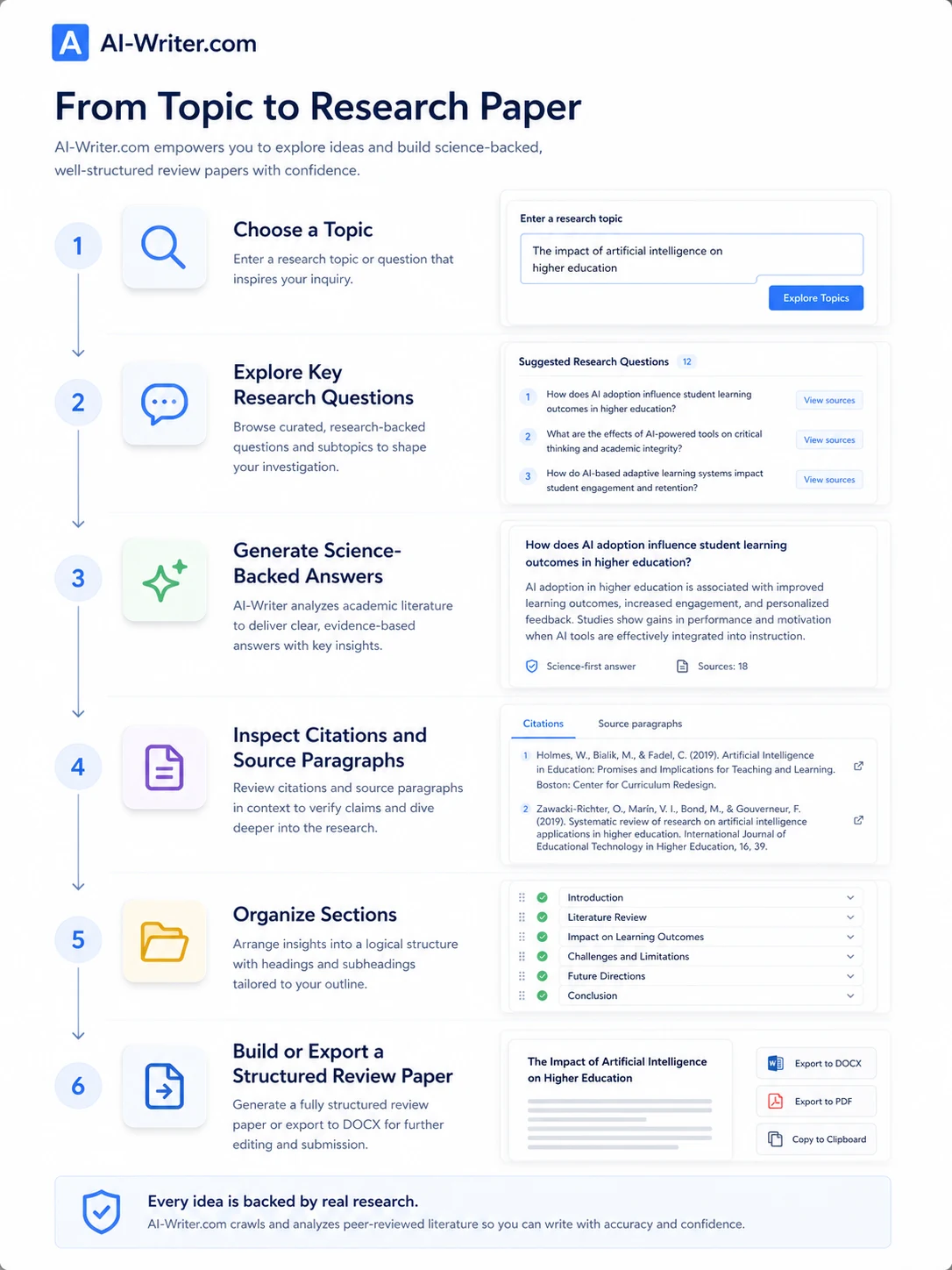
The first step is choosing a real research question. Not a vague prompt. Not a broad topic like “climate change” or “AI in education.” A better test is a question you would normally spend time sourcing manually.
Then AI-Writer.com can help you explore the topic, identify important questions, generate a cited answer, and inspect the source paragraphs behind the claims. From there, the buyer has to do the serious work: check whether the sources are relevant, remove weak claims, add missing nuance, and rewrite the draft into the final voice.
For a longer project, the Topic Explorer and review-paper workflow become more interesting. Instead of asking for one answer, you can map several questions, organize sections, and turn the research into something more structured. That is where the tool can feel more useful than a generic chatbot.
The decision point is not whether the first answer sounds good. It is whether the cited workflow saves time after verification.
Workflow check: Test AI-Writer.com with one research task you would normally source manually before treating a paid plan as necessary.
Real-world buyer scenarios
A graduate student writing a literature-backed section may get the most obvious value. The tool can help turn a question into cited material and bibliography details. The risk is over-trusting the generated answer. The buyer still has to read sources, check citation relevance, and follow academic policy.
A technical content writer preparing a complex explainer can also benefit. AI-Writer.com may shorten the research phase by surfacing source-backed explanations. It may fail if the final article needs brand voice, product-specific insight, or proprietary details that public scientific sources cannot provide.
An SEO writer working on evidence-heavy content may use it as a source layer before optimization. That is a reasonable use case. But AI-Writer.com does not replace keyword clustering, SERP analysis, on-page SEO, or editorial judgment. If search optimization is the main job, NeuronWriter is the more direct SEO workflow route.
A small research team may consider a higher plan if several users repeatedly ask source-backed questions. I would not jump to that too quickly. Team value depends on answered-question volume, user count, and whether the workflow becomes repeatable enough to justify the price.
Key features that actually matter
Topic Explorer
Topic Explorer is useful when the buyer starts with a subject but does not yet know which questions to cover. It helps map the research path before drafting.
Buyer note: This matters most for longer articles, review papers, technical explainers, and academic-style projects. If you already know the exact angle and sources, the value may be smaller.
AI research answers
The core feature is the ability to ask a question and receive an answer grounded in scientific literature. This is the main reason to test the product.
Buyer note: Do not judge only by fluency. Check whether the answer is specific, well-supported, and useful after you read the cited source material.
Verifiable citations and source paragraphs
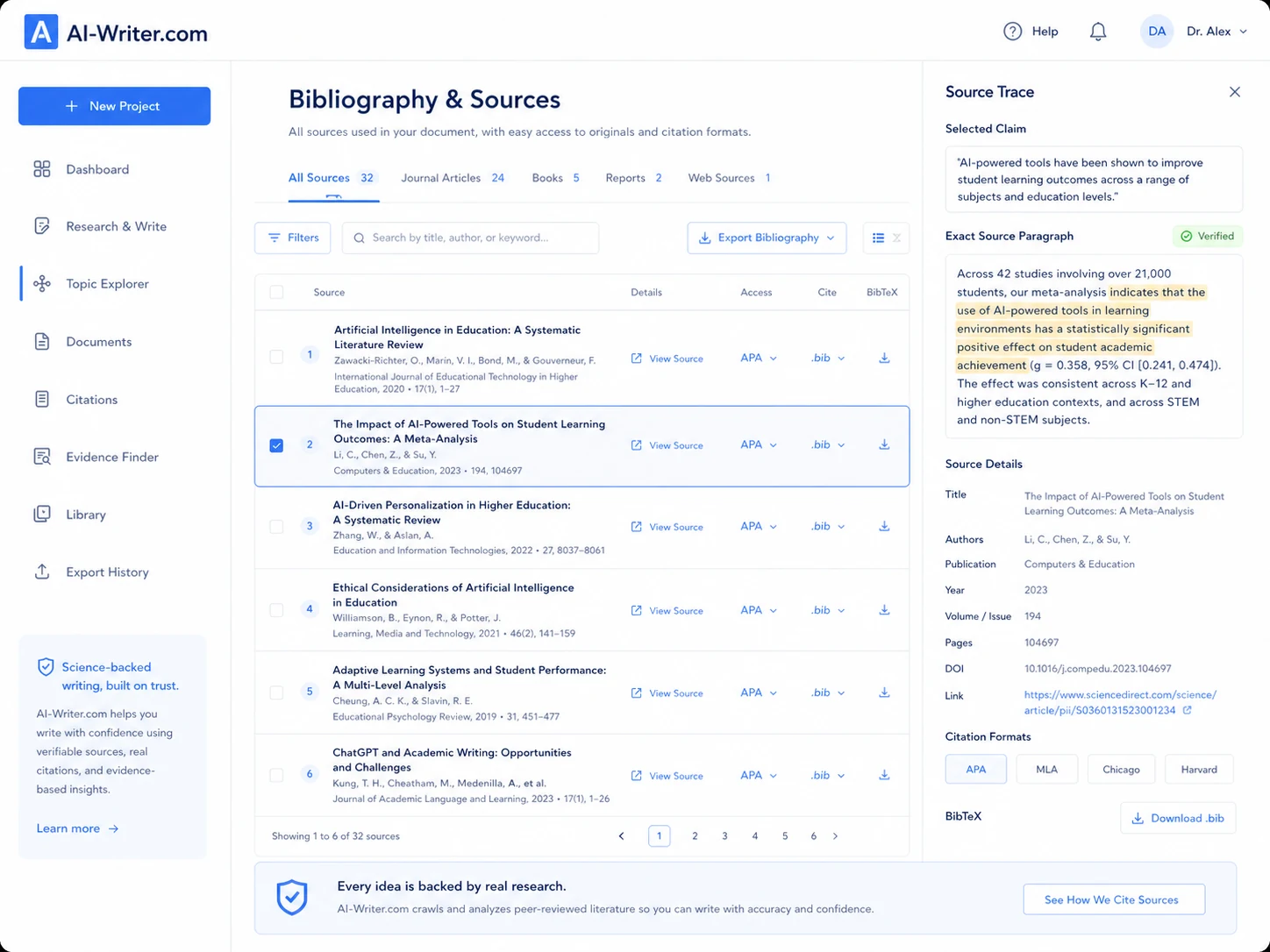
AI-Writer.com emphasizes traceability: source paragraphs, links, bibliographic details, citation formats, and BibTeX support.
Buyer note: This is the difference between “nice draft” and “usable research starting point.” If citations are weak or mismatched for your field, the subscription becomes harder to justify.
Review-paper workflow
For bigger projects, the ability to organize questions and sections can help buyers move from individual answers to a structured research asset.
Buyer note: This is more useful for research planning than for final writing polish. Expect to revise heavily before publishing or submitting anything.
Citation formats and bibliography support
The tool’s support for common citation styles and BibTeX can reduce formatting friction for academic or research-heavy workflows.
Buyer note: Still verify formatting expectations for your institution, client, or publication. Citation support is helpful, but it does not remove responsibility for accuracy.
Pricing and plan value
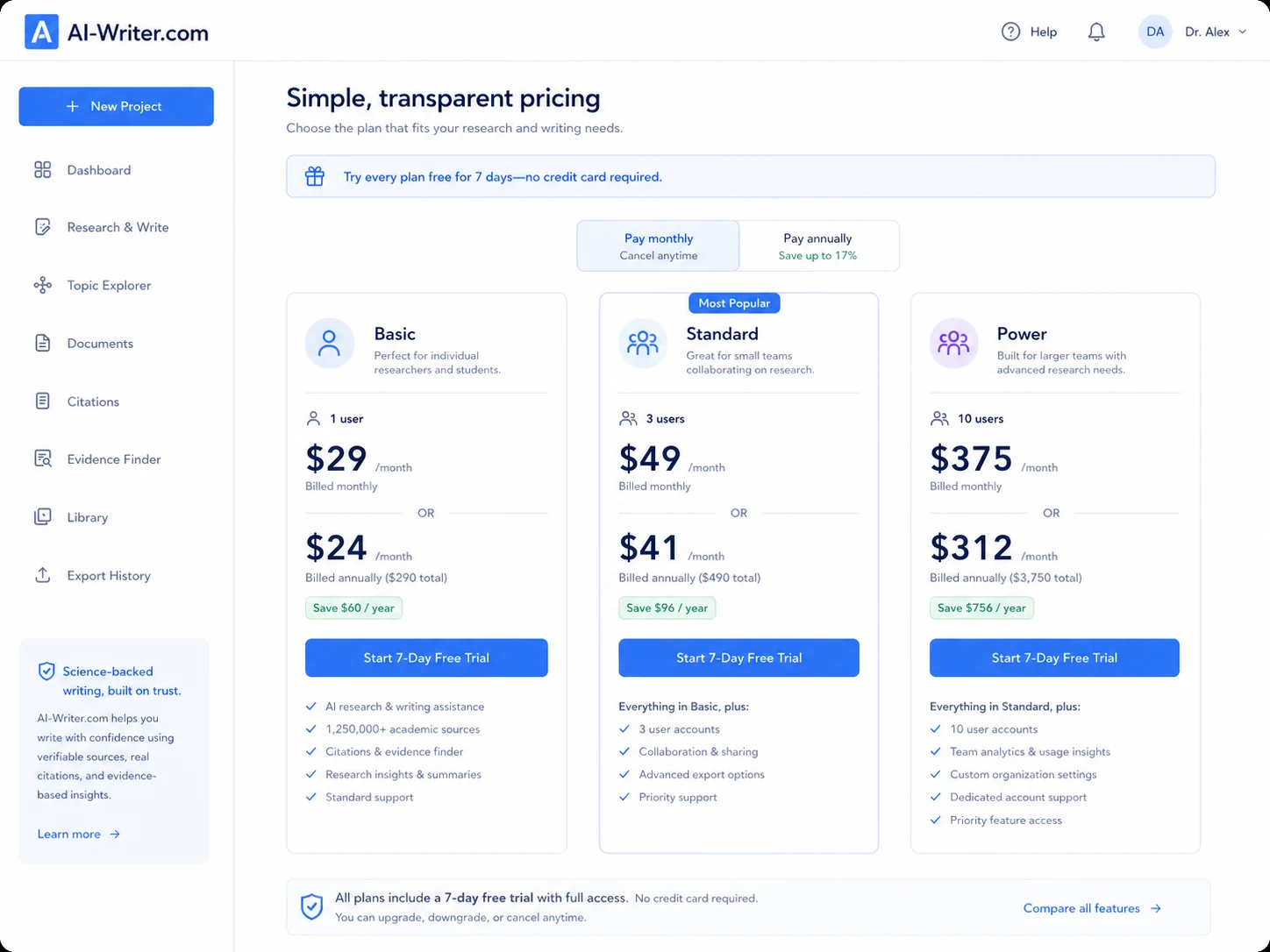
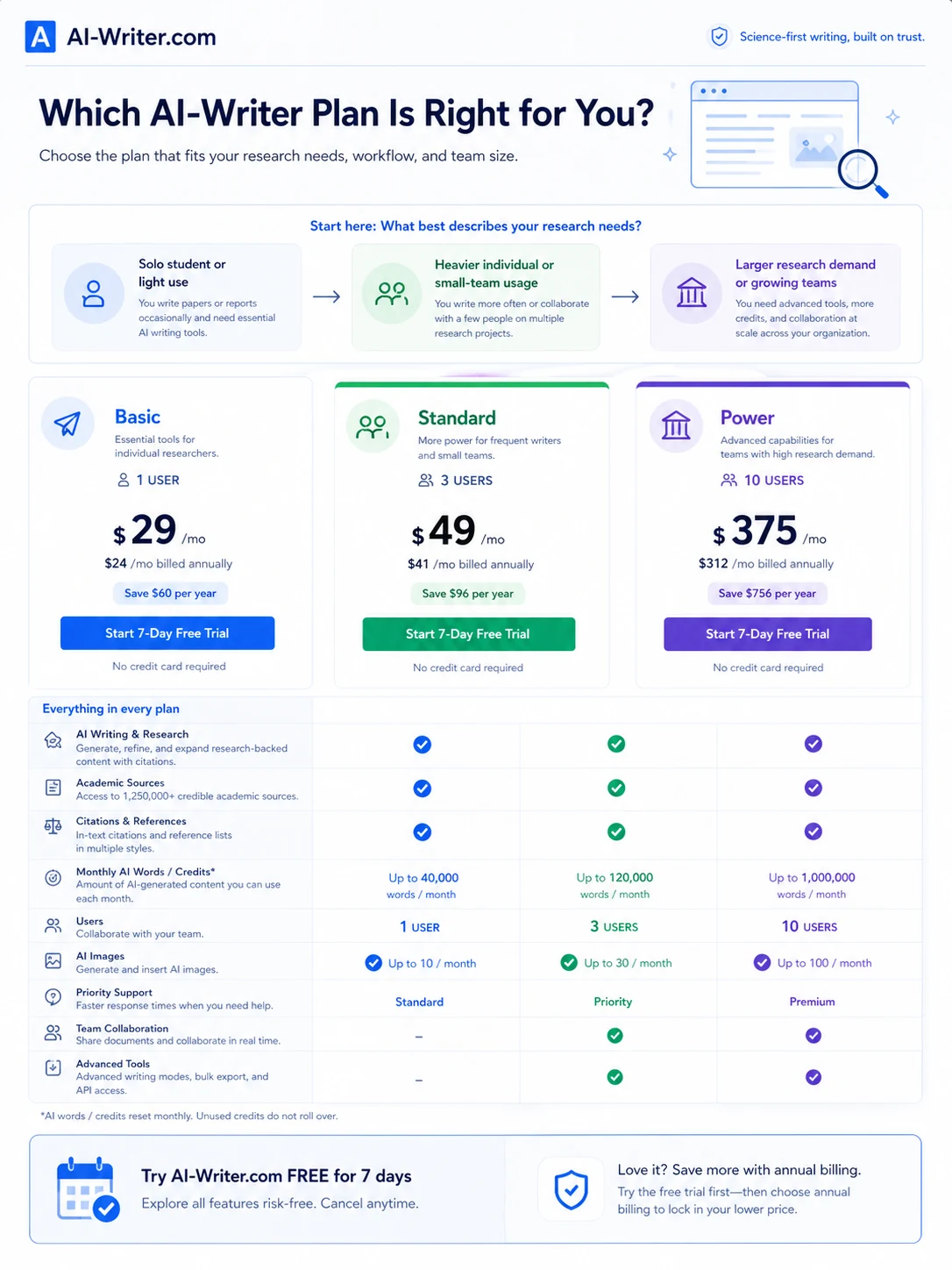
The current public pricing page shows three paid paths: Basic at $29 per month, Standard at $49 per month, and Power at $375 per month. The same page presents annual billing with lower effective monthly prices: Basic at $24 per month billed at $290 yearly, Standard at $41 per month billed at $490 yearly, and Power at $312 per month billed at $3,750 yearly.
The pricing question is not just the headline price.
Basic is the safer first paid step for a single user testing whether source-backed answers are useful enough. Standard becomes more relevant if multiple users or heavier research volume matter. Power is a much bigger jump and should only make sense when the buyer has intense demand for trustworthy AI research.
The official page also presents a 7-day free trial that does not require a credit card and does not automatically become a subscription. That is the right first step for most buyers.
For my money, annual billing should come later. A lower effective monthly price looks attractive, but research tools are only worth annual commitment after they prove repeated value. The buyer should test source relevance, editing workload, and question limits first.
Pricing check: If the trial proves useful, compare monthly and annual billing against your real research volume before checkout.
Check AI-Writer.com pricing Check current offers Read store guide
Free plan, trial, coupon, and checkout notes
A permanent free plan was not clearly presented in the public product data I reviewed. The safer reading is that AI-Writer.com offers a 7-day free trial rather than a long-term free tier.
That trial matters because it is presented as no-card and not auto-converting into a subscription. Buyers should use it seriously. Do not waste the trial on toy prompts. Use one research question that reflects your real work.
Coupon logic is secondary here. AI-Writer.com already has a trial and annual billing savings. A coupon page can be useful near checkout, but it should not drive the decision. The better order is:
- Test the trial.
- Check source relevance.
- Estimate monthly research volume.
- Compare Basic, Standard, and Power.
- Review monthly versus annual billing.
- Check the current coupon or deal route only after the product fit is clear.
A discount cannot fix weak citations, poor fit, or a workflow you will not repeat.
What I would check before buying AI-Writer.com
If I were buying AI-Writer.com for a real research workflow, I would check these points before paying:
- Whether the cited sources actually support the generated claims.
- Whether the source paragraphs are specific enough to verify quickly.
- Whether the output still needs heavy rewriting before it becomes usable.
- Whether Basic gives enough user access and answered-question capacity for the month.
- Whether Standard or Power is justified by real team usage, not vague future plans.
- Whether annual billing is worth the larger commitment after the trial.
- Whether cancellation and refund expectations are clear enough for your risk tolerance.
The easy mistake is treating citations as a trust shortcut.
The better move is to use citations as a verification path. If AI-Writer.com makes verification faster, it can be useful. If you still have to rebuild the research manually, the paid plan becomes harder to defend.
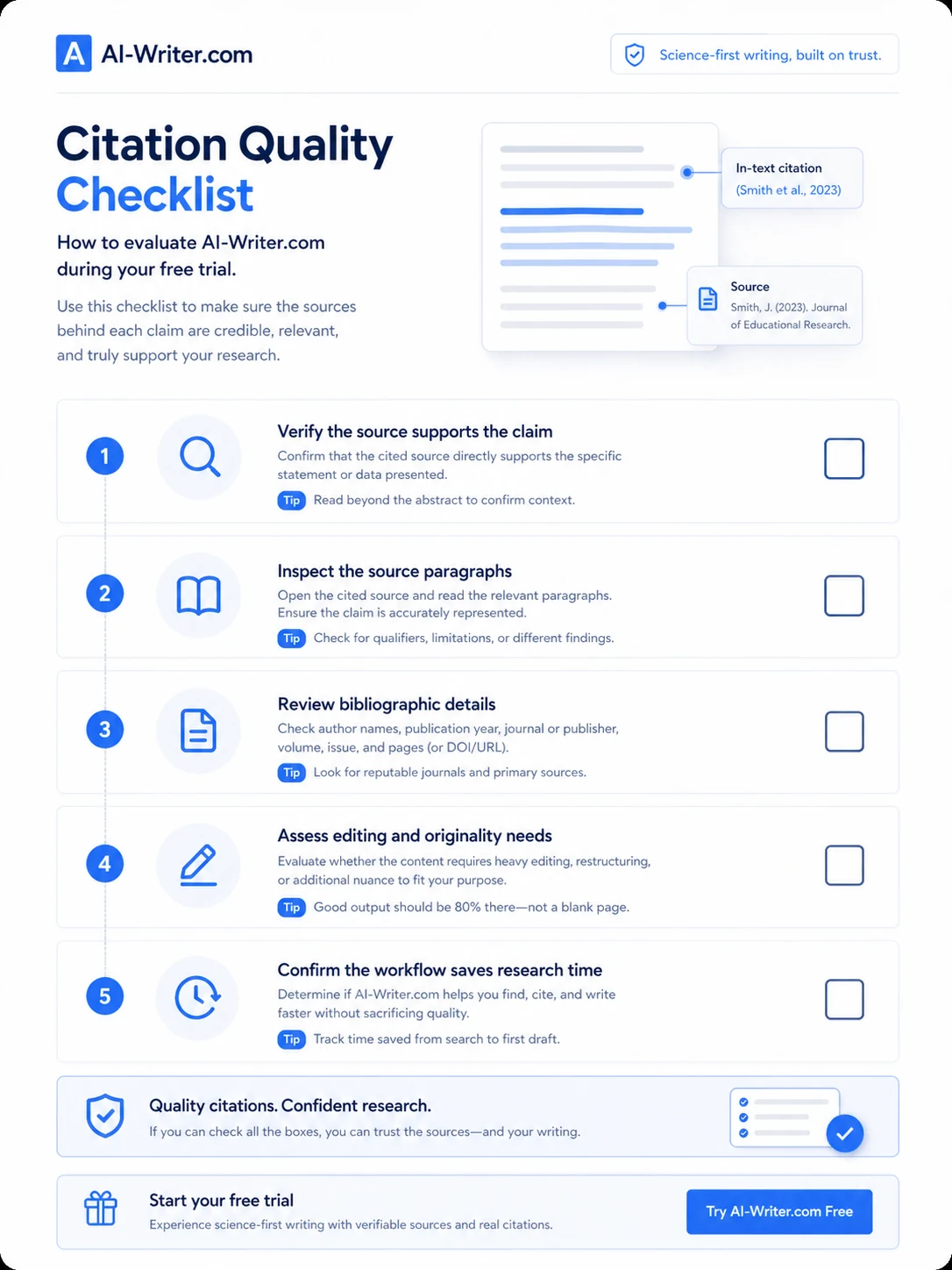
A simple test before paying
Before paying, I would run a small test like this:
- Choose one research question that normally takes at least an hour to source manually.
- Generate an answer inside AI-Writer.com.
- Open several cited source paragraphs and check whether they support the claims.
- Export or copy the output into your normal writing environment.
- Edit the draft until it meets your standard.
- Track whether the tool saved meaningful time after verification.
- Decide whether this kind of task happens often enough to justify a monthly plan.
This test is intentionally practical. It avoids the trap of asking whether the output “looks good.” Looking good is not enough for research-backed writing.
Pros explained
The biggest advantage is source traceability. AI-Writer.com gives buyers a clearer verification path than many broad AI writers. That matters when claims need to be checked, not merely polished.
The second advantage is the research-first workflow. Topic Explorer and review-paper style organization are more useful for structured research than a simple blank prompt box. This helps when the buyer does not yet know which questions the article or paper should cover.
The third advantage is the trial structure. A no-card 7-day trial lowers the risk of testing the tool honestly before paying. That is especially important because research quality is hard to judge from a homepage.
The fourth advantage is focus. AI-Writer.com is not trying to be every writing tool at once. It is easier to understand when judged as a source-backed research assistant.
That focus is also the boundary. It is a strength only if your workflow needs it.
Cons explained
The first drawback is creative fit. AI-Writer.com is not the obvious choice for brand voice, social media, landing pages, or campaign copy. Buyers who need that may find Rytr, Copy.ai-style tools, or other marketing writers more natural.
The second drawback is verification responsibility. The product can surface citations, but it cannot remove the need for human review. If a buyer blindly trusts generated research, the tool becomes risky.
The third drawback is paid-plan justification. Basic is not unusually expensive for a specialized research writer, but the value depends on how often you use it. Standard and Power need an even clearer workload.
The fourth drawback is refund clarity. I found privacy and legal information, plus cancellation guidance in the public FAQ, but I would not rely on a generous refund window unless the current checkout or support terms explicitly confirm it.
None of these drawbacks make AI-Writer.com a bad product. They just define the right buyer.
Green flags and red flags
Green flags:
- You regularly write research-backed content.
- You care more about source traceability than playful writing style.
- You have one or more real questions to test during the trial.
- You are willing to read and verify cited source paragraphs.
- You can measure whether the tool saves time after editing.
Red flags:
- You only want quick marketing copy.
- You expect citations to remove the need for judgment.
- You are considering annual billing before testing a real workflow.
- You do not know how many research questions you will run per month.
- You mainly want a coupon instead of a better research process.
The product becomes stronger when buyers know exactly what they need from it. It becomes weaker when buyers treat it as another general-purpose AI writer.
AI-Writer.com vs alternatives
AI-Writer.com should be compared by job, not by feature count.
Jenni AI vs AI-Writer.com
Jenni AI is usually the stronger comparison for buyers who want academic writing assistance inside a document-style workflow. It may feel more natural for drafting, editing, and building academic text interactively.
AI-Writer.com may make more sense when the buyer starts from research questions and wants cited answers, source paragraphs, and bibliography details as the main workflow.
NeuronWriter vs AI-Writer.com
NeuronWriter is an adjacent route, not a direct research-writing replacement. It is stronger when the job is SEO optimization, SERP planning, content scoring, and competitive structure.
AI-Writer.com is stronger when the job is source-backed research. An SEO writer may use both types of tools, but for different steps.
Rytr vs AI-Writer.com
Rytr is a simpler low-cost route for short-form drafts, ideas, and basic marketing copy. It is easier to justify when citations are not important.
AI-Writer.com is the better fit when the buyer needs to inspect sources. If you do not need that, a cheaper general writer may be enough.
WordAI vs AI-Writer.com
WordAI is more focused on rewriting and variation. It is not trying to be a research assistant.
AI-Writer.com is better for building a cited starting point. WordAI is more relevant after you already have text and need rewritten variants.
Trust, refund, and buyer-risk notes
The trust question with AI-Writer.com is not whether it writes confidently. Most AI tools can do that now. The trust question is whether it helps you verify.
The official product positioning around scientific literature, citations, source paragraphs, bibliography details, and Topic Explorer is useful. It gives buyers a clearer way to inspect claims than a normal chatbot. But source-backed output still needs human review.
Pricing is clear enough to compare plan paths, but buyers should verify the current page before checkout. Plan names, question limits, user counts, and annual billing terms can change. I would also confirm cancellation expectations inside the account flow or current support terms before paying.
Refund risk deserves caution. A clear public refund window was not something I would lean on as the main safety net. The trial is the safer protection. Use it before entering a paid plan.
Data and privacy also matter because research prompts may contain sensitive ideas, unpublished work, client information, or academic material. Before uploading anything confidential, read the current privacy and legal pages and decide whether the tool fits your risk tolerance.
Coupon risk is simple: do not buy because of a code. Check current offers only after the tool passes your research workflow test.
Final verdict
AI-Writer.com is a good candidate if you need source-backed research writing and you are willing to verify the citations.
I would consider it if your work involves academic research, technical explainers, research-backed SEO articles, literature-style planning, or complex questions where traceable sources matter. I would start with the trial, test one serious question, and then decide whether Basic is enough before looking at larger plans.
I would skip it if you mainly need creative copy, brand voice, social posts, emails, or cheap general writing output. In that case, the research layer may feel heavier than necessary.
I would compare it with Jenni AI if academic drafting is the main job. I would compare it with NeuronWriter if SEO optimization is the real bottleneck. I would compare it with Rytr or another general writer if the task is simple marketing copy. I would compare it with WordAI if rewriting is the actual need.
The safest judgment is this: AI-Writer.com is not a generic AI writer with citations sprinkled on top. It is a research-first writing tool. If that is the problem you actually have, it is worth testing. If not, a cheaper or more creative alternative may be the cleaner buy.