Quick verdict
ProxyScrape is worth considering if you need proxy infrastructure for a real workflow, not just a pile of IPs that looks cheap on a pricing page.
That is the main buying distinction.
ProxyScrape gives buyers several routes: free public proxies, a limited Premium Trial, shared datacenter proxies, rotating residential proxies, unlimited residential plans, dedicated datacenter proxies, mobile proxies, and a Google SERP API path. That breadth is useful, but it also makes the decision easier to get wrong. A cheap datacenter package can be the wrong fit for a sensitive location-based workflow. A residential plan can be unnecessary if your task only needs stable datacenter speed. A free proxy list can help you learn, but it should not be treated like business infrastructure.
For my money, ProxyScrape makes the most sense for developers, SEO operators, QA teams, market research workflows, and automation buyers who already understand the job they are trying to solve. It is weaker for beginners who have not defined the workload, the protocol requirement, the target locations, or the compliance boundary.
The strongest reason to shortlist ProxyScrape is flexibility. The main caution is that proxy buying is usage-sensitive. Pricing, refund eligibility, traffic limits, protocol support, and target-site rules matter more than the lowest visible price. The safest next step is to test small, measure against the real workflow, and only then scale.
Next step: If ProxyScrape still fits your proxy workflow, verify the current buyer route before sending meaningful traffic through a paid plan.
Review snapshot
| Review point | Practical take |
|---|---|
| Best for | Developers, SEO teams, QA testers, automation users, and data teams that need configurable proxy infrastructure |
| Not ideal for | Buyers who expect free proxies to behave like production infrastructure or want a fully managed scraping service |
| Main use case | Routing legitimate public-data, monitoring, testing, localization, and automation workflows through the right proxy type |
| Pricing note | Product-based pricing, including datacenter per-proxy paths, residential per-GB paths, and higher-scale proxy products |
| Free path | Free public proxy list plus a limited 7-day Premium Trial for shared datacenter proxies |
| Main strength | Broad proxy product choice with dashboard, API, free testing, and multiple buying routes |
| Main concern | Choosing the wrong proxy type, overusing traffic before refund eligibility, or relying too heavily on free proxies |
| Direct alternatives | Webshare, Bright Data, Oxylabs, Decodo |
| Best next step | Define the workload, test the smallest relevant path, then compare proxy economics before scaling |
What is ProxyScrape?
ProxyScrape is a proxy infrastructure provider. In plain buyer language, it helps users route traffic through different proxy types so they can support legitimate workflows such as public web data collection, SEO monitoring, QA testing, localization checks, price monitoring, and automation.
It is not a complete scraping platform that magically collects, cleans, stores, and delivers data for you. It is the proxy layer. You still need the script, browser automation setup, data pipeline, compliance process, retry logic, target-site review, and monitoring discipline around it.
That matters because buyers sometimes judge proxy providers like normal SaaS tools. They look for the cheapest monthly number or the largest IP pool. Proxy buying is different. The same provider can be a good fit or a bad fit depending on the target site, traffic volume, location needs, protocol support, session behavior, and acceptable-use rules.
ProxyScrape currently presents itself around residential proxies, shared and dedicated datacenter proxies, unlimited residential proxies, mobile proxies, a free proxy list, proxy-checking tools, API access, and SERP-focused infrastructure. The product is broad enough to serve several buyer types, but it is not broad enough to remove the buyer’s responsibility to choose carefully.
Our review approach compares public product pages, pricing details, help documentation, buyer workflow fit, and nearby alternatives. I would not treat a free proxy list, a low per-proxy number, or a trial path as proof that ProxyScrape fits your workload. The better question is whether it gives you the proxy type your workflow actually needs.
Who should use ProxyScrape?
ProxyScrape is most useful for buyers who can define their proxy job before opening the pricing page.
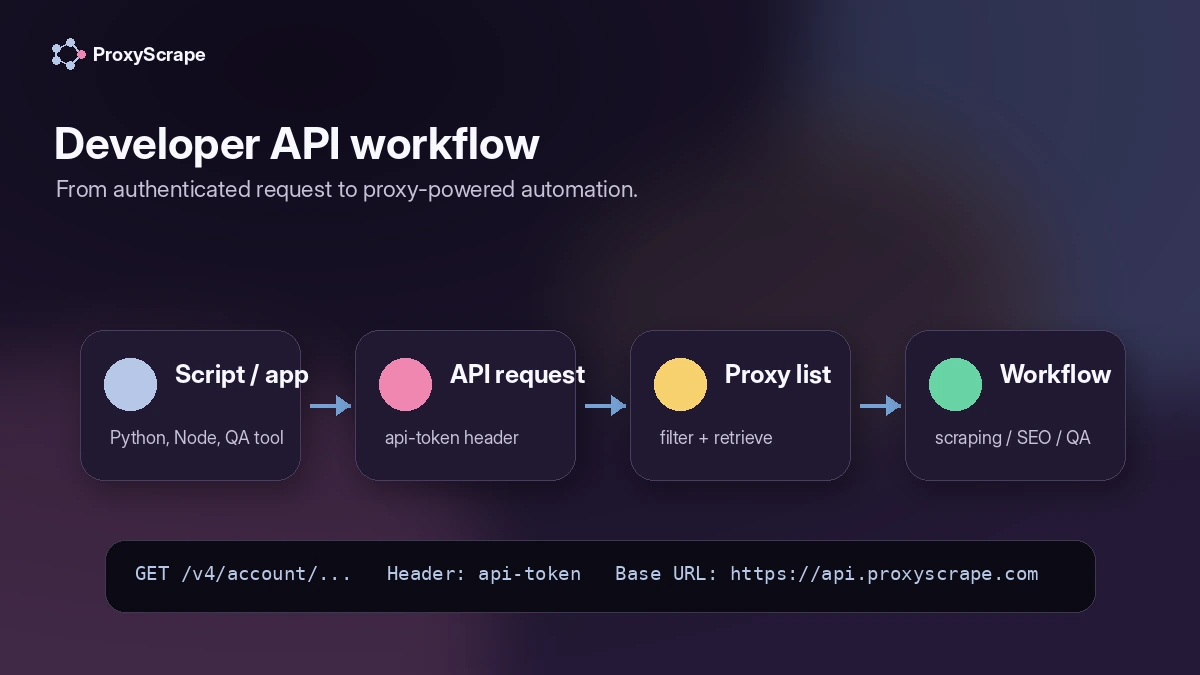
Developers and data teams are the clearest fit. If you already have scripts, browser automation, or internal tooling, ProxyScrape can provide the proxy layer you plug into that system. The condition is that you must test authentication, protocol support, request success rate, bandwidth use, and retry behavior on the actual workflow.
SEO teams may also find it useful for localized checks, SERP monitoring, rank-tracking workflows, and regional search behavior. In this case, location coverage and consistent results matter more than a generic “large IP pool” claim. I would verify whether the specific locations and session behavior fit the SEO workflow before buying a larger package.
QA and localization teams can use proxies to inspect how pages, offers, redirects, or content behave from different regions. Dedicated datacenter or residential access can both make sense here, depending on whether the test needs stability or real-user IP characteristics.
Market research and price monitoring teams may consider ProxyScrape when they already have a compliant public-data workflow and need proxy infrastructure to support it. The caution is that success depends on more than the proxy provider. Target-site rules, request pattern, data use, and tooling all matter.
Automation users can also shortlist ProxyScrape, especially if API-managed access or dashboard-based proxy management matters. The buyer condition is simple: confirm the current API, protocol, and authentication model before building around it.
Who should avoid ProxyScrape?
ProxyScrape is not the first tool I would recommend to someone who does not yet know which proxy type they need.
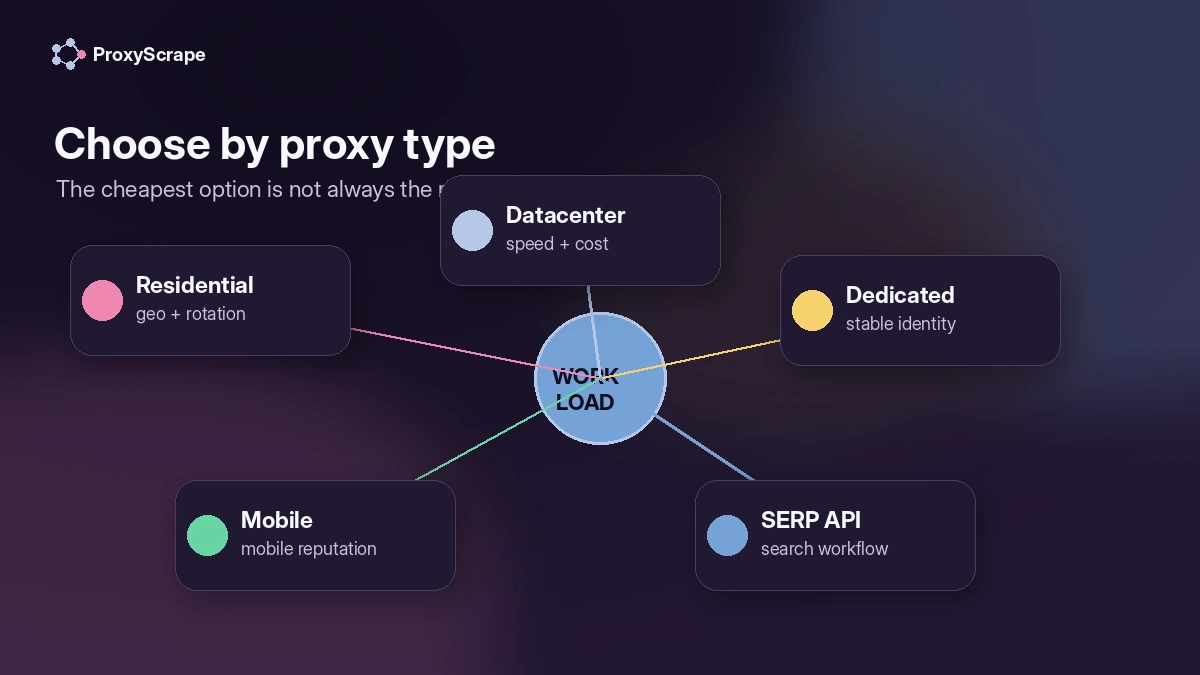
If you cannot explain whether your workflow needs datacenter proxies, rotating residential IPs, dedicated IPs, mobile proxies, or a SERP API, slow down. The wrong product path can make the cheapest plan expensive because the job still fails.
I would also be careful if you expect free public proxies to be private, stable, fast, or safe enough for production work. Free proxy lists are useful for learning and low-risk experiments. They are not a replacement for controlled paid infrastructure.
Teams that want a fully managed scraping service should compare broader platforms before buying ProxyScrape. ProxyScrape can supply the proxy layer, but it does not remove the need to configure tools, manage errors, respect rules, and process the output.
Larger organizations with procurement, compliance, governance, and managed-data requirements should compare Bright Data, Oxylabs, and other enterprise-oriented providers. ProxyScrape may still be useful, but the buying process should be more rigorous than a quick self-serve checkout.
Finally, anyone planning activity that violates laws, platform terms, account policies, or target-site rules should not treat a proxy provider as permission. A proxy is infrastructure, not a compliance shield.
How ProxyScrape fits into a real workflow
A practical ProxyScrape workflow starts before checkout.
First, define the job. Are you collecting public data, testing location-specific pages, monitoring search results, checking prices, running QA, or powering automation? That decision changes the proxy type.
Second, choose the smallest relevant test path. For rough learning, the free proxy list may be enough. For shared datacenter testing, the Premium Trial is more useful. For residential traffic, a small paid traffic test may be more realistic than trying to force a datacenter proxy into a residential-style job.
Third, run the proxy inside your real tool. Do not test only in isolation. Test inside Playwright, Selenium, a scraper, a SERP workflow, a monitoring job, or whatever process you will actually use.
Fourth, measure the practical signals: request success, speed, bandwidth consumption, location accuracy, session behavior, authentication friction, and error handling. This is where many proxy purchases succeed or fail.
Fifth, decide whether the issue is the proxy type, your script, the target site, compliance constraints, or the package size. Buying more proxies is not always the fix.
This is the buyer mistake I would watch for: buying a larger package before proving the smaller test. Proxy infrastructure should be scaled after the workflow works, not before.
Real-world buyer scenarios
A developer building a public-data workflow
A developer with an existing scraper may find ProxyScrape useful because it offers proxy types, API documentation, and dashboard access that can fit into a technical pipeline. The fit depends on whether the workflow needs datacenter speed, residential rotation, sticky sessions, location targeting, or a more specialized SERP route.
Where it may fail: assuming the proxy provider alone solves bans, retries, parsing, or target-site restrictions. The developer should test against the actual target before scaling.
An SEO team checking regional search behavior
An SEO team may use ProxyScrape for localized rank checks, SERP monitoring, and region-specific testing. Residential proxies or a SERP-focused path may be more relevant than the cheapest datacenter option.
Where it may fail: choosing based on price instead of location reliability, session behavior, and search-result consistency. I would compare ProxyScrape with more specialized SERP and enterprise proxy providers if the workflow is mission-critical.
A QA team testing location-specific pages
QA teams may use proxies to verify how websites, offers, redirects, and content behave across regions. Dedicated datacenter proxies can make sense when stability matters. Residential proxies may make more sense when the test needs real-user IP characteristics.
Where it may fail: not documenting what is being tested. A proxy can show a regional view, but the QA process still needs repeatable checks and clear acceptance criteria.
A beginner trying free proxies
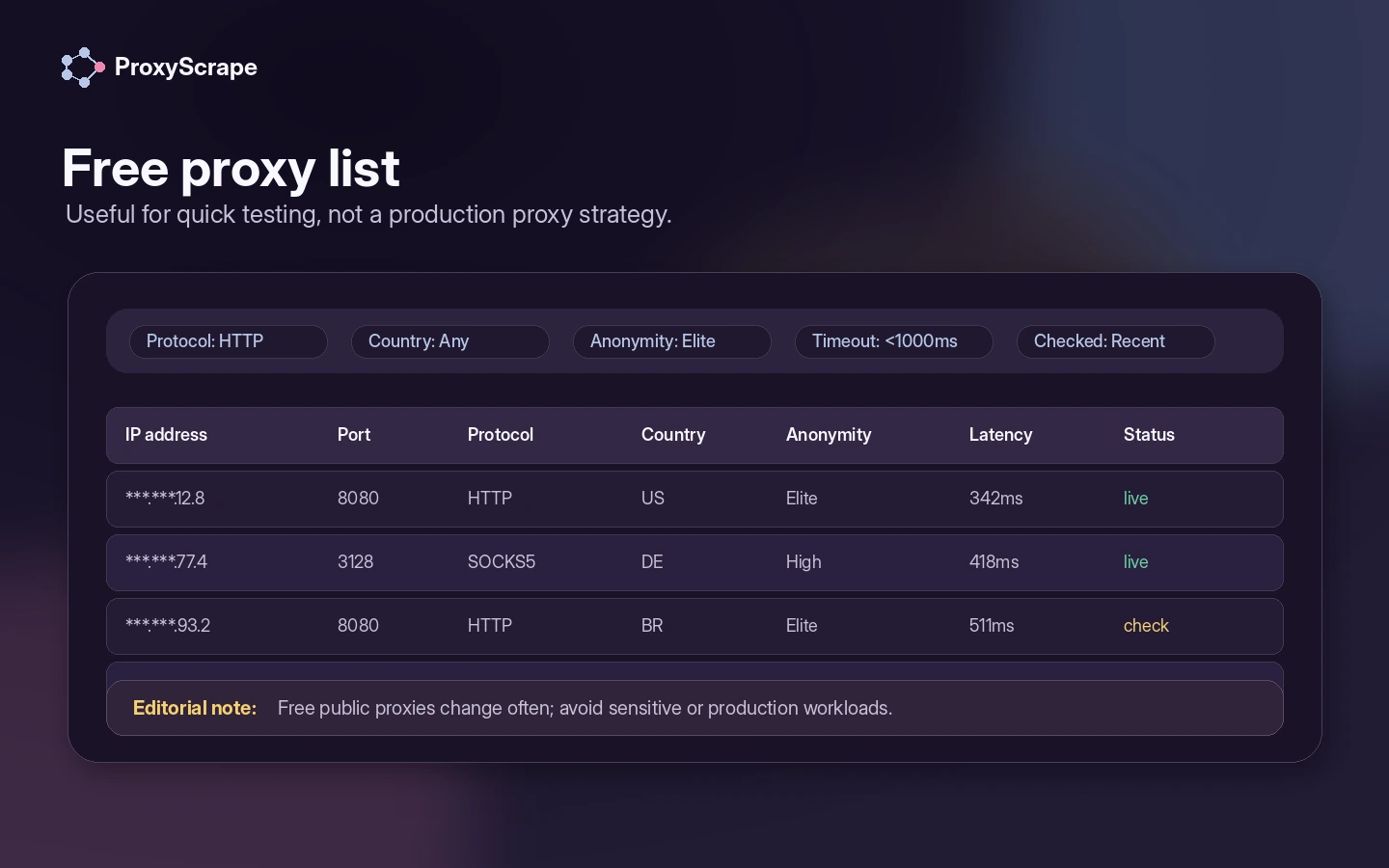
A beginner may start with ProxyScrape’s free proxy list to understand protocols, latency, anonymity labels, and proxy-checking basics. That is a reasonable learning path.
Where it may fail: treating free proxies as a production plan. Free public proxies can be unstable, blocked, slow, or unsuitable for sensitive work. The buyer should move to a controlled test path before using proxies for business operations.
Key features that actually matter
Multiple proxy product paths
ProxyScrape’s main feature is not one single proxy plan. It is the range of proxy paths: free public proxies, shared datacenter, dedicated datacenter, rotating residential, unlimited residential, mobile proxies, and SERP API options.
That matters because different jobs need different infrastructure. Datacenter proxies are often the cost-control path. Residential proxies may fit geo-sensitive or success-rate-sensitive workflows. Dedicated proxies can be better for stable monitoring. Mobile proxies are more specialized.
Buyer note: choose by workload first, not by the cheapest visible number.
Free proxy list and Premium Trial
The free proxy list is useful for learning and low-risk experiments. The 7-day Premium Trial is more relevant if you want to test shared datacenter proxies with defined limits before paying.
This is helpful because proxy buyers often need to test before committing. The limitation is that a free list and a datacenter trial do not prove that a residential, mobile, dedicated, or SERP workflow will work.
Buyer note: treat free access as a test lane, not a guarantee of paid-plan value.
API and account management
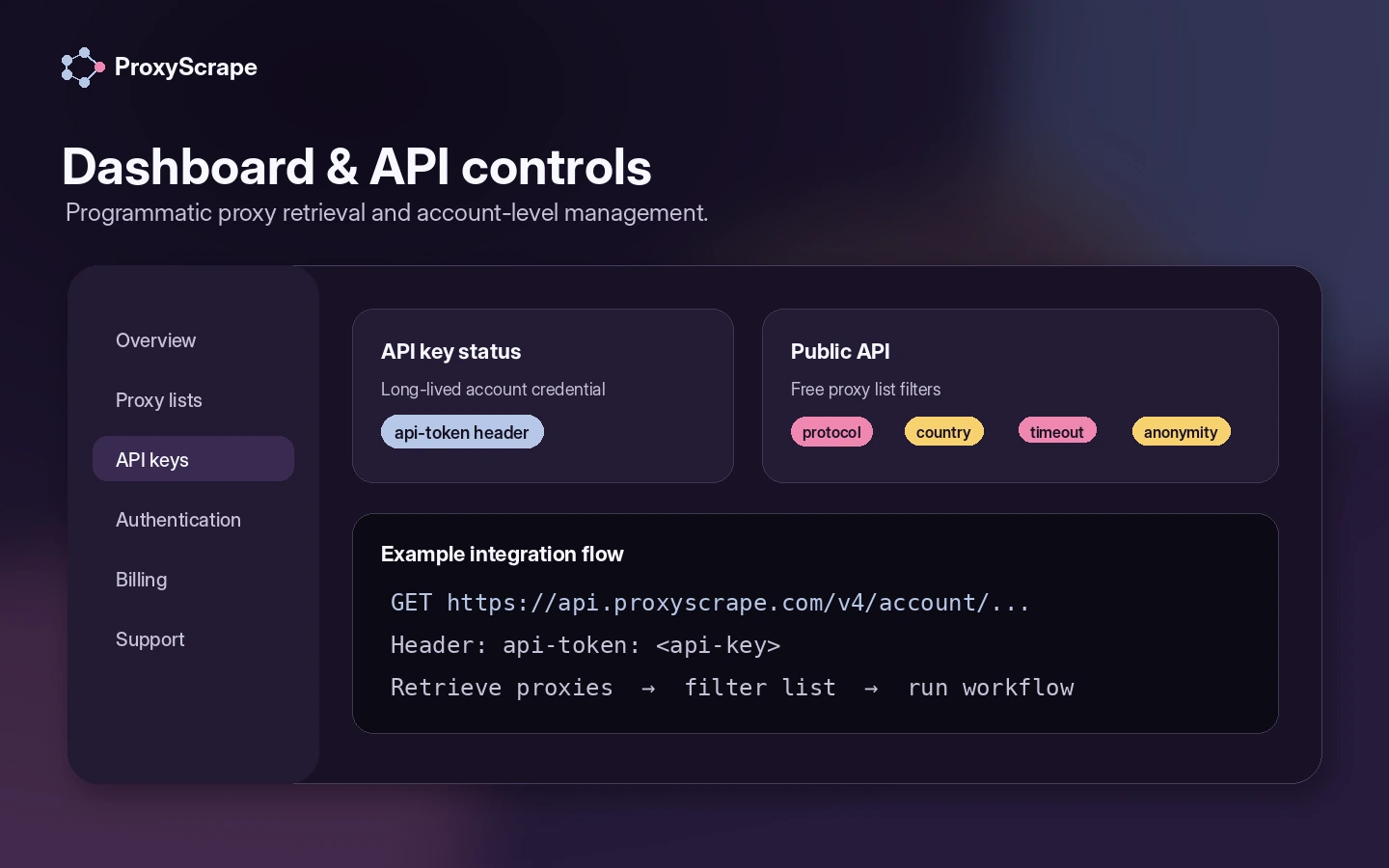
ProxyScrape’s API documentation matters for technical buyers. Public API access can support free proxy list retrieval, while authenticated account access can support more controlled workflows.
This becomes useful when proxy management needs to be repeatable inside internal tools. Manual copy-paste proxy use is one thing. Programmatic proxy retrieval and account-level management is another.
Buyer note: verify the current API token flow, endpoint coverage, permissions, and plan-level access before building around it.
Protocol and session differences
Protocol support is not a minor detail. HTTP, SOCKS5, UDP support, authentication style, session length, rotation behavior, and sticky-session needs can change whether a proxy product fits.
This is where buyers often overestimate feature lists. A proxy that works for one tool or target may not fit another.
Buyer note: test the exact protocol and authentication method your tool needs.
Product-based pricing
ProxyScrape pricing changes by proxy product. Some paths are priced by proxy count, others by traffic, bandwidth, duration, or custom package logic.
This flexibility is useful, but it makes price comparison harder. A low per-proxy datacenter entry and a per-GB residential plan are not interchangeable.
Buyer note: compare the billing unit against your real traffic estimate before assuming one path is cheaper.
Pricing and plan value
ProxyScrape is not a simple “one plan fits all” subscription.
The current public pricing structure is product-based. The site presents rotating residential, unlimited residential, premium datacenter, dedicated datacenter, mobile proxy, and Google SERP API routes. It also shows examples such as shared datacenter pricing from a low per-proxy entry, residential traffic sold by bandwidth, unlimited residential options for high-volume use, and dedicated datacenter packages.
The practical pricing question is not “what is the cheapest visible option?” The better question is “what unit am I actually paying for?”
A datacenter plan can be attractive when you need speed, lower cost, stable monitoring, and less sensitive routing. A rotating residential plan can make more sense when the workflow needs location depth, IP rotation, and more real-user-like network characteristics. Unlimited residential sounds appealing when traffic is high and predictable, but it is not automatically better for smaller workflows. Dedicated proxies are more relevant when stable allocation and reputation control matter.
The free proxy list is useful for basic learning. The Premium Trial is useful for testing shared datacenter behavior. Neither should be treated as proof that every paid ProxyScrape product will fit every task.
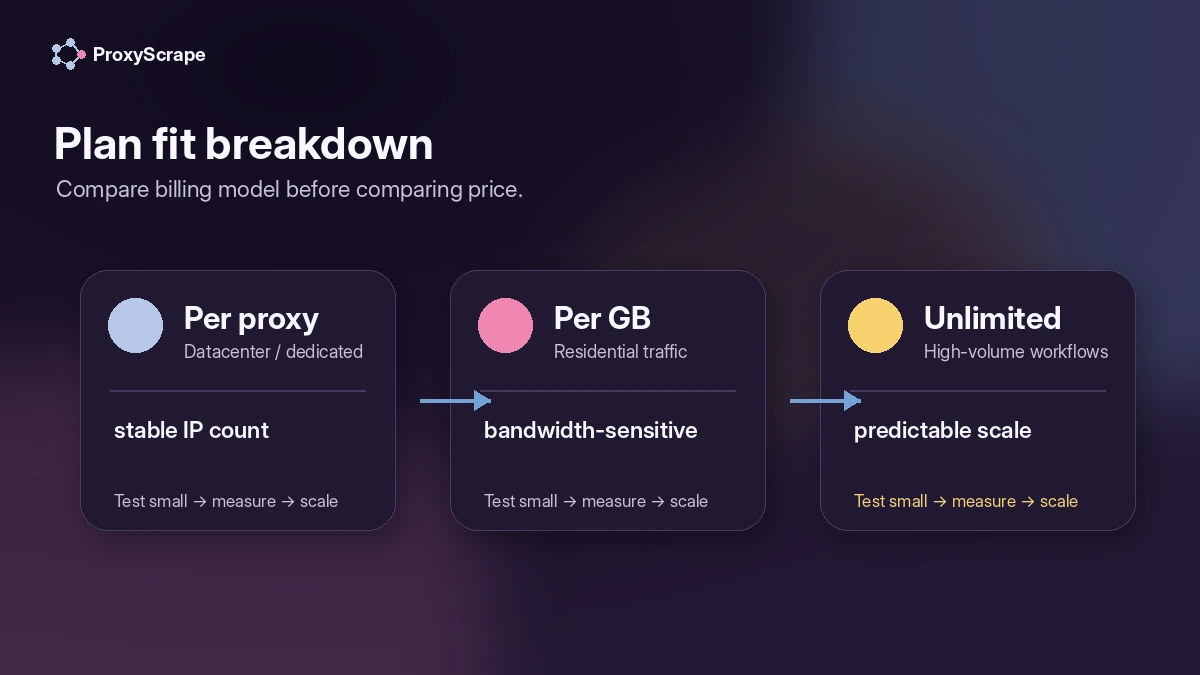
I would start with the smallest path that can prove the actual workflow. Move to a larger monthly or custom package only after measuring success rate, bandwidth use, protocol fit, and refund exposure.
Pricing check: ProxyScrape can be inexpensive or expensive depending on the proxy type you choose, so verify live pricing against your real traffic estimate before scaling.
Free plan, trial, coupon, and checkout notes
ProxyScrape has two useful low-risk entry points: the free public proxy list and the 7-day Premium Trial.
The free proxy list is best for learning, quick experiments, and understanding proxy fields such as protocol, country, anonymity, latency, and last-checked status. I would not use it for sensitive or production workloads. Public proxies can change quickly, and the fact that a proxy appears on a list does not make it reliable enough for business operations.
The Premium Trial is more useful if you specifically want to test shared datacenter proxies. It gives a controlled way to check whether ProxyScrape’s premium datacenter route fits your tool before paying. The limitation is that it does not validate every product path. Residential, unlimited residential, mobile, dedicated, and SERP workflows may need their own test logic.
The coupon angle should be secondary. A current offer can improve the purchase, but it should not drive the decision. The better order is: define workload, test small, verify pricing unit, read refund terms, then check any active offer path.
If you are close to checkout, I would check the ProxyScrape store guide first, then only use the ProxyScrape coupon page after the plan fit makes sense.
What I would check before buying ProxyScrape
If I were buying ProxyScrape for a real workflow, I would check these points before paying:
- Proxy type fit: Do you need datacenter, residential, unlimited residential, dedicated, mobile, or SERP-specific infrastructure?
- Billing unit: Are you paying by proxy count, bandwidth, traffic package, duration, or custom quote?
- Protocol support: Does your workflow need HTTP, HTTPS, SOCKS5, UDP, sticky sessions, or a specific authentication style?
- Location coverage: Are the required countries, cities, or regional routes available for the selected product?
- Real workload test: Have you tested speed, success rate, error behavior, and bandwidth use inside the actual tool?
- Refund conditions: Can you stay within the three-day and usage-sensitive refund conditions while testing?
- Compliance boundary: Does your planned use respect target-site rules, platform policies, privacy obligations, and applicable laws?
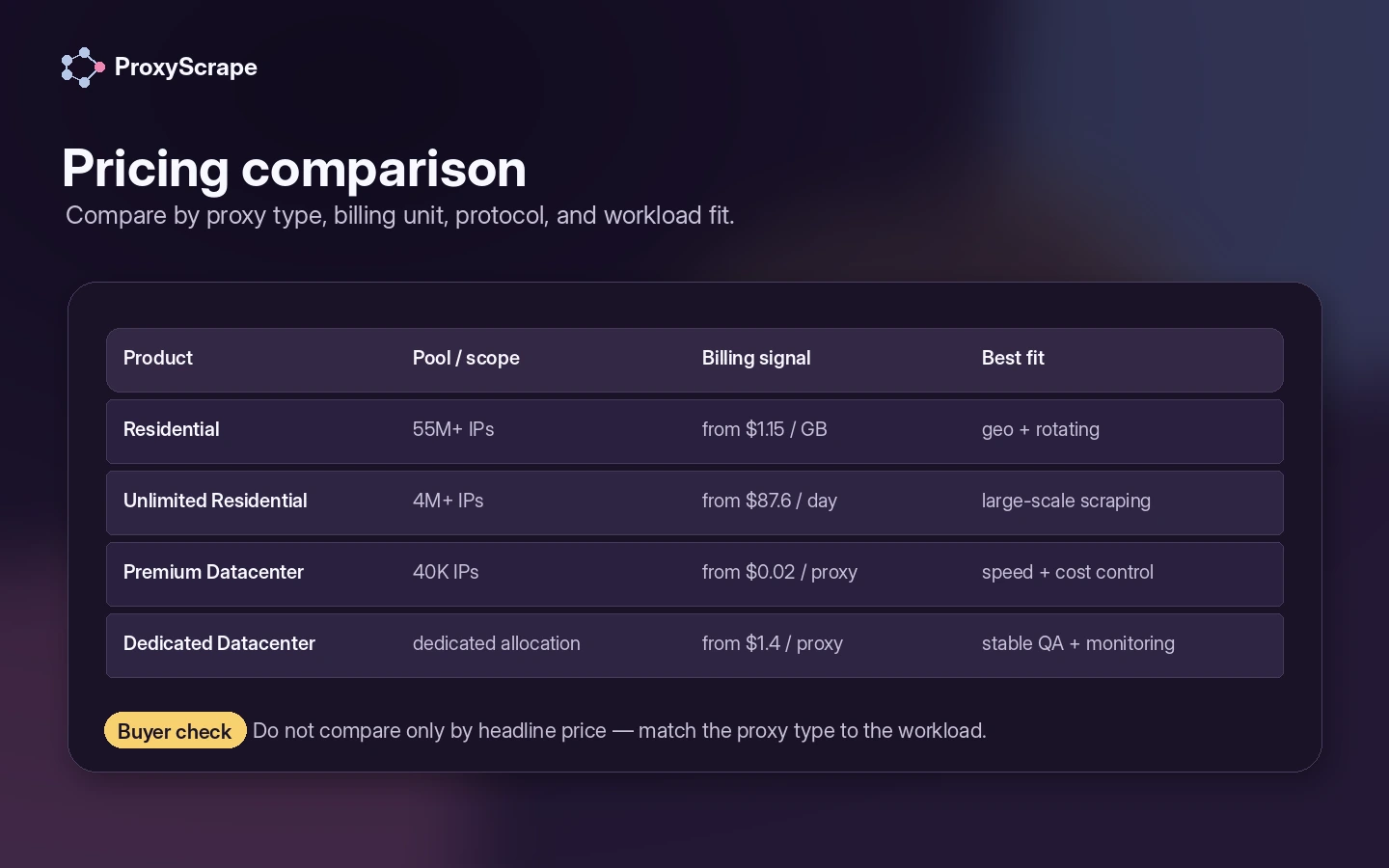
The first thing I would verify is proxy type. If that is wrong, the rest of the buying decision becomes noisy.
A simple test before paying
Before committing to a larger package, I would run a small test like this:
- Pick one real workflow, not a generic benchmark.
- Choose the smallest relevant ProxyScrape path for that workflow.
- Run the proxy inside the actual tool or script you plan to use.
- Track success rate, latency, bandwidth use, blocks, errors, and location behavior.
- Compare results against at least one alternative route or provider if the workflow matters commercially.
- Read refund and cancellation terms before sending meaningful traffic.
- Scale only after the proxy type and pricing unit both make sense.
This test will not prove everything, but it will reveal the main mismatch early. If the trial or small package does not work in the real workflow, a larger package probably will not fix the underlying decision.
Pros explained
ProxyScrape’s first real advantage is product range. You can evaluate free proxies, premium shared datacenter proxies, rotating residential proxies, unlimited residential traffic, dedicated proxies, mobile proxies, and SERP-related options in one provider ecosystem. That makes it easier to compare proxy categories without starting from zero each time.
The second advantage is the low-risk learning path. A free public proxy list and a limited Premium Trial give cautious buyers a way to test before paying. This matters in a category where buying too much too early is a common mistake.
The third advantage is developer fit. API documentation and dashboard-based access make ProxyScrape more practical for technical workflows than a simple proxy list site. If your team needs repeatable retrieval, filtering, or account-level management, this matters.
The fourth advantage is pricing flexibility. ProxyScrape can serve small tests, datacenter-volume needs, residential traffic, and larger proxy workloads. That flexibility is valuable when the buyer knows how to estimate usage.
The limit to all these pros is the same: they help only when the buyer chooses the right path. ProxyScrape is flexible, but flexibility does not replace planning.
Cons explained
The first drawback is decision complexity. ProxyScrape gives buyers many proxy paths, and that creates room for mismatch. A beginner may choose by price and end up with the wrong infrastructure for the job.
The second drawback is the free proxy temptation. Free public proxies can be useful, but they are not a production plan. They can be unstable, blocked, slow, or unsuitable for sensitive workflows. Buyers who expect free proxies to behave like paid infrastructure will likely be disappointed.
The third drawback is refund tightness. The refund path is conditional, short, and usage-sensitive. That does not make it unfair by itself, but it does mean buyers should not casually test large traffic volumes and assume they can reverse the purchase later.
The fourth drawback is that ProxyScrape is not a managed scraping solution. If you need data extraction, anti-bot orchestration, compliance support, parsing, storage, scheduling, and delivery in one service, a broader web data platform may be a better fit.
The fifth caution is operational responsibility. Proxy infrastructure can support legitimate work, but it also requires discipline. If your team does not document acceptable use, target-site rules, and data handling, the tool will not solve that gap for you.
Green flags and red flags
A green flag is that ProxyScrape gives buyers multiple ways to test before scaling. The free proxy list and Premium Trial are useful if you use them carefully.
Another green flag is the visible product separation. Residential, datacenter, dedicated, mobile, unlimited, and SERP routes are different enough that buyers can think in workflow terms rather than forcing every job into one plan.
The API documentation is also a positive signal for technical buyers. A proxy provider becomes more useful when it can support repeatable workflows, not only manual dashboard actions.
The red flags are mostly about buyer behavior.
Slow down if you are buying only because the per-proxy number looks low. Slow down if you have not tested the selected proxy type against the real target. Slow down if refund eligibility matters but you plan to send meaningful traffic immediately. Slow down if you are trying to use proxies for activity that violates rules or creates legal risk.
The product can make sense. The rushed purchase is the part I would avoid.
ProxyScrape vs alternatives
ProxyScrape should be compared with proxy providers by use case, not by homepage claims alone.
Webshare vs ProxyScrape
Webshare is often the stronger comparison if you want a simpler self-serve proxy buying experience. It can feel more straightforward for buyers who mainly want proxy server packages, clear account controls, and a familiar dashboard flow.
ProxyScrape may still make more sense if you want the free proxy list, Premium Trial, multiple proxy product paths, and a developer-friendly route in the same ecosystem.
Bright Data vs ProxyScrape
Bright Data is the stronger comparison for enterprise data collection, compliance workflows, datasets, scraping tools, and larger procurement requirements. It is not the same buying experience as a low-entry proxy package.
ProxyScrape may be the more approachable route if you want a smaller self-serve test before considering enterprise infrastructure.
Oxylabs vs ProxyScrape
Oxylabs is a serious alternative for larger teams that need premium proxy infrastructure, scraping APIs, enterprise support, and deeper operational reliability. It is usually the comparison I would make when the proxy workflow is business-critical.
ProxyScrape may still fit smaller teams that want flexible proxy access without immediately moving into enterprise-level buying.
Decodo vs ProxyScrape
Decodo is worth comparing when residential proxy usability, scraping infrastructure, onboarding, and business-friendly workflows matter. It may feel more polished for teams that want more guidance around residential proxy use.
ProxyScrape may still appeal to buyers who want a free test path, self-serve proxy choice, and a broader mix of proxy products.
Trust, refund, and buyer-risk notes
The trust question with ProxyScrape is not only whether the provider is real. It is whether your buying path is controlled enough to avoid waste.
The first risk is pricing misunderstanding. A per-proxy datacenter price, a per-GB residential price, an unlimited residential package, and a dedicated proxy allocation are different economic models. Compare them using your expected traffic, not a generic feature table.
The second risk is refund exposure. ProxyScrape describes a conditional refund path, but the conditions are narrow enough that buyers should test carefully. If refund flexibility matters, read the current terms before purchasing and keep initial usage controlled.
The third risk is data and privacy. Proxy providers naturally process account, authentication, traffic, and connection-related information. Buyers with sensitive workflows should read the privacy policy and decide whether the service fits internal requirements before using it in production.
The fourth risk is compliance. Proxy infrastructure should be used for legitimate, lawful, and policy-respecting purposes. Do not treat proxy access as a shortcut around target-site rules, account restrictions, or privacy obligations.
The fifth risk is overbuying. Bigger proxy pools and broader plans can sound safer, but they are not automatically better. Scale after the test proves the selected route.
Final verdict
ProxyScrape is a good shortlist candidate if you need flexible proxy infrastructure and you are willing to test the right proxy type before buying at scale.
I would consider it if you are a developer, SEO operator, QA tester, market researcher, or automation buyer with a legitimate workflow and a clear reason to use proxies. The product range, free list, Premium Trial, API documentation, and multiple proxy categories make it more useful than a basic proxy list.
I would skip it if you want a fully managed scraping service, need enterprise procurement depth from day one, expect free proxies to be reliable infrastructure, or cannot define the proxy type your task requires.
I would compare it with Webshare if simplicity matters, Bright Data or Oxylabs if enterprise data infrastructure matters, and Decodo if residential proxy usability and broader scraping workflow support matter.
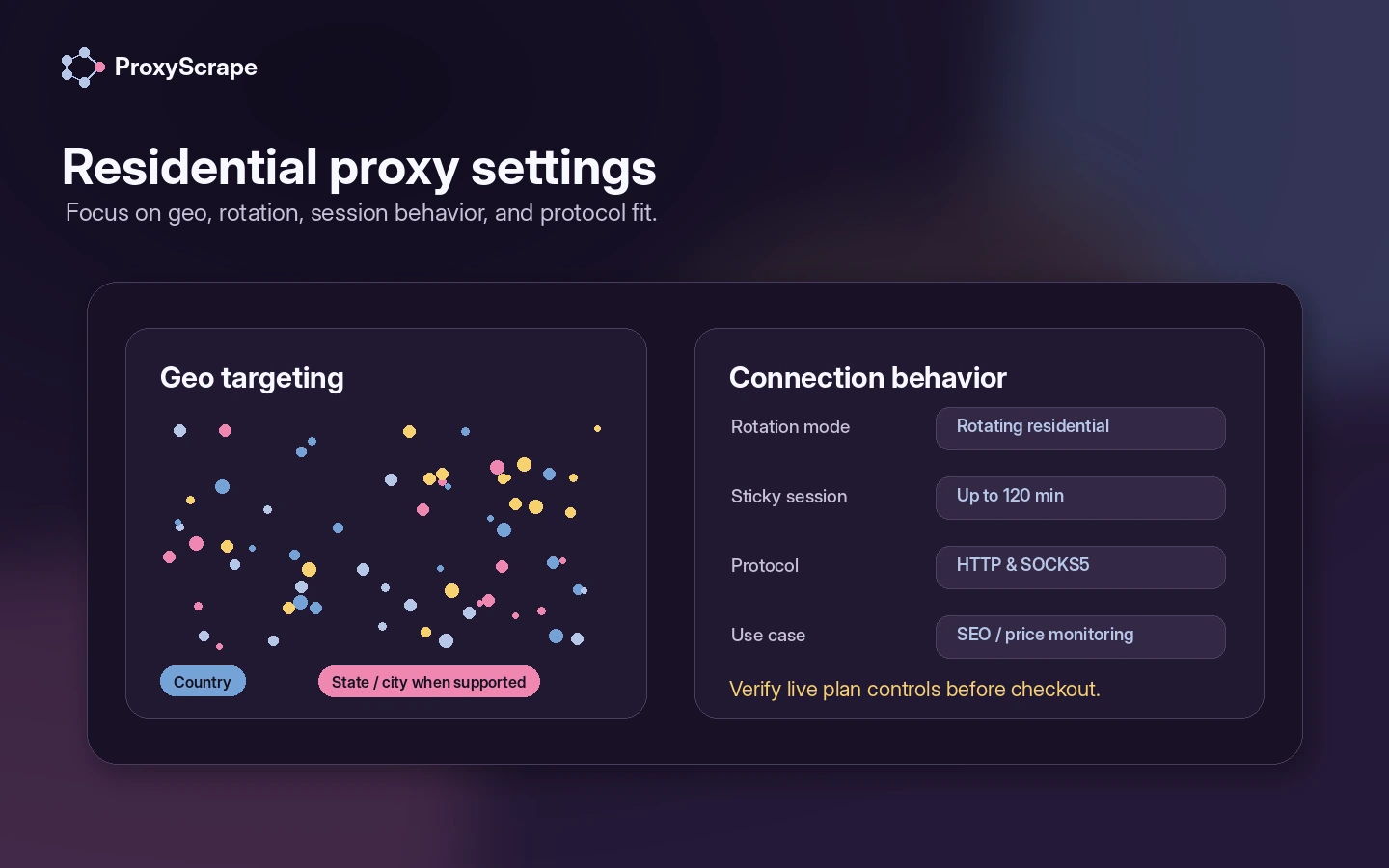
The practical verdict is simple: ProxyScrape can be useful, but only if you buy by workload. Start small, test honestly, read the refund conditions, and do not let the cheapest proxy route decide the whole purchase for you.