Quick verdict
Opinly is worth a careful look if you want SEO automation and competitor tracking to become part of a repeatable growth workflow.
I would not treat it as a simple “cheap SEO tool” decision.
The current public positioning is broader than a basic competitor dashboard. Opinly talks about site audits, content generation and scheduling, platform integrations, backlink exchange, keyword tracking, competitor analytics, and even a public live-build project meant to show its SEO automation in action. That makes the buyer question more interesting, but also more demanding.
The question is not only whether Opinly has a dashboard.
The real question is whether it can help you make better SEO decisions before the trial converts into paid billing.
That matters because Opinly has a short trial path, non-refundable language after trial conversion, and mixed public review signals around billing, cancellation, support, and value. For my money, this is the kind of tool I would only test with a prepared workflow: three to five competitors, a focused keyword set, a specific site or project, and one clear question you want answered before paying.
If Opinly shows you a useful content gap, keyword opportunity, competitor movement, internal-linking issue, or backlink decision quickly, it may earn a place in a lean SEO stack. If you only browse around the interface and hope the tool proves itself later, the trial window is probably too short.
The safest read: Opinly is potentially useful for small teams that want SEO and competitor signals in one lighter system, but the buying decision should be stricter than the homepage makes it feel.
Next step: If Opinly still sounds relevant, verify the current plan, trial terms, and billing path before starting a test.
Review snapshot
| Review point | Practical take |
|---|---|
| Best for | Small teams, founders, marketers, and lean SEO operators that need repeatable competitor and keyword monitoring |
| Not ideal for | Buyers who want a long refund window, casual one-off checks, or enterprise-grade competitive enablement |
| Main use case | Turning competitor SEO signals, keyword movement, content gaps, and backlink opportunities into decisions |
| Trial path | Terms mention a three-day free trial that requires a valid payment method and converts unless cancelled before the trial ends |
| Refund risk | Terms state that subscription fees after trial conversion and credit charges are non-refundable |
| Main strength | Combines SEO automation, keyword tracking, competitor analytics, content optimization, and backlink positioning in one growth workflow |
| Main concern | Mixed public review signals around billing, cancellation, support, and value-for-money mean buyers should test narrowly |
| Best alternatives to compare | Semrush, Similarweb, Competitors App, Klue, Google Alerts, or a manual spreadsheet workflow |
| Best next step | Prepare one real competitor workflow before starting the trial |
What is Opinly?
Opinly is an AI SEO and competitor-intelligence platform for teams that want to monitor rivals, track keywords, find SEO opportunities, improve content, and connect those signals to growth work.
That is the practical definition.
The homepage frames Opinly around automated SEO tasks: site audit, content generation and scheduling, platform integration, backlink exchange, keyword tracking, and competitor analytics. The platform page goes deeper into keyword tracking, content optimization, backlink building, and competitor analysis. Opinly also presents a public live project where it claims to track SEO, backlinks, and LLM visibility for a demo project.
So I would not describe Opinly as only a competitor price monitoring tool, even though some third-party directories still categorize it that way.
That category mismatch is important.
A buyer who expects a narrow competitor-price tracker may be confused by the current SEO automation angle. A buyer who expects a mature enterprise competitive intelligence platform may also be disappointed if they need battlecards, sales enablement, CRM workflows, deep market research, or institutional reporting. Opinly sits somewhere else: lighter than enterprise CI, broader than a simple rank tracker, and more automation-focused than a spreadsheet.
The tool makes the most sense if you want a system that watches SEO signals and turns them into actions: audit this site, track these keywords, monitor these competitors, generate or optimize content, build links, and measure whether the work is moving.
That is a useful promise.
But it is also the kind of promise that needs proof inside your own workflow.
Review methodology and evidence confidence
For this Opinly review, I would treat the evidence base as mixed.
The official site gives enough information to understand the current positioning. It clearly pushes SEO automation, keyword tracking, competitor analytics, content optimization, platform integration, and backlink work. The terms page is also unusually important because it spells out the short trial, automatic conversion, auto-renewal, non-refundable subscription fees after conversion, cancellation through account settings, and non-refundable credit usage.
That part is high confidence.
The pricing and buyer-satisfaction picture is less clean. The official pricing page exists, but the public data visible through third-party software directories does not line up perfectly with the store YAML and external pages. Capterra lists Opinly.ai under competitive intelligence, business intelligence, and competitor price monitoring with a small review base. Trustpilot currently shows a weak review profile and a pattern of complaints around payment, subscription, cancellation, and response time.
That does not automatically mean every buyer will have a bad experience. Public review sites can skew negative, and the product may also be evolving.
But it does change the editorial recommendation.
I would not start an Opinly trial casually. I would start it only when I already know what I am testing, what a useful result looks like, and exactly how I will cancel if the tool does not prove value quickly.
Who should use Opinly?
Opinly is most interesting for small businesses and lean marketing teams that have outgrown manual competitor checks but are not ready for a heavy enterprise system.
A founder might use Opinly to watch which competitors are gaining visibility, which keywords are moving, and which content angles are worth testing. That is a real use case because founders often do not have time to run deep SEO analysis manually every week.
A small SEO team might use it as a lighter monitoring layer. If the team already publishes content, tracks rankings, looks for backlink opportunities, and updates pages based on competitor movement, Opinly could bring those signals into one workflow.
A content operator might use it to connect competitor research with publishing decisions. The useful question is not “can Opinly generate content?” The useful question is whether it helps choose the right content to create, optimize, schedule, or internally link.
A marketer working with WordPress, Shopify, Webflow, or modern frameworks may also care about platform integration. If Opinly fits the publishing stack, the automation angle becomes more believable. If it does not fit the stack, it risks becoming another dashboard that looks useful but does not change the work.
The tool is also worth a look for buyers who want a lower-friction alternative before moving into Semrush, Similarweb, Klue, or a more specialized competitor-monitoring product.
But the buyer needs discipline.
Opinly is not the kind of tool I would evaluate by clicking around for ten minutes. I would judge it by one narrow test: can it surface a competitor, keyword, content, or backlink insight that changes what I do next?
Who should avoid Opinly?
I would avoid Opinly if you only need occasional competitor research.
If you run a competitor check once per quarter, you may be better off with Google, Google Alerts, spreadsheets, a few SEO exports, and manual review. A subscription tool only makes sense when the monitoring repeats often enough to save time or improve decisions.
I would also be careful if you need a low-risk trial. Three days is short. It can work if you prepare before signing up. It is not generous if your team needs internal approval, multiple users, or a slower evaluation cycle.
I would avoid relying on Opinly if your main need is enterprise competitive enablement. Tools like Klue are built around sales enablement, battlecards, competitive intel workflows, and larger team processes. Opinly’s current public positioning feels more SEO and growth automation focused.
I would also avoid it if billing clarity and refund flexibility are more important to you than feature curiosity. The official terms are clear enough to create a buyer-protection warning: once a trial converts, subscription fees are described as non-refundable, and credits are also described as non-refundable. Public review signals make this worth taking seriously.
Finally, I would not choose Opinly simply because a deal or coupon page exists. A discount can reduce cost, but it cannot fix a short trial, unclear workflow fit, or a dashboard that does not produce useful insight for your niche.
How Opinly fits into a real SEO workflow
A good Opinly test should begin before you create the account.
That sounds boring, but with a short trial it matters.
Here is the workflow I would use:
- Choose one website or project.
- Pick three to five competitors.
- Choose five to ten keywords that actually matter.
- Identify one content gap you already suspect.
- Check whether Opinly confirms, challenges, or improves your view.
- Look for one action: update a page, create a brief, track a competitor, build a backlink angle, or adjust a keyword target.
- Verify the plan, renewal date, and cancellation process before the trial ends.
The tool becomes useful if it changes the next action.
It is much less useful if it only gives you charts that feel interesting but do not guide a decision.
This is where many AI SEO tools get overestimated. The dashboard may look alive. The charts may move. The tool may use AI language around growth and automation. But the buyer still needs to ask: did this help me choose a better keyword, write a better brief, spot a competitor move, identify a backlink gap, or fix an SEO issue?
That is the workflow test.
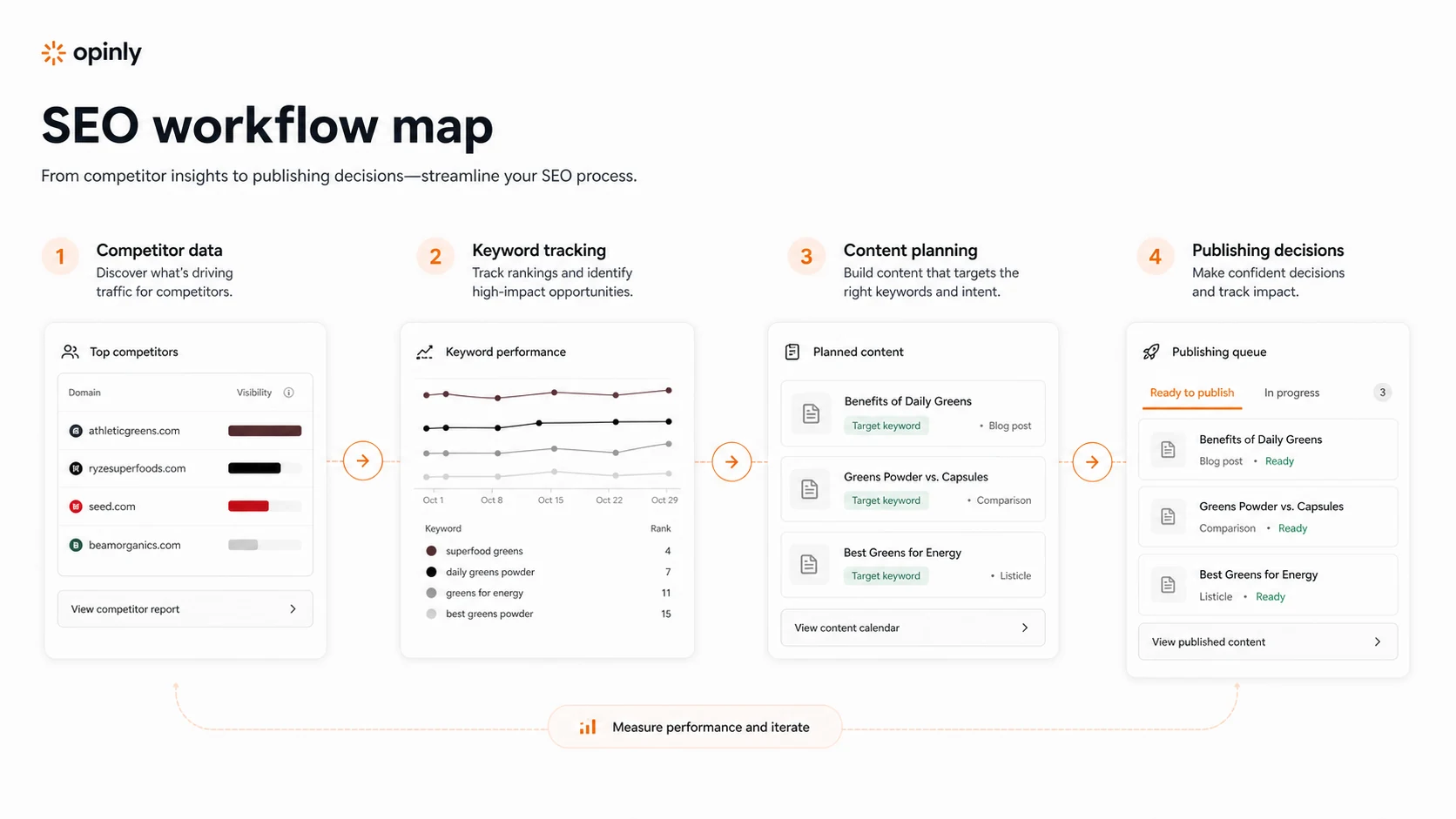
Workflow check: Opinly is easier to evaluate when you start with a real competitor and keyword list instead of browsing the product cold.
Key features that matter
Opinly’s feature set should be judged by decision value, not by how many SEO words appear on the homepage.
Site audit
A site audit can be useful if it identifies technical SEO issues that you can actually fix. The buyer check is whether the audit produces clear priorities or just a long list of warnings.
For a small team, this matters because technical SEO work competes with content, links, and product work. If Opinly helps you pick the fixes that matter most, the audit module has value. If it only repeats generic SEO advice, it becomes less compelling.
Content generation and scheduling
Opinly’s content generation and scheduler angle is interesting, but I would be careful not to evaluate it like a plain AI writer.
The better question is whether the content workflow is informed by competitor and keyword data. If the tool helps you identify what to publish, when to schedule it, and how to connect it with existing SEO opportunities, that is more valuable than generic AI article generation.
The risk is over-automation. SEO content still needs judgment, topical structure, internal linking discipline, source quality, and editorial review. I would not publish automatically without a quality-control layer.
Platform integration
Opinly mentions CMS and framework integrations, including WordPress, Shopify, Webflow, NextJS, Nuxt, Svelte, and manual options. This can matter a lot.
A tool that integrates with the place where content gets published has a better chance of becoming part of the real workflow. A tool that stays isolated often becomes another tab that the team forgets to check.
Before paying, I would verify the exact integration path for your stack.
Backlink exchange
Backlink exchange is the feature I would treat most cautiously.
Backlinks can matter for SEO, but automated link placements and exchange networks need careful judgment. Buyers should understand how the network works, whether links are relevant, whether quality control exists, and whether the approach fits their risk tolerance.
This is not a feature I would use blindly just because it is available.
Keyword tracking
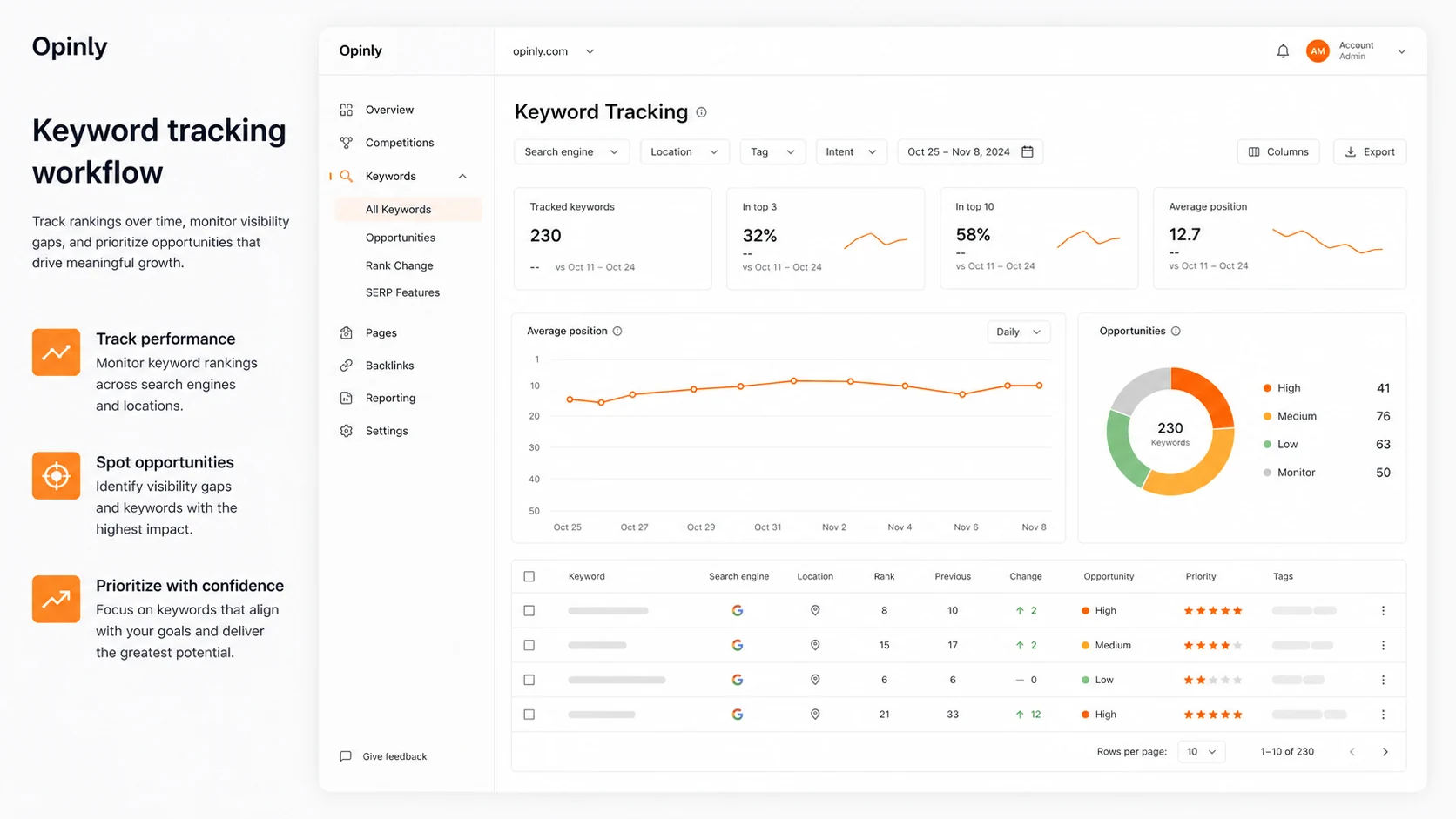
Keyword tracking is one of Opinly’s cleaner use cases. The official platform messaging focuses on tracking performance, prioritizing terms, and finding new opportunities based on volume, intent, and competition.
The buyer question is simple: does the tool help you make better decisions than your current rank tracker or SEO suite?
If yes, useful. If no, duplicate cost.
Competitor analytics
Competitor analytics is the heart of the review.
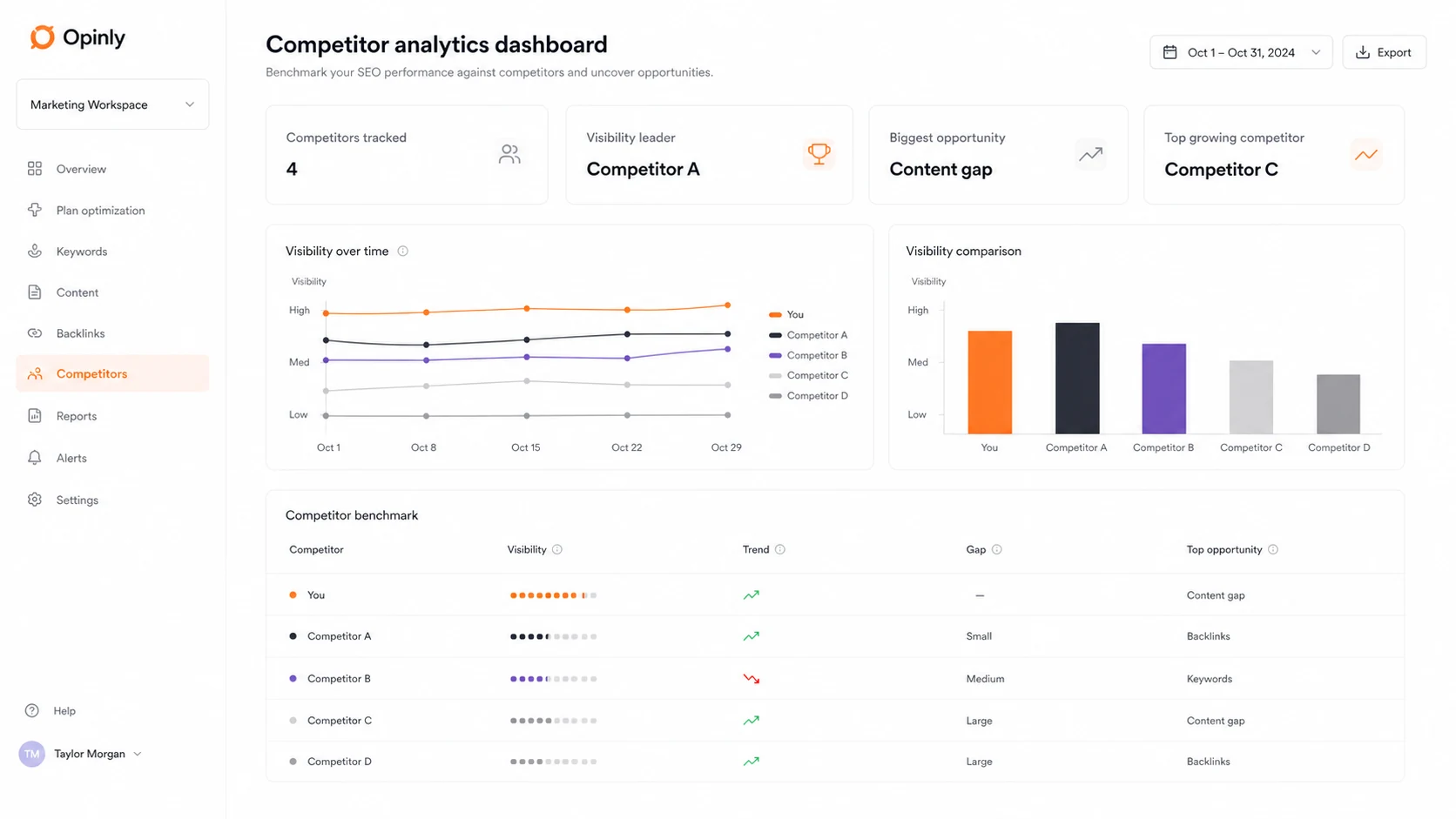
Opinly can make sense if it helps you monitor competitor keyword rankings, content, backlink strategies, missed opportunities, and performance benchmarks. The best version of this workflow is not passive observation. It is active prioritization.
A useful competitor dashboard should tell you what to do next.
Pricing and plan value
Pricing is the part of Opinly I would verify live before making any decision.
The internal store data says the official pricing page should be treated as the source of truth, but also warns that third-party pricing references are not fully consistent. That matches what I found publicly: Capterra, CompetitorTools, and the official pages do not all present the same buyer picture.
That does not mean the official price is wrong.
It means the checkout page matters more than old directory listings.
The bigger issue is not even the headline price. The bigger issue is whether the plan gives you enough competitor, keyword, reporting, automation, integration, and credit capacity to test the workflow properly.
I would check these before starting:
| Pricing check | Why it matters |
|---|---|
| Trial length | Three days can disappear quickly if you are unprepared |
| Payment method | Terms say a valid payment method is required for the trial |
| Conversion timing | The trial converts unless cancelled before it ends |
| Billing interval | Monthly vs annual cost changes the risk profile |
| Included limits | Competitors, keywords, content credits, image credits, reports, websites, or integrations may affect real value |
| Cancellation access | You should know where cancellation happens before the renewal deadline |
| Refund language | Subscription fees after trial conversion are described as non-refundable |
The cheapest route is not automatically the safest route.
With Opinly, the safest route is a prepared trial. Use the trial to answer one narrow question, then decide whether the paid plan earns its place.
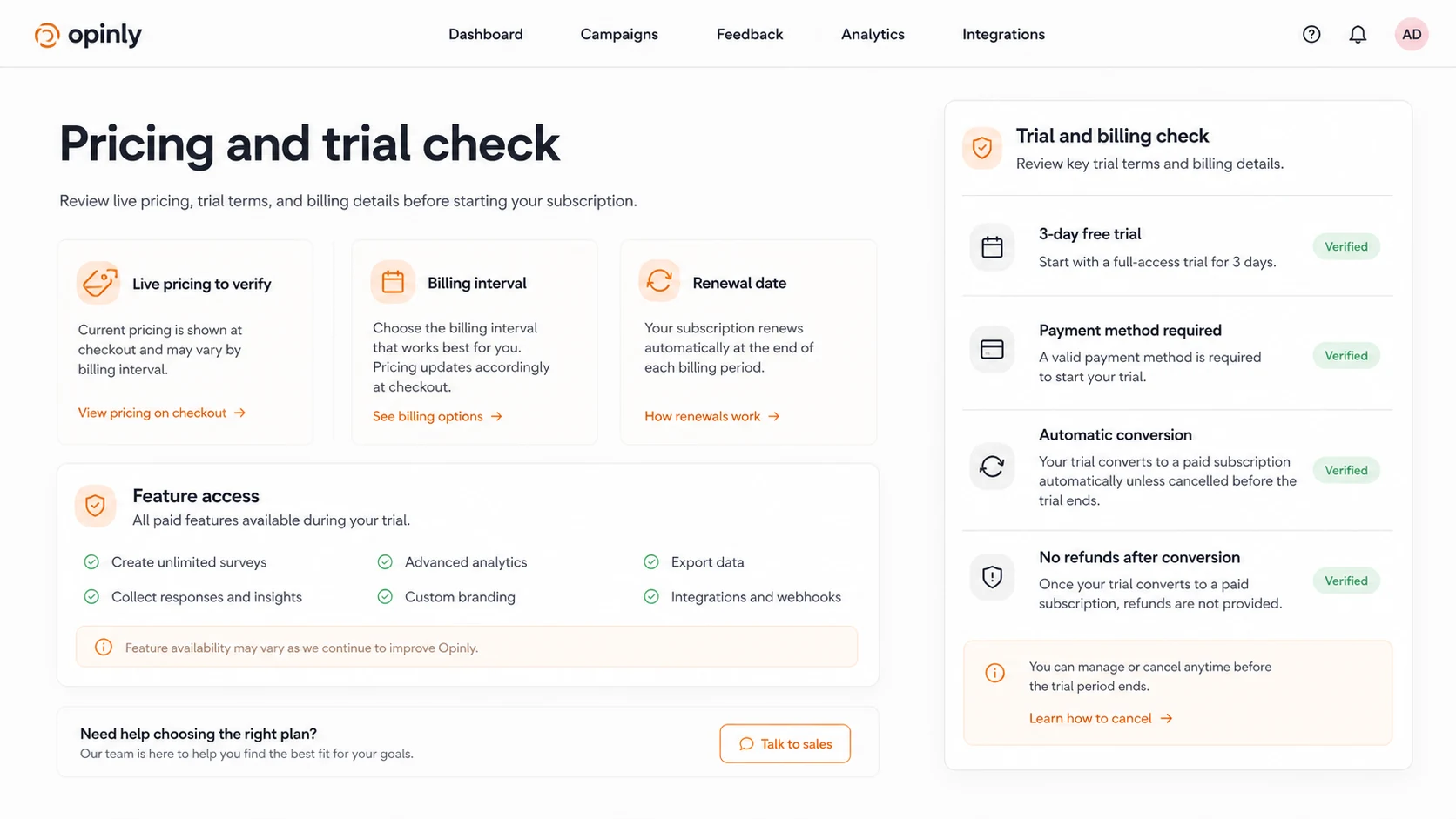
Pricing check: Do not rely only on third-party pricing snippets. Confirm the live plan, renewal date, and cancellation route directly before you start the trial.
Free trial, coupon, and checkout notes
Opinly should not be treated as a coupon-first purchase.
That does not mean you should ignore savings. It means the savings path should come after the workflow decision.
The official terms mention a three-day free trial that may require a valid payment method and converts into paid subscription billing unless cancelled before the trial ends. They also state that paid subscription fees after trial conversion are non-refundable, and that credits are non-refundable.
That changes how I would approach the product.
Before starting the trial, I would prepare:
- competitor list
- keyword list
- site or project URL
- one content gap to investigate
- one backlink or authority question
- one integration question
- cancellation deadline
- screenshot or note of the selected plan and renewal timing
If Opinly offers a checkout deal, use it only after the product passes the workflow test. If the product does not produce useful insight during the trial, a lower price is not a win.
The most buyer-protective sequence is:
- Read the current commercial overview on the Opinly store guide.
- Prepare one narrow SEO or competitor test.
- Open Opinly and verify the live trial and plan terms.
- Use the Opinly coupon page only as a final checkout check.
- Cancel before conversion if the tool does not change a real decision.
That sequence may feel slower, but it is safer.
Checkout caution: A discount is useful only after Opinly has proven workflow fit. Verify trial conversion and cancellation before treating any offer as low risk.
What I would check before buying Opinly
This is the section I would not skip.
For tools with clean pricing, strong reviews, and a long trial, the buying checklist can be light. Opinly needs a stricter checklist because the trial is short, public review signals are mixed, and the product positioning has evolved from competitor research into broader SEO automation.
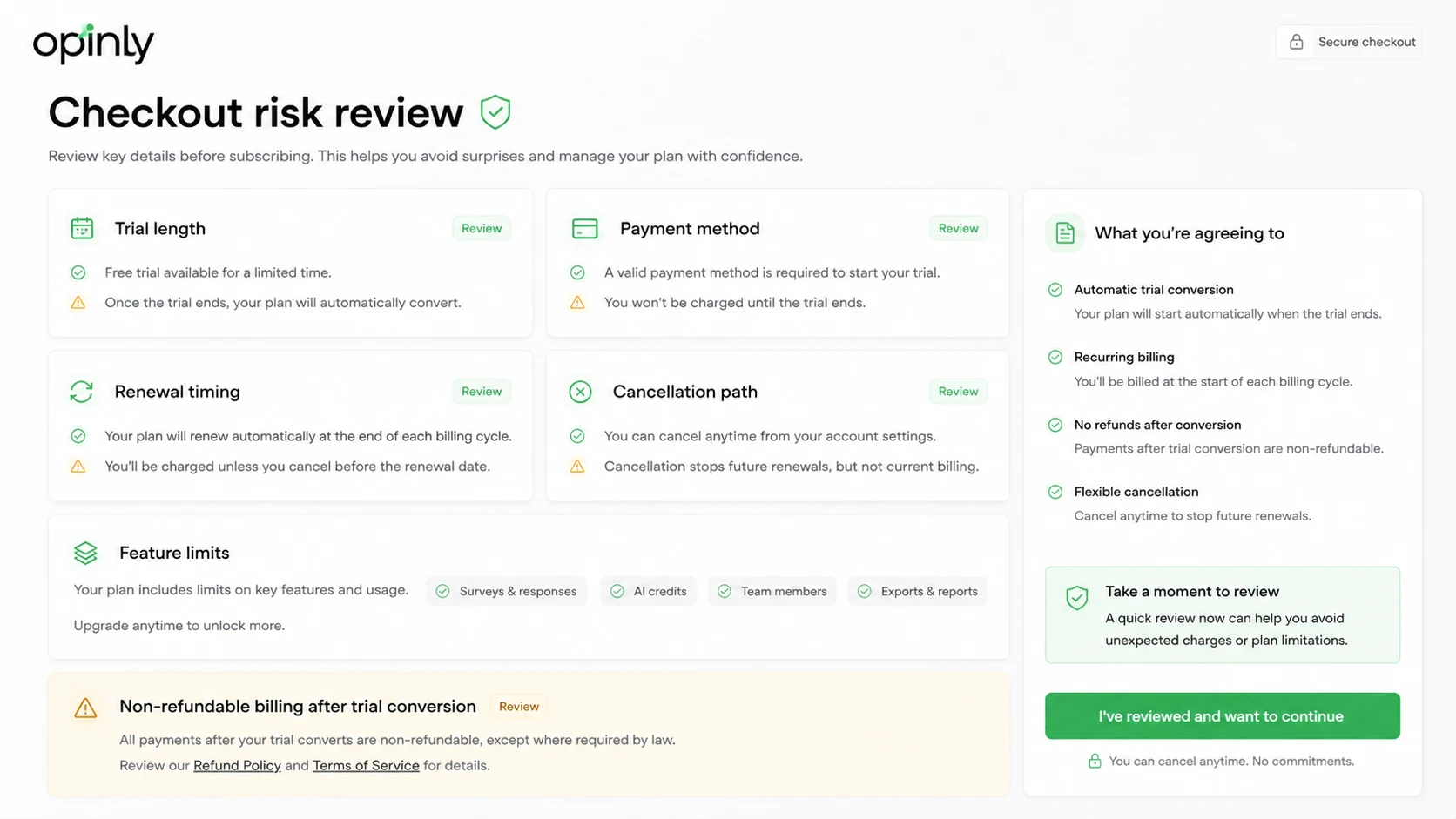
Here is what I would verify:
1. Does the trial still match the terms page?
The terms mention a possible three-day trial. Confirm the live trial length and whether payment details are required before you begin.
2. What exactly happens after the trial?
Check the selected plan, billing interval, renewal date, and first charge amount. Do not assume the lowest advertised number is the plan you selected.
3. Can you cancel inside the account?
The terms say cancellation can be done through account settings. I would locate that path before the trial deadline.
4. Are content or image credits involved?
The terms reference usage-based billing for blog credits and image credits. If your use case involves content generation, understand credit consumption before testing heavily.
5. Do competitor and keyword limits match your workflow?
A competitor-intelligence tool becomes weak if the plan only lets you monitor too few rivals, keywords, sites, or reports for your real project.
6. Do integrations support your publishing stack?
If you use WordPress, Shopify, Webflow, NextJS, Nuxt, Svelte, or another stack, verify what “integration” means in practice.
7. Does the backlink feature fit your risk tolerance?
Do not treat backlink automation as automatically safe. Check relevance, quality, controls, and whether you want that kind of link-building workflow attached to your site.
8. Does the tool produce one actionable insight?
This is the test that matters most.
If Opinly cannot help you pick a keyword, content update, competitor response, backlink opportunity, or site audit priority within the trial window, I would not let it convert just because the dashboard looks promising.
Opinly vs alternatives
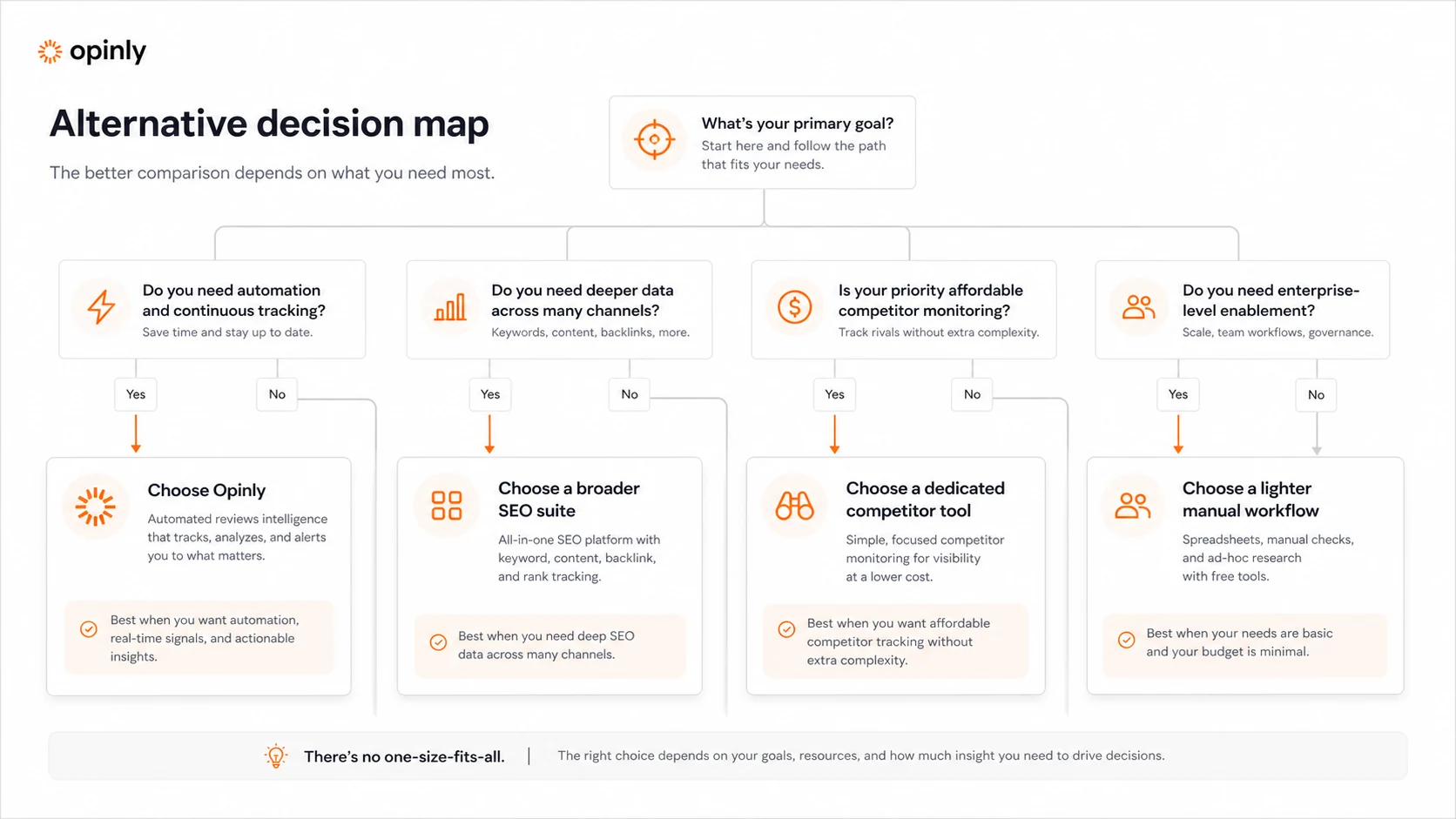
The best Opinly alternatives depend on what problem you are actually trying to solve.
I would not compare it directly with every AI tool in the same broad software category. Opinly is not really a humanizer, image generator, or general productivity tool. It is closer to SEO automation, competitor monitoring, and lightweight growth intelligence.
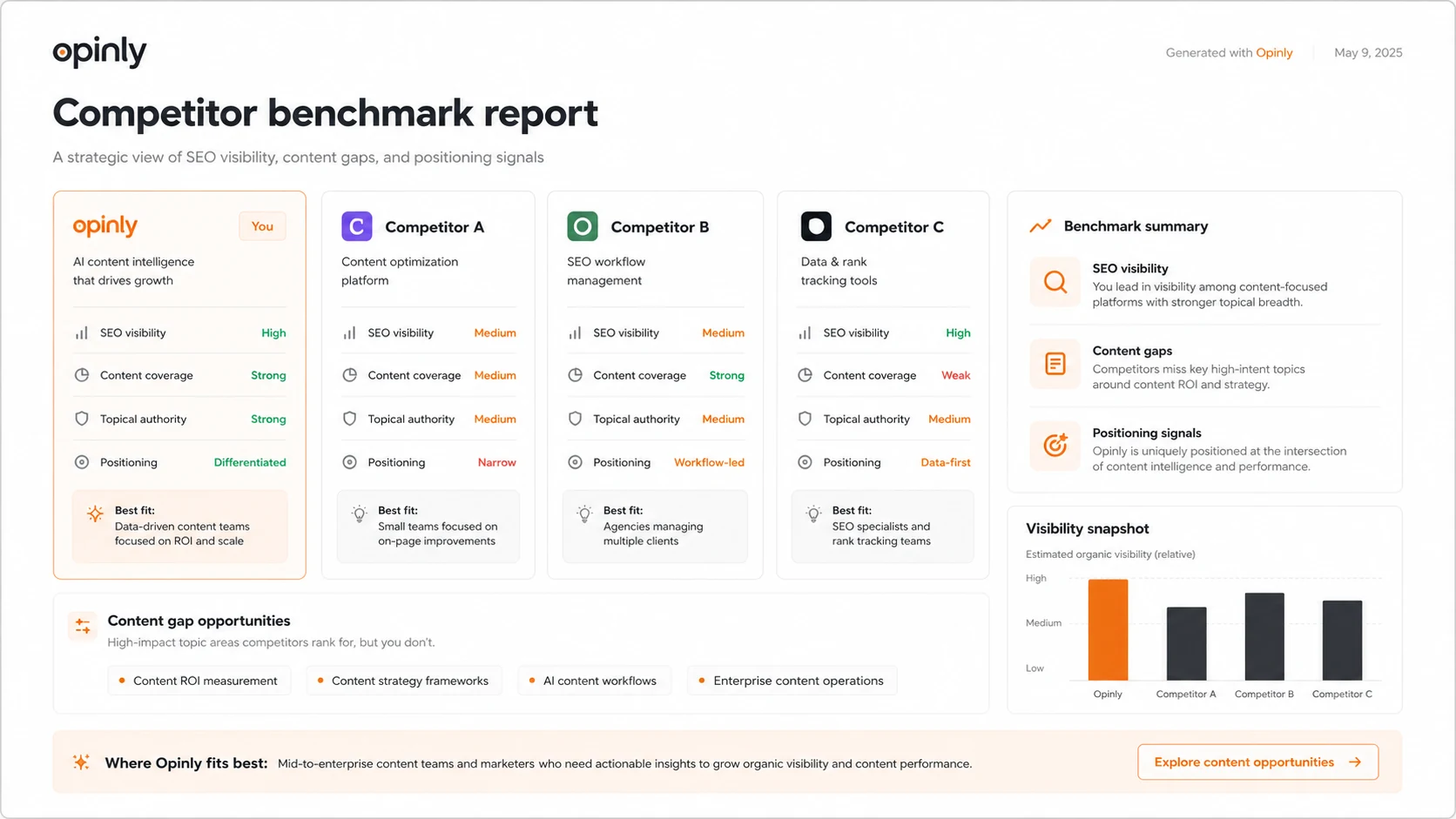
Opinly vs Semrush
Semrush is the stronger comparison if you need a mature SEO suite with broad keyword data, competitive research, backlink tools, site audits, rank tracking, advertising research, and agency-friendly workflows.
Opinly may feel lighter and more automation-oriented. Semrush is more established and deeper, but it can also be more expensive and more complex.
I would compare Semrush first if SEO data depth matters more than a simplified automation workflow.
Opinly vs Similarweb
Similarweb is a better comparison if your main need is traffic intelligence, market-level visibility, audience behavior, and broader competitive research.
Opinly is more SEO-action oriented. Similarweb is more market-intelligence oriented.
If you need to understand where traffic comes from, how competitors perform across channels, or how a market is moving, Similarweb may be the stronger route. If you need a lighter SEO workflow around keywords, content, backlinks, and competitor signals, Opinly may be more relevant.
Opinly vs Competitors App
Competitors App is a more direct comparison for monitoring competitor changes. It may fit buyers who want simpler alerts around websites, keywords, email, social, ads, or related movement.
Opinly appears more focused on SEO automation and content-related growth work.
If you mainly want alerts, compare Competitors App. If you want SEO task automation layered on top of competitor signals, Opinly is the more relevant test.
Opinly vs Klue
Klue is not a budget substitute. It is a stronger comparison for larger teams that need competitive enablement, sales battlecards, win/loss intelligence, and organized competitive knowledge across the business.
Opinly is not trying to be that kind of enterprise CI system.
If your sales team needs competitive messaging and battlecards, look at Klue. If your SEO or founder team needs lighter competitor and growth signals, Opinly is closer to the job.
Opinly vs Google Alerts and spreadsheets
This is the alternative many buyers should consider first.
If your competitor research is simple, you may not need a paid tool yet. Google Alerts, manual SERP checks, spreadsheets, Search Console, and occasional SEO exports can cover a surprising amount of early-stage research.
Opinly becomes more interesting only when the manual workflow becomes too slow, inconsistent, or easy to ignore.
About the current internal related routes
The internal store data currently includes broader software routes that are not direct Opinly substitutes. I would not use those as purchase comparisons in the body of this review.
That is not a problem with the site structure. It just means the buyer-decision logic should stay honest: Opinly should mainly be compared with SEO suites, competitor-monitoring tools, market-intelligence platforms, and manual monitoring workflows.
Green flags
There are real positives here.
The first green flag is category focus. Opinly is not just saying “AI” in a vague way. The current official pages point to concrete SEO workflows: site audit, content optimization, keyword tracking, platform integration, backlinks, competitor analysis, and public performance tracking.
The second green flag is that the company is showing a live project. I would still verify the claims carefully, but a public build is more useful than a generic homepage screenshot because it gives buyers something to inspect.
The third green flag is small-team fit. Not every buyer wants an enterprise CI platform. Some teams need a lighter way to monitor competitors and move SEO work forward.
The fourth green flag is that the terms are explicit. The refund and trial language may be strict, but it is visible. That allows a careful buyer to make a better decision before starting.
Red flags
The first red flag is the short trial window.
Three days can be enough if you are prepared. It is not enough if you need team discussion, multiple experiments, or slow onboarding.
The second red flag is refund language. Subscription fees after trial conversion are described as non-refundable, and credits are also described as non-refundable. That makes the cancellation deadline important.
The third red flag is public review sentiment. Trustpilot currently shows many complaints around payment, subscription, cancellation, and response time. Capterra shows a small review base and a low rating. I would not ignore that.
The fourth red flag is positioning complexity. Opinly touches site audit, content, keywords, backlinks, competitor analytics, LLM visibility, and platform integration. That breadth can be useful, but it also makes plan-fit verification harder.
The fifth red flag is backlink automation. Any automated backlink or exchange system needs careful evaluation. I would not treat that as a default benefit without understanding quality controls and SEO risk.
Simple test before paying
Here is the simplest Opinly test I would run.
Pick one project.
Then create this test sheet before starting the trial:
| Test item | Example |
|---|---|
| Competitors | 3 to 5 direct competitors |
| Keywords | 5 to 10 keywords you care about |
| Content gap | One page or topic you suspect competitors cover better |
| Backlink question | One authority or link gap you want to investigate |
| Integration question | Whether your CMS or framework fits the workflow |
| Success marker | One decision Opinly must improve before trial conversion |
Then use Opinly for that narrow test only.
Do not spend the trial exploring every feature. That is how short trials become paid subscriptions without evidence.
A good result might be: “We found a competitor keyword cluster worth targeting.” Or: “The tool showed a backlink gap we can investigate.” Or: “The audit revealed a site issue we should fix before publishing more content.”
A weak result is: “The dashboard looked interesting.”
That is not enough.
Pricing risk and refund risk
This deserves its own judgment.
Opinly may be affordable compared with some bigger tools, depending on the current plan and billing interval. But affordability is not the same as low risk.
A short trial plus automatic conversion plus non-refundable terms creates a narrow decision window. That does not make the product bad. It means the buyer needs to behave like the trial is a live checkout process, not a free playground.
I would also be careful with credit usage. The terms mention blog credits and image credits, and describe credit charges as non-refundable. If you plan to test content generation or image generation, understand what consumes credits before running experiments.
The practical buyer rule is simple:
Do not start the trial until you are ready to test.
If you are busy, wait. If the team is not aligned, wait. If you have not chosen competitors or keywords, wait. The trial is more useful when the setup work is already done.
My buyer-protective take
Opinly is not a tool I would dismiss outright.
The SEO automation angle is relevant. Many small teams do need help turning competitor movement, keyword changes, content gaps, and backlink opportunities into a more consistent growth process. If Opinly can do that cleanly, it has a real use case.
But I would not call it an easy buy.
The trial and refund terms put pressure on the buyer. The public review signals add caution. The category positioning is broad enough that buyers need to verify which modules matter for their plan. And the backlink/content automation angle needs quality control, not blind trust.
So the decision is conditional.
Consider Opinly if you have a repeatable SEO workflow, know which competitors and keywords you want to monitor, and can test value inside the trial window.
Skip Opinly if you need a relaxed evaluation period, a generous refund path, mature enterprise competitive enablement, or only occasional manual research.
Compare Opinly with Semrush if SEO data depth matters most. Compare it with Similarweb if market and traffic intelligence matter most. Compare it with Competitors App if monitoring alerts matter most. Compare it with Klue if sales enablement and battlecards matter most. Use Google Alerts and spreadsheets if your needs are still simple.
That is the cleaner decision.
Final verdict
Opinly is a serious maybe, not an automatic yes.
It has a believable role for small teams that want SEO automation and competitor intelligence without immediately moving into a heavier platform. The current official positioning around keyword tracking, content optimization, backlinks, site audit, competitor analysis, integrations, and public project tracking gives it more substance than a generic AI dashboard.
But the buyer risk is real.
The short trial means you need to prepare before signing up. The non-refundable language means cancellation timing matters. The public review signals mean billing and support should be checked carefully. And the broad feature promise means you should verify the exact modules, limits, and credits attached to the plan you choose.
For my money, the safest next step is not to chase an Opinly coupon first. It is to prepare one real SEO competitor workflow, verify the live pricing and trial path, then test whether the tool changes a decision before the trial converts.