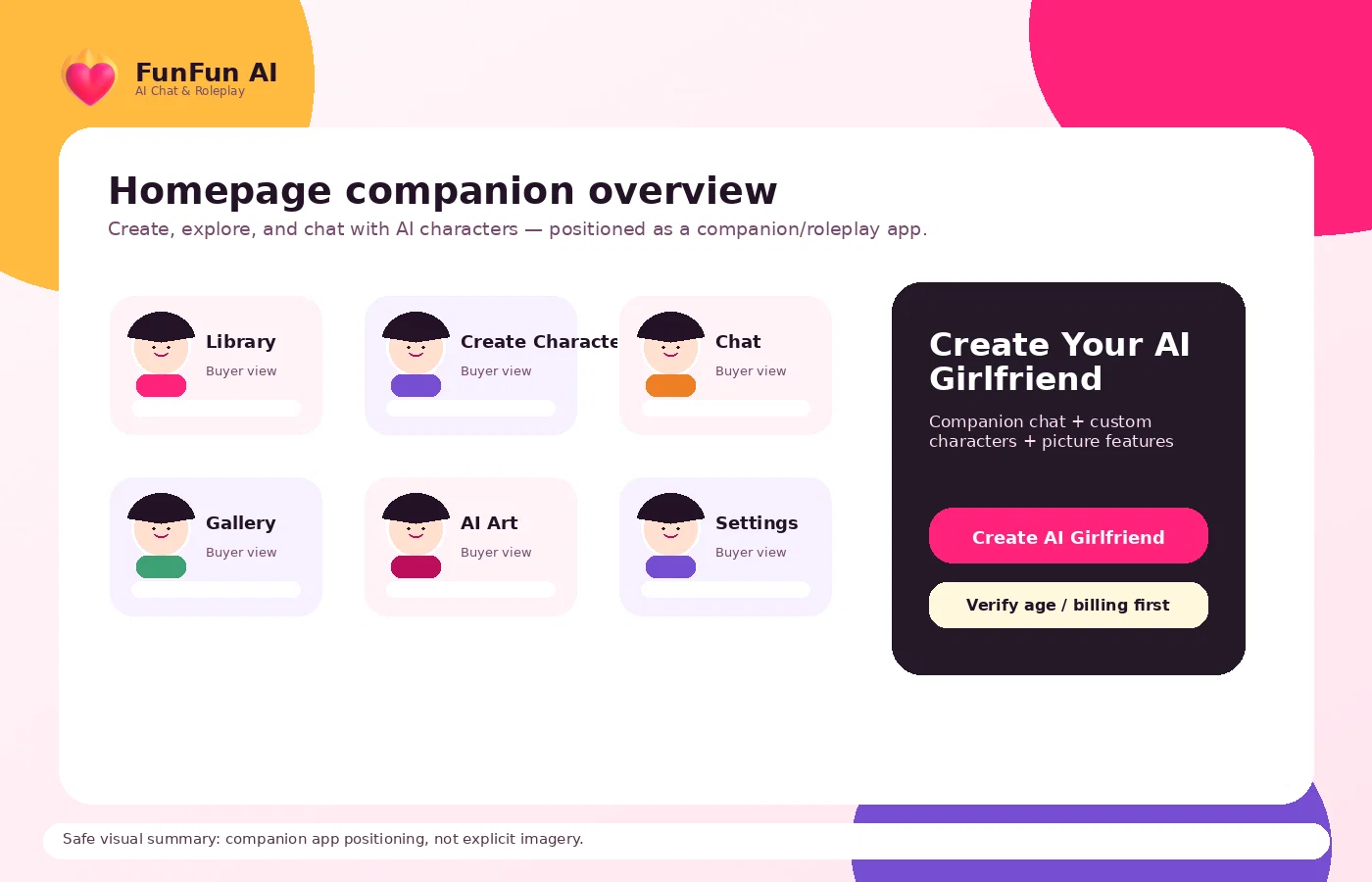
Quick verdict
FunFun AI is worth a cautious look if you specifically want an adult AI companion app, not a general chatbot, writing assistant, productivity tool, or emotional-support replacement.
That distinction matters.
The product is built around AI companion chat, character creation, roleplay-style conversation, and premium features such as generated media or voice-style extras through tokens. The official homepage makes the category obvious: this is a virtual companion experience, with personalization and AI-generated interaction at the center of the product. I would not judge it by the landing page alone, though. The real buying decision is whether the chat style feels good enough to repeat, whether the premium features are worth the subscription, and whether the refund and token rules feel acceptable.
For my money, FunFun AI only makes sense after a light free test. The free path can help you decide whether the tone, character options, and overall category feel right. It should not be treated as proof that annual billing is safe or that premium media features will satisfy you long term.
The main strength is focus. FunFun AI is not trying to be a business platform. It is a companion app for adults who want personalized character interaction. The main weakness is purchase risk: the refund window is short, token usage can affect eligibility, remaining tokens may expire after cancellation, and pricing can vary by checkout route, app store, region, and promotion.
Next step: If FunFun AI still fits what you want from an AI companion app, test the free path first and verify the live buyer route before subscribing.
Review snapshot
| Review point | Practical take |
|---|---|
| Best for | Adults who want AI companion chat, character creation, and roleplay-style interaction |
| Not ideal for | Buyers looking for therapy, factual advice, business automation, or a low-risk subscription test |
| Main use case | Creating or choosing an AI companion, chatting, testing personalization, and deciding whether Premium features are worth paying for |
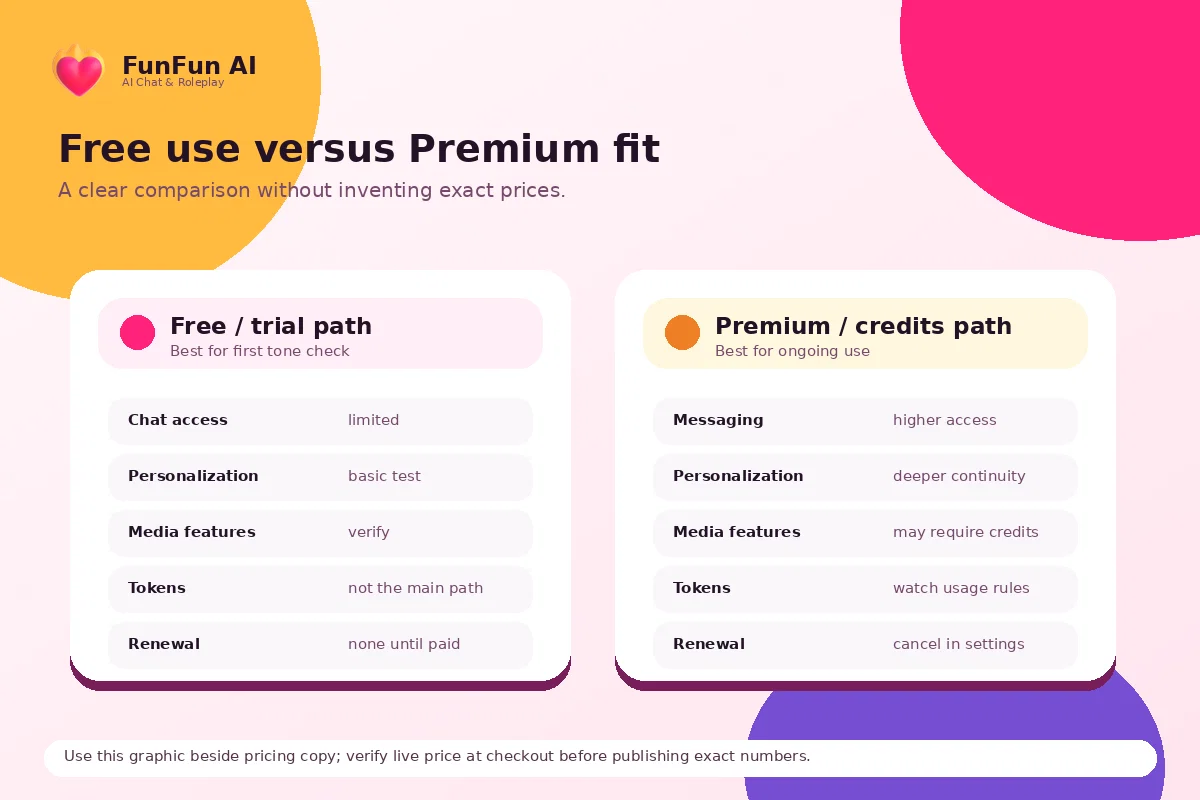
| Free path | Useful for a first tone check, but limited for long-term value judgment |
| Paid path | Premium unlocks the real subscription decision, including unlimited messaging and monthly tokens |
| Main strength | Focused companion-chat experience with web and mobile availability |
| Main concern | Token rules, refund timing, app-store pricing variation, adult-content comfort, and privacy boundaries |
| Direct alternatives | Candy AI, DreamGF, GirlfriendGPT, Nastia AI, SpicyChat AI |
| Best next step | Test lightly first, then check live checkout pricing and refund rules before using tokens heavily |
What is FunFun AI?
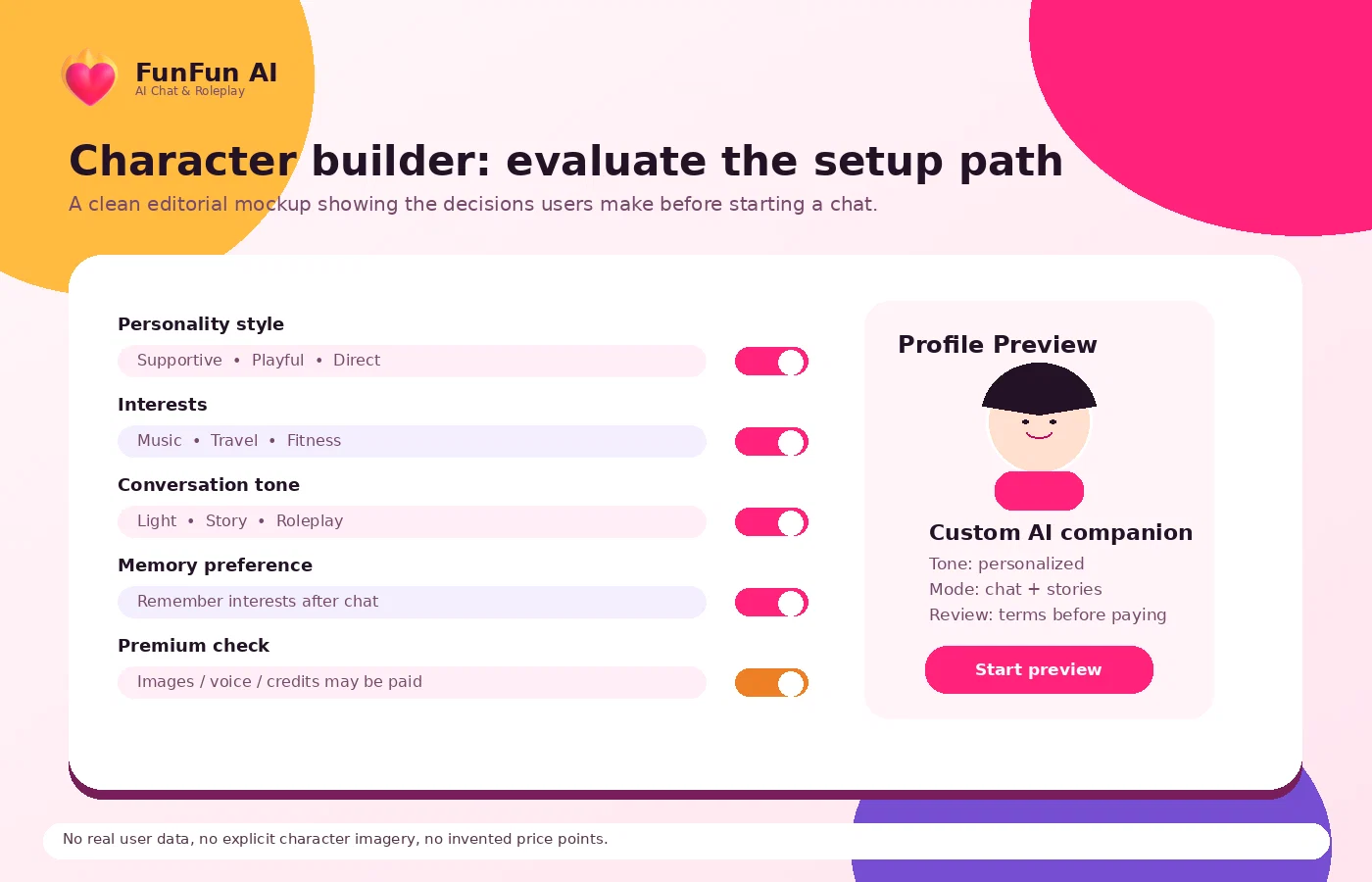
FunFun AI is an AI companion and roleplay chat app for adults. In plain language, it lets users create or choose virtual AI companions, chat with them, customize personality-style details, and use premium features that may include generated images, voice notes, or other media-style extras.
It is not a normal AI assistant.
That may sound obvious, but it is the first buying filter. FunFun AI should not be evaluated like ChatGPT, Claude, Jasper, Rytr, or a customer-support chatbot. The value is not productivity output. The value is whether the companion experience itself feels engaging, safe enough for your comfort level, and worth paying for repeatedly.
The current public homepage presents FunFun AI as a virtual girlfriend and companion-chat product, with customization, multiple characters, memory-style personalization, and picture-sharing as part of the experience. The App Store listing also frames it as AI chat and roleplay, with character building and personal conversations. That puts it firmly in the AI companion category.
Our review approach compares public product pages, official terms, privacy details, app-store information, buyer workflow fit, refund risk, pricing signals, and nearby companion alternatives. We do not treat a discount, a low monthly equivalent, or a visually polished companion gallery as proof that the product fits the buyer.
The common wrong expectation is thinking an AI companion app can replace human support, therapy, relationship advice, or emotionally reliable companionship. It cannot. The safer way to treat FunFun AI is as entertainment software with personal-feeling interaction, subscription rules, data tradeoffs, and moderation boundaries.
Who should use FunFun AI?
FunFun AI makes the most sense for adults who already know they want an AI companion app.
The first fit is the casual companion-chat buyer. This person wants to try virtual character conversation, see whether the replies feel engaging, and decide whether the app is enjoyable enough to revisit. For this buyer, the free path is useful because it can reveal tone quickly. The condition is simple: do not subscribe just because the homepage looks appealing. Test the actual conversation first.
The second fit is the roleplay and character-customization buyer. FunFun AI puts character creation and companion identity near the center of the experience. If the product’s character style matches your taste, it may feel more focused than a general chatbot. The thing to verify is which customization options are free, which require Premium, and which features spend tokens.
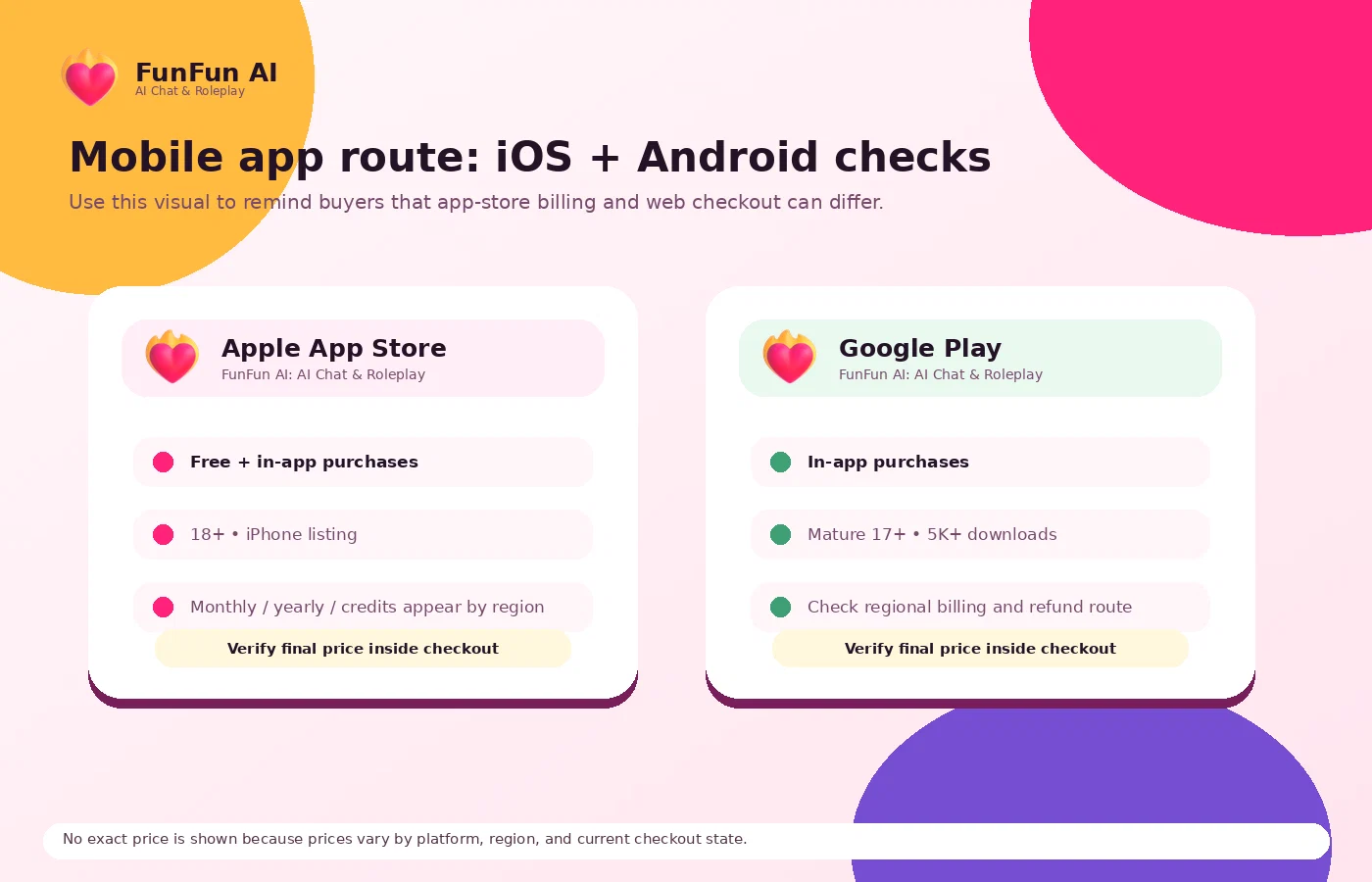
The third fit is the mobile-first companion app user. The product has mobile app availability, and the App Store listing shows in-app purchase options. That is useful if you prefer the app experience over browser-only chat. The caution is that app-store pricing, billing, renewal, and regional currency can differ from what third-party review pages describe.
The fourth fit is the buyer comparing several AI companion apps. FunFun AI is worth placing beside Candy AI, DreamGF, GirlfriendGPT, Nastia AI, and SpicyChat AI. The comparison should not be only about who has the lowest headline price. It should be about tone, memory, character variety, media quality, refund flexibility, privacy comfort, and whether the app remains enjoyable after the first few sessions.
Who should avoid FunFun AI?
You should avoid FunFun AI if you are looking for therapy, mental health support, crisis support, or real relationship advice. Companion apps can feel personal, but they are still AI-generated entertainment systems. Treating them as emotional infrastructure is the wrong decision point.
You should also avoid it if you want business utility. FunFun AI is not built for sales automation, content operations, customer support, research, coding, or task management. If your goal is productivity, the product category is already mismatched.
I would be careful if you dislike adult-oriented companion apps or do not want personal-feeling chat data connected to an account. This category invites more intimate conversation than normal SaaS. That makes privacy and content boundaries more important than they would be for a simple writing tool.
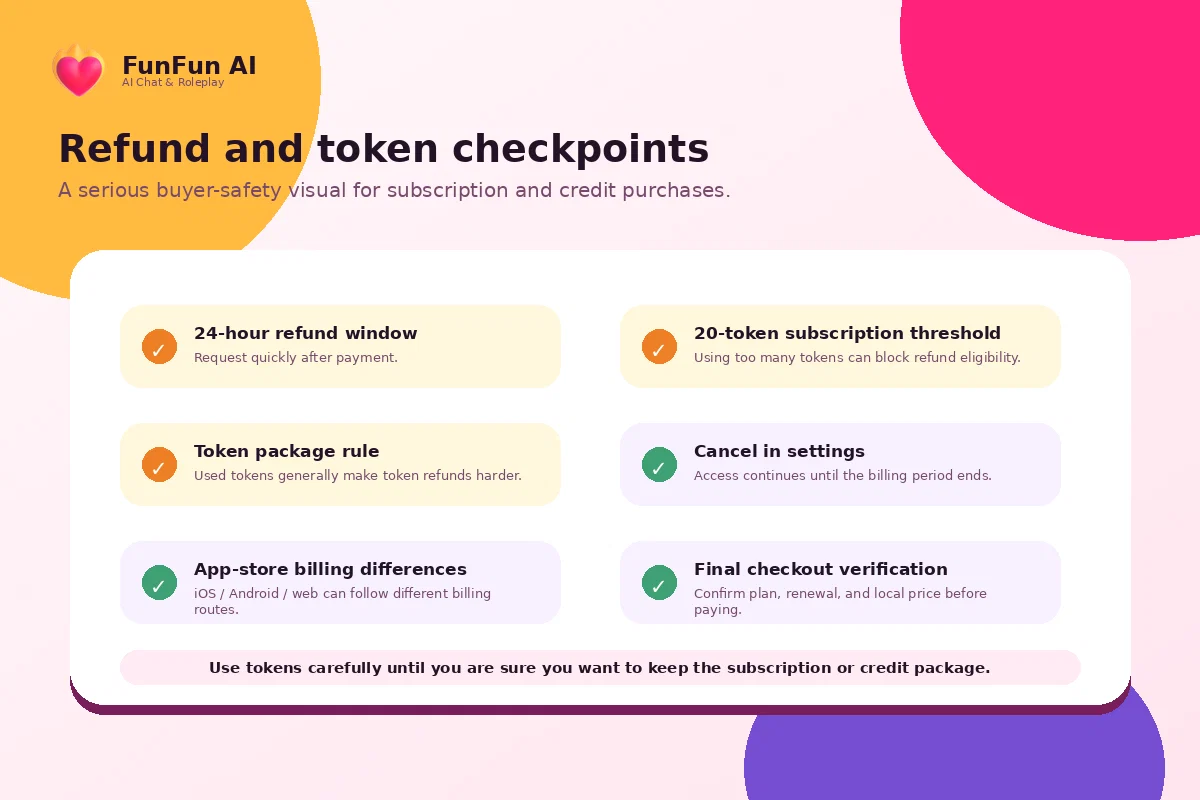
You should avoid subscribing quickly if you need refund flexibility. The official terms describe a 24-hour refund request window, and token usage can affect eligibility. That is not the kind of policy I would treat casually.
Finally, FunFun AI is not ideal if you expect the free path to show everything that matters. Free access can help you judge the tone, but the real paid decision involves unlimited messaging, monthly tokens, media-style features, renewal, and cancellation. That requires a more careful checkout check.
How FunFun AI fits into a real workflow
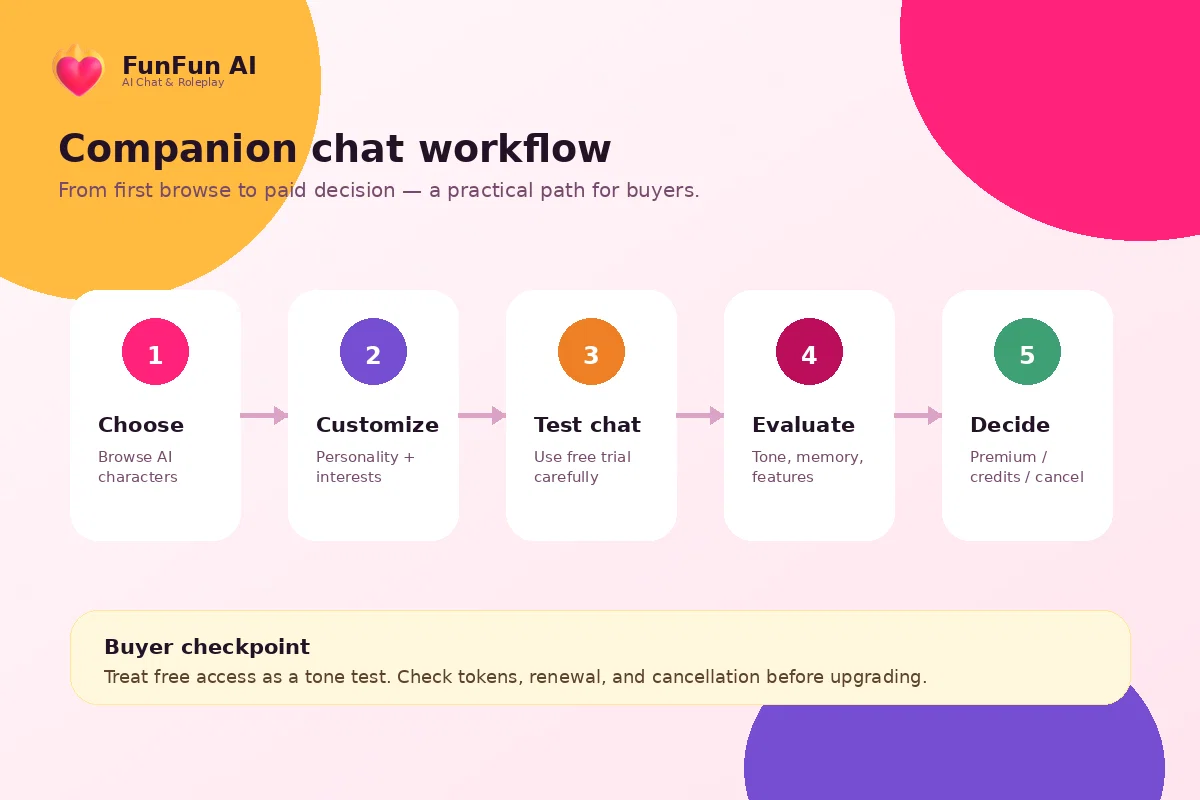
A good FunFun AI evaluation workflow is short, careful, and not driven by the subscription page.
Start by deciding whether you actually want the category. This is not a broad AI assistant. It is a companion and roleplay app. If that feels uncomfortable, unnecessary, or distracting, stop there.
Next, use the free entry path lightly. Choose or create a character, start a conversation, and pay attention to the tone. Does it feel natural enough for repeat use? Does the character style match what you expected? Does the app feel playful in a way you enjoy, or does it feel shallow after a few exchanges?
Then look at the premium wall. The official terms describe a point where users who reach the free message limit are taken to a payment page, and paid users receive unlimited messaging plus a monthly token allowance for extended features. That means the paid workflow is not just “more chat.” It can also involve token-backed features.
Only after that should you compare monthly versus annual billing. Annual pricing can look attractive in this category, but I would not move to annual billing until I knew the app was something I would actually use often. The mistake buyers make here is paying for the fantasy of regular use before proving the habit.
Real-world buyer scenarios
The curious first-time AI companion user
This buyer wants to know whether AI companion chat feels fun or strange. FunFun AI may fit because the free entry path provides a low-friction way to test the category. The risk is overbuying too quickly. I would use the first session to judge tone and comfort, not to decide on annual billing.
The roleplay-focused buyer
This buyer cares more about character personality, dialogue flow, and customization than business utility. FunFun AI may fit if the available characters and creation tools feel aligned with that preference. Where it may fail is depth. Some companion apps feel interesting at first but become repetitive. The buyer should test whether the app sustains conversation after the first novelty fades.
The visual companion buyer
This buyer wants generated images or media-style companion features, not only text chat. FunFun AI can be relevant here because the official positioning and terms connect the product to images, voice notes, and token-backed extended features. The buyer should verify exactly how many tokens are included, what each feature costs, and whether extra token packages are needed.
The privacy-sensitive buyer
This buyer may like the idea of AI companion chat but feel unsure about personal data. FunFun AI is a weaker fit unless the buyer is comfortable with the privacy policy, account setup, content moderation rules, and the possibility that flagged content may be reviewed under the terms. For this buyer, privacy comfort matters more than price.
Key features that actually matter
AI companion chat
The core feature is the companion chat experience. This is what buyers should test first. If the replies feel generic, awkward, or not aligned with your preferred style, Premium will probably not fix the mismatch.
Buyer note: judge the product by conversation quality and repeat-use desire, not by homepage character images alone.
Character creation and customization
FunFun AI emphasizes creating a customized companion with appearance and personality preferences. This matters because character fit is one of the main reasons someone would choose a focused companion app over a general chatbot.
Buyer note: verify which creation options are free and which require Premium or token use before assuming customization is included.
Unlimited messaging on Premium
The official terms say paid users receive unlimited access to messaging. That is important because companion apps become frustrating if the free or low-tier path stops too quickly.
Buyer note: unlimited messaging only matters if you actually like the interaction enough to return regularly.
Monthly token allowance
The terms also describe 100 tokens per month for extended features such as image generation or voice notes. This is a major buying detail because token use can shape both value and refund flexibility.
Buyer note: do not burn through tokens during the refund window if you are still deciding whether to keep the subscription.
Web and mobile access
FunFun AI is available through its website and mobile app routes. The App Store listing presents it as free with in-app purchases and carries an 18+ age rating.
Buyer note: compare the web checkout and app-store checkout because price, currency, renewal handling, and subscription management may differ.
Pricing and plan value
FunFun AI’s pricing decision is less clean than a simple SaaS table.
The safest confirmed view is this: there is a free entry path, and the official terms describe a paid subscription that unlocks unlimited messaging plus 100 monthly tokens for extended features such as image generation or voice notes. The App Store listing also shows in-app purchases, including Premium and credit packages, but those prices are region-specific and may not match what a buyer sees in another country.
Third-party review pages often describe Premium around the low-to-mid monthly companion-app range, with cheaper annual equivalents. I would treat those as orientation, not final pricing. The checkout page is what matters.
The more important question is whether the plan structure fits your actual behavior. If you only want to try a few chats, the free path may be enough to decide that you do not need Premium. If you want repeated chat and occasional media-style features, Premium may make sense. If you want heavy image or voice-note use, the token system becomes the real cost checkpoint.
Annual billing is where buyers should slow down. A lower monthly equivalent can look appealing, but this category is habit-based. If you are not sure you will use FunFun AI regularly for several months, monthly billing is safer than committing because of a promotional-looking price.
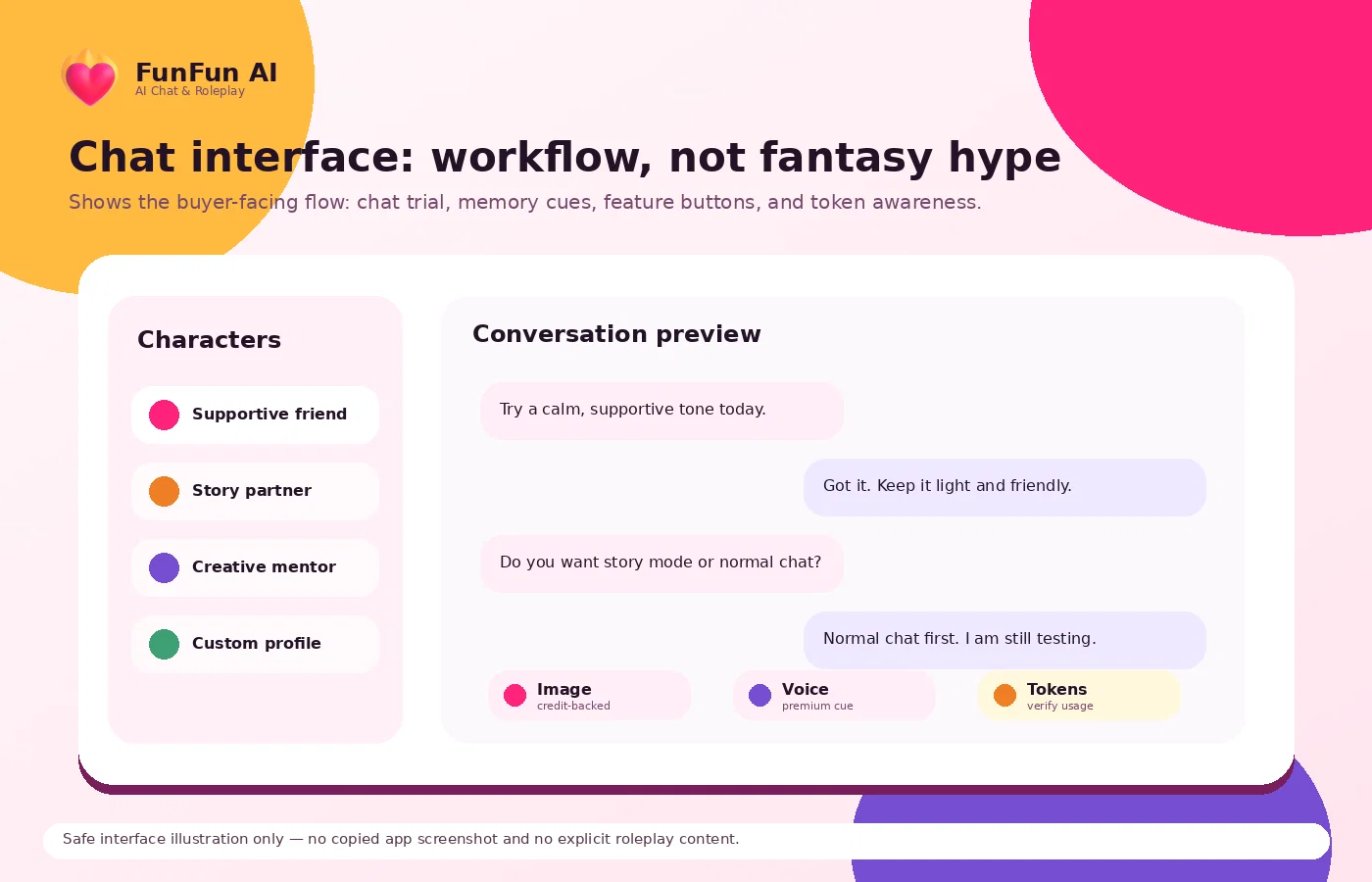
Pricing check: If the companion experience still fits, verify the live checkout price, token allowance, and cancellation path before paying.
Free plan, trial, coupon, and checkout notes
FunFun AI’s free path should be treated as a fit test. It is useful for checking whether you like the companion style, character options, and chat tone. It is not enough to fully judge Premium value, especially if the features you care about use tokens.
I did not see a separate traditional paid free trial in the official terms. The more practical way to evaluate the product is to use the free entry path, then decide whether the subscription and token allowance are enough for what you want.
Coupon handling should be secondary. Public coupon pages in this category can be inconsistent, and a discount does not solve the bigger question: will you use the app often enough to justify a subscription? The safer buying order is:
- Test the free chat lightly.
- Decide whether the category feels right.
- Check the live checkout price.
- Review token rules and refund timing.
- Compare monthly versus annual only after you know the app fits.
If a current deal path exists, use it only after workflow fit is clear. Do not let a reported coupon path become the reason you subscribe.
Checkout caution: Treat any discount as secondary. First confirm the chat style, Premium unlocks, token rules, and refund window.
What I would check before buying FunFun AI
If I were buying FunFun AI for a real repeat-use companion workflow, I would check these points before paying:
- Whether the free chat tone actually feels enjoyable after the first few messages.
- The live monthly and annual checkout price in my region and payment method.
- Whether Premium includes the features I care about, or whether those features spend tokens.
- How fast 100 monthly tokens might disappear if I use images, voice notes, or other extended features.
- The 24-hour refund request window and the token-usage conditions that may block eligibility.
- Whether app-store billing and web billing use the same price, cancellation route, and renewal timing.
- Whether I am comfortable with the privacy policy, adult-content rules, moderation language, and account data involved.
The first thing I would not do is subscribe and immediately use tokens heavily. If refund flexibility matters, token use is exactly the detail to slow down on.
A simple test before paying
Before paying, I would run a small FunFun AI test like this:
- Create or choose one companion that genuinely matches your interest.
- Use the free chat lightly and pay attention to tone, memory, and repetition.
- Try a few different conversation styles without sharing sensitive personal details.
- Check which feature you hit first: message limit, media limitation, character limitation, or payment prompt.
- Read the Premium and token language before entering payment details.
- Compare the monthly and annual path, but assume monthly is safer until repeat use is proven.
- Wait until you know you want the app beyond novelty before using extra tokens or buying token packages.
This test is not about proving whether the app is “good.” It is about proving whether it is good enough for you to pay for repeatedly.
Pros explained
The first real pro is category clarity. FunFun AI does not hide what it is. It is an AI companion and roleplay app, and that clarity helps buyers self-select quickly. If you want productivity, skip it. If you want companion chat, it is at least in the right category.
The second pro is the free entry path. A limited free experience is useful because companion apps are personal-fit products. You cannot judge them only by features. You need to feel whether the tone works for you.
The third pro is the Premium structure. Unlimited messaging plus a monthly token allowance is easy to understand at a high level. It gives repeat users a clearer paid route than a product that charges only by the message.
The fourth pro is that the official terms are specific about several buyer-risk areas: age requirements, subscription renewal, cancellation, token expiry, refund timing, and adult-content boundaries. Those details do not remove risk, but they do give careful buyers something concrete to review.
Cons explained
The biggest con is refund flexibility. A 24-hour refund window is short, and token usage can affect eligibility. That means FunFun AI is not a product I would subscribe to casually and test aggressively after payment.
The second con is pricing clarity across surfaces. Web checkout, app-store pricing, regional currency, promotions, and third-party pricing pages may not line up. The buyer has to treat live checkout as final.
The third con is privacy sensitivity. Companion apps invite personal conversation. FunFun AI’s privacy policy and terms may be acceptable to some users, but this is still a higher-sensitivity category than a normal tool directory, grammar checker, or image editor.
The fourth con is category limitation. FunFun AI is not useful outside its narrow purpose. If you want factual help, productivity, business automation, or mental health support, a companion app is the wrong tool.
Green flags and red flags
Green flags:
- You want an adult AI companion app and already understand the category.
- The free chat tone feels enjoyable after more than a few messages.
- You value character creation and personalization more than productivity.
- You understand token usage and do not expect unlimited media generation.
- You are comfortable with the privacy and content terms.
Red flags:
- You are subscribing mainly because of a discount or annual price.
- You expect an AI companion to replace human support, advice, or therapy.
- You are not comfortable with adult-oriented AI chat or personal-feeling data.
- You plan to use tokens heavily before deciding whether to keep the plan.
- You cannot find a clear cancellation route or checkout price in your region.
FunFun AI vs alternatives
FunFun AI has to be compared with other AI companion apps, not general AI chatbots. The right alternative depends on whether you care more about chat tone, visual generation, character depth, content boundaries, mobile access, or billing risk.
Candy AI vs FunFun AI
Candy AI is a direct comparison if you want a more recognizable AI companion brand and a broader premium companion positioning. FunFun AI may still make sense if you prefer its character style, free test route, or mobile app feel. I would compare both before paying annually.
DreamGF vs FunFun AI
DreamGF is the stronger comparison when visual companion creation is a major part of the buying decision. FunFun AI can still be relevant if chat and character personality matter as much as visuals. The tradeoff is usually media expectations versus subscription and token comfort.
GirlfriendGPT vs FunFun AI
GirlfriendGPT is worth comparing if text roleplay, dialogue flow, and memory feel more important than image-style extras. FunFun AI may feel simpler for buyers who want a more guided companion app experience rather than a prompt-heavy route.
Nastia AI vs FunFun AI
Nastia AI is an adjacent direct companion route for buyers who want a different roleplay and personality style. Compare it if FunFun AI’s characters do not match your preferred tone, or if you want to test how another app handles memory and conversation depth.
SpicyChat AI vs FunFun AI
SpicyChat AI is relevant if you mainly want a larger character-roleplay ecosystem. FunFun AI may be better if you prefer a more contained companion app with web and mobile access. The decision comes down to breadth versus focused companion flow.
Trust, refund, and buyer-risk notes
FunFun AI is the type of product where trust checks matter more than usual.
First, verify the age and content rules. The official terms describe adult content for registered users and require users to be at least 18 or of legal age in their country. This is not a product for minors or for buyers who are uncertain about adult-oriented AI companion apps.
Second, treat privacy seriously. The privacy policy lists account-related personal information such as email, first name, and last name when provided, and the terms warn users not to disclose sensitive personal information in AI companion conversations. That is sensible advice. I would avoid sharing addresses, financial details, passwords, deeply private identity details, or anything I would not want connected to an account.
Third, understand moderation. The terms say conversations are generally confidential, but also describe content moderation filters and possible manual review when violations are detected. Buyers should not assume companion chat is the same as a private offline journal.
Fourth, read the payment and refund language. The terms describe automatic renewal, cancellation through account settings, continued access until the end of the current billing period, token expiry after cancellation, and a 24-hour refund request window with restrictions tied to token usage and payment method.
Fifth, do not treat app-store prices, third-party price tables, or public deal pages as permanent. Check the current buyer route before paying.
Final verdict
I would consider FunFun AI if you are an adult buyer who clearly wants AI companion chat, likes the free interaction style, and understands that Premium value depends on repeated use plus careful token management.
I would skip it if you want therapy, business utility, factual help, a long refund test window, or a low-sensitivity app where privacy barely matters.
I would compare it with Candy AI, DreamGF, GirlfriendGPT, Nastia AI, and SpicyChat AI before committing to annual billing. The companion category is personal-fit driven, so the “best” app is often the one whose tone, visual style, pricing model, and rules you can live with after the novelty wears off.
The safest next step is not to chase the lowest price first. Start with the free experience, keep the first test light, verify the current checkout route, read the refund and token rules, and only then decide whether FunFun AI deserves a paid spot in your routine.